
ALBUFEIRA · FEBRUARY · 37.1° N
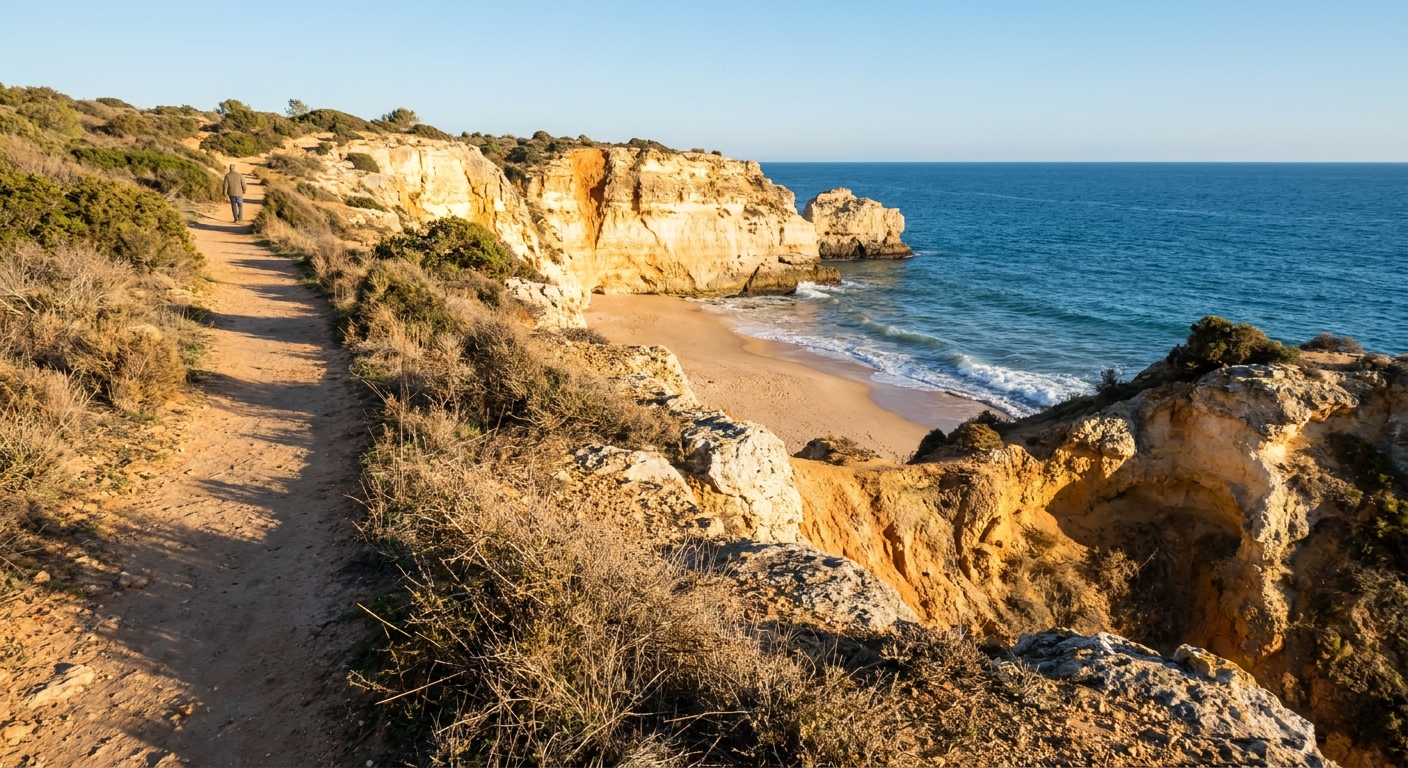
The Old Town stairs are empty at ten in the morning, the cliff path east of town runs for a mile without a parasol on it, and the Faro station records an average high of 62.6°F. February in Albufeira is a walking month with beaches attached, and the only real argument is about the water.
The trade is plain. Sea water averages 61.3°F, the sun goes down at 6:12 pm on February 15, and you eat dinner after dark. In exchange you get 62.6°F afternoons, 1.65 inches of rain spread across 5.4 days, and enough room on the sand to lose the people you came with.
THE MONTH AT A GLANCE · ALBUFEIRA · FEBRUARY
Come in February for cliff paths, quiet coves and low-season calm, not for swimming: the water averages 61.3°F and the light is gone by 6:12 pm.
LOW SEASON · SEA 61.3°F · 10H 53M OF DAYLIGHT ON FEB 15
Go for: cliff walking at 62.6°F, the Old Town and Praia dos Pescadores without a crowd, and a long beach walk east with room to spare.
Think twice before: booking a swimming vacation. 61.3°F is wetsuit water, and the sea is colder in February than it was in January.
Normals: IPMA station 554, Faro · Sea: Open-Meteo Marine 2015-2024 · full sources at the end
On this page
- Albufeira weather in February62.6°F days, 1.65 inches of rain
- Sea temperature in February61.3°F, measured as daily maxima
- How busy Albufeira gets in low seasonCrowds, booking and the tax we could not verify
- Things to do when it is too cold to swimOld Town, the coves and Praia da Falésia
- A two-day February planTwo days built on 10h 53m of light
- February vs January and MarchHow the three months compare, with numbers
- Is February a good time to visit?The verdict, by traveler type
Every figure here comes from one official thermometer and one marine model, and both are named where they are used. The year-round list of beaches, bases and drives lives in our Albufeira guide, and the twelve-month ranking for the country belongs to the best-time verdict.
Albufeira weather in February: average highs, lows and rain days
| Measure | February normal |
|---|---|
| Average high | 62.6°F (17.0°C) |
| Average low | 47.8°F (8.8°C) |
| Precipitation | 1.65 in |
| Days with 0.04 in (1 mm) or more | 5.4 |
| Days with 0.39 in (10 mm) or more | 1.4 |
| Sea surface, mean of daily maxima | 61.3°F |
| Daylight on February 15 | 10 hours 53 minutes |
The normals above come from IPMA, the Portuguese national weather service: station 554 at Faro, a real instrument 5.0 m above sea level, averaged over 1991 to 2020. February runs 62.6°F by day and 47.8°F at night, with 1.65 inches of rain. One caveat travels with those numbers. Faro lies at the eastern end of the Algarve while Albufeira is central, and the readings describe a coastal station rather than the hills inland, which are colder and considerably wetter.
An average February records 5.4 days with at least 0.04 inch (1 mm) of rain, which is measurable rain about one day in five and roughly 22 dry days to place your walks in. Those are IPMA’s thresholds, not the 0.10-inch line American tables use, so the two counts do not swap. Total rainfall, at 1.65 inches, is under what January collects.
The gap between 62.6°F and 47.8°F is 14.8°F, and you feel all of it between the midday cliff path and the walk back from dinner. Pack in layers: a shirt for the middle of the day, a genuine jacket for after sunset, and shoes with grip, because Algarve limestone and Old Town cobbles stay slick for hours after a shower.
On February 15 the sun rises at 7:19 am and sets at 6:12 pm local time, for 10 hours 53 minutes of daylight. Portugal keeps UTC through the winter, so those are the times your phone shows. Put the outdoor half of the day before 4 pm. The light on the red cliff faces turns gold well before six, and dinner is an indoor event.
Can you swim in Albufeira in February? Sea temperature and what it feels like
Sea surface off Albufeira averages 61.3°F in February, from the Open-Meteo Marine model over 2015 to 2024. Read the number with its definition attached: it is the mean of daily maxima, the warmest reading of each day, so a true 24-hour average runs a shade cooler. February is also the coldest of the three winter months in the water, below January’s 62.0°F, because the Atlantic lags the air.
For most visitors 61.3°F means a wetsuit, and for the rest a short, loud dip. Air at 62.6°F gives you nothing on the way out, so the towel matters more than the entry, and children last minutes rather than hours. Bodyboarding with neoprene works. A lazy afternoon of swimming does not.
We could not verify February wave heights or wind speeds off Albufeira, so we quote none. Check the marine forecast the morning you plan to get in, and keep in mind that a cove such as Praia da Coelha and the open sand at Praia da Falésia do not take the same swell.
How busy is Albufeira in February? Crowds, prices and booking
February falls in the Algarve’s low season, and that is a calendar fact rather than a price. We found no monthly occupancy series and no room-rate series for Albufeira, so we crown no month cheapest and we publish no percentages. What the calendar does say is simple enough: no school summer holiday, and Easter never lands in February.
Without occupancy data we will not put a number of weeks on the booking window. The constraint in February is rarely the room, it is the flight and the car, and with 10 hours 53 minutes of daylight we would give the town three or four nights rather than a week. Routes and seasons out of the US are handled in our flights guide, while the car guide walks through tolls and the insurance line before you sign anything.
We could not verify whether Albufeira levies a municipal tourist tax, at what rate, or whether it applies in the winter months, so no amount appears in our figures. Ask the property to state it at booking rather than at checkout, and price it per person per night when you compare two rooms.
The line worth paying up for in February is the car. A rental turns one town into a coast inside a short day: the cliffs and boardwalk at Carvoeiro to the west, the lagoon town of Tavira to the east, both reachable and back before 6:12 pm. A bus timetable spends daylight you do not have. Book it with the room, not at the airport counter.
Things to do in Albufeira in February: the Old Town, the coves and Praia da Falésia
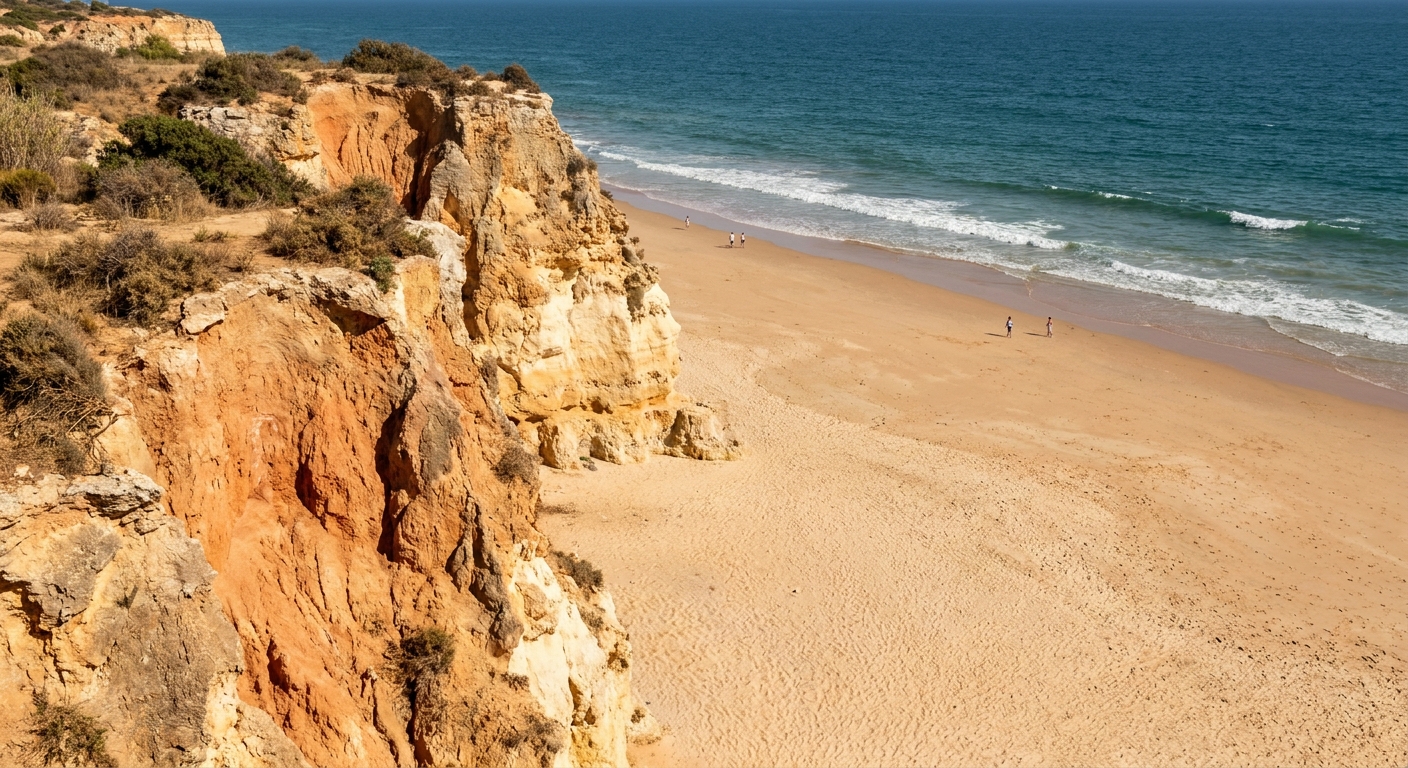
February hands you the cliff path in the middle of the day. At 62.6°F you can walk from the Old Town east toward Olhos de Água at noon in a shirt, and the sand is wide and quiet enough that the walk stays continuous rather than a slalom between towels. The same 62.6°F makes the climb back up the steps a pleasure instead of a penalty.
Names for the list. Praia dos Pescadores is directly under the Old Town, reached through the pedestrian tunnel or the escalators. Praia de São Rafael and Praia da Coelha hold their coves west of the center, Olhos de Água keeps its freshwater springs in the sand to the east, and Praia da Falésia runs on toward Vilamoura beneath the red faces. We could not verify February hours or fares for the marina’s boat operators, so none are printed.
What the month changes is the air, not the ground. The sand at Falésia is the same sand, the springs at Olhos de Água run all year, and at 61.3°F the water sits within a degree of January and March alike. The air does the moving: 62.6°F at noon against 47.8°F before sunrise, which is why one cliff walk is warm at one o’clock and cold at eight. Cave trips to Benagil hang on a sea state we could not verify for February, so treat them as a maybe.
Free in February, and free in every other month: the clifftop paths between the coves, the Old Town squares, the beach escalators, the whole sweep of sand east of town. Nothing about the date discounts them. What the date adds is a choice of table at lunch and a beach you do not have to share, and our Algarve orientation ranks the rest of the coast if you want to drive for a better one.
Albufeira in February: a two-day itinerary
Day one runs on the light. Coffee at 8, on the cliff path by 9:30 as the air climbs toward 62.6°F, and the Olhos de Água stretch walked before lunch. Eat at one, when a terrace still works. Give the afternoon to Praia da Falésia, then take the steps back up around five, when the gold hits the cliff faces. Sunset at 6:12, dinner in the Old Town after dark, jacket on, because the night is heading for 47.8°F.
Day two takes the car west: the boardwalk at Carvoeiro in the morning, the headland at Ponta da Piedade outside Lagos after lunch, and home before the light goes. If your day lands among February’s 5.4 wet ones, change the plan rather than the trip. The walled old town of Faro is an easy run east on the A22, and Albufeira’s own covered lanes absorb a rainy afternoon. The A22 has charged no tolls since January 1, 2025.
Albufeira in February vs January and March
| Measure | January | February | March |
|---|---|---|---|
| Average high | 61.3°F | 62.6°F | 66.0°F |
| Average low | 46.9°F | 47.8°F | 51.4°F |
| Precipitation | 1.94 in | 1.65 in | 1.84 in |
| Days with 0.04 in (1 mm) or more | 6.0 | 5.4 | 5.6 |
| Sea surface, mean of daily maxima | 62.0°F | 61.3°F | 60.9°F |
February runs 1.3°F warmer by day than January and 3.4°F cooler than March, with the nights on the same slope at 47.8°F against 46.9 and 51.4. It is the driest of the three at 1.65 inches, under January’s 1.94 and March’s 1.84, and it carries the fewest wet days at 5.4. The sea moves the other way and keeps falling: 62.0°F in January, 61.3 in February, 60.9 in March, all three taken as daily maxima from the same marine model.
Shift four weeks forward and you buy 3.4°F of afternoon and 3.6°F of night, at a cost of 0.2 of a wet day, 0.19 inch more rain and 0.4°F of sea. Shift four weeks back into January and you give up 1.3°F by day, take on six-tenths of a wet day and 0.29 inch more rain, and get water that is 0.7°F warmer for your trouble.
Is February a good time to visit Albufeira?
Yes for walkers, drivers and photographers, and for anyone who wants the Algarve’s geography without company. No for swimmers, for sunbathers, and for families whose children measure a vacation in hours in the water. At 62.6°F in the air and 61.3°F in the sea, this is a coast to walk along rather than lie on.
If the answer is no, March is not the fix. Four weeks later gives 66.0°F afternoons while the water cools to 60.9°F, so the air improves and the sea does not. For warm water, look well past March, and the country-wide ranking in our best-time verdict sorts out which months carry it.
What February holds over its two neighbors: the fewest wet days at 5.4, the least rain at 1.65 inches, and afternoons already warm enough to walk the cliffs in a shirt.
The last word
Decide about the water first and the rest of the trip falls into place. Let the sea go, and February gives you the cliffs, the coves and a quiet Old Town, with roughly 22 rain-free days to spend them on. One figure we have held back: of those 5.4 wet days, only 1.4 bring 0.39 inch (10 mm) or more, so most February rain is the sort you wait out over a long lunch rather than the sort that cancels a day. Pack the jacket for 47.8°F at dawn, book the car with the room, and start walking by 9:30.
Sources & data for this guide
- February normals: high 62.6°F, low 47.8°F, 1.65 in, 5.4 days at 1 mm or more, 1.4 days at 10 mm or more · IPMA, climatological normals 1991-2020, station 554 Faro, altitude 5.0 m · checked Sep 23, 2026
- January and March normals used in the comparison table · same IPMA station and same 1991-2020 period · checked Sep 23, 2026
- Sea surface 61.3°F (January 62.0°F, March 60.9°F), mean of daily maxima 2015-2024 · Open-Meteo Marine API · checked Sep 23, 2026
- Daylight 10h 53m, sunrise 07:19 and sunset 18:12 UTC on February 15 · sunrise-sunset.org · checked Sep 23, 2026
- Scope reserve: the Faro station stands at the eastern end of the Algarve while Albufeira is central, and inland or high ground is colder and much wetter than these coastal readings.
- What we could not verify: a municipal tourist tax for Albufeira and its rate, February opening hours or fares for marina boat operators, and February wave and wind data. We found no occupancy or room-rate series, so we call no month cheapest.
- Place descriptions and the two-day plan are editorial · hours, boat schedules and tolls change, so check operators when you book.