
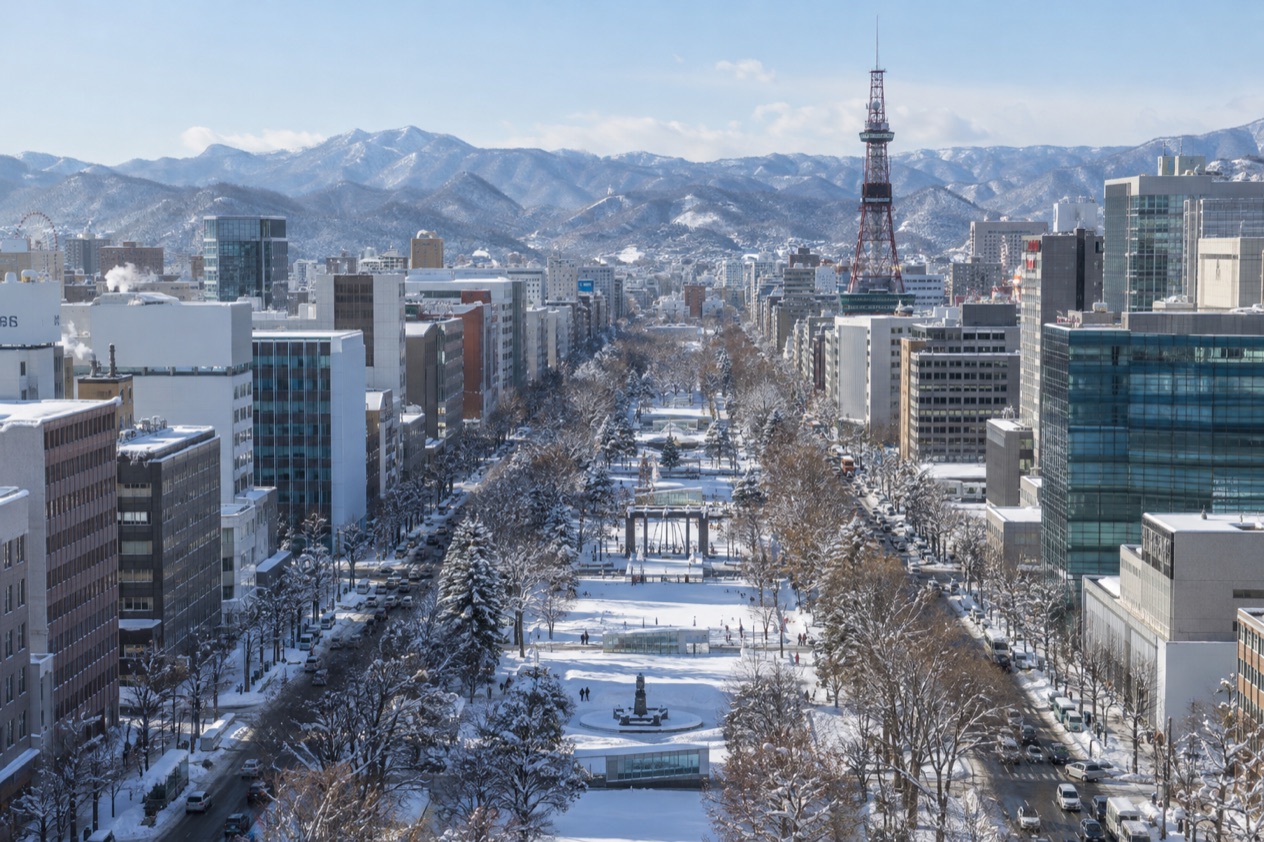
In February, Sapporo’s Odori Park turns into a long white gallery where enormous snow sculptures stand under floodlights and people in puffy coats stop to photograph every one. Steam rises from ramen shops, bowls of miso soup warm cold hands, and the snow squeaks underfoot on the way back from Susukino. This is Hokkaido’s capital in the depth of winter, a month for snow, skiing, festival crowds and hearty food for travelers who come to enjoy the cold instead of escaping it.
What is the weather like in Sapporo in February?
February in Sapporo is a true winter month: cold, snowy and gray more often than bright, though a little less harsh than January and with the days clearly growing longer.
| Month | Average high (°F) | Average low (°F) | Precipitation (in) | Days with 1 mm or more of precipitation | Hours of sunshine | Daylight on the 15th | Snowfall (in) |
|---|---|---|---|---|---|---|---|
| January | 31.3 | 20.5 | 4.27 | 18.3 | 90 | 9 h 20 min | 53.9 |
| February | 32.7 | 20.8 | 3.62 | 16.0 | 104 | 10 h 30 min | 45.7 |
| March | 40.1 | 27.7 | 3.06 | 13.9 | 145 | 11 h 51 min | 29.1 |
Afternoons hover just around the freezing point, which means snow stays dry and powdery on the sidewalks instead of melting into slush. Nights drop well below it. Almost every day of the month brings some snow or sleet, so the city lives with it: heated shop entrances, sanded crossings and locals who walk with short, careful steps.
The precipitation here falls as snow, not as rain, and it comes in flurries and longer snowy spells that can leave a gray sky for days. Sunny breaks do happen and they make the white streets sparkle. Daylight lasts a good while longer than in January, which gives you real time to walk outdoors before the festival lights take over.
Dress in layers: a thermal base, a warm middle layer and a waterproof, windproof coat that covers your hips. Boots with a grippy sole matter more than anything else you bring, and gloves, a hat and a scarf are worth wearing every day. Indoors, trains, shops and restaurants are heated, so you will peel off layers as often as you put them on.
What to do in Sapporo in February
February is the month the city is built for. The Sapporo Snow Festival, held in February every year, anchors the calendar, and the rest of the month fills with ramen, ski slopes, steaming pots and the pleasure of walking through a city that is entirely at home in snow.
The Sapporo Snow Festival
The festival runs for seven days and spreads over three sites: Odori, Susukino and Tsudome. The Odori Site sits in Odori Park in the center of Sapporo, and it is the one most visitors picture, with giant snow sculptures lined up along the park and lit after dark.
Susukino, the entertainment district, brings the festival into the bar-lined streets, where ice sculptures stand among neon signs. Tsudome is the third site, a separate venue with its own snow attractions. Seeing the sculptures in daylight and again lit up gives you two quite different views of the same work.
Walk slowly and stop for hot drinks at the stalls. The cold is real, so plan on warm breaks between sites. The festival suits families, couples and photographers, and anyone who wants to see what snow becomes in skilled hands.
Setsubun and the bean-throwing
Early in February, Japan marks Setsubun, the day before the start of spring on the old calendar. The main ritual is mamemaki, in which roasted soybeans called fukumame are thrown out the front door or at a family member wearing an oni (demon) mask, with the cry of Oni wa soto! Fuku wa uchi!, meaning Devils out! Fortune in!
Afterward it is customary to eat roasted soybeans, one for each year of your life plus one extra for luck in the year ahead. Supermarkets and convenience stores sell bags of beans and paper oni masks in this season, so you can join in even as a visitor. In a snowy city, throwing beans into the cold air feels especially fitting.
Eating your way through the cold
Sapporo’s winter food is rich and warming. Miso ramen with butter and corn is the bowl most visitors seek out, and soup curry, loaded with big pieces of vegetable and chicken in a thin, spiced broth, is a local specialty worth a lunch. Seafood from Hokkaido, hot pots and grilled lamb round out the table.
At the Sapporo Beer Museum and its pub, the Sapporo Beer Garden, visitors can enjoy a beer and lamb barbecue. Hot sake and a late-night bowl of ramen in Susukino are the usual way to end a festival evening. Izakaya, the casual Japanese pubs, give you small plates and a warm room after the cold.
Skiing and snow outings around Sapporo
Hokkaido typically has snow earlier than other regions, and peak ski season falls in January and February, when snowfall is most frequent. Sapporo hosted the first Winter Olympic Games in Asia in 1972, and the city has been a winter sports base ever since. Rusutsu and Niseko are among the resorts travelers look to from here.
Niseko United is one mountain with four resorts: Annupuri, Niseko Village, Grand Hirafu and Hanazono. It provides live lift and weather status reports for every resort on its website, and lift passes can be bought online. Early February draws the largest number of skiers to the slopes, so expect the lifts to be at their liveliest.
Not skiing? Snow still shapes the day. The Sapporo Streetcar, one of only two operating circular tram systems in Asia, rolls along its loop through the white streets, and Otaru Canal, with its glowing gas lamps and stone warehouses, gives a nostalgic evening scene for those who add an outing.
A two-day itinerary for Sapporo in February
Day 1 belongs to the festival. Start with a hot breakfast and walk to Odori Park for the snow sculptures in daylight, when you can see the carved detail up close. Stop for a bowl of miso ramen at midday, then use the afternoon to wander the park slowly, with warm drinks between stretches outdoors.
As the light fades, head to Susukino to see the ice sculptures among the neon. Dinner can be an izakaya, a hot pot or a grilled-lamb place, followed by a last warm drink. Returning to Odori after dark shows the sculptures lit, a different scene from the morning.
Day 2 widens the circle. Spend the morning at the Tsudome site, the third festival venue, for its snow attractions. Over lunch try soup curry, then give the afternoon to the Sapporo Beer Museum and a beer with lamb barbecue at the Beer Garden. If you would rather be on the mountain, make this the ski day and use a resort such as Rusutsu or Niseko.
If the weather turns and snow falls hard, the indoor options are the museum and its pub, cafés for long warm breaks, and a ride on the streetcar for the view from inside. Evenings suit a ramen alley or an izakaya, where the glass fogs up and the cold stays outside.
Is Sapporo busy in February?
Yes, February is a lively month in Sapporo, driven by the Snow Festival and by the ski season.
The festival lasts seven days and brings visitors to Odori Park, Susukino and Tsudome, so those areas feel full during the event. Outside those days, the city goes back to a normal winter rhythm, with commuters in boots and shoppers ducking from one heated shop to the next.
On the slopes, peak ski season in Hokkaido falls in January and February, and early February draws the largest number of skiers. That shapes the pace of the resorts more than the city itself. Evenings in Susukino stay animated, and ramen counters and izakaya stay busy with festival-goers and skiers returning from the mountain.
If you want a calmer feel, spend the festival days at the sites and use the other days for the museum, the cafés and the streets away from the park. The city is well used to winter visitors and moves easily despite the snow.
What to pack for Sapporo in February
Pack for steady cold and snow, with enough layers to handle warm interiors and long hours outdoors at the festival.
- A waterproof, windproof winter coat, because snow falls on most days of the month.
- Insulated boots with a grippy sole for packed snow and icy crossings.
- Thermal base layers for evenings at the festival sites.
- Gloves, a warm hat and a scarf, since you will stand still to look at sculptures.
- A light sweater for heated trains, restaurants and shops.
- Sunglasses, for the glare when the sun comes out over white streets.
Good to know before you go
Snow is part of daily life in Sapporo, and almost every day of February brings some. Allow time for slower walking and keep your plans flexible on heavy-snow days, especially for ski outings, where lift and weather status can be checked on the Niseko United website.
The Snow Festival is held in February every year and spans three sites, so decide in advance which ones you want to see. Setsubun, with its bean-throwing, falls early in the month and gives a local touch to the first days.
Sapporo in February vs January and March
Going four weeks earlier means January: colder, with more snow, shorter days and less sunshine. The ski season is in full swing, but the Snow Festival belongs to February, so you would miss the sculptures. It suits skiers who care about snowfall more than the city events.
Going four weeks later means March: noticeably milder, with far less snow, many more hours of sun and daylight stretching toward the evening. The festival is over, but streets are easier to walk, and the ski season continues until April in Japan generally, with each resort setting its own dates.
Stay in February if the sculptures, the festival lights and the early-month Setsubun are the point. Shift to January for the deepest winter feel and to March for an easier walk through the city with a bit of spring in the air.
Is February a good time to visit Sapporo?
Yes, February is a good time for travelers who love snow, festivals and winter food, and who are happy to dress for real cold.
It suits families and couples who want the sculptures at Odori Park, skiers who plan time in Niseko or Rusutsu, and food lovers who come for miso ramen, soup curry and lamb. It is a poor match for anyone who dislikes cold, gray skies or walking on snowy sidewalks. Those travelers will enjoy the city more in March, when it warms up.
On arrival, start with Odori Park to get your bearings and see the festival site in daylight, then plan your remaining days around Susukino, Tsudome and the mountain. Keep one evening free for a long bowl of ramen after hours in the cold. What makes February special here is the sight of an entire city turning snow into art, with giant sculptures glowing in Odori Park and hot bowls waiting at every corner.
Sources
- Japan Meteorological Agency (JMA), Normal values 1991-2020, monthly (https://www.data.jma.go.jp/stats/etrn/view/nml_sfc_ym.php?prec_no=14&block_no=47412), station Sapporo, elevation 17 m, checked October 11, 2026
- Computed from the date and the latitude of the place (sunrise equation, solar elevation -0.833 degrees), October 11, 2026
- Wikipedia, Setsubun (https://en.wikipedia.org/wiki/Setsubun), checked October 11, 2026
- Japan National Tourism Organization, festivals and events (https://www.japan.travel/en/see-and-do/festivals-and-events/), checked October 11, 2026
- Sapporo Snow Festival official website (https://www.snowfes.com/english/), checked October 11, 2026
- Wikipedia, Sapporo Snow Festival (https://en.wikipedia.org/wiki/Sapporo_Snow_Festival), checked October 11, 2026
- Japan National Tourism Organization, winter in Japan (https://www.japan.travel/en/guide/winter-guide/), checked October 11, 2026
- Japan National Tourism Organization, skiing and snowboarding in Japan: regions, resorts, seasons (https://www.japan.travel/en/sports/snow/), checked October 11, 2026
- Wikipedia, Climate of Japan (https://en.wikipedia.org/wiki/Climate_of_Japan), checked October 11, 2026
- Japan National Tourism Organization, flowers by season: cherry blossom, plum, wisteria, hydrangea, where and when (https://www.japan.travel/en/see-and-do/flowers/), checked October 11, 2026
- Wikipedia, Prunus mume (https://en.wikipedia.org/wiki/Prunus_mume), checked October 11, 2026
- Japan National Tourism Organization, skiing guide (https://www.japan.travel/en/guide/skiing/), checked October 11, 2026
- Wikipedia, List of ski areas and resorts in Japan (https://en.wikipedia.org/wiki/List_of_ski_areas_and_resorts_in_Japan), checked October 11, 2026
- Japan National Tourism Organization, weather and seasons in Japan (https://www.japan.travel/en/plan/weather/), checked October 11, 2026
- Niseko United, winter (https://www.niseko.ne.jp/en/winter/), checked October 11, 2026
- Wikivoyage, Sapporo (https://en.wikivoyage.org/wiki/Sapporo), checked October 11, 2026
- Japan National Tourism Organization, Sapporo (https://www.japan.travel/en/destinations/hokkaido/hokkaido/sapporo-and-around/), checked October 11, 2026
- Hokkaido Love, the official Hokkaido tourism site (https://www.visit-hokkaido.jp/en/), checked October 11, 2026
- Hokkaido Love, what to see and do (https://www.visit-hokkaido.jp/en/spot/), checked October 11, 2026
To plan your stay
- Things to Do in Sapporo: Snow Festival, Odori Park, Ramen and Day Trips
- Where to Stay in Sapporo: Sapporo Station, Odori, Susukino and Ryokan Stays
- Sapporo from Tokyo: The Hayabusa Shinkansen, the Seikan Tunnel and What Awaits on Hokkaido
- Know Before You Go to Sapporo: Entry, Money, Getting Around and Local Customs