
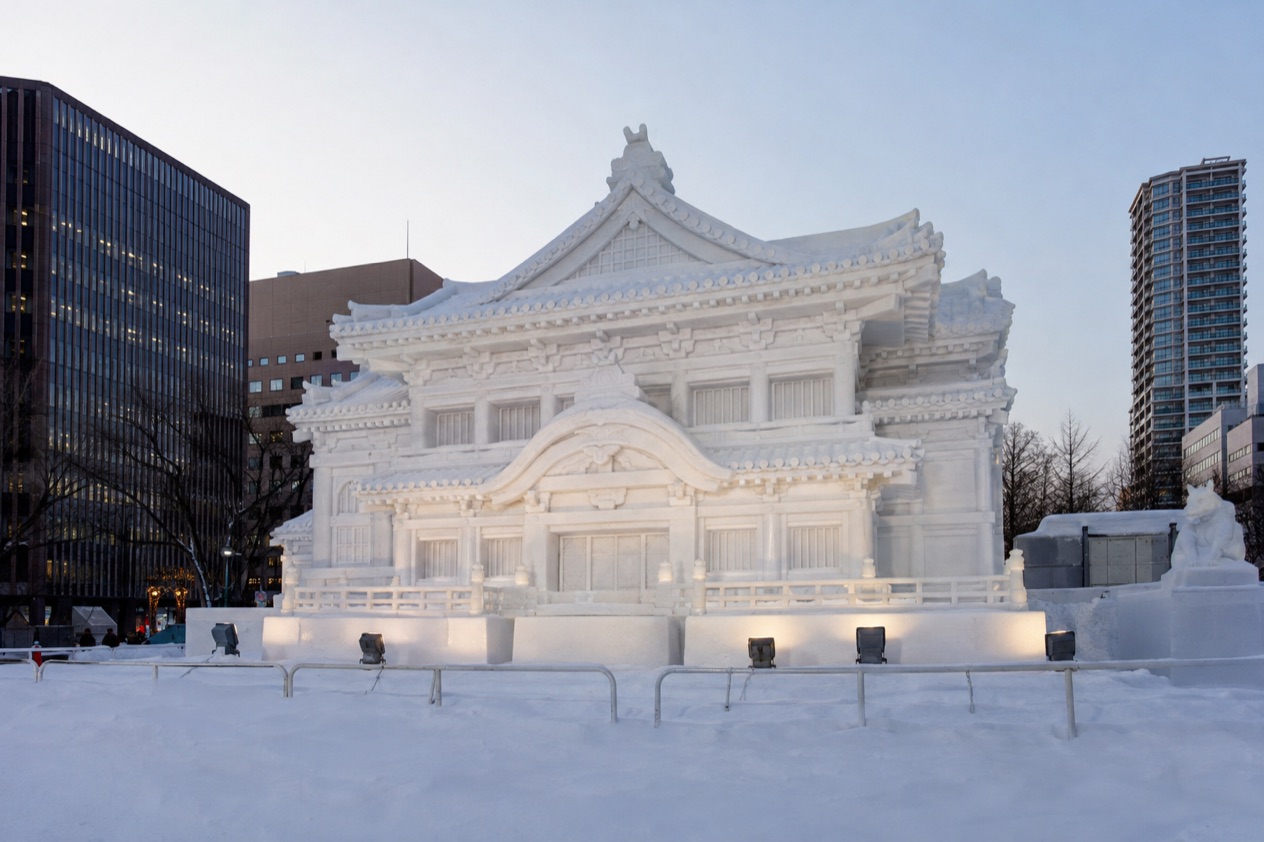
Walk into Odori Park in the first week of February and the long green lawn of summer has turned into a street of white giants, snow carved into palaces, characters and landmarks, lit up against a dark winter sky. Steam rises from cups of hot drinks, boots squeak on packed snow, and the TV Tower stands over the whole scene. This is a winter festival in Sapporo, in Hokkaido, built for travelers who want to see snow turned into art and spend an evening or two among the sculptures.
Is visiting the Sapporo Snow Festival worth it?
Yes, if you like winter outdoors and want a festival you can walk through rather than watch from a seat. It suits couples who want lit sculptures and a hot drink, families whose children will happily spend an hour on a snow slide, and food lovers who like eating Hokkaido produce standing in the cold.
The festival is held for one week in early February, and it is spread over three sites, each with its own character. Odori is the big open-air gallery of snow sculptures in the center of the city. Susukino turns to ice and the nightlife district.
Tsudome is the playground, with slides and rafts for anyone who wants to do more than look. You can pick one site or string them together, and that flexibility is a large part of the appeal.
What sets it apart from other winter attractions around Hokkaido is that it happens in the middle of a city. Elsewhere on the island, winter means ski slopes, trekking and hot springs, which are the outdoor pleasures Hokkaido is known for.
Sapporo also hosted the first Winter Olympic Games in Asia, and the city has treated snow as a civic asset ever since.
The honest caveat is the cold. January in Sapporo brings highs around freezing and snow on most days, and early February is much the same. If you are happy in a heavy coat, boots and gloves, the festival is a delight. If you want a quiet, indoor trip, the sculptures will feel like a lot of standing around in the cold, though cafés and food courts are never far away.
Add the Hokkaido food on offer, from seafood to potatoes, corn and dairy, and the festival becomes as much a tasting trip as a sightseeing one.
What to see at the Sapporo Snow Festival
Odori Site: the snow sculpture avenue
The Odori Site is the heart of the festival. It sits in Odori Park in the center of Sapporo and stretches for about 0.9 miles, so you walk it block by block, from one cluster of sculptures to the next. Large, medium and small snow sculptures line the park, and projection mapping brings some of them to life after dark with moving light across the snow.
Look for the Sapporo Citizen Snow Sculptures, made by local groups, which often have a more playful, homemade charm than the grand pieces. The International Snow Sculpture Contest has been held here since 1974, so the teams you see working or displaying are part of a long tradition.
There is also a snow slide for anyone who wants to take part. For a view over the whole avenue, the TV Tower looks down on the sculptures.
Regional food stalls here serve fresh seafood, potatoes, corn and dairy products from across Hokkaido. Eat as you go, and keep a pair of warm gloves you can take off easily.
Susukino Site: ice, lights and a warm drink
Susukino is the nightlife district, and its site carries the theme Enjoy the Ice. Where Odori is snow, Susukino is ice, with an ice sculpture show and the Ice Sculpture Contest, in which carvers turn clear blocks into glittering figures that catch the neon and the festival lights.
The site is interactive. In Fureai Hiroba you can touch or ride on ice sculptures, Illumination Street is the place for photographs, and the Ice Bar serves hot drinks, a nice contradiction in a street made of ice. Each year the Susukino Queen of Ice beauty contest is also held here. Because the site sits among the bars and restaurants of Susukino, it is easy to follow a walk among the carvings with dinner.
Tsudome Site: slides, rafts and families
Tsudome is the site for doing rather than looking. It offers slides, snow rafts, a tube slide and snow rafting, along with medium and small snow sculptures, and a gourmet food court to warm up in. Children and their parents can both have fun on the slides and rafts, which makes this the natural choice for a family outing.
Plan Tsudome as its own part of the visit, apart from the Odori and Susukino evenings. Wear waterproof trousers or layers you do not mind getting snowy, since the slides and rafts mean sitting and sliding in the snow.
When to visit the Sapporo Snow Festival
The festival is held for one week in early February, every year, so the month to plan around is February, and the exact dates are set by the organizers from one year to the next. Plan your flights and hotel around that week, because the sculptures are built for it and are not there at other times of the year.
The weather in the weeks around it is properly wintry. In an average January in Sapporo, highs stay just below freezing, lows fall well into the teens, and snow or sleet falls on nearly every day of the month, with a deep total of snowfall.
Skies are often gray, with only a modest amount of sunshine, so expect flakes in the air and a soft light on the sculptures. Dress for that, with a warm base layer, a windproof coat, a hat, gloves and boots with a good grip.
| Month | Average high (°F) | Average low (°F) | Precipitation (in) | Days with 1 mm or more |
|---|---|---|---|---|
| January | 31.3 | 20.5 | 4.27 | 18.3 |
| April | 53.1 | 38.1 | 2.15 | 9.6 |
| July | 77.7 | 64.2 | 3.57 | 7.7 |
| October | 61.5 | 46.4 | 4.33 | 11.6 |
As for the time of day, the sculptures are worth seeing twice if you can. In daylight you can read the detail of the carving and see the full scale of the large pieces.
After dark, the lighting and the projection mapping at Odori change the mood completely, and the ice at Susukino and Illumination Street come into their own with the lights on. Visitors split the day, with Tsudome by day and the city sites in the evening. If you visit Sapporo in other seasons, you will find a very different city, with a mild October and a green July, but the sculptures belong to February alone.
Tips for your visit
Dress in layers and treat your feet as the priority. Waterproof boots with a grip, warm socks, gloves you can use with a phone, a hat and a scarf make a long walk along the avenue comfortable. Snow, sleet and wind are all part of the picture, and a thin pair of liner gloves under heavier ones lets you take photographs without freezing your fingers.
Think of the sites as three different outings. Odori and Susukino are both in central Sapporo, so they combine naturally into one evening on foot, starting with sculptures at Odori and ending with ice and a hot drink at Susukino.
Tsudome, with its slides and rafts, deserves a separate stretch of time, especially if you are traveling with children. Leave room to stop for food, because the Hokkaido stalls and the Tsudome food court are part of the pleasure.
A few things pair well with the festival nearby. The Sapporo Beer Museum and its pub, the Sapporo Beer Garden, offer a beer and lamb barbecue, a warm and filling change from the cold.
A day trip can take you to Otaru, where the canal has glowing gas lamps and stone warehouses, or to Furano, where Ningle Terrace is a craft village of about 15 shops tucked among the forests. Hokkaido is also known for skiing, trekking, hot springs and gourmet food, so a few extra days easily fill with more winter activities.
For families, Tsudome is the obvious stop, since both children and parents can have fun on the slides and rafts. Snow underfoot and crowds along the avenue can make the festival tiring for anyone with limited mobility or a stroller, so build in warm breaks. A warm room to return to, a hot drink and a rest between sites keep the day enjoyable.
One more habit worth having is to look up as well as ahead. The sculptures are enormous, and the best views of the sculpture avenue at Odori come from the TV Tower, which looks down over the park and gives you the whole pattern of the festival at once.
Good to know before you go
Plan for a cold, snowy week and keep your phone and camera batteries warm in an inside pocket, since cold drains them quickly. Hot drinks and food are available across the sites, from the Ice Bar at Susukino to the food court at Tsudome. Winter pavements can be slick, so walk with care along the avenue and near the slides, and keep a little distance from the large sculptures, which are made of snow and can change in the weather.
Sources
- Japan National Tourism Organization, festivals and events (https://www.japan.travel/en/see-and-do/festivals-and-events/), checked October 11, 2026
- Sapporo Snow Festival official website (https://www.snowfes.com/english/), checked October 11, 2026
- Wikipedia, Sapporo Snow Festival (https://en.wikipedia.org/wiki/Sapporo_Snow_Festival), checked October 11, 2026
- Japan National Tourism Organization, Sapporo (https://www.japan.travel/en/destinations/hokkaido/hokkaido/sapporo-and-around/), checked October 11, 2026
- Hokkaido Love, the official Hokkaido tourism site (https://www.visit-hokkaido.jp/en/), checked October 11, 2026
- Hokkaido Love, what to see and do (https://www.visit-hokkaido.jp/en/spot/), checked October 11, 2026
- Japan Meteorological Agency (JMA), Normal values 1991-2020, monthly (https://www.data.jma.go.jp/stats/etrn/view/nml_sfc_ym.php?prec_no=14&block_no=47412), station Sapporo, elevation 17 m, checked October 11, 2026
To plan your stay
- Best Time to Visit Sapporo: Snow Festival, Summer Weather and Seasonal Highlights
- Where to Stay in Sapporo: Sapporo Station, Odori, Susukino and Ryokan Stays
- Sapporo from Tokyo: The Hayabusa Shinkansen, the Seikan Tunnel and What Awaits on Hokkaido
- Know Before You Go to Sapporo: Entry, Money, Getting Around and Local Customs