
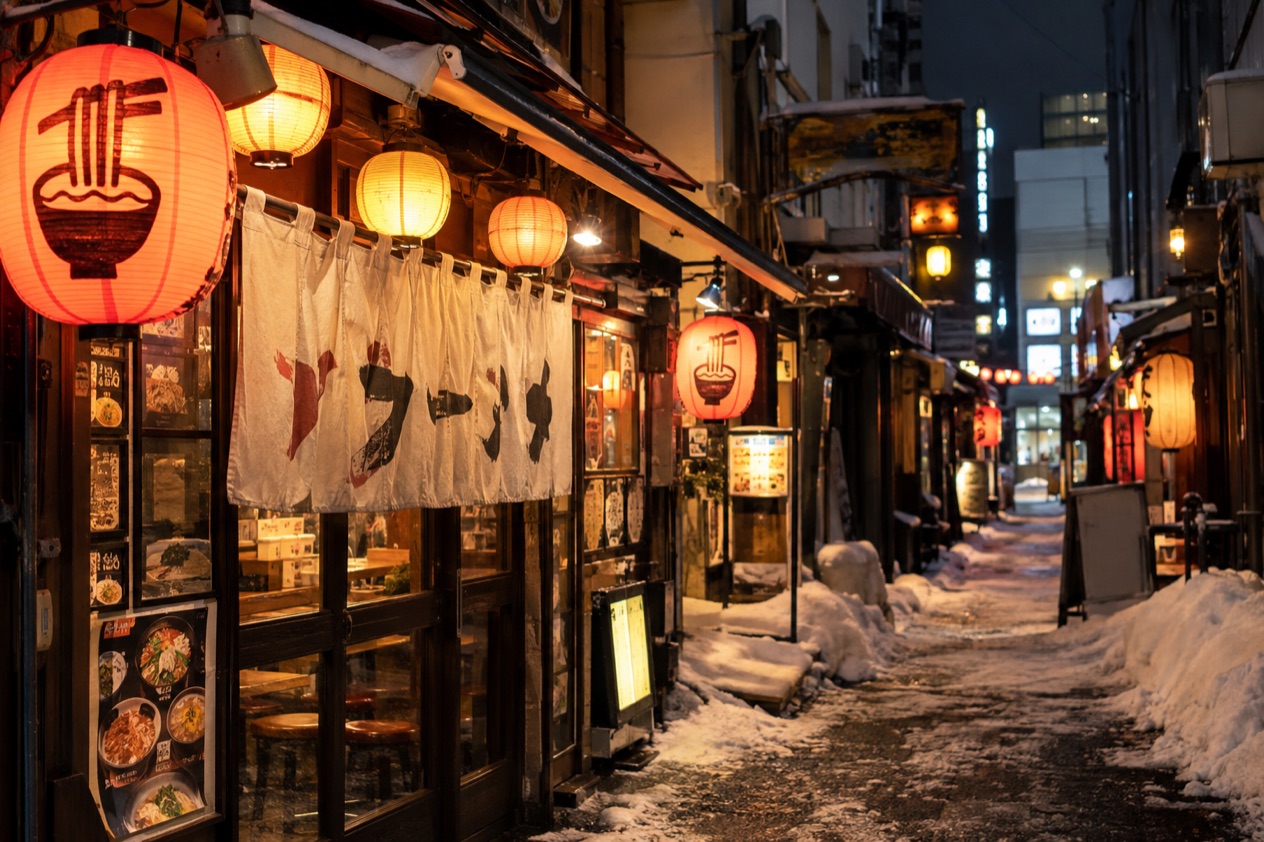
Steam fogs the windows of a ramen-ya on a cold Hokkaido evening, and from behind the counter comes the roar of a wok. A bowl lands in front of you with a brown miso broth shimmering under a film of hot oil, a tangle of yellow noodles rising out of it.
This is Sapporo ramen, a dish that belongs to the city as much as its snow does. The visit is a meal rather than a monument, and the pleasure is in the bowl, the room and the weather outside.
Is visiting Sapporo ramen worth it?
Yes, if you like noodles and want to taste the dish that Sapporo is especially famous for: rich miso ramen, which was invented in this city. It suits solo travelers who like to eat at a counter, couples looking for a warming dinner after a day in the cold, and anyone building a trip around food. It is less of a fit for someone who wants a sight with a gate, a guided route and a view.
What sets it apart from the other ramen you may eat in Japan is how well it matches its home. Sapporo is the capital of Hokkaido, the northernmost island of the country, and miso ramen is described as ideal for the island’s snowy winters. The broth is hearty, the noodles hold up in it, and the whole bowl is built to keep you warm while the streets outside are white.
Nearby Hokkaido cities answer with bowls of their own. Hakodate is known for salt-flavored ramen, a lighter idea altogether, so a trip around the island can turn into a comparison of broths.
Farther afield, Japan has a bowl for nearly every region, from the pork-bone tonkotsu of Kyushu to the soy-flavored chicken broth of Tokyo. Sapporo’s contribution is the miso one, and eating it in Sapporo is the way to understand why it became a signature.
The city gives the bowl a good setting. Sapporo hosted the first Winter Olympic Games in Asia, it throws a snow festival every February, and it has a beer museum with a pub, so a day of eating here has plenty to build around.
What to see at Sapporo ramen
The miso broth
The broth is the reason for the trip. Miso, the fermented soybean paste that flavors so much of Japanese cooking, gives the soup a deep, savory, slightly sweet body, and cooks often work it into a wok with aromatics before the stock goes in. What arrives is darker and thicker than a soy or salt broth, with a layer of oil on top that holds the heat.
Look at the surface when the bowl is set down. The sheen, the steam and the flecks of ground pork or garlic tell you how the kitchen works. Sip the broth before you touch the noodles, and notice how it clings to the spoon, which is exactly what you want on a cold night.
Noodles and toppings
Ramen is a Japanese-Chinese fusion dish built on Chinese-style alkaline wheat noodles served in hot broth, and the Sapporo version tends to use springy, yellow, curly noodles with real chew, strong enough to stand up to a heavy broth. Part of the fun is the slurp: eating noodles audibly is the habit in a ramen-ya, and it cools each mouthful as it goes in.
The toppings change from shop to shop. Sliced chashu pork, bean sprouts stir-fried in the wok, scallions, bamboo shoots and a half egg are common, and Hokkaido touches such as sweet corn or a pat of butter melting into the soup are what many people associate with a bowl up here. Each addition changes the broth as you eat, so the last spoonfuls taste different from the first.
The ramen-ya itself
The best quality ramen is usually found in specialist ramen shops called ramen-ya, and that is where a Sapporo ramen visit happens. These are small, focused places where one dish is the whole menu, often with a counter facing the kitchen so you can watch the cook shake noodles dry and ladle the broth.
The room is part of the experience: fogged glass, a steady rhythm of orders called out, a line of diners bent over their bowls. Ramen as a stand-alone shop has a long history in Japan, and the first specialized ramen shop, Rairaiken, opened in 1910 in Asakusa, Tokyo. The ramen-ya you walk into in Sapporo carries on that idea.
Other bowls to measure it against
Ramen originated in Yokohama Chinatown in the late 19th century, and since then nearly every region has made it its own. Hakodate’s salt ramen is the other great Hokkaido style. Kitakata is known for thick, flat, curly noodles in a pork and niboshi (dried small sardine) broth, while Yokohama’s Ie-kei style pairs thick, straight noodles with a soy-flavored pork broth similar to tonkotsu.
Hakata ramen, from Fukuoka in Kyushu, is rich and milky from pork bones, with thin, resilient noodles. Tokyo-style ramen offers slightly thin, curly noodles in a soy-flavored chicken broth. Tasting Sapporo’s miso bowl next to any of these makes its character plain: it is the heaviest on seasoning and the most at home in the cold.
Hours, tickets and rules
Sapporo ramen is a dish served in specialist ramen-ya, not a single site with a gate, so there is no one entrance fee or one set of hours to give. You pay for the bowl you order, in yen, and each shop is its own small world with its own rhythm of service.
A few things shape the meal. Ramen-ya are where the best quality ramen is usually found, which is why a counter seat in a shop that makes nothing else is worth choosing over a general restaurant that lists ramen among many dishes. The sit-down is brief and unhurried at the same time: you eat while the noodles are best, then you go.
If you want to turn the meal into something longer, two other places connect to it. The Sapporo Beer Museum has a pub, the Sapporo Beer Garden, where visitors can enjoy a beer and lamb barbecue, a very different Hokkaido meal. And for the history of the dish itself, the Shin-Yokohama Ramen Museum is a museum about ramen in the Shin-Yokohama district of Kohoku-ku, Yokohama, a reminder that the story starts in another city.
The one rule worth knowing comes from tonkotsu restaurants rather than miso shops. Most tonkotsu ramen restaurants offer a system known as kae-dama, where customers who have finished their noodles can request a refill for a few hundred yen more. It belongs to the pork-bone style of Kyushu, so do not count on it in a Sapporo miso shop.
When to visit Sapporo ramen
Winter is when the dish makes the most sense, and January is the proof. The air stays below freezing even in the afternoon, snow or sleet falls on nearly every day of the month, and a bowl of miso ramen feels like the answer to the street outside. February brings the Sapporo Snow Festival, the winter event of Hokkaido, and a hot bowl fits naturally into a day spent among snow sculptures.
| Month | Average high (°F) | Average low (°F) | Precipitation (in) | Days with at least 1 mm of precipitation | Sunshine (hours) |
|---|---|---|---|---|---|
| January | 31.3 | 20.5 | 4.27 | 18.3 | 90 |
| April | 53.1 | 38.1 | 2.15 | 9.6 | 176 |
| July | 77.7 | 64.2 | 3.57 | 7.7 | 168 |
| October | 61.5 | 46.4 | 4.33 | 11.6 | 146 |
April is the thaw. Days are cool, a little snow can still fall, and many of the sunniest hours of the year start to appear, so a walk through the city can end in a hot bowl without feeling like a retreat from the weather. It is a good shoulder month for people who want ramen without the deep winter.
July is warm and humid by Sapporo standards, with few rainy days, and a heavy miso bowl is a different proposition then. Some people enjoy it anyway as a contrast with the beer garden and its lamb barbecue, others prefer to look for lighter styles such as salt ramen from nearby Hakodate. Either way, it is the month that tests the idea that miso ramen is only for the cold.
October, the month of the current moment, sits between the two. Afternoons are cool enough that a steaming bowl is welcome, there is rain on a fair share of days, and the first flakes of snow can appear, though they rarely settle. The mood is of a city turning toward winter, and that is when miso ramen starts to taste right.
Tips for your visit
Plan the ramen as the center of an evening or a lunch rather than a stop between stops. A bowl takes the time it takes, and the pleasure of a ramen-ya is in not rushing it. Come hungry, because Sapporo bowls are rich and filling, and think about ordering a smaller extra rather than a second bowl.
Dress for the season. In January, the cold between the door of your hotel and the door of the shop is part of why the bowl tastes so good, so warm layers matter. In July, a light shirt is enough. In October, a jacket you can take off in a warm ramen-ya works well, since the room will be steamy and the street is cool.
Combine the meal with something else in the city. The Sapporo Beer Museum and its pub, the Sapporo Beer Garden, offer a beer and lamb barbecue for a very different kind of Hokkaido dinner. In February, the Sapporo Snow Festival fills the winter calendar. And the city’s Winter Olympic history, as host of the first Winter Games in Asia, gives a reason to look at it as a winter capital.
Beyond the city, Hokkaido offers skiing, trekking, hot springs, Ainu and Jomon culture and gourmet food of every kind. Otaru Canal, with its glowing gas lamps and stone warehouses, adds a nostalgic evening scene to a food trip. A ramen trip works well as the first chapter of a longer one on the island.
Good to know before you go
Sapporo ramen is meant to be eaten hot and without fuss, so the habits are simple: sit, order, slurp, and leave the broth for the last spoonfuls. Bowls are paid for in yen, and a refill of noodles, where a shop offers it, costs a few hundred yen more. Weather changes the meal more than anything else, so look at the sky before you go and let the cold or the rain decide which bowl suits the evening.
Sources
- Wikipedia, Ramen (https://en.wikipedia.org/wiki/Ramen), checked October 11, 2026
- Japan National Tourism Organization, Sapporo (https://www.japan.travel/en/destinations/hokkaido/hokkaido/sapporo-and-around/), checked October 11, 2026
- Hokkaido Love, the official Hokkaido tourism site (https://www.visit-hokkaido.jp/en/), checked October 11, 2026
- Hokkaido Love, what to see and do (https://www.visit-hokkaido.jp/en/spot/), checked October 11, 2026
- Japan Meteorological Agency (JMA), Normal values 1991-2020, monthly (https://www.data.jma.go.jp/stats/etrn/view/nml_sfc_ym.php?prec_no=14&block_no=47412), station Sapporo, elevation 17 m, checked October 11, 2026
To plan your stay
- Best Time to Visit Sapporo: Snow Festival, Summer Weather and Seasonal Highlights
- Where to Stay in Sapporo: Sapporo Station, Odori, Susukino and Ryokan Stays
- Sapporo from Tokyo: The Hayabusa Shinkansen, the Seikan Tunnel and What Awaits on Hokkaido
- Know Before You Go to Sapporo: Entry, Money, Getting Around and Local Customs