
Step through the gate beside the moat and the white walls of Himeji Castle give way to clipped pines, raked gravel and the sound of water running over stone. Koko-en is a walled garden made of several smaller gardens, each with its own mood, and the castle keep keeps appearing over the rooftops and trees as you move between them. It is a visit for people who like to wander slowly, look closely and sit down now and then.
Is visiting Koko-en Garden worth it?
Yes, for anyone already coming to Himeji Castle, and especially for travelers who enjoy gardens, photography or a slower stretch in a day of sightseeing. Koko-en rewards people who like to notice small things: the pattern of a clay wall, a stepping stone set at an odd angle, a carp rising beneath a bridge. It is less of a draw for travelers who want only the big monument and nothing else.
What sets it apart from the other gardens you may visit in Kansai is how it is built. Instead of one large landscape, it is a series of enclosed garden rooms, divided by walls and hedges, and each one shows a different way of arranging water, stone, trees and flowers.
The garden stands on the grounds of what were once samurai residences connected to the castle, and the layout was designed in the spirit of Edo-period gardens. Here the pleasure is variety, and the castle serves as borrowed scenery over the walls.
The castle itself explains why the pairing works. Himeji Castle, called White Egret Castle for its white plaster exterior, has stood for more than 400 years and came through wartime bombing and the Great Hanshin earthquake intact. After the keep, with its steep wooden stairs and dark interior, the garden offers a change of pace: soft greens, running water and benches where you can sit and let the visit settle.
What to see at Koko-en Garden
The garden is best understood as a walk through contrasting settings, linked by paths of stepping stones and gravel. You pass from open lawns and ponds into shaded corners, then out again to a view of the keep. Here are the parts visitors remember.
The pond gardens and koi
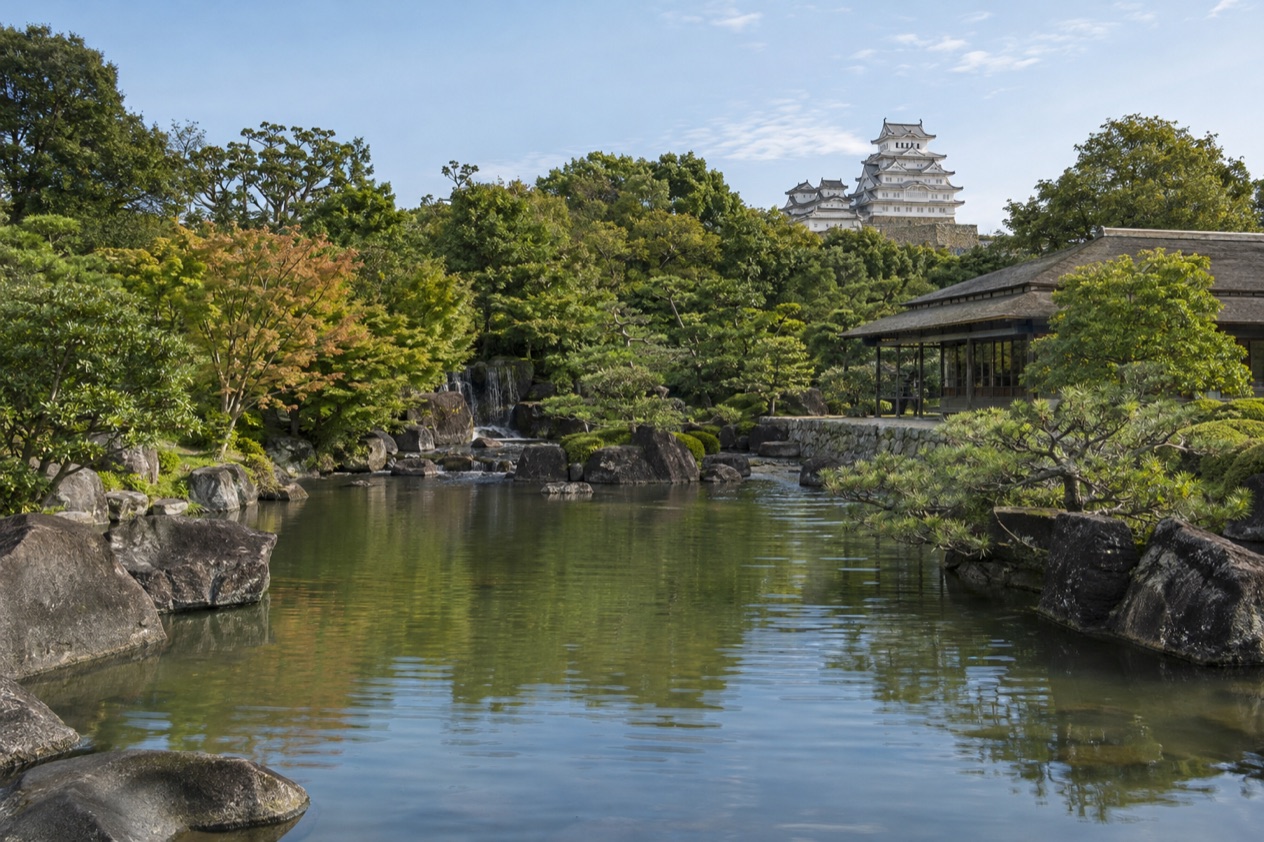
Water is the thread that ties the garden together. Streams run between the rooms, small waterfalls drop over rock faces, and ponds hold koi in orange, white and gold. The design follows the old idea of the strolling garden, in which the view changes at every turn and a bridge or a stone lantern frames each new scene.
Stop on a bridge and watch the fish gather. The carp are used to people, and the surface of the pond mirrors the pines and the white walls beyond. A pond garden like this reads very differently in rain, when the stones darken and the moss turns a deeper green, so a gray day is no reason to skip it.
The pine garden and the tea house
One of the garden rooms is given over to pines, shaped by careful pruning into the layered forms you see in Japanese garden painting. Gravel, rock and a few well-placed shrubs leave space around each tree, so every pine can be seen as a sculpture. This is the part of the garden closest to the classic image of a samurai residence.
A tea house stands among the gardens, in keeping with the tea-garden tradition behind the layout: a path meant to slow the walker down before the tea room, with stones that make you watch your feet and then lift your eyes to a view. Even if you do not sit for tea, the path leading to it shows how the garden was meant to be used.
The flower garden and the bamboo grove
A flower garden brings seasonal color to the walk. Plum blossoms, cherry blossoms, azaleas, wisteria, hydrangeas and maples are the kinds of plants Japanese gardens use to mark the year, and what you find in bloom depends on the week of your visit. Check what is flowering when you arrive instead of planning around one particular plant.
Nearby, a bamboo grove changes the light. The stalks sway and creak, the air feels cooler under the leaves, and the path turns almost into a corridor. After the open ponds and bright flower beds, it is a pleasant pause before you reach the next garden room.
Views of the castle from the garden
The garden’s special trick is the way it uses Himeji Castle as a backdrop. Along the paths, the white keep appears above walls and trees, sometimes in full, sometimes as a single roofline between branches. This is borrowed scenery, a well-known technique of Japanese garden design in which a distant landmark becomes part of the composition.
Photographers tend to look for the angles where a pine branch, a stone lantern or a pond reflection frames the keep. Because the castle is a UNESCO World Heritage Site and a national treasure, these glimpses give the garden a sense of place that few other gardens in Japan can match.
When to visit Koko-en Garden
A garden built around planting and water changes through the year, so there is no single right moment, only different pleasures. Think of the visit in terms of seasons first, then of how it fits around the castle, whose hours set the rhythm of a day in Himeji.
Spring is the season travelers picture. Plum and cherry blossoms light up the branches, the lawns turn fresh green, and the castle’s white walls stand out against pink petals.
Blossom timing shifts from one spring to the next, so treat any date as a rough guide and look at the trees when you get there. Early summer brings the deep greens of moss and maple leaves, along with flowers that like the damp, and the garden feels lush after rain.
Autumn is the other favorite. Maples turn red and orange around the ponds, their reflections doubling the color, and the stepping-stone paths are scattered with fallen leaves. In winter the structure of the garden shows: bare branches, clean lines of stone and wall, and pines that look as sharp as ink drawings. A dusting of snow, when it comes, changes the whole picture, though it is a chance and not something to plan on.
For the day itself, build the schedule around the castle. The castle opens in the morning and closes in the late afternoon, and from May to August it stays open an hour later, which gives summer visitors more room to combine the keep and the garden.
On any day, the main keep admits only the first 15,000 visitors, so those who want to climb it should reach the castle before the garden. The garden then makes a softer second half to the day.
Rain does not spoil a visit here. Wet stone, dripping pines and mist over the ponds are some of the garden’s best scenes, and the paths are made for walking at a measured pace. On a hot summer day, the shade of the bamboo grove and the sound of running water make the garden a place to slow down.
Tips for your visit
Travelers reach Himeji from Osaka, about an hour and a half away by train heading west. That makes it a day trip from Osaka, and an easy addition to a Kansai itinerary that already includes Kyoto, Nara or Kobe. Himeji Castle and Koko-en sit side by side, so the two fit naturally into one outing.
Plan the castle first and the garden second. The keep is the more demanding visit, with stairs and a limited number of entries each day, while the garden is a place to unwind afterward. These are the castle’s hours and closed days, which shape the rest of your schedule:
| Site | Open | Closed |
|---|---|---|
| Himeji Castle (September to April) | 09:00 to 17:00, admission until 16:00 | December 29-31 |
| Himeji Castle (May to August) | 09:00 to 18:00, admission until 17:00 | December 29-31 |
Wear shoes you can walk in comfortably. The garden paths are made of gravel, stepping stones and uneven pavers, and you will be on your feet for much of the visit. A hat and a bottle of water suit the summer months, and a light rain jacket handles the showers that can come through at any season.
A camera is worth carrying. Koko-en is built for framing: lanterns, bridges, pines and the white keep in the distance.
Families will find plenty to hold a child’s attention: koi in the ponds, waterfalls, bridges and stepping stones. Keep a hand on young children near the water. For travelers with limited mobility, the stepping stones, gravel and changes of level are worth bearing in mind when planning how much of the garden to cover.
Himeji rewards a longer look if you have the time. After the castle and the garden, you can walk the streets of the city and look for a local meal, such as the anago (conger eel) and sweet treats the region is known for. The walk back toward the station gives the castle one last view over the rooftops.
Good to know before you go
Koko-en is a place for unhurried walking, so leave room in the day instead of fitting it between train times. Keep your voice low near the tea house and the ponds, as in any Japanese garden, and avoid stepping off the paths onto moss or raked gravel.
Carry some yen for small purchases, and bring a bag for any trash you create, since public bins are scarce in Japan. After a rainy spell the stones can be slick, so watch your footing, and pause on a bench before you head back to the station.
Sources
- Wikipedia, Himeji Castle (https://en.wikipedia.org/wiki/Himeji_Castle), checked October 11, 2026
- Japan National Tourism Organization, Himeji (https://www.japan.travel/en/destinations/kansai/hyogo/himeji-and-around/), checked October 11, 2026
- Wikivoyage, Himeji (https://en.wikivoyage.org/wiki/Himeji), checked October 11, 2026