
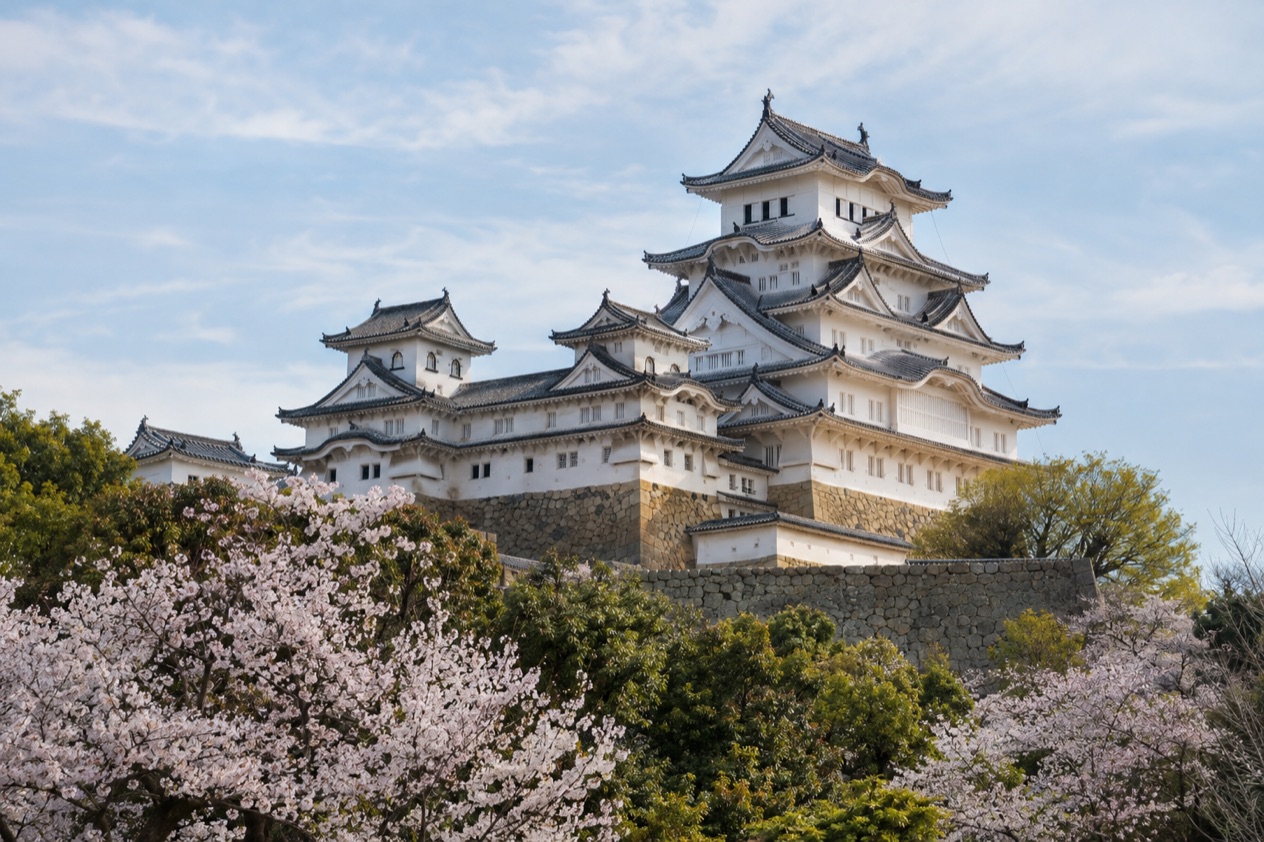
Himeji Castle rises over the city in white plaster, its roofs layered like the wings of a bird about to lift off, and it is the reason the building is called the White Egret Castle. You see it first from the streets leading toward the grounds, growing larger with every block. A visit here is a slow climb through gates, walls and wooden floors, a chance to walk inside a fortress that has stood for centuries.
Is visiting Himeji Castle worth it?
Yes, especially for travelers who want to walk through a real castle rather than a modern rebuilding, and for anyone who enjoys architecture, history or simply a striking building. Himeji Castle dates back more than 400 years and is one of the 12 original castles in Japan, which means the timbers you pass beneath belong to the old structure and not to a postwar replica.
Its survival is part of the story. The castle has been spared for four centuries from war, earthquakes and fires, and it came through the bombing of World War II and the Great Hanshin earthquake of 1995 intact. That record is rare in a country where so many fortresses burned, fell or were reconstructed in concrete.
Recognition has followed. The castle is both a Japanese national treasure and a UNESCO World Heritage site, registered in 1993 among the first World Heritage sites in Japan. Its gleaming white exterior earned it the names Hakuro-jo and Shirasagi-jo, White Egret Castle and White Heron Castle, and the image of a bird in flight explains the shape of the gabled roofs.
What sets it apart from other castles in the Kansai region is the combination of scale, authenticity and finish. Many castles offer a museum inside a concrete shell. Here you take off your shoes, climb steep wooden stairs and look out through the same openings defenders once used.
The castle also reopened to the public on March 27, 2015 after restoration work, and the plaster and roof tiles of the main keep show that renewal. It suits history fans, photographers, families with children who like a good fortress, and anyone building a Kansai trip around more than temples.
What to see at Himeji Castle
The castle is a complex rather than a single building, and the pleasure lies in how its parts unfold as you move inward from the outer approach to the top of the keep.
The main keep
The main keep is the heart of the visit and the building everyone has seen in photographs. From outside it appears as a stack of white gabled roofs, each one set slightly off the last, which gives it the feathered look behind the egret nickname. Inside, the mood changes completely: dark wooden pillars, plain floors worn smooth and narrow stairways that climb from level to level.
Look for the racks along the walls where weapons were once kept, the thick timber frame holding everything up, and the small windows that frame the city below. At the top you get a view over the rooftops of Himeji. Entry to the main keep is limited to the first 15,000 visitors each day, a figure worth keeping in mind when you plan your arrival.
The approach, gates and walls
Before you reach the keep, the route winds through a series of gates and along stone walls, and this is where the castle shows its military logic. The path turns, doubles back and narrows, a design meant to slow anyone approaching with bad intentions. For a visitor it means the keep appears and disappears from view, revealed in slices between walls and roofs.
Take your time here and look at the stonework and the openings in the plaster walls through which defenders could watch the path. These outer parts are a good place to photograph the castle, since the white walls and curved roofs frame well against the sky.
A castle that survived
One part of the experience is not a place but an idea: that this building is still here. Himeji Castle remained intact through the bombing of World War II and the 1995 Great Hanshin earthquake, and has been spared for four centuries from war, earthquakes and fires. Standing in its grounds, it is worth pausing to notice how rare that is.
The restoration that ended with the reopening in March 2015 returned the keep to its bright white finish, so what you see is a castle both old and freshly cared for. Its sister castle relationships with Château de Chantilly in France and Conwy Castle in Wales place it among the great castles of the world.
When to visit Himeji Castle
The castle is open daily from 09:00 to 17:00, with admission until 16:00. From May to August it stays open until 18:00, with admission until 17:00. Those longer summer hours give you more room in the day, and they matter if you arrive from Osaka in the afternoon.
| Site | Open | Last admission |
|---|---|---|
| Himeji Castle, September to April | 09:00 to 17:00 | 16:00 |
| Himeji Castle, May to August | 09:00 to 18:00 | 17:00 |
| Himeji Castle, closed | December 29-31 | Closed |
Because entry to the main keep is limited to the first 15,000 visitors each day, arriving earlier in the opening window is the logical way to secure your place. That is a matter of arithmetic and not a prediction about crowds, but it is the reason to plan the castle as the first stop of your day in Himeji and not an afterthought.
As for the seasons, the castle is an outdoor visit with long walks across open grounds, so weather shapes the experience. Clear days make the white walls glow against the sky, while a gray or drizzly day gives the plaster a softer, quieter look. Spring and autumn are the seasons travelers have in mind for Japan, but no bloom or leaf date for Himeji is given here, so treat those as general hopes and not promises.
If your dates are flexible, remember the closure from December 29 to 31, which falls right at the end of the year. Anyone traveling in Japan over the New Year period should build the castle into a day before those dates.
Tips for your visit
Start from the city. Himeji is about 1.5 hours west of Osaka by train, so the trip fits comfortably into a day with time to spare for the castle grounds. Wear shoes that come off easily, since the inside of Japanese historic buildings is traditionally entered in socks or slippers, and bring a light layer for the interior, where the wooden floors and stairs feel different from the sunlit walk outside.
Plan generously for the grounds. The castle is a complex of gates, walls and courtyards, and the pleasure comes from wandering rather than rushing to the keep. Photographers will want time at the outer approach, where the keep rises over the walls, and again after the climb for the view from the top.
Pair the castle with the city around it. Himeji covers a wide area, and the streets that lead to the grounds are a pleasant way to arrive and leave. Travelers use the castle as the anchor of a Kansai day trip, and it also sits comfortably alongside other stops in the region as part of a longer route.
For families and travelers with limited mobility, bear in mind what the visit involves: the keep is reached by steep wooden stairs between levels, and the grounds are large. No facilities, guide services or access arrangements are described here, so plan the visit around your own comfort and the stairs inside the main keep.
Good to know before you go
Plan your timing around the opening hours and the daily limit on entry to the main keep, and remember that the castle closes for the last three days of December. Carry a little cash and a card for the day, and keep an eye on the weather forecast, since the walk across the grounds is outdoors and rain in the Kansai region can turn the stone paths slick underfoot.
Sources
- Wikipedia, Himeji Castle (https://en.wikipedia.org/wiki/Himeji_Castle), checked October 11, 2026
- Japan National Tourism Organization, Himeji (https://www.japan.travel/en/destinations/kansai/hyogo/himeji-and-around/), checked October 11, 2026
- Wikivoyage, Himeji (https://en.wikivoyage.org/wiki/Himeji), checked October 11, 2026