
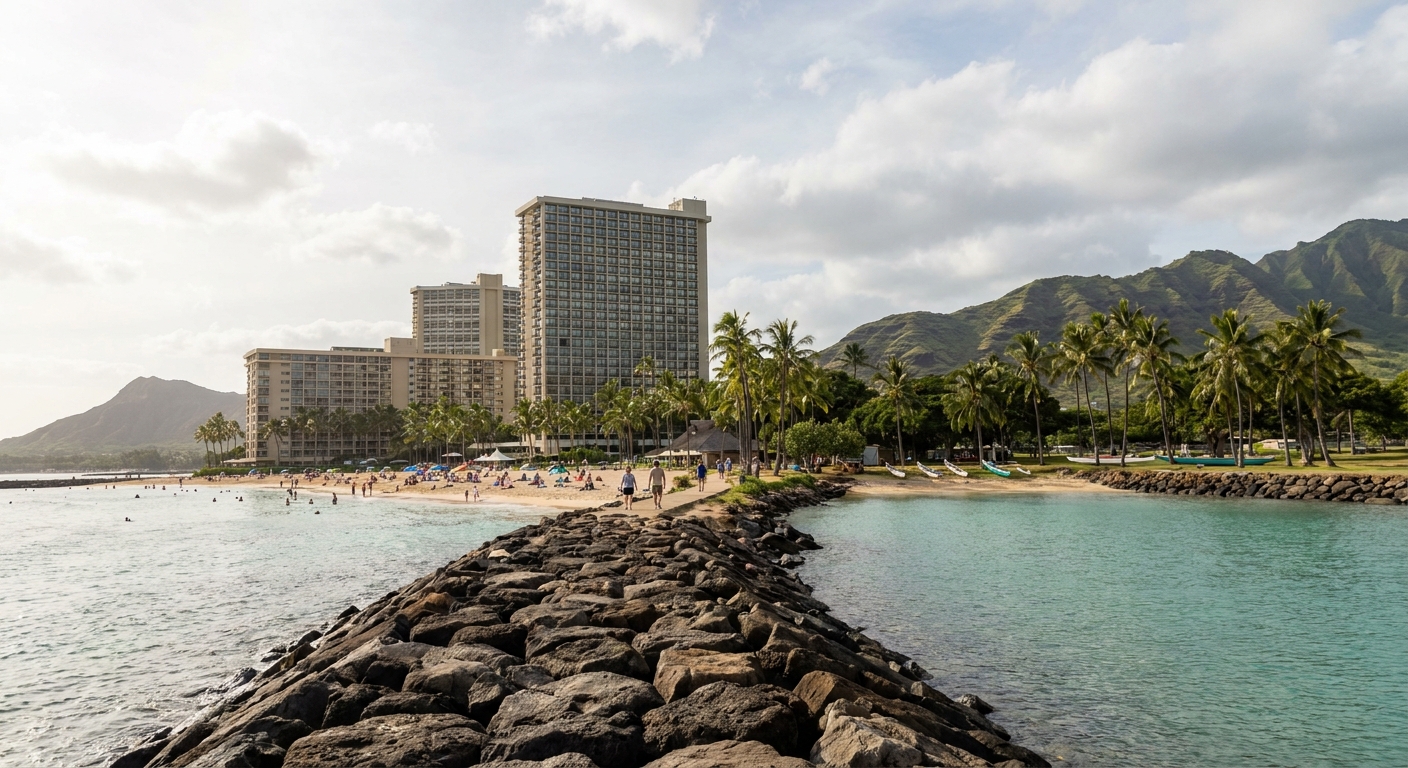
Early morning in Waikiki means surfboards sliding down Kalakaua Avenue, outrigger canoes pushing off from the sand and the Duke Kahanamoku statue draped in fresh lei. Forty-odd minutes up the leeward coast, Ko Olina wakes more quietly, with families wading into a rock-ringed lagoon and joggers on the seaside path. Oahu gives you both, so the choice depends on whether you’d rather have a city beach with everything at your doorstep or a sheltered resort nook.
Which is better, Waikiki or Ko Olina?
Waikiki suits travelers who want to walk to dinner, learn to surf and see Honolulu without renting a car, while Ko Olina suits families and couples who want calm lagoons, a drier coast and a resort routine. Each fits a different kind of vacation.
| Category | Waikiki | Ko Olina |
|---|---|---|
| Beaches | One long city beach with gentle rolling waves | Four man-made lagoons sheltered by rock breakwaters |
| Vibe | Busy, urban, always something going on | Quiet, planned resort with seaside paths |
| Things to do | Surf lessons, Diamond Head, zoo, aquarium, shopping | Lagoon time, resort pools, walks, easy access to Pearl Harbor |
| Nightlife | Bars, live music and late dining along Kalakaua and Kuhio | Resort restaurants and early nights |
| Weather | January rain: 2.38 inches | January rain: 1.36 inches |
| Getting there | TheBus W Line from the airport, about 30 minutes by car | About 45 minutes by car from Waikiki |
| Best for | First-timers, surfers, travelers without a car | Families with small children, couples, a slow week |
Beaches and the sea
Waikiki is a long curve of city sand with gentle, rolling waves, and that is exactly why so many first-time surfers and outrigger canoe riders learn here, with lesson stands lined up along the beach. Ko Olina is built around four lagoons with Hawaiian names: Kohola, Honu, Naia and Ulua. Rock breakwaters shelter them, which is why the water stays calmer than the open leeward coast. Public parking at the lagoons runs sunrise to sunset on a first-come basis, so arriving early matters on weekends.
For small children and unhurried wading, Ko Olina wins. For surf lessons, people-watching and a beach with a real city behind it, Waikiki wins. At the beach entrance, signs advise you to look over that day’s posted warnings plus the surf and currents before entering the water, to swim only near a lifeguard at either spot when one is on duty, and to keep a respectful distance from sea turtles wherever you find them.
Things to do
In and around Waikiki
Waikiki was once a playground of Hawaiian royalty, and its first hotel, the Moana Surfrider, went up on the shore in 1901. The Waikiki Historic Trail marks its stops with surfboard-shaped markers, and shopping and dining line Kalakaua and Kuhio Avenues. At the Diamond Head end, Kapiolani Park holds the Honolulu Zoo, with the Waikiki Aquarium across the avenue on the shore.
Diamond Head, the crater behind Waikiki, is the classic morning hike, with a summit view over the whole coast. Hanauma Bay and Pearl Harbor are the other favorite outings, both reachable in about half an hour by car. The table gives hours and costs for the ones that need reservations.
| Site | Open | Admission |
|---|---|---|
| Diamond Head State Monument | 6 a.m. to 6 p.m., last entry 4:30 p.m. | $5 per person plus $10 per vehicle, non-residents, reservation required |
| Hanauma Bay | Closed Mondays and Tuesdays | $25 plus a 2.35% online fee, non-residents |
| Pearl Harbor National Memorial | Not specified | Free |
In and around Ko Olina
Ko Olina’s days revolve around the lagoons and the paved path that links them, more than a mile and a half of seaside walking across a resort of 642 acres. Mornings are for wading and paddling, evenings for a stroll at sunset when the light turns the breakwaters gold.
From November through April, humpback whales pass offshore, peaking from January through March. Pearl Harbor lies between Honolulu and Ko Olina on the same freeway corridor, so it fits a day trip in either direction. Nightlife here means dinner and a quiet drink, not a late scene.
Weather and the best time to go
Ko Olina is the drier of the two all year, and the leeward corner is the island’s driest resort coast. In an average January it sees about half the rain of Waikiki, and showers in Waikiki come as short passing spells, a few days in the month.
Summer is hotter and nearly dry on both coasts, with August afternoons in the high 80s and the sea at its warmest in the fall. Winter turns a bit cooler and wetter, with Ko Olina still the sunnier of the two. The Central Pacific hurricane season runs from June 1 to November 30.
Getting there and getting around
Waikiki is the easier base without a car. From the airport, TheBus W Line rolls through Downtown, Kakaako and Ala Moana Center, then finishes in Waikiki, and buses show up every 10 to 30 minutes, based on the time of day. By car the airport is about 30 minutes away, traffic permitting.
From Waikiki, Downtown Honolulu is a short drive, and Pearl Harbor and Hanauma Bay sit about half an hour away. Ko Olina is about 45 minutes by car, 26 miles up the coast. Once there, you mostly walk the resort paths, so the car or a ride matters for leaving the resort.
Who should choose which
Choose Waikiki if you want a first Hawaii trip with surf lessons, a hike up Diamond Head, restaurants to walk to and the option to skip the rental car. Choose Ko Olina if you travel with young children, want calm lagoon water and a drier coast, and are happy to settle into a resort rhythm.
The two combine well on a longer stay: a few nights in Waikiki for the city and the hikes, then a few at Ko Olina to slow down. The 45-minute drive between them makes the switch easy.
Good to know before you go
Hotel bills in both places carry Hawaii’s 11% state transient accommodations tax plus Oahu’s 3% county tax, so the room rate is not the final number. Keep to the usual habits of a busy resort area, and watch your belongings on the beach and in parked cars.
Sources
- NOAA NCEI, monthly normals 1991-2020, station USC00519397, checked September 8, 2026
- Open-Meteo Marine API, average 2015-2024, checked September 8, 2026
- sunrise-sunset.org, sunrise and sunset calculated for the 15th of the month, checked September 8, 2026
- Hawaii Tourism Authority, Go Hawaii, Waikiki (gohawaii.com/islands/oahu/regions/honolulu/waikiki), checked September 25, 2026
- Hawaii DLNR, Division of State Parks, Diamond Head State Monument, checked September 25, 2026
- Hawaii DOT Airports, HNL, The Bus and Skyline ; HVCB, map Driving Times from Waikiki (2010), checked September 25, 2026
- TheBus, fares effective January 7, 2024 ; HOLO, For Visitors, checked September 25, 2026
- Hawaii Department of Taxation, Announcement 2025-03 ; City and County of Honolulu, OTAT FAQ, checked September 25, 2026
- Waikiki Aquarium, Box Jellyfish Calendar, checked September 25, 2026
- NOAA Fisheries, Viewing Marine Wildlife in Hawaii, checked September 25, 2026
- DBEDT (Hawaii Department of Business, Economic Development & Tourism), press release « Visitor Spending Increased in December 2025 », dbedt.hawaii.gov/blog/26-04, checked September 24, 2026
- City and County of Honolulu, DPR, honolulu.gov/dpr/hanauma-bay-nature-preserve, checked September 25, 2026
- Hawaii DLNR Division of State Parks ; gostateparks.hawaii.gov/diamondhead, checked September 25, 2026
- National Park Service, nps.gov/perl, checked September 25, 2026
- TheBus, thebus.org/Fare/TheBusFares20240701.asp, checked September 25, 2026
- NOAA NCEI, monthly normals 1991-2020, station USW00022551, checked September 8, 2026
- Ko Olina Resort, Lagoons (koolina.com/destination/lagoons), checked September 25, 2026
- Ko Olina Resort, press release « City and Ko Olina Partner To Launch New Public Access Plan for Lagoons », October 15, 2020, checked September 25, 2026
- Hawaii Tourism Authority, Go Hawaii, itineraire « 4 Days in Waikiki and 3 Days on the Leeward Coast » ; HVCB, map Driving Times from Waikiki (2010), checked September 25, 2026
- NOAA NCEI, normals 1991-2020, stations USW00022551 (Kalaeloa) and USC00519397 (Waikiki), via PLAN-HAWAII.md §1, checked September 24, 2026
- NOAA, Hawaiian Islands Humpback Whale National Marine Sanctuary, Responsible Recreation, checked September 25, 2026
- NWS Honolulu / Central Pacific Hurricane Center, « 2026 Central Pacific Hurricane Season Outlook », weather.gov/hfo/hurricaneOutlook2026, checked September 24, 2026