
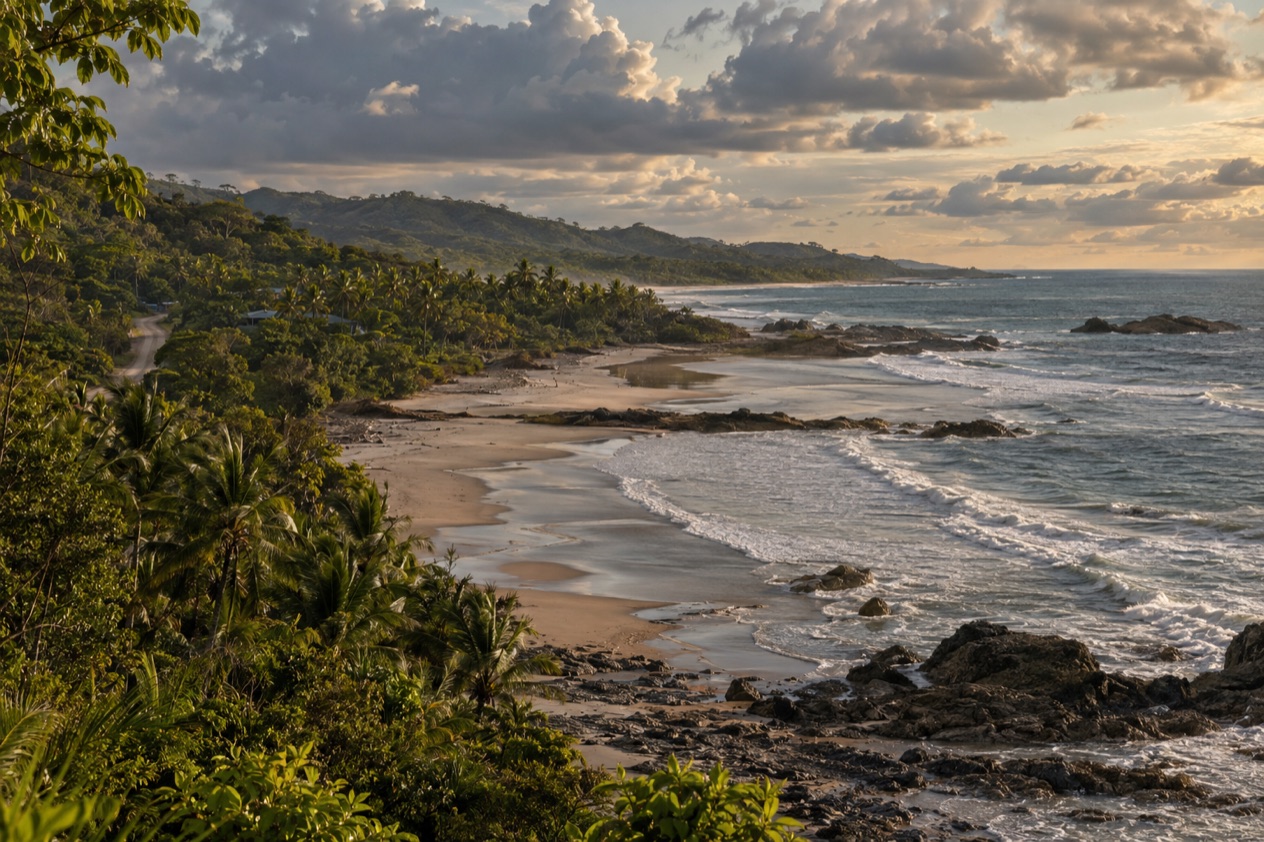
In August, the dirt road through Santa Teresa turns a deep red-brown after the afternoon downpours, and the jungle behind the beach looks almost painfully green. As evening falls, surfers carrying boards beneath their arms head back from the ocean, while the scent of grilled fish and woodsmoke floats from kitchens open to the air. At the southwestern end of the Nicoya Peninsula, this is the green season at its fullest, a month of warm water, empty rooms and a town keeping its own rhythm.
What is the weather like in Santa Teresa in August?
August is hot, humid and very rainy, with warm mornings, showery afternoons and nights that never really cool down. Rain falls on most days of the month, so think of it as a green-season month, not a dry one.
| Month | Average high (°F) | Average low (°F) | Rain days | Sea (°F) |
|---|---|---|---|---|
| July | 82.1 | 76.2 | 22.9 | 85.6 |
| August | 81.9 | 76.1 | 25.1 | 85.7 |
| September | 81.5 | 75.7 | 26.5 | 86.0 |
The rhythm of a typical day is the thing to plan around. Mornings are often the brightest stretch, with soft sun on the beach and a light breeze, so that is when most people surf, practice yoga or walk the sand. Clouds tend to build by midday, and the rain often arrives in the afternoon, sometimes as a short, heavy burst and sometimes as a steady gray drizzle that lasts into the evening.
You can usually get by in just a light layer, since evenings remain mild enough for a T-shirt and shorts. The air is sticky, so clothes dry slowly and the dust of the dry months is replaced by mud and puddles on the road. Daylight lasts about twelve and a half hours in mid-August, which gives a long enough window to fit a morning session and an early dinner around the weather.
Even on rainy days the light can be lovely. Storm clouds break up over the Pacific around sunset, and the sky turns orange and pink behind them. Still, a rainy day here can be a full gray one, so keep a plan for the indoors, and do not count on a clear sky at any particular hour.
Can you swim in Santa Teresa in August?
The water is warm, but swimming conditions can be dangerous at any hour, so stay out when in doubt. At this time of year it feels closer to a warm bath than to a cold plunge, and you can stay in for as long as you like.
Warm does not mean gentle, though. Santa Teresa is a surf beach, and the Pacific here usually brings real waves, with the swell often stronger in the green season.
Multiple U.S. tourists die every year because of rip currents, which are extremely hazardous, and on most Costa Rican beaches there are no lifeguards on duty and no warnings about dangerous conditions. Check for any flags on display, find out from your hotel or surf school where the water is best that day, and keep out of the water when in doubt.
Strong swimmers who are comfortable in surf will enjoy the shore break and the long stretches of beach. Families and nervous swimmers should ask locally about the day’s conditions, keep children close at all times, and stay out when in doubt.
At low tide, the rock pools along the shore can be fun to explore, and the quieter stretches toward Mal Pais sometimes offer a gentler setting. Bring a rash guard if you plan to stay in the water for long, since the sun is strong even through thin clouds.
What to do in Santa Teresa in August
The month begins with a national moment. On August 2, hundreds of thousands of Costa Ricans walk on pilgrimage to the Basilica of Our Lady of the Angels in Cartago, far from the coast but felt across the country, with the day’s mood showing up in conversation, in church services and on the news.
August 15 is Mother’s Day, a national holiday, when families gather for long lunches and many locals take the day off.
Beyond the calendar, August is a good month to do what Santa Teresa does best, early in the day, and to leave the afternoons to the rain. The town has no formal center, just a long road lined with surf shops, bakeries, juice bars, taquerias and small hotels tucked into the trees. The crowd is a mix of surfers, yoga students and long-stay remote workers, and in the green season it feels more local and less hurried.
Surfing the green-season swell
Surfing draws the crowds here, and the green season often serves up steady waves along this part of the coast. Beginners can take lessons on the more forgiving beach breaks, with instructors who read the tide and the wind for you. More experienced surfers head for the stronger breaks and watch the tides closely, since the same beach can feel completely different between morning and evening.
Go out early, when the wind is usually lighter and the surface cleaner, and be out of the water when the clouds turn dark. Rent a board by the day if you did not bring one, and choose a school that talks to you about rip currents before it talks about turns. In the rain you can still paddle out, but lightning is a reason to come in at once.
Yoga, food and slow mornings
Santa Teresa has a yoga scene too, and plenty of studios run open-air sessions in covered pavilions that work beautifully with the rain, while a downpour drumming on the roof only deepens the mood. Mornings draw the biggest crowds, and once class lets out, everyone makes their way to a cafe for breakfast featuring smoothie bowls, fresh fruit and robust Costa Rican coffee.
For a meal, stop by a small local soda and get a casado, the classic mix of rice, beans, salad and plantains, with fish, chicken or beef as your choice. Gallo pinto, the rice and beans cooked together with onion and pepper, shows up at breakfast with eggs. Along the road you will also find wood-fired pizza, fresh ceviche, fish tacos and plenty of vegetarian cooking, and coconut water from a roadside stand is a good way to cool down after a walk.
Mal Pais and the nature reserve nearby
A short ride south along the same coast brings you to Mal Pais, a quieter village with its own beach, rocky tide pools and a handful of small restaurants. South along the same coast is Mal Pais, a quieter village reached by a road with trees closing in overhead and glimpses of the sea between them.
Farther along is Cabo Blanco, a nature reserve at the tip of the peninsula, known for forest trails that lead toward the coast. In the green season, trails can be muddy and slippery, and sloths, monkeys and birds are chances rather than promises. Because park access and regulations can shift, visit the official page before building your day around it, and bring a rain jacket along with sturdy shoes.
On the wettest afternoons, the best plan is a slow one. Settle into a covered cafe with a book, get a massage, take a cooking class, or watch the storm from a hammock. The rain may linger, but if the sky clears, the wet evening beach can glow at sunset.
A two-day itinerary for Santa Teresa in August
Day 1 is for the beach and the town. Start early with coffee and a surf lesson or a long walk on the sand while the sky is at its clearest. Come back for a hearty breakfast, then pass the late morning in the sea or in a yoga class, and enjoy a relaxed lunch of ceviche or a casado at a little soda before the clouds roll in.
When the afternoon rain arrives, move indoors: a cafe, a massage, a souvenir shop or a hammock on a covered porch all work. If the sky clears before evening, walk to the beach for sunset and watch the surfers catch the last waves. Daylight lasts about twelve and a half hours, so dinner can be early, at a pizza place or a fish restaurant on the main road, and bed comes early too.
Day 2 heads south. Leave in the morning for Mal Pais, where the beach is quieter and the tide pools are best explored while the light is good. Have lunch in the village at a simple beachside spot, then check the nature reserve’s official access information before deciding whether the weather allows a forest walk.
Return to Santa Teresa by late afternoon, before the heaviest rain. If the weather turns, spend the afternoon at a cooking class, a spa or a cafe with a good book. For your last evening, choose a restaurant with a covered terrace, order the catch of the day and listen to the rain on the roof.
Is Santa Teresa busy in August?
Not especially, since August falls in the green season and the town is usually calmer than in the dry months. Surfers and yoga students still fill the road in the mornings, but the crowds are smaller, and most beaches have plenty of space.
Visitors include travelers from North America and Europe, long-stay remote workers and Costa Rican families, especially around Mother’s Day on August 15, when the holiday weekend can bring more local visitors. Rooms are usually easier to find than in peak season, and restaurants rarely have long waits, though the best-loved small places can still fill on weekends.
As a habit, book early for the holiday weekend and for any room with a special view, and book later for the quiet weeks of the month. Roads can be muddy, so ask a local provider which vehicle suits the conditions. If a particular surf lesson, yoga getaway or boat trip matters to you, ask the provider about availability, and when a nature reserve is involved, look at the park’s official page for whatever reservation rules apply.
What to pack for Santa Teresa in August
Pack for heat, humidity and sudden rain, and keep things light and quick-drying.
- A light rain jacket, because afternoon showers can arrive quickly and last for hours.
- Quick-drying clothes, since the humid air keeps cotton damp for a long time.
- Sunscreen and a hat, as the sun is strong in the brighter mornings.
- A rash guard, for hours in the surf without sunburn.
- Sandals and sturdy shoes, for muddy roads and forest trails.
- A dry bag, to keep phones and cameras safe from the rain.
- Insect repellent, for the evenings near the trees.
Good to know before you go
The U.S. State Department rates Costa Rica Level 2, ‘Exercise increased caution,’ due to crime; it says petty crime is common throughout Costa Rica and that violent crime also affects tourists, including armed robbery, homicide and sexual assault.
August is a rainy month, so build flexibility into the plan and keep mornings for the things that matter most. Mother’s Day on August 15 is a national holiday, and some local businesses may close or keep shorter hours.
The main road is dirt, and after heavy rain it can be muddy and slow, so allow extra time for rides and transfers. Book rooms, rental vehicles and any lessons you care about first, and leave the afternoons loose.
Santa Teresa in August vs July and September
Going a month earlier changes little. July is slightly less rainy, with a few more gaps between showers, and the sea is just as warm. It also overlaps with school vacations for some travelers, so the beach can feel a little busier, and rooms can be harder to find in the holiday weeks.
A month later, September is the rainiest of the three, with more days of showers and more gray afternoons. The sea is a touch warmer, the town is quieter and the green is at its deepest, but the road can be muddier and some small businesses slow down. Surf can still be good, though days with long clear spells become rarer.
Choose July if you want the best odds of a bright morning, and August if you want a balance of warm water and fewer crowds. Pick September if quiet and green matter more than sunshine, and you do not mind planning around the rain.
Is August a good time to visit Santa Teresa?
Yes, for travelers who like warm water, green scenery and a relaxed town, and who accept that rain is part of the plan. Surfers, yoga students and anyone happy with slow mornings and covered afternoons will feel at home.
Travelers who want long sunny days, dry roads or a guaranteed clear view should choose another month. People who dislike humidity, or who need a fixed outdoor schedule, may find August frustrating, since most days see some rain.
On arrival, walk to the beach first and look at the water, then ask your hotel or surf school about the day’s conditions and where the currents are strongest. Then settle into the rhythm of the town, with early starts, a long lunch and an evening watching the sky clear over the Pacific. What makes August here special is that mix of rain, warm sea and empty sand, and the way the jungle seems to breathe after every storm.
Sources
- Open-Meteo / ECMWF ERA5, normals 1991-2020 computed for the grid cell at 9.6458N 85.1698W, checked October 8, 2026
- Open-Meteo Marine API, average 2015-2024, checked October 8, 2026
- sunrise-sunset.org, sunrise and sunset calculated for the 15th of the month, checked October 8, 2026
- U.S. Department of State, Costa Rica Travel Information, Safety and security (https://travel.state.gov/content/travel/en/international-travel/International-Travel-Country-Information-Pages/CostaRica.html), checked October 8, 2026
- U.S. Department of State, Costa Rica Travel Advisory, issued April 1, 2026 (https://travel.state.gov/content/travel/en/traveladvisories/traveladvisories/costa-rica-travel-advisory.html), read via the State Department open data API on October 8, 2026
To plan your stay
- Things to Do in Santa Teresa: Surf, Yoga, Beaches and Day Trips
- Where to Stay in Santa Teresa: Beach Areas, Boutique Stays and How to Choose
- Best Time to Visit Santa Teresa: Dry Season, Green Season, Weather by Month and Festivals
- Santa Teresa in July: Green-Season Rain, Warm Surf and the July 25 Holiday