
Early in the morning, the dirt road behind Santa Teresa Beach is already moving. Surfers walk toward the water with boards under their arms, a yoga class stretches on a wooden deck, and a thin veil of dust or mud, depending on the season, hangs over the cafes.
By evening the scene shifts a few miles along the coast, where sunset crowds gather on the sand and the road glows with lanterns. The choice you face is which stretch of this long, barefoot strip to call home, and each one has a distinct rhythm.
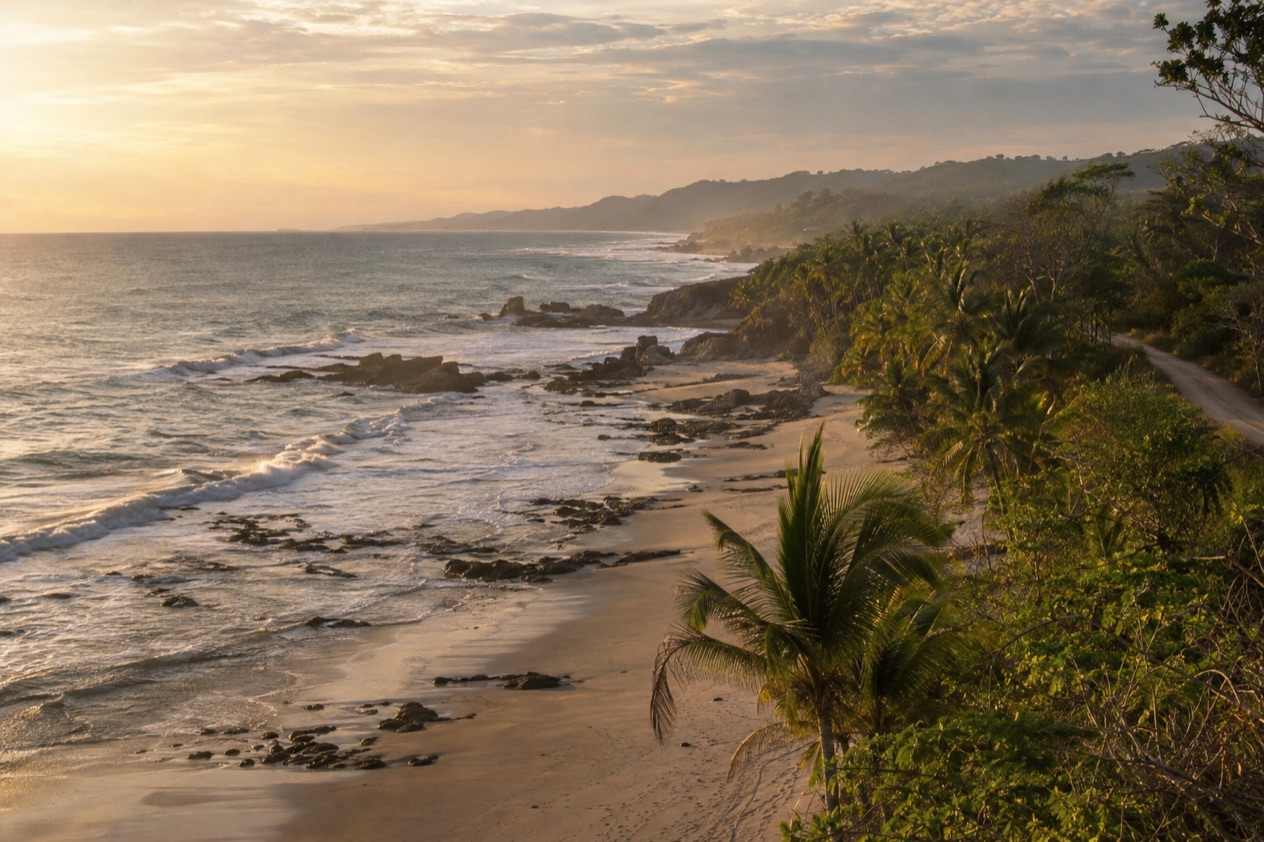
What is the best area to stay in Santa Teresa?
For a first visit, the middle of the strip around Santa Teresa Beach is the easiest choice, while Playa Hermosa suits quieter beach days, Mal Pais suits budget travelers and families wanting space, and the central stretch suits anyone who wants restaurants and nightlife on foot. Santa Teresa is not a town with a downtown grid. It is a single dirt road running behind a long beach, and the area you pick decides how much of your day happens on foot and how much on wheels.
First-timers usually do best near the middle of the road, where the cafes, smoothie stands, surf shops, yoga studios and small groceries cluster. You can walk to breakfast, to a board rental and to dinner without arranging a ride. The trade-off is movement and noise: the road is busy with quads, bikes and trucks, and in the dry season the dust drifts into everything.
Beach lovers who want to wake up with the surf in their ears look toward the sandy edge of Playa Hermosa, where lodging tends to sit among trees right behind the beach. It feels more residential and a bit calmer, with fewer places to eat close by. Those who want tide pools and a more rustic feel head south toward Mal Pais, where the road is rougher and the bays are more varied.
Budget travelers have the most luck in the simpler guesthouses, hostels and apartments set one or two lanes back from the beach, away from the busiest corner. You give up the sea view and gain a quieter room and a smaller bill. Families often prefer apartments or villas with a kitchen and a little garden, since meals can be cooked at home when the day has been long and the children are tired.
Nightlife seekers stay in the central stretch, where beach bars, live music and late dinners all sit within a short walk. Even here the scene is more sunset drinks and a guitar than a club district, and most people are up early for the waves. Couples looking for something quiet and a bit polished tend to choose boutique hotels tucked into the jungle slopes, which trade walkability for privacy and views.
All these areas share the same two facts. The coast is a surf destination first, so the sea is powerful in many places and rip currents are very dangerous, and the road is unpaved, so every room comes with a certain amount of dust or mud. Everything else, from the feel of the evening to the sound at 6 a.m., depends on the stretch you choose.
Think also about how you will spend your days. If your plan is surf lessons, yoga and long lunches, staying close to the center removes the logistics. If you want to read, swim in the pool and watch the sunset from a terrace, a place farther along the road gives you that stillness. Santa Teresa rewards choosing a mood rather than chasing a single best address.
The best areas to stay in Santa Teresa
Central Santa Teresa: the lively middle
The middle of the strip is where Santa Teresa looks like the postcard: open-air restaurants, juice bars, bakeries, surf schools and shops selling sarongs and boards, all along the same dusty road. Mornings begin with coffee and fruit bowls, afternoons with surf sessions, and evenings with tacos, fish and live music under string lights. First-timers, people traveling alone, and those who prefer to keep the car or ATV parked will all feel at home here.
Lodging here runs from simple guesthouses and hostels to small boutique hotels and apartments with a pool in a shared courtyard. Large all-inclusive resorts are not part of the picture. Rooms close to the road can hear traffic and early-morning engines, so a room set back behind a garden is worth looking for.
Before booking, compare the room’s location with the restaurants, shops and beach access you expect to use. Beyond it, people hop on bikes or quads. A tip: look at where the room sits relative to the bar or restaurant next door, because the lively atmosphere that draws you here can also keep you awake.
Playa Hermosa: calmer, greener, beach first
To the north, the road passes into Playa Hermosa, where the beach is wide and the surroundings feel more residential. Lodging hides among almond trees and tropical gardens, often with a pool and a short path to the sand. Mornings here are for yoga on a terrace or an early walk along the shore, and evenings tend to be quiet, with dinner at a small restaurant down the road.
This area suits couples, small groups and travelers who want the surf-town feel without sleeping in the thick of it. Typical stays are boutique hotels, villas and rental houses, and you will find fewer shops and bars at your door. That also means you plan your meals a little more, since the best restaurants may be a short ride away.
With fewer shops and bars nearby, decide how you will get to meals and activities before booking. A tip: choose a place with a good kitchen or a breakfast included, so slow mornings do not depend on a trip down the road. Because waves here can be strong and rip currents are very dangerous, ask about current conditions before swimming.
Playa Carmen: the first stretch toward the south
Playa Carmen sits at the southern edge of the busy part of town, close to the surf break that gave the area its fame. It has the feel of a small village that grew around the waves, with shops, bakeries and surf camps within a short walk, but a calmer pace than the very center. Many visitors who come back year after year settle here.
Lodging includes small hotels, surf lodges, apartments and guesthouses, with some places set beside the water and others a few lanes in. It suits surfers, families and those who want an easy walk to the sea and a handful of restaurants without being in the loudest part of the road.
Moving around is mostly on foot or by bike along the beach road, with a quad or a ride for farther trips. Stay close to the sand if the waves are your reason for coming, since a ten-minute walk with a board feels longer in the heat.
Mal Pais: rustic, spread out and relaxed
Mal Pais lies at the far southern end, where the road narrows and the surf towns gives way to rocky coves, tide pools and forested hillsides. The feel is quieter and more rural, with a scattering of small restaurants and a few groceries. Travelers come for space, for sunsets and for the slower rhythm.
Lodging is mostly small guesthouses, family-run cabins, apartments and a few boutique hotels, often with generous gardens. It suits families, longer stays and people who prefer a base with a kitchen. Evenings are quiet, and nightlife means a dinner and a drink rather than a late night.
Mal Pais is farther from the center, so decide before booking how you will handle meals and trips along the coast. A tip: in the green season, ask about road access to the lodging, as muddy sections can slow down arrival.
Santa Teresa areas compared
| Area | Best for | Feel | Getting around |
|---|---|---|---|
| Central Santa Teresa | First visit, nightlife, walkable days | Lively, busy road, cafes and surf shops | On foot, by bike or quad |
| Playa Hermosa | Couples, beach days, quiet stays | Calm, green, residential | Bike, quad or a ride |
| Playa Carmen | Surfers, families, easy beach access | Relaxed village near the waves | On foot or by bike |
| Mal Pais | Families, longer stays, budget | Rustic, spread out, quiet | Own wheels or arranged rides |
The main trade-off in Santa Teresa is between the sea at your doorstep and life at your doorstep. Staying directly beside the beach gives you early waves, sunset and the sound of the surf, but often means a longer walk or ride to good food and shops. Staying near the center gives you coffee, dinner and music within a few steps, but the beach may be a sandy path away and the road noise is part of the package.
Quiet and nightlife pull in opposite directions. The central stretch has the beach bars, the late dinners and the people, and it keeps going after sunset.
Playa Hermosa and Mal Pais sleep early and wake with the birds, which many visitors prefer after a long day of surfing. If your group has mixed tastes, a base at Playa Carmen offers a middle path, with places to go out nearby and a calmer room to return to.
Another trade-off is independence. Staying in a walkable spot means you can leave the vehicle at home, which suits visitors who flew in or prefer not to drive on rough roads. Staying farther out gives you more space, bigger gardens and better views, but every meal and every beach trip becomes a small journey. Think about how often you want to be moving.
Dust and mud also differ by position. During the dry season that dirt road turns dusty, while the green season brings mud, and no rooms feel it more than those right alongside it. A property set behind trees or on a side lane will be cleaner and quieter, even if it is only a few steps farther back.
Finally, consider the kind of stay. Boutique hotels and villas tend to cluster in the quieter stretches, while guesthouses, hostels and apartments crowd the central and southern parts. A stay of a few nights suits the center, where everything is close. A stay of a week or more often feels better farther along the road, where you can settle in, cook a few meals and let the days stretch out.
How to choose your hotel in Santa Teresa
All-inclusive resorts are not the model in Santa Teresa. The town is built from small hotels, guesthouses, villas and apartments, so you choose a place to sleep and then eat out at cafes and restaurants along the road. For most visitors that is part of the appeal, since meals are a way of discovering the town. If you want food included, look for lodging that serves breakfast, or an apartment with a full kitchen.
Beachfront or set back is the next question. A room close to the sand gives you the sound of the waves, a short walk with a board and an easy sunset, though the sea here is powerful and rip currents are very dangerous, so check the beach flags and ask locally before swimming. A room a few lanes back is usually quieter, a bit cooler under the trees and often easier on the budget.
The season shapes the experience. In the dry months, from about December to April, the road is dusty and the days are sunny and busy, so booking early for the holiday weeks is wise.
During the green season, roughly May through November, most days bring rain, frequently in the afternoon or in intense downpours, and October ranks among the wettest months. Rooms are easier to find, the hills are vivid green, and the road turns muddy, so a covered terrace and a good drainage setup matter more than a view.
Families should think about space and kitchens. A villa or apartment with a pool or garden gives children room to play and parents a place to rest after a beach morning. Look at the layout too, because steps, sandy paths and uneven ground are common here. Travelers with limited mobility should ask each property about step-free access before booking.
Before booking, check a few practical points. Ask how far the room is from the road and from any bar or restaurant, since noise travels in a town of open-air buildings. Ask about air conditioning or fans, because the nights are warm and humid, and about mosquito screens. Look at how the lodging handles dust or mud at the entrance, and whether a rainy afternoon leaves you with somewhere pleasant to sit.
Transfers deserve thought too. The trip to Santa Teresa is long and partly on unpaved roads, so many guests arrive tired. Ask the lodging whether it can arrange a pickup and explain how guests usually complete the final stretch. If you will be on foot or by bike most of the stay, a place with easy access to the main road saves effort each day.
For yoga and wellness, look at lodging that has its own studio or sits close to one, since classes often start early and a short walk makes the difference between going and skipping. For surf, a place with board storage, a rinse area and a short path to the break is worth more than a large pool. Your plans for the days should guide the choice more than the photos of the room.
Lastly, trust the setting. Santa Teresa suits small, personal places run by owners who know the coast. Reading about the surroundings, the sounds at night and the walk to the beach tells you more than a star rating. A simple, well-placed room usually beats a grand one in the wrong spot.
Good to know before you go
The U.S. State Department rates Costa Rica Level 2, ‘Exercise increased caution,’ due to crime; it says petty crime is common throughout Costa Rica and that violent crime also affects tourists, including armed robbery, homicide and sexual assault.
Reaching Santa Teresa from San Jose usually eats up most of a day, what with the drive and the car ferry from Puntarenas to Paquera and then a long ride over roads that are partly unpaved, though a short flight to a nearby airstrip gets you there faster. Plan your arrival for daylight if you can, and tell your lodging when you expect to reach town so someone is there to welcome you.
Sources
- Open-Meteo / ECMWF ERA5, normals 1991-2020 computed for the grid cell at 9.6458N 85.1698W, checked October 8, 2026
- U.S. Department of State, Costa Rica Travel Information, Safety and security (https://travel.state.gov/content/travel/en/international-travel/International-Travel-Country-Information-Pages/CostaRica.html), checked October 8, 2026
- U.S. Department of State, Costa Rica Travel Advisory, issued April 1, 2026 (https://travel.state.gov/content/travel/en/traveladvisories/traveladvisories/costa-rica-travel-advisory.html), read via the State Department open data API on October 8, 2026
To plan your stay
- Best Time to Visit Santa Teresa: Dry Season, Green Season, Weather by Month and Festivals
- Things to Do in Santa Teresa: Surf, Yoga, Beaches and Day Trips
- Santa Teresa in January: Dry-Season Weather, Surf, Beaches and What to Do
- Santa Teresa in February: Dry Weather, Surf, Envision Festival and Two Days on the Beach