
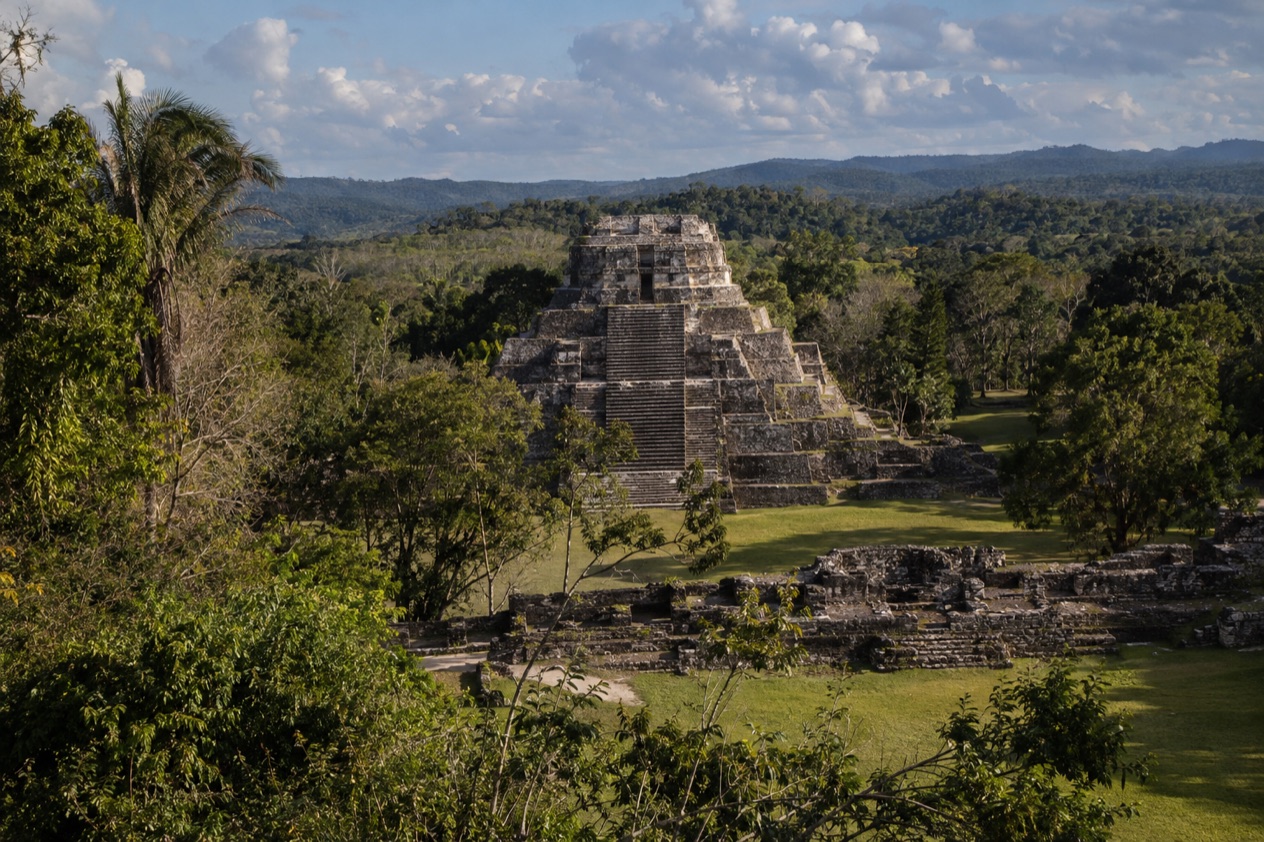
A hand-cranked ferry creaks across the Mopan River, and on the far bank a road climbs toward a pyramid that rises out of the trees. That small crossing is how many travelers meet the Maya past of Belize, a country where temples sit inside the jungle, beside a river, or on a hill above a town. The sites run from the Cayo District to the New River, the Toledo District and the shore of Corozal Bay.
Which Maya sites can you visit in Belize?
You can visit a long list of them, and the best known are Xunantunich, Caracol, Lamanai, Altun Ha, Cahal Pech and Lubaantun, with Nim Li Punit, Cerro Maya and El Pilar rounding out the map. Together they reflect a civilization far more advanced and densely settled than the quiet forest suggests, one that thrived in Belize well before 1000 AD. Each site has its own character, and a few days is enough to see how different they feel from one another.
Xunantunich and the river ferry
Xunantunich is the one with the ferry. The ride across the Mopan River on a hand-cranked platform is part of the visit, and it sets the mood before you see a single stone. The star is El Castillo, a pyramid that stands 130 feet tall and looks over the surrounding forest.
The site sits near the village of San Jose Succotz in the Cayo District. Listen for birds and howler monkeys in the trees around the plazas, and take your time on the grass between the buildings. It suits anyone who likes a site with a little story to the arrival.
Caracol and Cahal Pech above San Ignacio
Caracol is set in a lush jungle setting in the Cayo District, and its monuments carry inscriptions in Classic Ch’olti’an, the aristocratic language of the Lowland Maya. Reading about a language carved in stone makes the plazas feel less like ruins and more like a capital with its own voice.
Cahal Pech, whose name means The Place of Ticks, overlooks San Ignacio Town. Its interconnected structures show how Maya architecture changed over the centuries, so you can walk from older rooms to later ones in a single visit. Both are a good fit for travelers who like jungle atmosphere with a town close by.
Lamanai on the New River
Lamanai means Submerged Crocodile, and the site lies along the banks of the New River in the Orange Walk District. Alongside the monumental Maya architecture you find the remnants of two Spanish churches and a sugar mill, so the visit layers several centuries of history in one walk.
It is a site for people who enjoy seeing how one place kept being used long after the great temples were built. The river setting gives it a feel quite different from the hill sites of Cayo.
Altun Ha, Lubaantun and Nim Li Punit
Altun Ha was an ancient trading center and a major ceremonial center in the Classic Period. It is where the Jade Head was excavated, described as the largest carved jade in Mesoamerica and tied to the sun god Kinich Ahau. The carving came from a tomb, and it is the reason many people put this site on a list.
Lubaantun is known for limestone blocks laid without mortar, a detail you can see up close in its walls. Nim Li Punit, occupied in the Late Classic Period, is renowned for the Jade Wind Jewel and its elaborately carved stelae. Both lie in southern Belize and reward travelers who like to look closely at craftsmanship.
Where are they?
They spread across the country, with the largest cluster in the Cayo District around San Ignacio, and the rest in the north, the Belize District and the far south. Knowing which region each belongs to helps you group visits sensibly.
The Cayo District
Xunantunich stands near the village of San Jose Succotz, reached by the river ferry. Caracol and Cahal Pech both overlook San Ignacio Town, and Cahal Pech is only a short 10-minute walk from the town center, which makes it easy to fit around a day in town.
El Pilar lies about 12 miles northwest of San Ignacio Town and straddles the Belize-Guatemala border. It is a sprawling city with over 25 plazas, most of its structures left unexposed for conservation. A forest garden there offers a glimpse of traditional Maya agricultural practices, a quieter kind of attraction than a tall pyramid.
The north and the Belize District
Lamanai sits on the New River in the Orange Walk District. Altun Ha is in the Belize District, 31 miles from Belize City on the Old Northern Highway, so it is the one that sits closest to the country’s largest city.
On Corozal Bay, Cerro Maya lies at the southeastern end of the bay. It was part of a coastal trading network linking the New River to Chetumal Bay, and research suggests its architecture served as an astronomical observatory. Nearby history includes Cerros on Chetumal Bay, a trade and ceremonial center, and Cuello near Orange Walk, whose jars and bowls are among the oldest pottery unearthed in Mexico and Central America.
The Toledo District
Lubaantun is one mile from San Pedro Columbia Village. Nim Li Punit lies near the village of Indian Creek in the Toledo District. The two are the southern pair of the country’s big sites, set among villages rather than towns.
How do the sites compare?
They differ in setting more than anything: a pyramid above a river ferry, a temple complex on a jungle river, a hilltop above a town, stone walls without mortar. Opening hours are the same for most, and the table gives what the sites state.
For a first visit, Xunantunich and Caracol give the strongest sense of monumental architecture in a jungle setting. Lamanai adds a river and colonial remains, while Altun Ha brings the jade story. Lubaantun and Nim Li Punit are for travelers who want craftsmanship and carved stone, and El Pilar for those who prefer a quiet forest garden to a climb.
Every site follows the same code. Excavating or damaging monuments is prohibited, nothing may be removed (no plant, stone, earth or pottery), and loud noise such as shouting, singing or clapping is not allowed. Camping, hunting and feeding wildlife are prohibited as well.
Good to know before you go
The U.S. State Department rates Belize Level 2, “Exercise increased caution”, because of crime, and says the south side of Belize City has historically had the highest concentration of violent crime.
Tickets at the sites are priced by age category: minors, adults and Belizean Golden Citizens aged 65 and over, with separate Resident and Non-Resident types. The Atlantic hurricane season runs from June 1 to November 30, which covers the weeks around October, so keep an eye on the forecast when planning travel to these sites.
Sources
- NICH ticketing, Xunantunich (https://ticketing.nichbelize.org/product/xunantunich/), checked October 11, 2026
- NICH ticketing, Caracol (https://ticketing.nichbelize.org/product/caracol/), checked October 11, 2026
- NICH ticketing, Lamanai (https://ticketing.nichbelize.org/product/lamanai-mayan-temple/), checked October 11, 2026
- NICH ticketing, Altun Ha (https://ticketing.nichbelize.org/product/altun-ha/), checked October 11, 2026
- NICH ticketing, Cahal Pech (https://ticketing.nichbelize.org/product/cahal-pech/), checked October 11, 2026
- NICH ticketing, Lubaantun (https://ticketing.nichbelize.org/product/lubaantun/), checked October 11, 2026
- NICH ticketing, Nim Li Punit (https://ticketing.nichbelize.org/product/nim-li-punit/), checked October 11, 2026
- NICH ticketing, Code of conduct (https://ticketing.nichbelize.org/code-of-conduct/), checked October 11, 2026
- Wikipedia, History of Belize (https://en.wikipedia.org/wiki/History_of_Belize), checked October 11, 2026
- NICH ticketing, Cerro Maya (https://ticketing.nichbelize.org/product/cerro-maya/), checked October 11, 2026
- NICH ticketing, El Pilar (https://ticketing.nichbelize.org/product/el-pilar/), checked October 11, 2026
- U.S. Department of State, Belize Travel Advisory, Level 2, March 11, 2026 (https://travel.state.gov/), checked October 11, 2026
- NOAA National Hurricane Center, Climatology (https://www.nhc.noaa.gov/climo/), checked October 11, 2026