
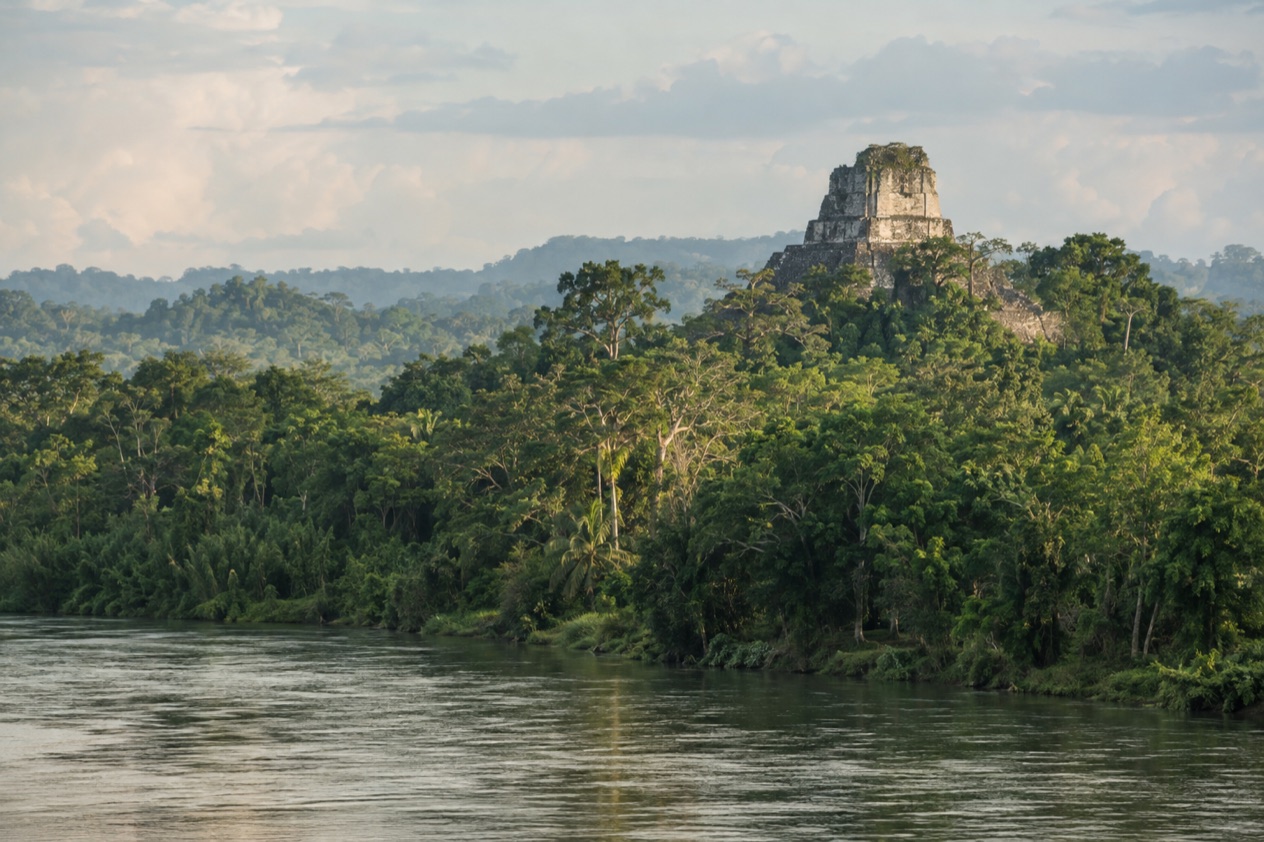
The boat slows along the banks of the New River, and somewhere in the trees a howler monkey starts up its roar. Then the jungle opens onto stone: temples rising out of the canopy, a lagoon glinting beyond them. Lamanai, in the Orange Walk District, is a Maya site you reach through the forest and the river, and the journey is part of the visit.
Is visiting Lamanai worth it?
Yes, for anyone who likes their ruins with a bit of adventure attached, and for travelers who want wildlife and archaeology in the same outing. Lamanai means ‘Submerged Crocodile’, a name that points to the crocodiles living along the banks of the New River, and the site sits right at that water’s edge.
What separates Lamanai from other Maya sites in Belize is the approach and the setting. Many visitors travel up the river by boat through mangroves and swamp savannah, where you may spot monkeys, birds, bats, turtles and crocodiles before a single temple appears. At the site itself, many of the temples are uncovered, and many of the hills around you are temples that have not yet been excavated, so the forest feels like it is hiding as much as it shows.
There is also a story in the finds. More copper artifacts have been recovered at Lamanai than at any other site in the ancient Maya world, with a total of 187 excavated. And the ruins are not only Maya: the remains of two Spanish churches and a sugar mill sit among the monumental architecture, layers of history in one forest clearing.
What to see at Lamanai
The High Temple
The High Temple is the structure that gives the site its skyline. From its summit, the view runs across the surrounding jungle to a nearby lagoon, part of the New River. It is the spot where the scale of the forest sinks in, a green carpet broken only by the tops of other buildings and the shine of the water.
Look at how the temple stands apart from the trees around it, and at the other mounds that surround it, still wrapped in vegetation. Visitors must stay on the demarcated trails and use handrails where they are provided, and jumping on monuments is not permitted.
The Mask Temple
The Mask Temple is named for its decoration: a 13-foot stone mask of an ancient Maya king, carved with a broad face and elaborate headdress. It is one of the most photographed images at Lamanai, and standing in front of it gives you a sense of how the Maya used sculpture to announce who held power.
Take a moment to look at the details of the carving rather than just the overall shape. The mask is the kind of thing a guide can talk about for a while, from the symbols to the meaning of kingship in the Maya world.
El Castillo and the jungle paths
On the river tour from San Pedro, you explore the Maya monuments and can climb the El Castillo Temple for a view of the lagoon. Between the buildings, you walk through dense jungle and learn about Belizean bush medicine, the plants that local people have long used for healing.
The forest is lively as you stroll. You might hear howler monkeys and see toucans. The walking paths are fairly smooth but rough enough to pose a problem for anyone using a walker, wheelchair or scooter.
The museum and the colonial ruins
A small museum shows local artifacts and gives a historical overview of the site, a good place to put the temples in order before or after you walk them. Tourist facilities and small shops are available too.
The remnants of the two Spanish churches and the sugar mill tell the later chapters of the story, after the great Maya buildings. Seeing them in the same forest as the temples is a reminder that Lamanai was a place people kept coming back to.
Hours, tickets and rules
Lamanai is open every day, including Sundays and public and bank holidays, from morning to late afternoon. The last tour goes one hour before closing. Tickets come in two types, Resident and Non-Resident, with age categories that include Minor, Adult and Belizean Golden Citizen (65+).
| Site | Open | Admission |
|---|---|---|
| Lamanai | Every day, 8:00 am to 5:00 pm, including Sundays and public and bank holidays. Last tour one hour before closing. | Resident and Non-Resident ticket types, with Minor, Adult and Belizean Golden Citizen (65+) categories |
At the site, wear outdoor-appropriate footwear for rugged terrain. Stay on the demarcated trails and use handrails where they are provided. No loud noise, shouting or music is permitted, and jumping on monuments is not allowed. A maximum of 15 visitors per tour guide is allowed.
The rules for all of Belize’s archaeological reserves apply here as well. It is prohibited to damage or deface monuments, enter active excavations, remove any plant, stone, earth or pottery, camp, hunt or feed wildlife, smoke or start a fire, or consume alcohol. Pets must be kept on a leash, garbage must be carried out, and coolers must stay at the parking lot and designated picnic areas.
How to get to Lamanai
There are two ways in: up the river or along a dirt road. Organized day boat trips run from Orange Walk Town along the New River, and visitors travel up the river for a 26-mile scenic boat ride through dense jungle. Along the way you can see exotic birds, Morelet’s crocodiles and howler monkeys.
By road, Lamanai can be reached by dirt and gravel road through the Mennonite area of Shipyard in Orange Walk District. On the way, you pass many Mennonite villages, and at the site, young Mennonite children greet visitors selling peanuts and homemade cookies.
The Lamanai River Experience from San Pedro
From San Pedro, the Lamanai River Experience begins with a 20-minute flight to Tower Hill in Orange Walk. After landing, a 10-minute ride through sugar cane fields brings you to the banks of the New River, where the boat takes you through mangroves and swamp savannah to the New River Lagoon and the Maya site.
The full-day tour departs from San Pedro at 8am and returns at 2pm. It includes a visit to the museum, a Belizean lunch and a gift shop, and afterward you board the boat to return to San Pedro.
From a cruise ship
Cruise ship passengers arriving in Belize City can arrange tours to Lamanai. The tour is approximately 6-7 hours, and because port times can be limiting, it should be prearranged online.
When to visit Lamanai
Lamanai is open every day from 8:00 am to 5:00 pm, so the question is less about which day than which hour. Arriving when the gates open puts you among the temples at the start of the day, and the last tour leaves one hour before closing, so a late arrival leaves little room.
On the full-day tour from San Pedro, the group leaves at 8am and heads back at 2pm, which gives you a feel for how a day here is shaped by the boat. The river trip itself is part of the pleasure, with wildlife along the banks in the mangroves and the swamp savannah.
The Atlantic hurricane season runs from June 1 to November 30, so a visit between those dates falls inside it, and a visit in the rest of the year falls outside the official season. Because the site is reached by river or by dirt and gravel road, it is sensible to keep that in mind when choosing your dates.
There is no festival or equinox date attached to Lamanai in what we know, so the choice of month rests on your own travel plans. Any day the site is open is a day you can walk among the temples, hear the howler monkeys and look out over the lagoon from the top of a temple.
Tips for your visit
For the river tour, the recommended items are comfortable clothing, a hat, a spare set of dry clothes, repellent, sturdy walking shoes and a camera. The shoes matter: the terrain is rugged, and outdoor-appropriate footwear is expected at the site.
Plan the day around the boat ride as much as the ruins. The trip up the New River is a highlight in itself, with birds, crocodiles and monkeys along the way, so keep the camera handy before you reach the temples.
Families and mobility
Tickets have separate Minor categories, so children are counted differently from adults. The walking paths in the ruin complex are fairly smooth but rough enough to pose a problem for those using walkers, wheelchairs or scooters, which is worth knowing before you plan the day.
If you bring a guide, a maximum of 15 visitors per tour guide is allowed. At the site, handrails are provided in places, and visitors must use them where they are available.
Staying nearby and what to combine
Lamanai Outpost Lodge is the only place to stay in the Lamanai area, and it is expensive but luxurious with plenty of activities. Another ancient Maya site, Chau Hiix, lies 9.3 miles east of Lamanai and is accessible by waterway travel.
The small museum and the shops at the site are good places to pause. On the tour from San Pedro, a Belizean lunch is part of the day, so there is no need to plan your own meal.
Good to know before you go
The U.S. State Department rates Belize Level 2, “Exercise increased caution”, because of crime, and says the south side of Belize City has historically had the highest concentration of violent crime.
Small shops and tourist facilities are available at the site, and young Mennonite children sell peanuts and homemade cookies to visitors. At the reserve, selling or trading materials within the boundaries is prohibited, and littering is prohibited, so carry your garbage out with you. The Atlantic hurricane season runs from June 1 to November 30.
Sources
- NICH ticketing, Lamanai (https://ticketing.nichbelize.org/product/lamanai-mayan-temple/), checked October 11, 2026
- Wikipedia, Lamanai (https://en.wikipedia.org/wiki/Lamanai), checked October 11, 2026
- Wikivoyage, Lamanai (https://en.wikivoyage.org/wiki/Lamanai), checked October 11, 2026
- Tropic Air, Lamanai River Experience (https://www.tropicair.com/tropic-air-tours/lamanai-river-experience/), checked October 11, 2026
- NICH ticketing, Code of conduct (https://ticketing.nichbelize.org/code-of-conduct/), checked October 11, 2026
- U.S. Department of State, Belize Travel Advisory, Level 2, March 11, 2026 (https://travel.state.gov/), checked October 11, 2026
- NOAA National Hurricane Center, Climatology (https://www.nhc.noaa.gov/climo/), checked October 11, 2026