
Morning on a Belizean caye starts with the slap of a screen door, the smell of coffee and fry jacks, and a boat engine idling at the end of a wooden dock. A few hours inland, the same hour belongs to howler monkeys and mist lifting off the Macal River. Belize packs reef, village, jungle and Garifuna coast into a small country, so the real choice is the kind of place you wake up in, and that shapes everything else about the trip.
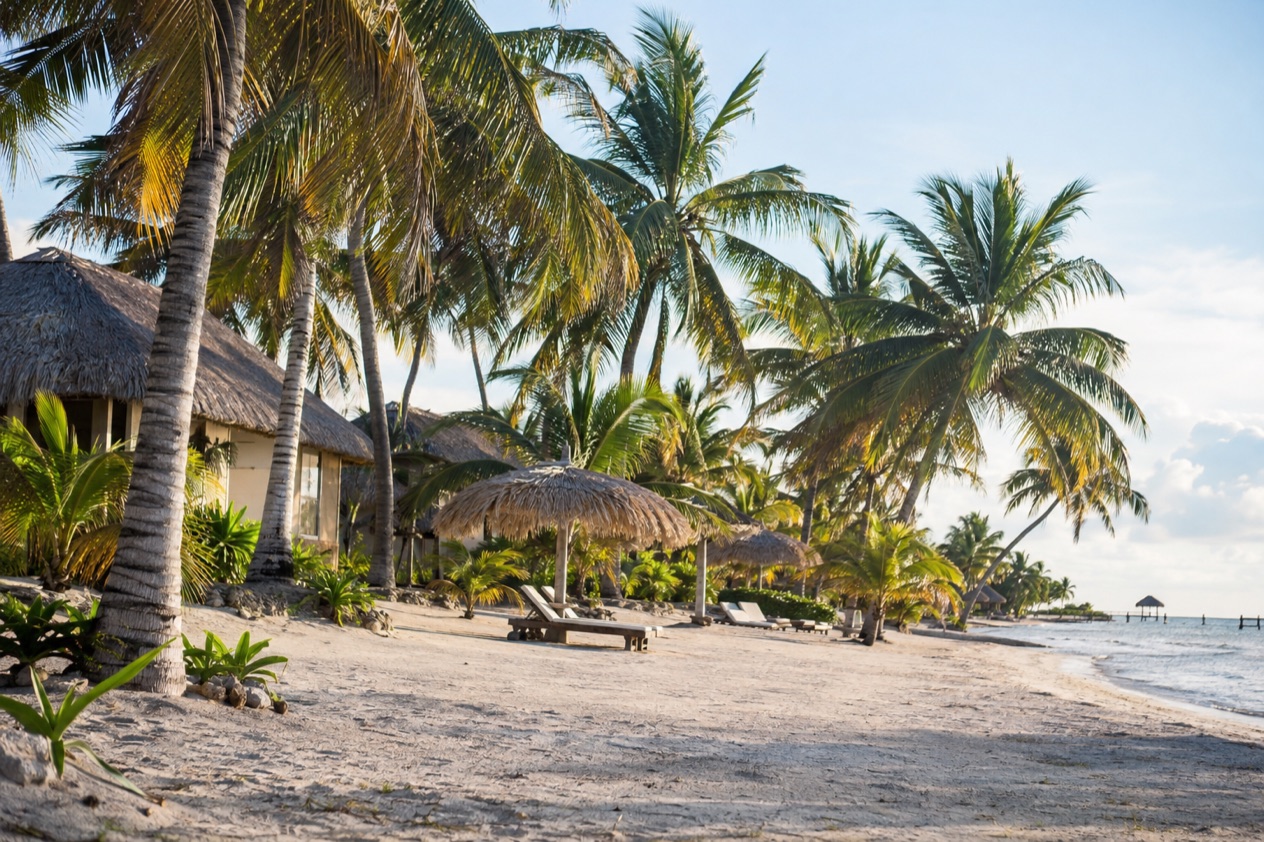
What is the best area to stay in Belize?
For a first visit that blends reef and village, Ambergris Caye and Caye Caulker are the usual starting points, while Placencia and Hopkins suit travelers who want a long beach and a village rhythm, and San Ignacio and the Cayo District suit anyone who came for the jungle and the Maya sites. Nightlife and the widest choice of restaurants gather around San Pedro.
Families and groups tend to look at places with villas or separate houses. Budget travelers will find the village-style stays on the smaller cayes and in the towns of the mainland more in keeping with their plans than the island resorts.
The areas differ in setting first. Ambergris Caye is the largest of about 200 cayes off the coast, a long, narrow island with a real town, San Pedro, on its southern part and resorts strung out to the north.
Caye Caulker is a small island with a village feel, sandy lanes and a reef close offshore. On the mainland coast, Placencia sits at the tip of a peninsula with a pedestrian Sidewalk through the village, and Hopkins is a Garifuna village facing the Caribbean with the Maya Mountains behind it.
Inland the mood changes completely. San Ignacio is a market town on the banks of the Macal River in western Belize, and the lodges around it sit among rainforest, river bends and, farther up, the pine-covered Mountain Pine Ridge.
The Belize Hotel Association describes its member resorts, hotels and lodges in four kinds of settings: beach, jungle, island and mountain. That list is a good way to think about the country, because each setting brings its own mornings, its own sounds and its own way of spending a day.
Other bases exist for specific plans. Belize City, the largest country’s city and a port at the mouth of Haulover Creek, is where many journeys begin and where the water to the cayes starts. Belmopan, the capital, was built after Hurricane Hattie damaged Belize City in 1961 and sits nearer the center of the country.
Dangriga is the capital of the Stann Creek District and a Garifuna cultural hub on the coast, and Corozal Town lies on the Caribbean in the far north, close to the Mexican border. These are towns that serve a purpose, a stop on the way or a window on daily life, while the areas below are where most people put their bags down for several nights.
A good way to decide is to picture your best day. If it ends with a rum punch on a dock and a walk to dinner in town, look at the cayes. If it ends with a drum circle, a plate of fish with coconut rice and a long stretch of sand, look south.
If it ends with a river dip after a morning among ruins, look west. Many travelers split a trip between two settings, a few nights in the jungle and a few by the sea, and Belize’s size makes that natural.
The best areas to stay in Belize
Ambergris Caye and San Pedro
Ambergris Caye is about 25 miles long and a mile wide, and the character of your stay depends on where you land along that strip. San Pedro, on the southern part of the island, is the town: restaurants, bars, shops, dive operators and streets busy with golf carts and bicycles.
Resorts face the Caribbean on the east side of the island, looking out toward the reef. Farther north, the properties spread out and the mood turns more secluded, with thatched casitas and villas, including an adults-only resort with plunge pools on private terraces.
The lodging here runs from resorts and boutique hotels to villas and apartments, and the island suits couples, divers and snorkelers heading to Hol Chan and Shark Ray Alley, and groups who want a villa. Some of the villas on the north end are described as a fit for adult families or small groups. A private-island resort with seafront villas and private pools sits off the coast of San Pedro, for those who want to be set apart from the town altogether.
A tip: decide whether you want to walk to dinner or to disappear. Staying in or near town puts you among the evening crowd, while the northern resorts are for people who plan to eat and spend most of their time on the property.
Caye Caulker
Caye Caulker is a small island about 20 miles north-northeast of Belize City, roughly five miles in length, with the Barrier Reef a mile offshore. The village has sandy streets, brightly painted wooden houses, seafood grills and beach bars, and its unofficial motto, Go Slow, is taken seriously. Travelers come for the relaxed pace, the reef excursions and the evening scene of lobster on the grill and music drifting from open-air bars.
Lodging is mostly small: guesthouses, small hotels and apartments, which makes it a natural fit for budget travelers, backpackers and anyone who prefers a village to a resort. The island suits visitors who like to be among local life, chatting with the owner on the porch and walking everywhere. A tip: pick a spot near the center of the village if you want to step out the door into the cafés and bars, and look farther along the shore if you want to hear mostly the wind in the palms.
Placencia
Placencia is a small village at the southern tip of a long peninsula in the Stann Creek District, with a white-sand beach on the Caribbean on one side. Its signature feature is the Sidewalk, a concrete pedestrian-only path that runs most of the length of the village and ends at the shore, lined with restaurants, shops and small businesses. Evenings here mean strolling the Sidewalk for dinner, with no traffic to dodge.
Lodging stretches along the peninsula: beachfront resorts and residences, guesthouses in the village and, at the end of the peninsula, a collection of thatched dwellings set directly on the sand and open to the air. One resort sits along the Placencia Road, and another beachfront property has 28 such dwellings furnished with hand-carved wood. It suits couples, families who want a beach and a village together, and anyone who prefers to base on the mainland and take boat trips from there.
A tip: choose between the village, where you can leave the car-free Sidewalk right outside your door, and the beachfront resorts a little way along the peninsula, where the setting is the main attraction.
Hopkins
Hopkins is a Garifuna village on the Caribbean coast, home to a population that was largely Garifuna at the 2010 census. Here the culture is part of the stay: drumming in the evening, cassava bread and hudut, the fish and plantain dish, served in small family-run restaurants. The beach runs along the village, and beachfront properties sit to the south, with the Maya Mountains behind.
One adventure and dive resort south of the village occupies 45 acres of beachfront with a private nature preserve, set between the mountains and the sea. Smaller guesthouses and cabanas are found in the village itself. Hopkins suits travelers who want a coastal base with culture and nature close at hand, and who are happy to spend evenings in a village rather than a resort town.
A tip: staying in the village puts you within reach of the drum evenings and the small restaurants, while the larger properties to the south offer a self-contained stay with the preserve on the doorstep.
San Ignacio and the Cayo District
San Ignacio sits on the banks of the Macal River in western Belize, about 63 miles west of Belize City, and with its twin town of Santa Elena it forms a community of more than 21,000 people. It is a market town, with a lively market and a main street of restaurants and shops, and it is the gateway to the Cayo District’s ruins, caves, rivers and forest. One resort sits at the doorstep of the Maya site of Xunantunich.
Jungle lodges line the river and the hills. One was founded on the Macal River in 1981 as one of Belize’s first eco-resorts, with accommodations from rustic to luxury villas with private Jacuzzis and plunge pools. Higher up, a 20-room lodge in the Mountain Pine Ridge Reserve opened to the public in 1993. Cayo suits nature lovers, couples and anyone who wants evenings among trees and river sounds rather than the sea.
A tip: choose between a stay in town, with restaurants on the doorstep, and a lodge out in the forest, where the setting is the experience and meals are likely taken on the property.
Belize areas compared
| Area | Suits | Feel | Setting |
|---|---|---|---|
| Ambergris Caye and San Pedro | Couples, divers, snorkelers, groups | A real town with restaurants and bars, resorts spread north along the island | The largest of about 200 cayes, facing the Caribbean on its east side |
| Caye Caulker | Budget travelers, village lovers | Small, sandy-lane village with beach bars and seafood grills | A small island with the Barrier Reef a mile offshore |
| Placencia | Couples, families, beach lovers | A village with a pedestrian Sidewalk and a white-sand beach | The southern tip of a peninsula in the Stann Creek District |
| Hopkins | Culture and nature seekers | A Garifuna village with drumming and family restaurants | On the Caribbean coast, with the Maya Mountains behind |
| San Ignacio and Cayo | Jungle, ruins and river lovers | A market town with forest lodges around it | On the banks of the Macal River in western Belize |
The main trade-off is beach against local life. The mainland villages of Placencia and Hopkins give you a beach and a daily life that goes on whether or not visitors are there, with Garifuna culture especially present in Hopkins.
Quiet against nightlife is the second choice. San Pedro has the busiest evening scene in this set, while a resort on the northern end of Ambergris or on a private island is built around privacy. Caye Caulker has bars, but they go with the village pace. Cayo is for early nights and river mornings, although San Ignacio has restaurants and bars of its own.
A third trade-off is the sea against the forest. Splitting a trip is easy to imagine: a few nights in Cayo among the ruins and caves, then a few on the coast or a caye to finish with the water. The two settings feel like different countries, and together they give a fuller picture of Belize than either does alone.
How to choose your hotel in Belize
Start with the setting you want, because the Belize Hotel Association groups its member resorts, hotels and lodges by beach, jungle, island and mountain. A beach setting means mornings on the sand, an island setting means boats, and a mountain or jungle setting means trails, river sounds and early starts. That choice matters more than the star rating or the room style, since it decides what you will see from your terrace.
Next, think about how much of the stay you want to spend on the property. Some places are built to be a destination, such as a private island resort that takes only 30 guests at a time, with overwater bungalows looking onto the Caribbean.
Others are a base for the day, like a village guesthouse where you eat out and spend your time elsewhere. Check what each property lists as included and what is on site, and match that to how you like to travel. Some resorts offer tours of their own, and others expect you to arrange outings.
The room type shapes the stay as well. Casitas with thatched roofs, villas with private pools, dwellings open to the air on the sand, rustic cabins and luxury rainforest villas are all found in Belize.
Open-air design is part of the appeal on the coast, and it brings the sounds of the place into the room, including wind, waves and wildlife. If you are sensitive to noise, ask where the property sits relative to bars, docks and roads.
Beachfront or not is a real decision. On Ambergris Caye, the east side faces the Caribbean and the reef, and a property there looks out on the open sea. Properties off the water, in town or on the other side of the road, can be a different experience. Before booking, find out which way the property faces and whether it sits directly on the sand, because that shapes what you see and hear.
Families and groups should look at what each property offers in space. Villas suit adult families or small groups, and some resorts are adults-only, so if you are traveling with children confirm that the property welcomes them.
For travelers who need step-free access or have other accessibility needs, ask the property directly, since details differ from one place to the next. Some places have many steps and open-air paths, which is part of their setting.
Timing matters for the coast. The Atlantic hurricane season runs from June 1 to November 30, which is worth weighing when you plan a stay on a caye or the coast. For cayes, remember that you arrive by water or air, so think about how you will connect from the mainland, and ask the property how its transfers work.
One last check is licensing. Every hotel in Belize must display its Hotel Registration and Accommodation License in a conspicuous place, preferably at the reception counter.
It is a small detail, but it tells you that the property is registered with the Belize Tourism Board. The Belize Hotel Association also publishes an official accommodation guide of its members, which is a place to begin if you want to compare resorts, hotels and lodges across the country.
Good to know before you go
The U.S. State Department rates Belize Level 2, “Exercise increased caution”, because of crime, and says the south side of Belize City has historically had the highest concentration of violent crime.
Many trips begin in Belize City, the largest city in the country, where the road west leads to San Ignacio and the water leads out to the cayes. Once you have picked your area, ask your hotel how its own transfers work, since that depends on where it sits.
Sources
- Belize Tourism Board, Hotels (https://www.belizetourismboard.org/hotels/), checked October 11, 2026
- Belize Hotel Association (https://www.belizehotels.org/), checked October 11, 2026
- Hamanasi Adventure and Dive Resort, the resort (https://www.hamanasi.com/belize-resort/), checked October 11, 2026
- Matachica Resort and Spa, home (https://www.matachica.com/), checked October 11, 2026
- Victoria House Resort and Spa, the resort (https://www.victoria-house.com/victoria-house/), checked October 11, 2026
- Thatch Caye Resort, about (https://www.thatchcaye.com/about-thatch-caye), checked October 11, 2026
- Chaa Creek, about (https://chaacreek.com/about-chaa-creek/), checked October 11, 2026
- Itz'ana Belize Resort and Residences, home (https://www.itzanabelize.com/), checked October 11, 2026
- Ka'ana Resort, home (https://www.kaanabelize.com/), checked October 11, 2026
- The Coppola Hideaways, Turtle Inn (https://thecoppolahideaways.com/resort/turtle-inn), checked October 11, 2026
- The Coppola Hideaways, Blancaneaux Lodge (https://thecoppolahideaways.com/resort/blancaneaux-lodge), checked October 11, 2026
- Cayo Espanto Private Island, home (https://aprivateisland.com/), checked October 11, 2026
- Wikipedia, Ambergris Caye (https://en.wikipedia.org/wiki/Ambergris_Caye), checked October 11, 2026
- Wikipedia, San Pedro Town (https://en.wikipedia.org/wiki/San_Pedro_Town), checked October 11, 2026
- Wikipedia, Caye Caulker (https://en.wikipedia.org/wiki/Caye_Caulker), checked October 11, 2026
- Wikivoyage, Caye Caulker (https://en.wikivoyage.org/wiki/Caye_Caulker), checked October 11, 2026
- Wikipedia, Belize City (https://en.wikipedia.org/wiki/Belize_City), checked October 11, 2026
- Wikivoyage, Belize City (https://en.wikivoyage.org/wiki/Belize_City), checked October 11, 2026
- Wikipedia, Placencia (https://en.wikipedia.org/wiki/Placencia), checked October 11, 2026
- Wikivoyage, Placencia (https://en.wikivoyage.org/wiki/Placencia), checked October 11, 2026
- Wikipedia, San Ignacio, Belize (https://en.wikipedia.org/wiki/San_Ignacio,_Belize), checked October 11, 2026
- Wikivoyage, San Ignacio (Belize) (https://en.wikivoyage.org/wiki/San_Ignacio_(Belize)), checked October 11, 2026
- Wikipedia, Hopkins, Belize (https://en.wikipedia.org/wiki/Hopkins,_Belize), checked October 11, 2026
- Wikipedia, Dangriga (https://en.wikipedia.org/wiki/Dangriga), checked October 11, 2026
- Wikipedia, Belmopan (https://en.wikipedia.org/wiki/Belmopan), checked October 11, 2026
- Wikivoyage, Belmopan (https://en.wikivoyage.org/wiki/Belmopan), checked October 11, 2026
- Wikipedia, Corozal Town (https://en.wikipedia.org/wiki/Corozal_Town), checked October 11, 2026
- Wikivoyage, Corozal (https://en.wikivoyage.org/wiki/Corozal), checked October 11, 2026
- U.S. Department of State, Belize Travel Information, Travel Advisory (Level 2) (https://travel.state.gov/), checked October 11, 2026
- U.S. Department of State, Belize Travel Advisory, Level 2, March 11, 2026 (https://travel.state.gov/), checked October 11, 2026
- NOAA National Hurricane Center, Climatology (https://www.nhc.noaa.gov/climo/), checked October 11, 2026