
The trail to the ATM Cave winds through the forest of Tapir Mountain Nature Reserve, and by the time the trees open onto the cave mouth your shoes are already wet from the river crossings. Inside, headlamps pick out glittering limestone walls, broken Maya pots and, deeper in, human skeletons lying where they were left centuries ago. Actun Tunichil Muknal, near San Ignacio in the Cayo District, is a guided, muddy, physical visit to a sacred Maya place, and it rewards travelers who like their history untouched.
Is visiting the ATM Cave worth it?
Yes, if you are fit and curious enough to spend a day getting wet and muddy for one of the most intimate encounters with the ancient Maya anywhere in Central America. National Geographic placed Actun Tunichil Muknal first on its list of Top 10 Sacred Caves, and the reason becomes clear once you are standing among the offerings. The cave has been open to the public only since the late 1990s, so it still feels like a place being discovered rather than a stop on a well-worn circuit.
What sets it apart from its neighbors is that nothing has been moved behind glass. The temples of the Cayo District, such as Xunantunich and Cahal Pech, are open-air monuments you walk around in daylight. Here the ceramics, stoneware and bones remain in the dark chambers where Maya priests left them, and you see them by the beam of your own headlamp. Two other caves in the region, Barton Creek and Nohoch Ch’een, also require a guide, but the ATM is the one known for human remains and for the way the visit unfolds: a jungle hike, a river entrance and a slow climb into a dry upper chamber.
It is not a casual outing. The tour from Chaa Creek is described as requiring a good to very good fitness level, children must meet a height requirement, and no cameras are allowed without a permit. If you want souvenir photographs of every skeleton, this is not the cave for you. If you want to listen to a licensed naturalist guide explain why the Maya treated caves as doorways to the underworld, and to come out into the daylight feeling you have seen something few people ever do, it is one of the finest days in Belize.
What to see at the ATM Cave
The jungle trail and the river crossings
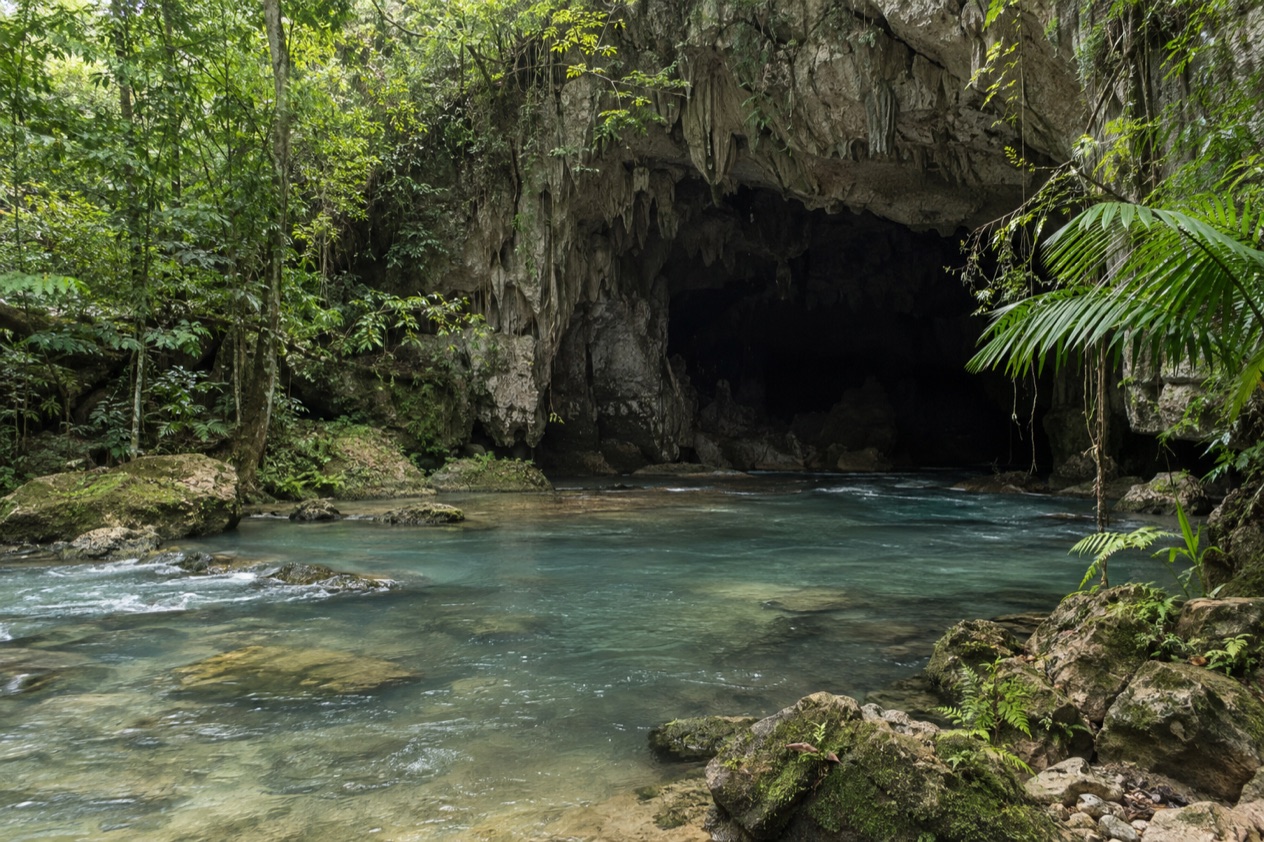
The visit begins before the cave itself, on a 45-minute walk along a jungle trail that crosses three rivers. The forest here is thick and green, with the sounds of birds and insects overhead, and your guide may stop to point out trees, plants or tracks along the way. You get wet early, which is why the right footwear matters, and why the walk feels like a proper approach rather than a stroll from a parking lot.
The trail ends at the cave mouth, where the river flows out of the hillside. This entrance is dramatic in a quiet way: a dark opening, moving water and the knowledge that the Maya came here on purpose. Your guide gives a briefing before you go in, and from this point the headlamp becomes your only light.
The river passage
The main cave system runs about 3 miles, and its long river passage stretches for approximately 2 miles before it ends at an upstream sump. Visitors see only a portion of that, moving up the water channel between walls of pale, sculpted limestone. Formations of stalactites and flowstone catch the light, and the cave smells of damp stone and mineral water.
Along the way you begin to notice pottery shards and stoneware set in alcoves and on ledges. These were not dropped by accident. The Maya brought vessels into the cave for rituals tied to water, rain and the underworld, and in many cases the pots were deliberately broken, a gesture believed to release their spirit. Look at the way the pieces lie, and your guide will explain what you are seeing.
The upper dry chamber
At the end of the river section, you leave the water and climb into the upper passage, a large dry chamber where the most important remains lie. This is where the shoe rule applies: visitors are told to remove their shoes and wear socks to minimize foot traffic on the floor. Walking in socks over the stone, among ancient pottery, makes the care that this place demands very tangible.
Numerous examples of Maya pottery remain here, left in position. One artifact, known as the Monkey Pot, is one of just four of its type found in Central America. Your guide will lead you past the vessels slowly and explain what researchers think they were used for, so the chamber reads less like a museum and more like an altar room that has simply been left alone.
The skeletons and the Crystal Maiden
In the upper passage, 14 skeletal remains have been found. The best known is a skeleton nicknamed the Crystal Maiden, whose bones have been coated with calcite and glitter in the lamplight. Many researchers read these remains as evidence of Maya ritual offerings made in the cave, and the sight is sobering. The bones lie on the cave floor in positions that show how little has been disturbed.
The caution around the site comes from experience. All cameras without a permit are banned after a tourist accidentally dropped a camera and fractured a human skull in late May 2012. That is why you carry only what the guide allows, and why the visit is unhurried and quiet. You leave with images in memory rather than on a memory card.
Hours, tickets and rules
The ATM Cave can be visited only on a guided tour with a licensed operator, and the tickets are sold in advance rather than at the cave. Discounted prices for Belizean students, senior citizens and local residents on holidays do not apply to any cave site.
| Site | Open | Admission |
|---|---|---|
| ATM Cave tour from Chaa Creek | Starts at 7:00 am and lasts all day | Entrance fee $30 USD per person. Tour $164 USD per person for two or more people |
The rules are strict because the cave is a fragile archaeological site. Cameras are banned without a permit. Visitors remove their shoes and wear socks in the upper dry chamber. At all Belize archaeological reserves, visitors may not remove any plant, stone, earth or pottery, and may not damage, deface or interfere with monuments.
Shouting, screaming, whistling, singing and clapping are prohibited, as are alcohol, illegal substances, smoking and fires. Camping, hunting and feeding wildlife are not allowed, coolers must stay at the parking lot and designated picnic areas, and all garbage must be taken out. Children must be supervised by an adult at all times and must meet the 40 inch height requirement.
How to get to the ATM Cave
The cave lies inside Tapir Mountain Nature Reserve, near San Ignacio in the Cayo District, and you reach it as part of a guided tour rather than on your own. All visits must be booked in advance with a licensed tour operator, and the Belize Tourism Board, working with the National Institute of Culture and History, has granted licenses to a small group of agents to run tours here. A group visit follows the same rule.
From Chaa Creek, a lodge in the Cayo District, the cave is a one and a half hour drive. The Chaa Creek tour is all-day and starts at 7:00 am, with licensed naturalist guides accompanying visitors throughout. That departure time belongs to this lodge’s tour, and other operators set their own arrangements when you book with them.
Entrance tickets for the ATM Cave must be purchased in advance in order to manage visitor capacity, either through the Cahal Pech Archaeological Reserve Ticket Office or through the e-ticketing website. The drive ends at the trailhead, and from there the only way forward is on foot along the jungle trail, with the river crossings that lead to the cave mouth.
When to visit the ATM Cave
The tour from Chaa Creek leaves at the start of the day, and that early departure shapes the whole experience: you walk the jungle trail, enter the cave and spend the main part of the day in the dark, then return to the lodge.
Rain is the main thing that decides a date. Actun Tunichil Muknal periodically closes when rainfall causes the river’s water level to rise and potentially flood parts of the cave.
That is why a day of heavy rain, or the days after one, can mean the cave is closed, and why it helps to keep a spare day in your Cayo itinerary. If a closure caused by inclement weather occurs, the National Institute of Culture and History will consider an exchange of the ticket for another date or site.
The Atlantic hurricane season runs from June 1 to November 30, and in those months a tropical system can bring days of heavy rain to the region. Outside that window the river is less likely to be a concern, though rainfall can come in any month and the cave answers to the river each time.
What changes is the water, the light on the forest trail and the sound of the rivers as you cross them.
Tips for your visit
Bring secure closed-toe water shoes or lightweight hiking shoes with excellent grip, since you will cross rivers on the trail and move over wet rock in the cave. Chaa Creek provides headlamps and the necessary equipment for its tour, so you do not need to carry your own gear.
You will also need socks for the upper dry chamber, because shoes come off there. Because cameras are banned without a permit, leave yours at the lodge or in the vehicle.
The Chaa Creek tour lasts all day, and the cave visit is the center of it, so do not schedule other excursions around it. Because the tour demands a good to very good fitness level, travelers with mobility limitations or recent injuries should think carefully before booking. Licensed naturalist guides accompany everyone throughout, and their explanations are a large part of what makes the visit worthwhile.
Families should note that children must be supervised by an adult at all times and must meet the height requirement to enter. After a day underground, the logical pairing is the Maya architecture of the Cayo District, such as Cahal Pech near San Ignacio, whose ticket office also sells ATM Cave tickets. Dry clothes, a towel and a bag for wet shoes make the ride back more comfortable, and a refillable water bottle is useful on the jungle trail.
Good to know before you go
The U.S. State Department rates Belize Level 2, “Exercise increased caution”, because of crime, and says the south side of Belize City has historically had the highest concentration of violent crime.
The Chaa Creek prices are quoted in US dollars, while the National Institute of Culture and History states its prices in Belize dollars, so confirm which currency your operator is using when you book. The cave is a protected archaeological site, and the rules on collecting, noise and litter apply to every visitor from the trailhead onward.
Guides who lead tours must hold a valid license, which expires every year, so choose an operator that holds one. Everything you carry in has to come out with you, and the best way to honor the place is to leave the pottery and the bones exactly where they are.
Sources
- Wikipedia, Actun Tunichil Muknal (https://en.wikipedia.org/wiki/Actun_Tunichil_Muknal), checked October 11, 2026
- Chaa Creek, ATM cave tour (https://chaacreek.com/tour/actun-tunichil-muknal/), checked October 11, 2026
- Belize Tourism Board, Tour guide licensing (https://www.belizetourismboard.org/tour-guide/), checked October 11, 2026
- NICH ticketing, Code of conduct (https://ticketing.nichbelize.org/code-of-conduct/), checked October 11, 2026
- NICH ticketing, Policies and terms (https://ticketing.nichbelize.org/policies-terms-conditions/), checked October 11, 2026
- U.S. Department of State, Belize Travel Advisory, Level 2, March 11, 2026 (https://travel.state.gov/), checked October 11, 2026
- NOAA National Hurricane Center, Climatology (https://www.nhc.noaa.gov/climo/), checked October 11, 2026