
THE ALENTEJO · THINGS TO DO · BY ACTIVITY
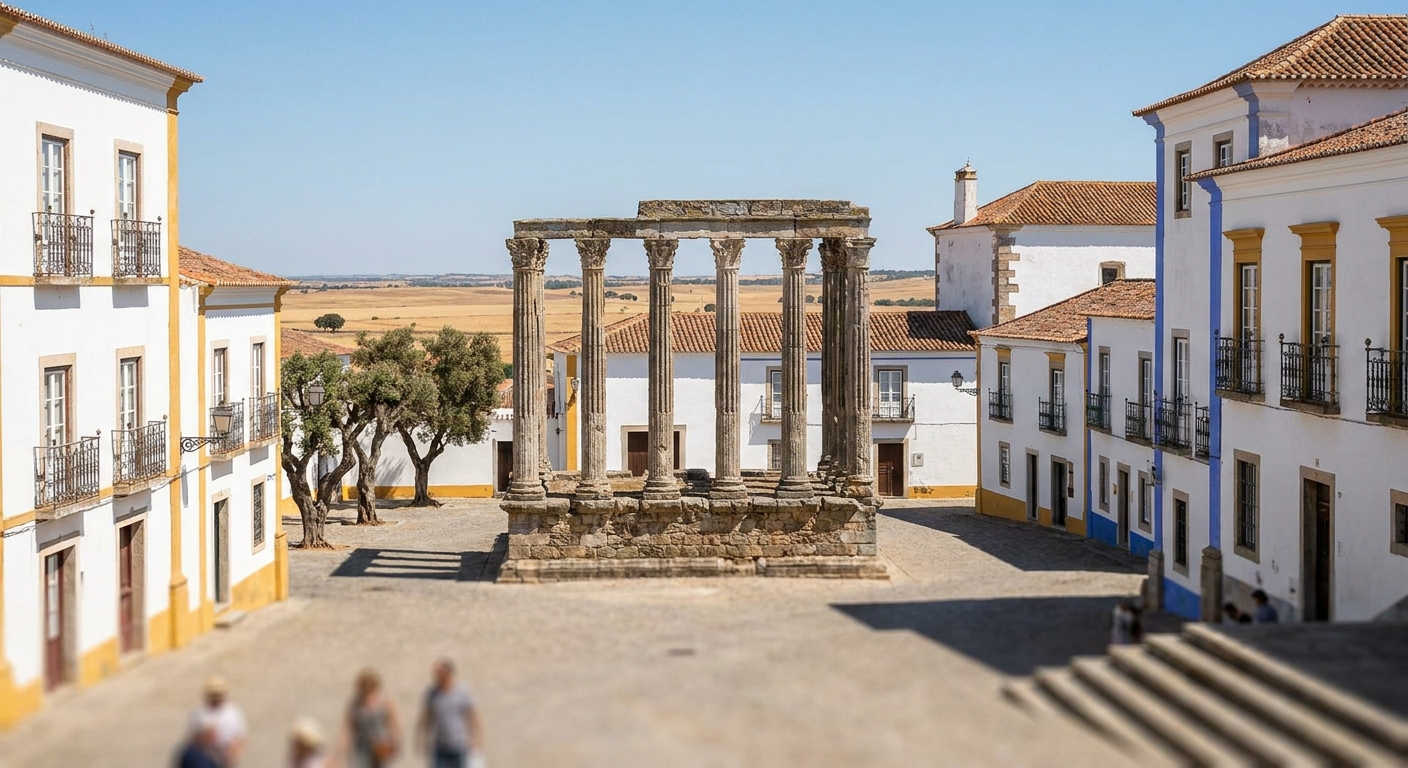
The Alentejo hands out a short list of set pieces with a lot of road between them. Inside Évora’s walls stand a Roman temple, a cathedral you climb and a chapel lined with human bones. West of town, granite stones sit in a cork oak grove at the end of a dirt track. East, a dammed river spreads into a lake under a certified dark sky. The rest is a white town on a ridge, a cellar on a farm, and lunch that takes two hours.
One practical split runs through the whole week. Évora is on the railway from Lisbon and is walked once you arrive. The stones, the lake, the villages and the wine estates sit off any timetable worth planning around, so reaching them means a rental car. Tolls and the rule about reserving an automatic are explained in renting a car in Portugal, and getting around Portugal maps what the trains and coaches genuinely cover.
THE ACTIVITY LIST IN BRIEF · ALENTEJO
Give Évora a day on foot, drive out to the Almendres stones in the morning, book one telescope night over Alqueva, and keep an afternoon free for a cellar and a long table.
ÉVORA BY TRAIN · EVERYTHING ELSE BY CAR · STARGAZING RESERVED AHEAD
Go for: the Roman temple columns before the coaches park, a telescope session under the Alqueva sky, and amphora wine poured beside a modern red from the same estate.
Think twice before: taking a low rental car up the Almendres track after rain, or booking a stargazing night without checking the Moon phase first.
Access arrangements, cellar bookings and museum hours move, so we link the owning guide and date every check · full list at the end
On this page
- Things to do in Évora in a dayRoman temple, cathedral roof, Capela dos Ossos
- Standing stones near ÉvoraCromeleque dos Almendres and the Zambujeiro dolmen
- Stargazing at AlquevaDark Sky Alqueva, the Cumeada observatory
- Which white hill towns to drive toMonsaraz, Marvão, Castelo de Vide, Estremoz, Mértola
- Alentejo wine and where to taste itReguengos, Borba, Vidigueira and vinho de talha
- Do you need a car in the Alentejo?Train to Évora, car for everything else
How the Alentejo’s sights split: Évora, the megalith fields west of it, the lake to the east
Évora is the hinge, and the only part of this list that works without a car. Trains from Lisbon reach the station below the walls, and the old town is small enough to cross on foot in a quarter of an hour. The temple, the cathedral and the bone chapel sit within a few streets of each other. Our Évora guide puts them in walking order and flags the midday coach hour. Rooms inside the walls give you the town early, before the day groups arrive.
West of town, the prehistory. The Cromeleque dos Almendres stands in a cork oak grove at the end of a dirt track. The Menir dos Almendres, a single stone, waits lower down on the way up. The Anta Grande do Zambujeiro is a burial chamber large enough to walk into, out among farmland. Escoural’s painted cave is supervised rather than open, and arranged before you go. All of it lies within a morning’s driving of Évora, and none of it is on a bus route.
East and south, the lake and the wine. The Guadiana was dammed at Alqueva and now gives the interior a shoreline, with Monsaraz walled on the ridge above it. Reguengos de Monsaraz, Borba, Vidigueira and Portalegre are the tasting country, and cork oak plain runs underneath the whole arrangement. The Atlantic cliffs of the Costa Alentejana behave like a separate trip on separate nights, and the regional guide handles where they fit.
The Alentejo’s main activities: Évora’s monuments, Almendres, Alqueva, the cellars, the table and the cork
1. Évora’s monuments, in one day on foot. The Corinthian columns of the Roman temple rise from a small square in the middle of a working town. The Sé cathedral opens its roof terraces over the tiles, and the Capela dos Ossos at the Igreja de São Francisco lines walls and pillars with bones. The Água de Prata aqueduct walks in from the countryside and vanishes into houses built between its arches. Praça do Giraldo stays busy on university terms. Ticketed interiors and the sequence to walk them belong to our Évora guide.
2. The Almendres cromlech and the Zambujeiro dolmen. A wide oval of weathered granite stands on an open slope among cork oaks, unfenced, with no ticket desk and often nobody else in sight. Signs and local guides describe the circle as older than Stonehenge. We are not printing a date here, because published estimates differ and we could not source one we trust. The approach matters more on the day: the last stretch is rutted dirt and a low rental car scrapes. A new circuit changed the arrangements, so confirm with Évora’s municipal tourism office before driving out.
3. The night sky over Alqueva. The reservoir country east of Évora holds a dark-sky certification, and the observatory at Cumeada, inside the Dark Sky Alqueva reserve, runs guided telescope sessions on reservation rather than on arrival. Cloud cancels them outright. The Moon sets the program: a moonless night gives the Milky Way, a bright one turns the evening toward craters. The plain sheds its heat quickly after sunset, so carry a layer even in August. Boats go out from Amieira, and the shore has freshwater beaches for a summer swim.
4. Alentejo reds, and the amphora wine. The sub-regions ring the plain: Reguengos, Borba, Vidigueira, Portalegre. A handful of producers still make vinho de talha, fermenting in clay amphorae by a method with Roman ancestry, and tasting it beside a modern red from the same estate is the reason to drive out. Most cellars are farms with a tasting room attached rather than visitor centers, so write or call ahead instead of turning up at the gate. Two or three estates fill an afternoon, and one person in the car has to skip the pouring.
5. The long lunch. Bread does the structural work in this kitchen: açorda thick with garlic and coriander, migas pressed alongside pork, sopa de cação with dogfish and vinegar. The meat everyone names is porco preto, black pig raised on acorns from the same oaks you drove past. Cheeses are sheep’s milk, Serpa and Nisa among them, and dessert arrives as sericaia with Elvas plums. Village kitchens keep fixed hours and shut in the afternoon. Dishes, regions and how a Portuguese menu is built fill our food and drink guide.
6. Cork oaks and the montado. The open oak pasture between the towns is a working farm system: trunks stripped high to a raw orange bark, pigs and sheep under the canopy, wheat sown in the gaps. Harvest falls in summer, and the stripped bark stacks in yards along the road. There is nothing to enter and nothing to book, so the driving is the visit, best on the minor roads between Évora, Montemor-o-Novo and Arraiolos. Arraiolos also sells the stitched wool rugs that carry its name.
Alentejo hill towns: Monsaraz, Marvão, Castelo de Vide, Estremoz and Mértola
Monsaraz sits walled on a ridge above the Alqueva water, cars left outside the gate, one main lane of whitewash and stone running the length of it. The castle yard at the far end was built out as a small bullring, and the wall walk hands you the reservoir from above. The village is tiny and the program after dinner is the sky. Sleeping there instead of driving off at dusk changes the visit completely.
Marvão is the far northeast: a granite crag near the Spanish border with a village folded inside its ramparts and a view running into Extremadura on a clear day. Castelo de Vide, on the slope below, keeps a medieval Jewish quarter and a synagogue site under its castle. The two make one loop on slow, narrow roads. This corner sits a long way from Évora, so give it a night rather than a detour.
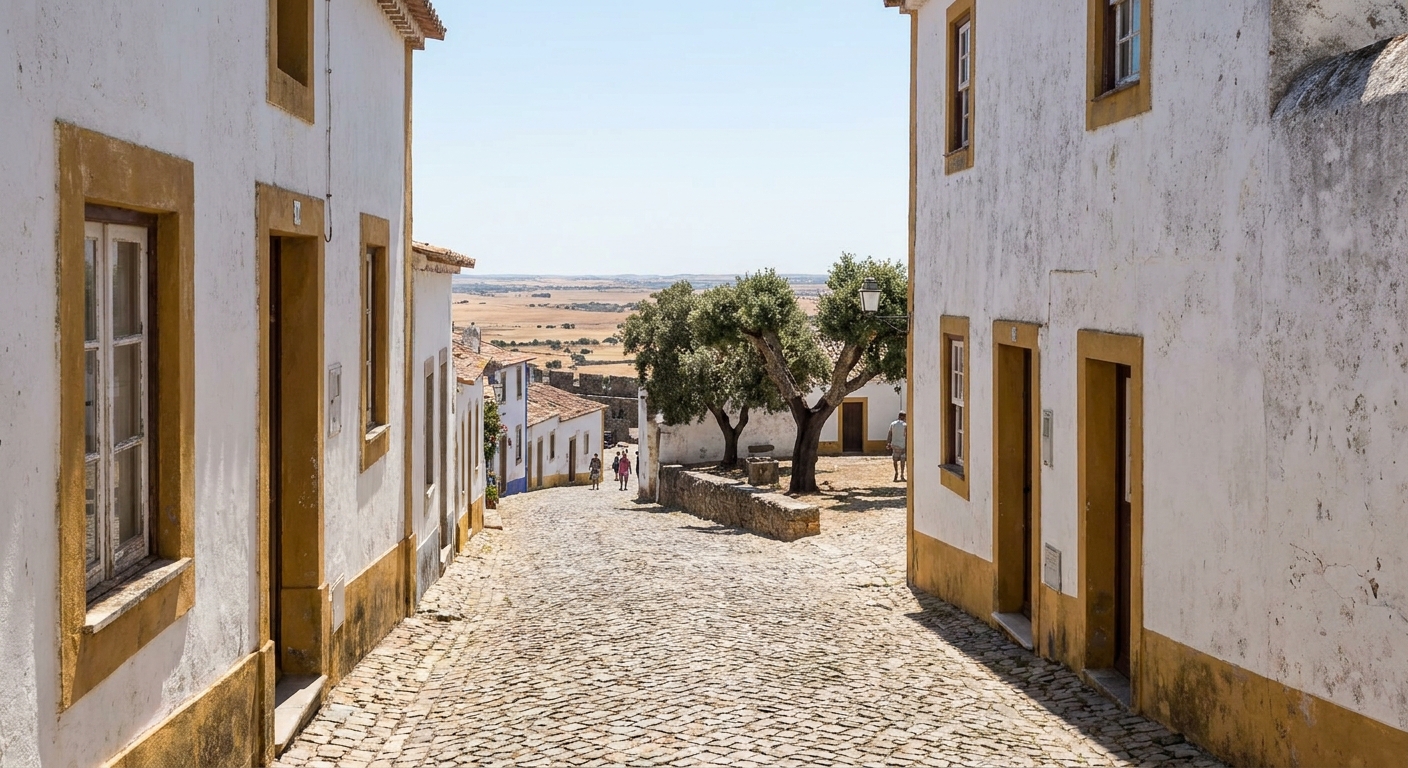
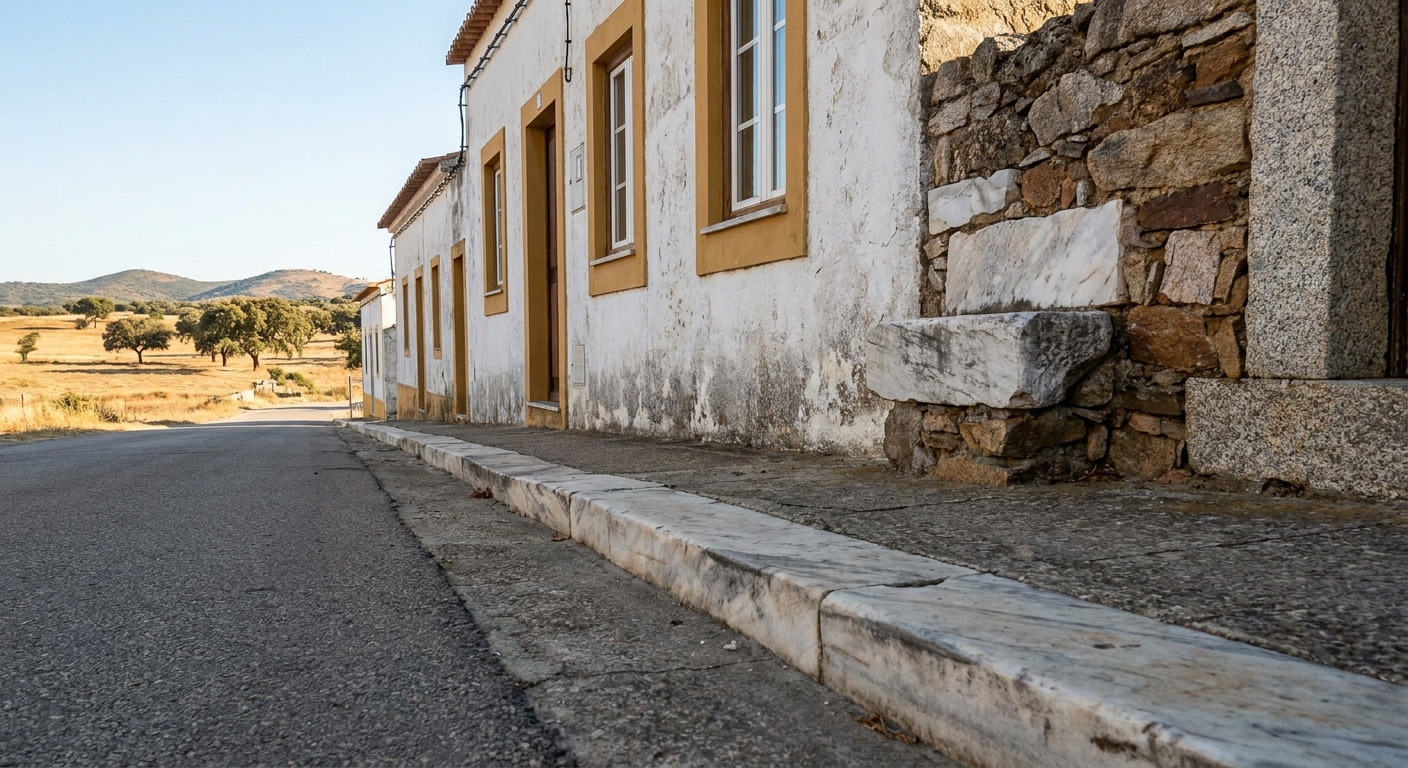
Estremoz and Vila Viçosa stand on marble and use it where other towns use granite: kerbs, doorsteps, fountains, garden walls. Estremoz fills its Rossio one morning a week with pottery, cheese and farm produce, and the upper town keeps a marble tower above the market. Vila Viçosa has the Paço Ducal, the palace of the House of Bragança, with a long marble facade facing the square. Both sit on the road toward Elvas and the border crossing.
Deep south, Mértola stacks a castle above the Guadiana with a former mosque serving as the parish church below it, and the town spreads its Roman, Islamic and medieval collections through small buildings around the streets. Beja, on the way down, keeps a tall castle keep and the Convento da Conceição, now the regional museum. This is the emptiest stretch of the plain, and restaurant choice thins outside the summer weeks.
The mechanics repeat in all of them. You park outside the walls and walk in, the lanes are steep and cobbled in a way that punishes wheeled luggage, and shutters come down for a long midday break in the hot months. Spring and autumn are the working seasons for walking these towns on foot, and the temperatures behind that verdict live on our month-by-month guide.
Free things to do in the Alentejo: the stone circle, Évora’s aqueduct, market mornings, cante alentejano
The Almendres cromlech has no gate, no desk and no fee, and neither does the menhir on the track below it. In Évora, the Água de Prata aqueduct is a public street with arches overhead and kitchens built into the bays. Praça do Giraldo costs nothing to sit in. The montado is free scenery from any minor road, and in late spring the wheat between the oaks changes color week by week until it goes to stubble.
Markets are the other free hour, from the Estremoz Rossio on its weekly morning to the produce stalls that appear in small-town squares. In village cafés you may still catch cante alentejano, the unaccompanied choral singing UNESCO lists as intangible heritage, sung by amateur groups rather than staged for visitors. The sky over Alqueva costs nothing from any dark pull-off near the water. The telescope and the person explaining what is in it are the part you pay for.
Alentejo days indoors: Évora’s museums, the Vila Viçosa palace, cool cellars and the Escoural cave
Heat drives people indoors here more often than rain does. Évora has the Museu de Évora beside the cathedral and the tiled halls of the old university, both cool through the afternoon. A cellar visit does the same work underground, and so does lunch that runs past three with the shutters half down. In winter the equation flips, and the draw becomes a fireplace and a plate of migas.
Two indoor visits need arranging instead of turning up. The painted cave at Escoural takes small supervised groups, booked in advance. The Paço Ducal at Vila Viçosa runs guided visits and keeps its own closing days. Hours move and palaces close for restoration, so check each institution’s own site the week you travel, and the Évora guide tracks what is currently open inside the walls.
Alentejo activities, nearest base, time and what limits them
| Activity | Where | Nearest base | Time (est.) | Access and booking |
|---|---|---|---|---|
| Roman temple, cathedral roof, Capela dos Ossos | Évora old town | Évora | One day | Ticketed interiors, coaches arrive midday |
| Standing stones | Cromeleque dos Almendres, west of Évora | Évora | 2–3 hours with the drive | Dirt track, low cars scrape, new circuit in place |
| Dolmen you can walk into | Anta Grande do Zambujeiro | Évora | 1–2 hours | Farm track, unstaffed |
| Prehistoric painted cave | Escoural | Évora or Montemor-o-Novo | 1–2 hours | Supervised, arranged in advance |
| Stargazing with telescopes | Dark Sky Alqueva reserve, observatory at Cumeada | Monsaraz or Reguengos de Monsaraz | An evening | Reserved ahead, cancelled by cloud |
| Cellar tasting, including vinho de talha | Reguengos, Borba, Vidigueira, Portalegre | Évora or Reguengos | An afternoon for two or three estates | Book direct, most are working farms |
| Walled hilltop village | Monsaraz | Monsaraz or Reguengos | Half a day | Park outside the gate and walk in |
| Ramparts and a border view | Marvão and Castelo de Vide | Marvão, Castelo de Vide or Portalegre | One day | Long drive from Évora, narrow roads |
| Marble streets and a weekly market | Estremoz and Vila Viçosa | Estremoz | Half a day | Market runs one morning, palace has closing days |
| Castle above the Guadiana | Mértola | Mértola or Beja | Half a day | Thin restaurant choice off season |
| Freshwater swim and boats | Alqueva shore, Amieira | Monsaraz | Half a day | Summer only, very little shade |
| Cork plain and montado driving | Évora, Montemor-o-Novo, Arraiolos | Évora | 2 hours of driving | Nothing to enter, minor roads |
Most rows here are their own half day, so a first Alentejo trip settles into two bases rather than four. Évora plus one night out at the lake covers almost everything above. Which nights go where is argued in the regional guide, and the plain slots into a longer route through ten days or two weeks, both drawn off our Portugal guide.
The Alentejo with kids: the lake, the stone circle, and the days that turn into heat and stairs
The days that land with children hold water or open ground. The Alqueva shore offers a freshwater swim with no surf in it, boats leave from Amieira, and the Almendres hillside is a field where running around bothers nobody. A telescope session works from about the age when a child can stand still in the dark. The bone chapel divides families sharply, and it is small enough to walk back out of within a minute.
Heat and stone steps are what end a family day early. Midsummer afternoons on the plain close the towns down, cathedral roofs and castle keeps are reached by narrow spiral stairs, and hill villages are cobbled all the way up. A stroller loses in Monsaraz and Marvão. Age-by-age advice and the week that actually holds together fill Portugal with kids.
Do you need a car in the Alentejo? Évora arrives by train, the rest does not
| Activity | Car? | Without one | Verdict |
|---|---|---|---|
| Évora old town | No | Trains from Lisbon, then everything on foot | The one part of the region that runs on rails |
| Almendres and Zambujeiro | Yes | Half-day guided runs leave from Évora | The realistic answer if you are carless |
| Escoural cave | Yes | Nothing scheduled goes there | Pair it with the stones on the same morning |
| Alqueva stargazing | Yes | You drive out and back in the dark | Ask about meeting points when you reserve |
| Wine estates | Yes | A taxi from Évora reaches one nearby cellar | Nominate a driver for a two-estate afternoon |
| Monsaraz, Marvão, Mértola | Yes | Coaches serve the larger towns only | Rent for the circuit, not for a single village |
| Costa Alentejana | Yes | Coach links reach the bigger coastal towns | Give the coast its own nights |
Picking the car up in Évora rather than at Lisbon airport spares you a city drive, and the walled center is no place to keep one. Portugal runs more than one motorway toll arrangement, and an automatic transmission has to be reserved as such rather than hoped for. Renting a car in Portugal explains both, while getting around Portugal shows where the rails and coaches stop being useful.
Rural roads out here are unlit and long, with cork oaks and livestock close to the edge, so night driving between villages runs slower than the map promises. What the whole trip costs is broken down in the cost guide. Comparing regions before you commit? Boat and beach days belong to things to do in the Algarve, river and harvest days to the Douro, city and mountain days to Porto and the North, and the national shortlist ranks them against each other.
What to skip in the Alentejo
Skip the attempt to bolt the megaliths onto a Lisbon day trip: the train handles the town, the stones do not fit around the return timetable. Skip Almendres in the early afternoon in July, because that hillside carries no shade at all. Skip the run to the Costa Alentejana for a swim if you are sleeping inland, since the Atlantic there is cold and the road back is long. And skip the fourth hill town. They repeat each other, and the third one adds little the first two did not already give you.
The last word
Above the door of the Capela dos Ossos in Évora runs a line the monks left for visitors: nós ossos que aqui estamos pelos vossos esperamos. We bones that are here await yours. The translation is posted on the wall, the room behind it is small enough to cross in a minute, and the skulls are set into the pillars in courses like brickwork. It is the one thing in this region nobody forgets to describe at dinner.
Book the Alqueva session for an early night of the trip, since cloud takes evenings away and a second attempt needs a spare one. Then leave one afternoon with nothing written in it. Somewhere on the minor road between Évora and Reguengos, the wheat runs flat to the horizon, a tractor is the only other vehicle, and the cork trunks stand orange where the bark came off in July. That hour is what the plain gives back for the driving it demands.
Sources & data for this guide
- No temperature, price or driving-time figures are quoted here by design: climate sits on our month-by-month guide and costs on the Portugal trip cost page · checked Sep 6, 2026
- Historic Centre of Évora inscription · UNESCO World Heritage List · checked Sep 6, 2026
- Dark-sky certification around the Alqueva reservoir, guided sessions booked in advance and dependent on cloud and Moon phase · Dark Sky Alqueva · checked Sep 6, 2026
- Cromeleque dos Almendres: visiting arrangements changed with a new circuit, so confirm with Évora’s municipal tourism information before driving out · checked Sep 6, 2026
- We print no date for the Almendres stones. Published estimates differ and we could not source one we were willing to state as fact, so the comparison with Stonehenge is reported as it is presented locally, not endorsed
- Alentejo wine sub-regions and vinho de talha fermented in clay amphorae · visitportugal.com (Turismo de Portugal) · checked Sep 6, 2026
- Cante alentejano, unaccompanied amateur choral singing · UNESCO intangible heritage · checked Sep 6, 2026
- Museum, palace and cave visiting hours are verified on each institution’s own site rather than republished here, because they change and works close buildings for long stretches · checked Sep 6, 2026
- Every duration in the tables is marked (est.) in the column header and comes from our own trips, not from operator timings