
PORTO AND THE NORTH · JANUARY · 1991–2020 NORMALS
Porto in January runs mild and wet rather than cold and dry. Afternoons average 57.2°F, the Atlantic keeps the worst of the cold off the coastal plain, and the rain arrives in bands that sweep through, sulk, and come back. It is the month when the city’s indoor pleasures, the port cellars across the river in Vila Nova de Gaia, the tiled naves, a bowl of tripas that takes an hour to finish, stop being the wet-weather fallback and become the actual plan.
Four weeks in either direction move the arithmetic more than you would guess. December’s nights are 2.2 degrees milder, February’s rain total is 2.09 inches lighter, and the morning light claws back a few minutes a week all month. Inland, around Braga and Guimarães and up the Douro terraces, the same January runs colder and wetter than anything a coastal thermometer records.
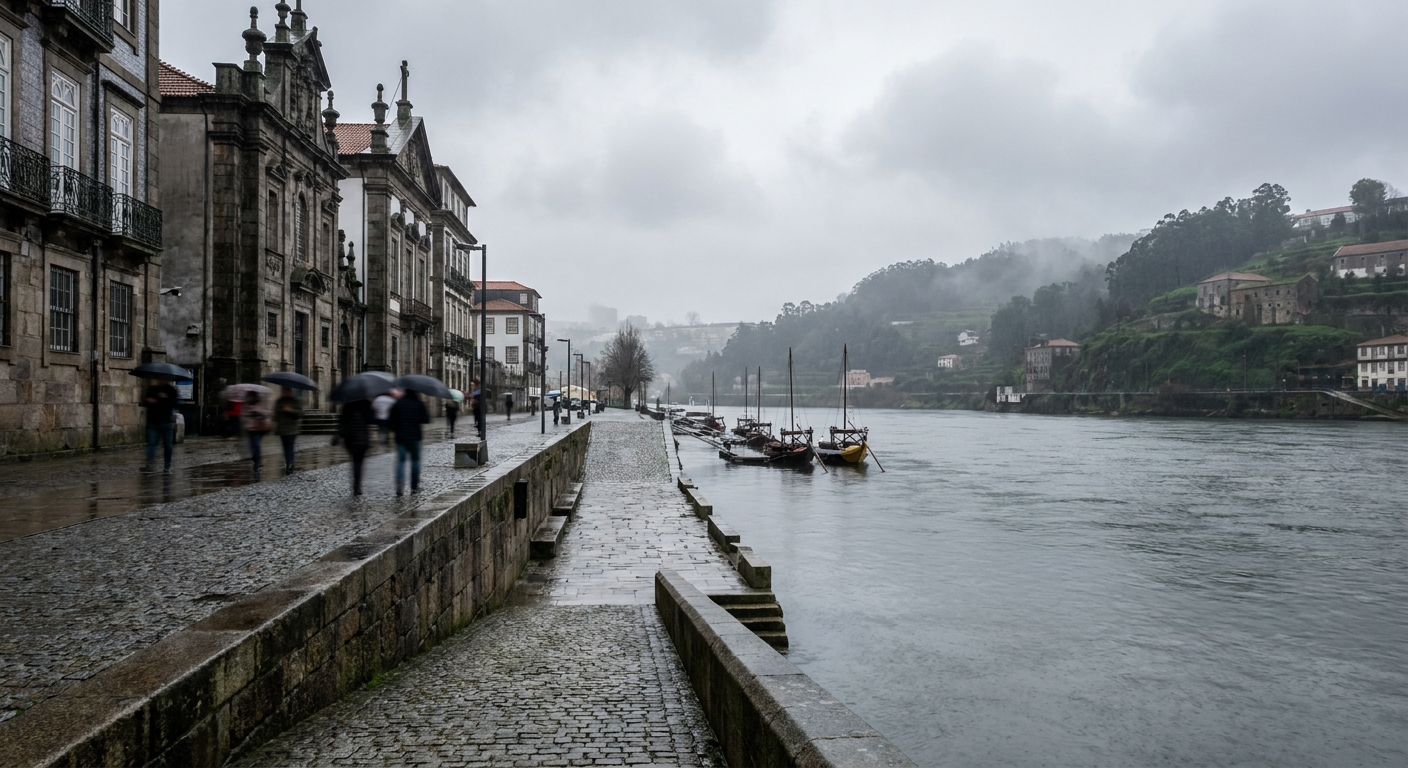
THE MONTH AT A GLANCE · PORTO AND THE NORTH · JANUARY
January gives the coast 57.2°F afternoons, 43.5°F nights and rain on 12.8 days, so keep the mornings free for the streets and put the cellars, markets and tiled interiors in the wet half of the day.
AVERAGE HIGH 57.2°F · 12.8 RAIN DAYS · 9H 35M OF DAYLIGHT ON JAN 15
Go for: mild coastal afternoons near 57°F, long indoor lunches, port cellars in Gaia, and a Douro Valley of bare vines and visible terrace stonework.
Think twice before: planning beach days or long upland walks. The coast averages 5.94 inches of rain over 12.8 days, and the high ground inland runs colder and far wetter than the airport station we quote.
Normals: IPMA station 545, Porto Pedras Rubras, 1991–2020 · Daylight: sunrise-sunset.org · full sources at the end
On this page
- Porto and the North weather in JanuaryHighs of 57.2°F and 12.8 rain days
- How cold the nights get, and sea temperatureLows of 43.5°F, and no verified water reading
- Crowds, prices and the tourist tax in JanuaryWhat we verified, and what we could not
- Things to do in JanuaryGaia cellars, Braga, Guimarães, the Douro line
- A two-day January itineraryTwo days built on 9 hours 35 minutes of light
- January vs December and FebruaryFebruary runs 2.09 inches drier
- Is January a good time to visit?Our verdict, and who should shift to February
Two numbers shape the whole visit: 5.94 inches of rain spread across 12.8 days, and 9 hours 35 minutes of daylight on January 15. Outdoor time becomes opportunistic, and an afternoon that starts at four is already losing the light. For everything that does not change with the date, the neighborhoods, the francesinha argument, the walk up to Clérigos, our Porto guide does that job.
Porto and the North weather in January: average highs, lows and rain days
| Measure | January normal |
|---|---|
| Average high | 57.2°F (14.0°C) |
| Average low | 43.5°F (6.4°C) |
| Precipitation | 5.94 in |
| Days with 0.04 in or more | 12.8 |
| Days with 0.39 in or more | 5.5 |
| Daylight on January 15 | 9h 35m · 7:56 a.m. to 5:31 p.m. |
Every figure here comes from IPMA, the Portuguese institute for the sea and the atmosphere, and specifically from station 545 at Porto Pedras Rubras, the airport, 67.7 m above sea level, over the 1991–2020 period. That is a real thermometer in a real place, not a model grid cell averaged over a square of map. Where it stands matters: it sits on the coastal plain. High ground inland is colder in winter and much wetter, so these readings are a poor guide if your day involves an upland trail.
Rain of at least 0.04 inch falls on 12.8 days in an average January, and 5.5 of those days deliver 0.39 inch or more. Translated: measurable rain about two days in five, and a proper soaking roughly one day in six. Those thresholds are IPMA’s own, not the 0.10-inch cutoff most American tables use, so the counts are not interchangeable with a US city’s. The 5.94-inch total mostly arrives in fronts, hours at a time, with bright gaps wide enough to walk the Ribeira between them.
Between the 57.2°F afternoon and the 43.5°F hour before dawn sits 13.7 degrees, which is modest by continental standards and still enough to matter when you are out from nine until nine. Layers do the work: a sweater, a genuinely waterproof shell with a hood, and shoes with grip. Porto’s granite sidewalks and its worn stone stairways turn slick the moment they are wet. An umbrella is fine in the sheltered lanes of Miragaia and useless in the wind over the river. Our packing guide covers the rest.
On January 15 the sun rises at 7:56 a.m. and sets at 5:31 p.m., mainland Portugal keeping UTC through the winter, for 9 hours 35 minutes of daylight. The usable share is shorter still, with rain falling on 12.8 days of the month and cloud sitting low on plenty of others. Put the Douro train, the boat, the viewpoint in the first half of the day, and let dinner start early.
How cold does Porto and the North get in January? Nights, frost and the sea
The two headline figures, 57.2°F and 43.5°F, are averages of daily maximums and daily minimums across thirty Januaries. They are not a forecast for your Tuesday. A run of Atlantic air can hand you three afternoons that feel like April, and a clear, still night under the same average will read several degrees below it. Thirty years of averaging smooths out exactly the weather you will actually get.
In practice: at eight in the morning you want a sweater under the shell, a scarf if you feel the cold, and dry feet. By two on a bright day you will be carrying the sweater in your bag, walking the Gaia waterfront with the jacket open. The wind off the river is the variable nobody packs for, and it is why a hood beats an umbrella on the Dom Luís I bridge.
We could not verify a count of nights at or below freezing for the airport station, so we give none. The normals put the average January low 11.5 degrees above freezing, and the valleys and uplands inland, which station 545 does not describe, run colder than that. On the water question: we found no sea-surface temperature series for the northern Portuguese coast, and published sea figures are usually averages of daily maximums, a touch warmer than a round-the-clock mean, so we borrow none and promise no swimming.
How busy is Porto and the North in January? Crowds, prices and the tourist tax
We found no monthly occupancy series and no room-rate series for Porto or the northern districts, so we crown no month cheap and no month busy. What the calendar does say is plain enough: January falls after the New Year week, before Carnival, and months away from the Douro harvest that fills the valley in September. Nothing in the northern winter draws the volume that the grape does.
That changes what is worth reserving. Instead of racing a season, you are working around winter schedules: some cellars, restaurants and smaller museums close for part of January or cut their hours, and we did not verify individual calendars. Check opening dates directly before you build a day around one address, and confirm the Douro line timetable the week you travel rather than the month you book.
On the municipal tourist tax charged per night, we could not verify the current rate or which northern councils apply it, so we quote no euro figure and no percentage. Ask at booking, and expect it as a separate line at check-in rather than inside the room price. Our trip cost guide handles the rest of the budget.
One upgrade genuinely changes a wet month: a room you can walk home to. When rain falls on 12.8 days and the light goes at 5:31 p.m., a central address turns a canceled afternoon into a nap, a bath and an early table, while an address across town turns it into a taxi hunt. Choose the location before the square footage, with our where-to-stay guide if you want the districts compared.
Things to do in Porto and the North in January
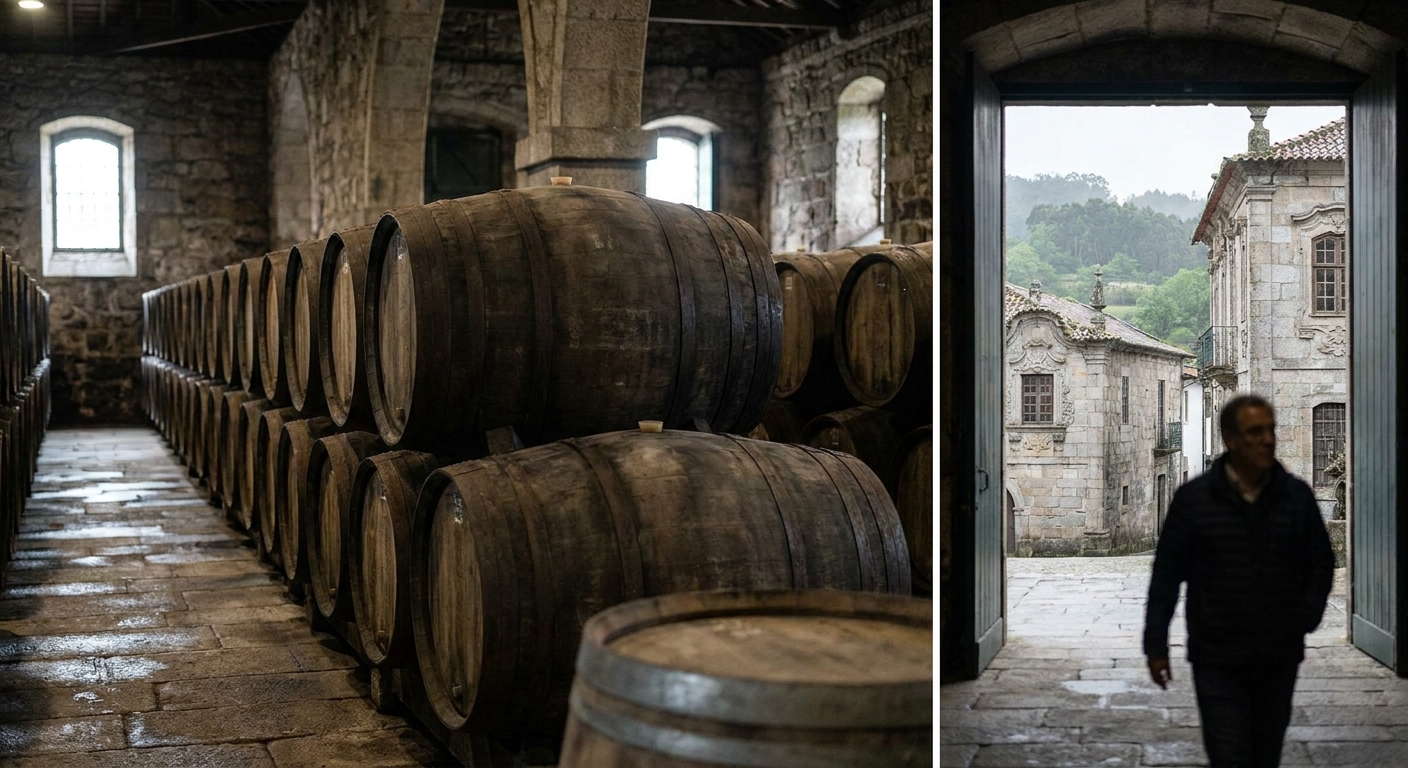
Winter puts you inside things, and the north has unusually good insides. Port cellars in Vila Nova de Gaia, the azulejo panels in the São Bento station hall, the Mercado do Bolhão under its roof, the cathedral on its terrace above the old town. Up the valley, the vines are cut back to stumps and the terraces show their dry-stone geometry, which a canopy of leaves hides for most of the year.
The shortlist worth dating to this month: a cellar tour and tasting in Gaia, the Douro Valley by the riverside rail line out of Campanhã, and two easy train towns, Braga for its baroque churches and Guimarães for its castle and medieval core. We did not verify winter hours or ticket prices for any of these, so confirm each one before you set out.
The buildings do not change with the season; the air around them does. A tiled nave is the same in January as in July, but stepping out of it into 57.2°F and a passing shower is a different visit than stepping out into a summer afternoon. In the valley, the river runs high and brown after weeks of Atlantic fronts, and the terraces you photograph are bare rather than green. Note that our rain figure is coastal, and the valley keeps its own weather.
We could not verify any January-only free admission or discounted winter rate, so we promise none. What costs nothing in any month still costs nothing now: the walk across the upper deck of the Dom Luís I bridge, the Ribeira quays, the Gaia waterfront at dusk. Dusk on the 15th is 5:31 p.m., which makes that last one an aperitif rather than an evening stroll.
Porto and the North in January: a two-day itinerary
Day one, coast and city. Out the door by nine, once the 7:56 sunrise has turned into usable light. São Bento’s tiled hall first, then the cathedral terrace and the descent through the lanes to the Ribeira before noon. Lunch indoors and slow, because early afternoon is when a front most often makes itself known. Cross the bridge to Gaia around two while the light holds, book the cellar tour for four, and by 5:31 p.m. you are already inside with a glass in front of you.
Day two goes up the Douro line from Campanhã, with the river on your right and bare terraces climbing away from it. Take the earliest departure you can face: the return leg after dark shows you nothing. If the forecast reads like one of the 5.5 heavy days, swap the valley for Braga or Guimarães, where the day happens in cloisters, cafés and museums instead of on a platform. Timetables and tickets sit in our getting-around guide.
Porto and the North in January vs December and February
| Measure | December | January | February |
|---|---|---|---|
| Average high | 58.5°F | 57.2°F | 59.0°F |
| Average low | 45.7°F | 43.5°F | 44.2°F |
| Precipitation | 6.04 in | 5.94 in | 3.85 in |
| Days with 0.04 in or more | 12.4 | 12.8 | 10.0 |
| Sea temperature | Not verified | Not verified | Not verified |
December’s afternoons run 1.3 degrees warmer than January’s and its nights 2.2 degrees warmer, at the cost of 6.04 inches of rain. February takes the warmest afternoons of the three at 59.0°F and the lightest rain by a distance: 3.85 inches against January’s 5.94, with the rain-day count dropping from 12.8 to 10.0. All three figures come from the same IPMA station and the same 1991–2020 period, so they compare cleanly.
Shift four weeks later and you gain close to three fewer rain days, 2.09 fewer inches in the bucket, a degree and three-quarters on the afternoon and a noticeably longer evening. Shift four weeks earlier and you gain milder nights and lose a tenth of an inch of rain, which is nothing. On the normals alone, February makes the stronger case, and January’s advantage is whatever your own calendar says about school terms, flight prices and time off.
Is January a good time to visit Porto and the North?
Yes, if the trip is a city trip. Porto at 57.2°F is walkable in a jacket, the cellars and the tiled churches are indoor by design, and a rainy afternoon in a market hall is not a wasted one. No, if your plan needs the outdoors to cooperate: beaches, long upland walking in the Gerês direction, or a photography itinerary that depends on light past five in the afternoon. Rain on 12.8 days will find those plans.
If that second description is yours, wait for February. Same region, same short train rides, 2.09 inches less rain and nearly three fewer rain days, with afternoons a degree and three-quarters warmer. For the full twelve-month picture rather than three, our best time to visit Portugal page lays out the year, and Lisbon vs Porto settles the other winter question people ask.
What January offers on its own terms: a day short enough that a four o’clock tasting counts as the evening, and air mild enough at 57.2°F to walk between cellars without a heavy coat on your arm.
The last word
Book the central room, keep the mornings unscheduled, and let the 5.94 inches decide the order of your days rather than the content of them. If you are choosing between late December and January on rain alone, stop: the gap is four tenths of a day, 12.4 against 12.8, and no traveler has ever felt it. Choose on flight prices, on who can get the week off, and on whether a 5:31 p.m. sunset sounds like a problem or like permission to eat dinner at seven.
Sources & data for this guide
- January normals, high 57.2°F, low 43.5°F, 5.94 in · IPMA, station 545 Porto Pedras Rubras, altitude 67.7 m, 1991–2020 · checked Sep 23, 2026
- Rain days at the 0.04 in and 0.39 in thresholds (12.8 and 5.5) · IPMA, same station and period · checked Sep 23, 2026
- December and February normals used in the comparison table · IPMA, same station and period · checked Sep 23, 2026
- Sunrise 7:56, sunset 5:31 and 9h 35m of daylight on January 15, local time UTC · sunrise-sunset.org · checked Sep 23, 2026
- Editorial admission: we found no sea-surface temperature series for the northern coast, no monthly occupancy or room-rate data, and no verified municipal tourist-tax rate, so we quote none of the three.
- Winter opening hours, cellar tour times and ticket prices change · confirm with each operator before you go.
To plan your stay
- Things to Do in Porto and the North: Port Lodges, Bom Jesus, Guimarães, Surf and Peneda-Gerês
- Best Time to Visit Porto and the North: Weather, Rain Days and the Quiet Months
- Porto and the North in February: Weather, Rain Days, Crowds and Prices
- Porto and the North in December: Weather, Rain Days and Short Daylight