
DOURO VALLEY · SEPTEMBER · 561 M STATION
A September afternoon in the Douro averages 77.4°F, and the night before it dropped to 55.4°F. Twenty-two degrees of daily swing is what the month sells: a fleece on the terrace at breakfast, shirtsleeves by three, dinner outdoors while the light goes. Wine has been made on these slopes by traditional landholders for some 2,000 years, and September is the part of the year when the valley is working rather than waiting.
Rain comes back, but gently. September records 1.93 inches over 5.2 days that measure any rain at all. Four weeks later, October brings 4.76 inches across 10.0 days. That single contrast decides more Douro trips than any other figure, and the normals below carry the rest of the case.
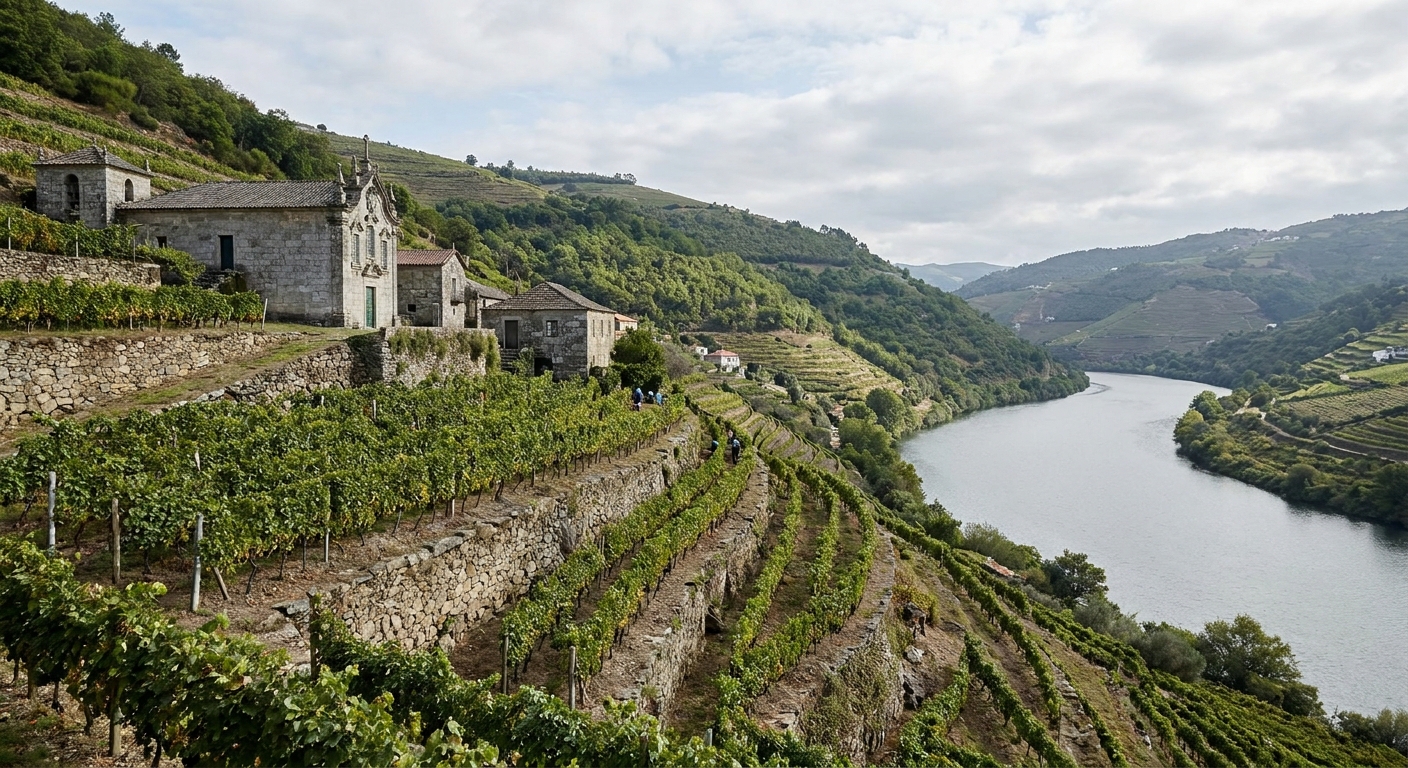
THE MONTH AT A GLANCE · DOURO VALLEY · SEPTEMBER
September keeps August’s long afternoons at 77.4°F, drops the nights to 55.4°F and stays dry enough to plan outdoors, with 5.2 rain days against October’s 10.0.
AVG HIGH 77.4°F · 5.2 RAIN DAYS · 12H 31M OF DAYLIGHT ON SEP 15
Go for: terrace driving with the windows down, nights cool enough to sleep, and one more dry month before October’s 4.76 inches.
Think twice before: arriving without a booked visit. We could not verify a single quinta opening hour or tasting price, so call ahead rather than turning up at a gate.
Normals: IPMA station 567, Vila Real, 1991-2020 · Landscape: UNESCO World Heritage Centre · full sources at the end
On this page
- Average highs, lows and rain days77.4°F days, 1.93 inches, 5.2 rain days
- How warm it gets, morning to afternoonThe 22-degree daily swing
- Crowds, prices and when to bookWhat we could verify, and what we could not
- Things to do in the Douro Valley in SeptemberQuintas, terraces and the tributary roads
- A two-day plan for the valleyTwo days, keyed to sunrise and sunset
- September vs August and OctoberHow the three months compare
- Is September a good time to visit?Our verdict, and who should shift
Beds, nights and the drive in from Porto belong to our Douro Valley guide, and the twelve-month ranking for the country sits in best time to visit Portugal. September’s own case rests on one thermometer, and it pays to know where that thermometer stands before you pack.
Douro Valley weather in September: average highs, lows and rain days
| September at Vila Real (561.5 m) | Normal, 1991-2020 |
|---|---|
| Average high | 77.4°F |
| Average low | 55.4°F |
| Rainfall | 1.93 in |
| Days with 0.04 in or more | 5.2 |
| Days with 0.39 in or more | 1.7 |
| Daylight, Sep 15 | 12h 31m |
| Sunrise and sunset, Sep 15 | 7:10 a.m. and 7:41 p.m. local |
Every figure here comes from IPMA, the Portuguese national weather service, and from one station: number 567 at Vila Real, a real thermometer at 561.5 m, read on the 1991-2020 normals rather than modeled in a grid cell. September there averages a high of 77.4°F, a low of 55.4°F and 1.93 inches of rain. Altitude matters more in the Douro than almost anywhere else in Portugal. Vila Real stands in the wine country but well above the water, and the valley floor around the Pinhão bend runs hotter than the station and hotter than Porto. Read these as wine-country figures, not riverbank ones, and not mountain ones either.
An average September records at least 1 mm of rain, 0.04 inch, on 5.2 days, and 10 mm or more, 0.39 inch, on 1.7 of them. Those are IPMA’s own thresholds, not the 0.10-inch bar that US tables use, so the counts are not interchangeable with the NOAA table for your home town. Over a fortnight on the ground it works out at roughly two damp days, with better than even odds that one of them is a proper soaking worth spending indoors. The other eleven or twelve are dry.
Twenty-two degrees separate the average night from the average afternoon, and that gap writes the packing list. Dawn on a schist terrace near 55.4°F wants a fleece or a light jacket. By mid-afternoon at 77.4°F the same fleece is in the car, and you want a hat instead, because a vineyard terrace has no shade at all. Add one thing with sleeves for dinner outdoors after dark. Our Portugal packing guide has the rest of the bag.
On September 15 the sun rises at 7:10 a.m. and sets at 7:41 p.m. local time, giving 12 hours 31 minutes of daylight. Both ends earn their keep in a valley built in steps, since low light is what separates one terrace from the next. Plan on the last viewpoint of the day around seven, and on the drive home finishing in the dark if you push past it.
How warm is the Douro Valley in September?
77.4°F by mid-afternoon, 55.4°F before dawn, 22.0 degrees apart. August at the same station swings wider, 84.2°F down to 58.8°F, or 25.4 degrees, and it does so from a far higher starting point. September holds the useful part of the summer heat and lets the nights fall to sleeping temperature, which is the single clearest difference between the two months on a working farm.
Before nine the air sits close to that 55.4°F low and the stone is still cold to the touch, so a layer at a morning viewpoint is not optional. By two the same spot is in the high seventies, and the valley floor beats it: a reading taken at 561 m understates what a boat deck at Pinhão feels like. Sun on water, sun on schist, no shade on a terrace. Carry more water than a city day asks for.
We read no frost-day count in the IPMA September normals for this station, so we give none. What the normals do say is that the average low sits more than 23 degrees above freezing, so the cold end of a September night here is a jacket question rather than an ice one. Head up onto the Marão or Montemuro ridges, the mountains that shelter the valley from the harsh Atlantic winds, and expect colder and wetter than anything in the table above.
How busy is the Douro Valley in September? Crowds, prices and when to book
September is the tail of the European summer calendar, and it is also the month the valley’s own year turns. The vindima, the grape picking, traditionally falls in this stretch, with a start date that moves each season with the ripeness and that we could not verify for any given year. Our harvest guide goes further into how it runs. On money, we found no occupancy series and no monthly room-rate series for the Douro, so we crown no month cheap and no month expensive.
Take the booking advice as reasoning, then, rather than measurement. A quinta is a farm before it is a hotel, a main house with its winery and outbuildings around it, most of them in the Upper Corgo and the Upper Douro, and eight rooms fill on a different curve than two hundred. Weekends go before weekdays in a picking month. Book the bed first, ask the quinta for a visit slot second, and build the driving around the slot you were given.
We could not verify a tourist-tax rate for the Douro municipalities, so we give no percentage and no per-night amount. If a municipal charge turns up at checkout, ask the property what it covers before you pay it at the desk. Our know-before-you-go guide gathers the rest of the small print for a Portuguese trip.
The one line of the budget that changes the month is the car. We could not verify a river-boat fare or a ticket price on the Douro railway line, so we quote none. What we can say is geography: the roads follow the tributaries, the Varosa, the Corgo, the Távora, the Torto and the Pinhão, and the driving between viewpoints is most of a day. Twelve and a half hours of daylight buys four or five stops with a rental and one or two without. Tolls and insurance are covered in our car rental guide.
Things to do in the Douro Valley in September: quinta visits, wine tasting and vineyard terraces
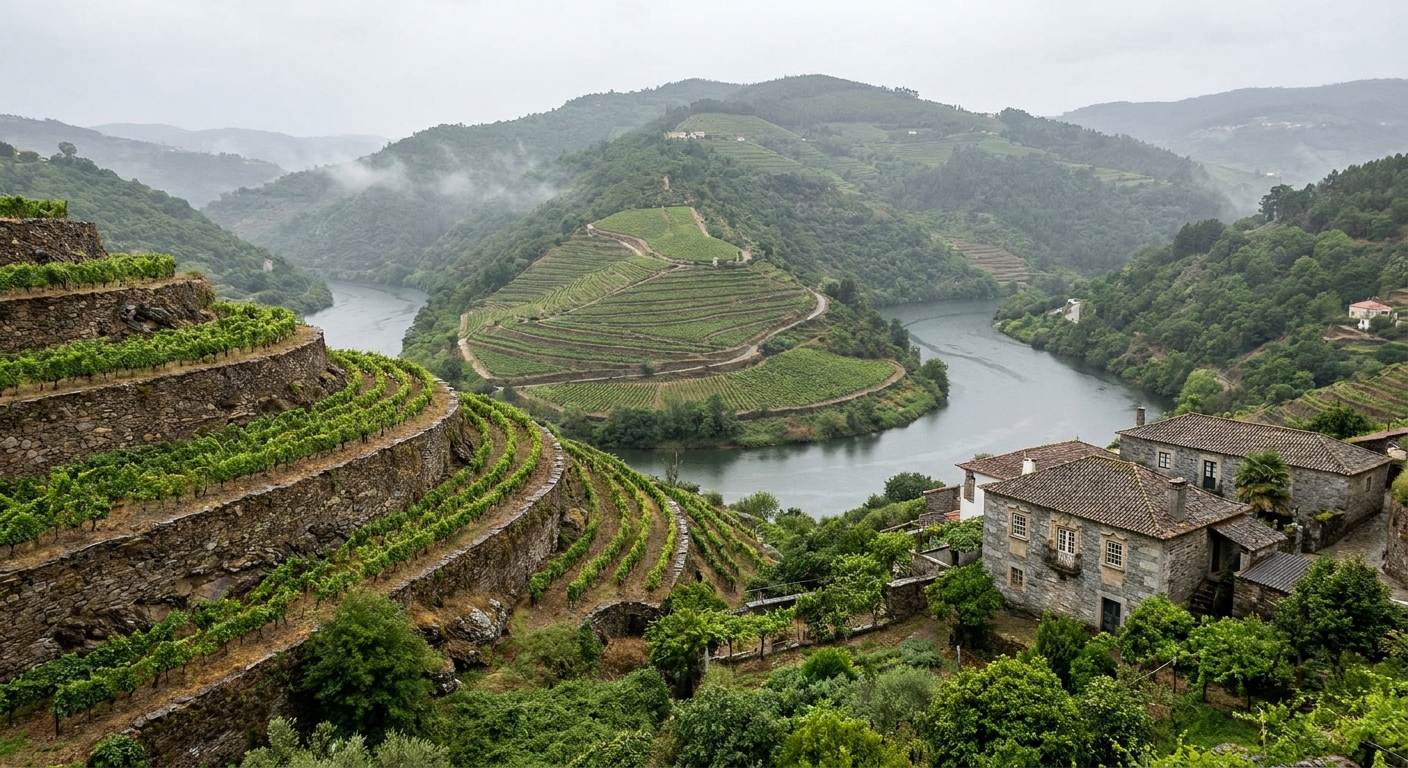
A full day outdoors is what the month makes possible: 77.4°F instead of August’s 84.2°F, and 5.2 rain days instead of October’s 10.0. Walking a terrace at two in the afternoon is reasonable in September and punishing four weeks earlier. It is also the stretch of the year when the working valley is visible from the road, because the picking season traditionally falls here, and tractors, crates and the smell of fermentation come with it.
The Alto Douro Wine Region has been inscribed by UNESCO since 2001, under criteria three, four and five: 24,600 hectares of terraced vineyard inside a buffer zone of 225,400 hectares, nine times the property, a ratio UNESCO itself calls difficult to manage. Two kinds of terrace date the slopes for you. The socalcos are narrow and irregular behind buttressed schist walls, one or two rows of vines each, and they predate the phylloxera of 1860. The long, wider, slightly sloping ones came with the replanting around 1900. We could not verify a single opening hour or tasting price, so call before you drive.
A schist wall does not change with the month. The air over it does. Those walls take the afternoon’s 77.4°F and release it after the 7:41 p.m. sunset, so an outdoor tasting stays comfortable at an hour that would be cold in October, when the average high has fallen to 66.7°F and the rain has multiplied by roughly two and a half. Same terrace, same river, 10.7 degrees of difference in the afternoon.
We could not verify any free-admission day or scheme in the valley, so we promise none. What needs no ticket is most of the landscape: the white-walled villages halfway up the slopes around their imposing 18th-century parish churches, the walled orange groves on the lower banks, the stone channels that once carried water down to catchments, and the road along any of the five tributaries at the hour the light comes in low.
The Douro Valley in September: a two-day itinerary
Day one starts at the 7:10 a.m. sunrise, because the first two hours are the cool ones and the roads are quiet. Take a viewpoint above the river while the air is near 55.4°F, then move to a cellar and a tasting between eleven and three, indoors, while the afternoon does its 77.4°F. Lunch long. From five the light rakes across the terraces and every bend on the tributary roads is worth a stop. Dinner outdoors after the 7:41 p.m. sunset, with the layer you shed at nine that morning back on your shoulders.
Day two crosses the river and adds a boat or the Douro line train if you would rather not drive twice. Save the ridge road toward Marão for a clear morning, when the whole terraced amphitheater is legible at once. If the day turns into one of September’s 1.7 heavy-rain days, drop to the valley floor: 0.39 inch of rain on schist is not a surface for cliff-edge driving. Cellars, a long lunch, a village church, and back before dark.
The Douro Valley in September vs August and October
| At Vila Real, 1991-2020 | August | September | October |
|---|---|---|---|
| Average high | 84.2°F | 77.4°F | 66.7°F |
| Average low | 58.8°F | 55.4°F | 50.2°F |
| Rainfall | 0.85 in | 1.93 in | 4.76 in |
| Days with 0.04 in or more | 2.3 | 5.2 | 10.0 |
Across the three months the temperature falls in steps and the rain rises in leaps. Highs run 84.2°F, 77.4°F, 66.7°F. Lows run 58.8°F, 55.4°F, 50.2°F. Rainfall goes 0.85 inch, 1.93, then 4.76, with the day count at 2.3, 5.2 and 10.0. The Douro is a river valley rather than a coast; swimming here is a river or a pool question, not a sea one.
Shift four weeks earlier and you gain dry pavement, 0.85 inch across 2.3 days, the driest of the three, and you pay for it with an unshaded terrace at 84.2°F in mid-afternoon and picking that has usually not begun. Shift four weeks later and October hands back 50.2°F nights and ten rain days, close to a third of the month, in exchange for the color the vines turn once the fruit is off. Neither trade is wrong, but they are opposite trades.
Is September a good time to visit the Douro Valley?
Yes for most travelers. Afternoons at 77.4°F, nights at 55.4°F and only 5.2 days with measurable rain make a week here plannable, and 12 hours 31 minutes of daylight on the 15th is enough for two viewpoints and a cellar in one day. No for two groups: anyone who wants guaranteed poolside heat from breakfast to dark, and anyone who needs empty single-track roads, since a picking month puts tractors and trucks on them.
If the answer is no, the fallback is August rather than October. It keeps the rain down to 0.85 inch over 2.3 days and pushes the afternoon to 84.2°F, which suits a trip built around a pool and short walks. October is the other direction entirely, 66.7°F and 4.76 inches, and it rewards travelers who do not mind planning around weather.
No other month puts 12 hours 31 minutes of daylight, afternoons under 80°F and a valley in full working season into the same four weeks.
The last word
Book the room before the visit, the visit before the driving, and leave one afternoon empty for the 1.7 days in an average September that deliver 0.39 inch of rain or more. One more thing about the ground you will be photographing from those viewpoints: torrential rain in late January 2001 damaged terraces badly enough that UNESCO called for a special effort to bring parts of the vineyards back into working order. A spatial plan followed in 2003, and a management body, the Douro Mission, was created in 2006. Those schist walls need constant maintenance, hand work that never really stops.
Sources & data for this guide
- September normals, rain days and IPMA’s 1 mm and 10 mm thresholds · IPMA, Normais Climatológicas 1991-2020, station 567 Vila Real, 561.5 m · checked Sep 23, 2026
- August and October normals used in the comparison · same IPMA station and same 1991-2020 period · checked Sep 23, 2026
- Daylight, sunrise and sunset for September 15, converted from UTC to local time · sunrise-sunset.org · checked Sep 23, 2026
- Inscription year and criteria, 24,600 ha property and 225,400 ha buffer, socalcos and post-phylloxera terraces, quintas, tributaries, orange groves, 2001 storm damage, 2003 plan and the 2006 Douro Mission · UNESCO World Heritage Centre, file 1046, Alto Douro Wine Region · checked Sep 23, 2026
- We could not verify any quinta opening hour, tasting price, river-boat fare, train fare or tourist-tax rate: UNESCO documents a landscape, not a visiting schedule. Call the property before you drive, and treat the booking advice as our reasoning, not a measured occupancy series.
To plan your stay
- Things to Do in the Douro Valley: Quinta Tastings, the River Train, Boats and Miradouros
- Douro Valley vs Alentejo: Monthly Temperatures, Rain Days and Daylight
- Best Time to Visit the Douro Valley: Month-by-Month Weather, Harvest Season and the Quiet Months
- The Douro Valley in August: Weather, Crowds and How It Compares to July and September