
DOURO VALLEY · MARCH · 41.3° N
The Douro in March is a valley of bare wood and grey stone under a sun that already has some strength in it. Up on the rim at Vila Real, the month averages 60.1°F by day and 42.1°F at night, and rain falls on 8.8 days out of 31. The river runs high, the tributaries run hard, and the terraced hillsides listed by UNESCO in 2001 are legible wall by wall, because nothing is in leaf yet.
That is the trade. No picking, no treading, no long warm evenings, and no boats full of people: for the autumn version, our harvest guide dates it. A March trip offers instead a quiet, cold-in-the-morning, drivable version of a landscape that usually has to be shared, plus one caveat we repeat below: very little in this valley keeps posted visitor hours, and we could not verify any.
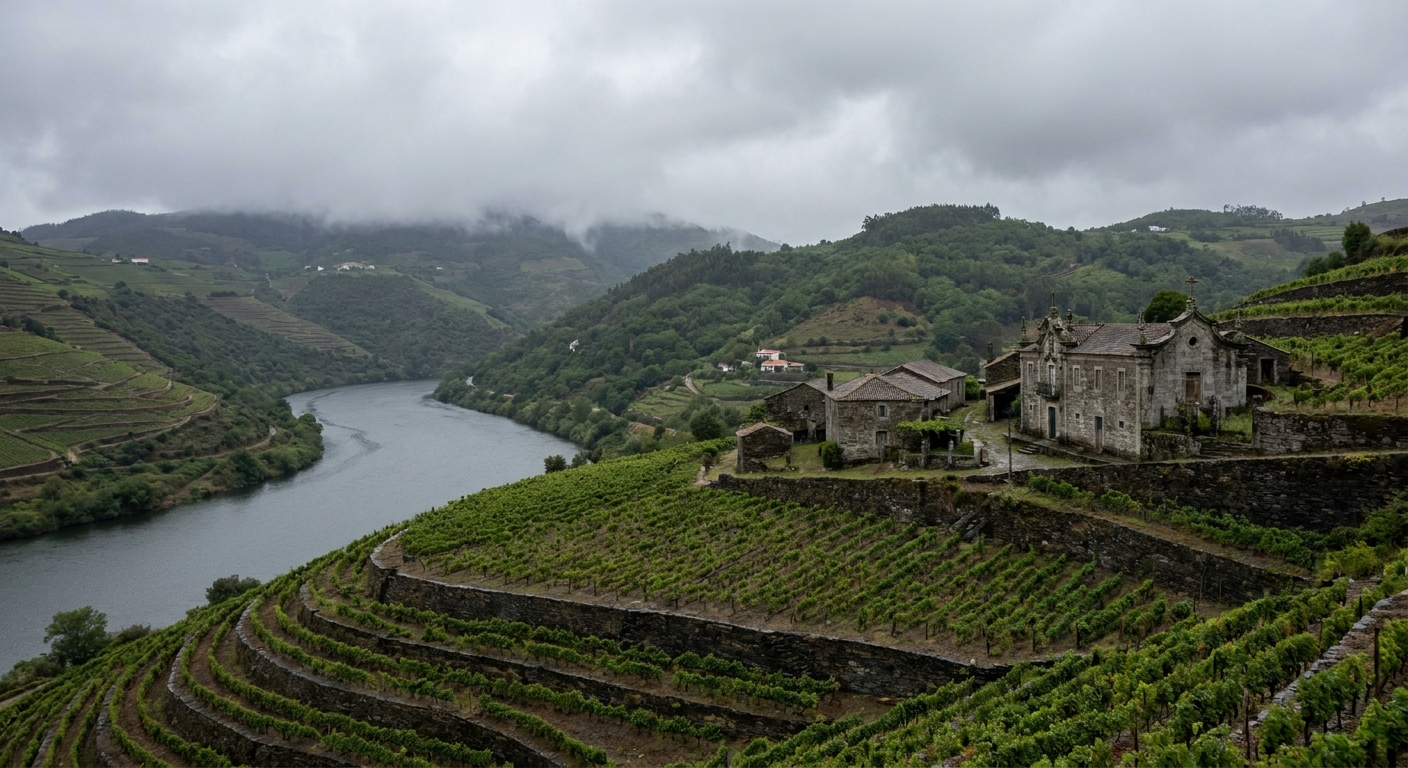
THE MONTH AT A GLANCE · DOURO VALLEY · MARCH
Go in March for bare terraces, 60.1°F afternoons and empty roads, and accept 42.1°F nights plus rain on nearly nine days out of 31.
IPMA 1991-2020 AT VILA REAL, 561.5 M · 8.8 RAIN DAYS · 11 H 59 MIN OF DAYLIGHT ON MAR 15
Go for: the pre-1860 socalco terraces read as pure stonework, empty roads across a 24,600-hectare vineyard, and afternoons sheltered from the harshest Atlantic winds by the Marão.
Think twice before: packing for a Lisbon spring. Nights average 42.1°F at 561.5 m, and 3.2 March days bring 0.39 inch of rain or more.
Normals: IPMA station 567, Vila Real · Light: sunrise-sunset.org · Landscape: UNESCO file 1046 · full sources at the end
On this page
- The Douro Valley weather in March60.1°F days, 3.59 inches, 8.8 rain days
- How cold the nights get42.1°F lows and an 18-degree swing
- Crowds, prices and booking in MarchWhat we can price and what we cannot
- Things to do in the Douro Valley in MarchPinhão, the Upper Corgo and the terraces
- A two-day Douro itineraryTwo days from a 6:40 am sunrise
- March, February or AprilHow the three months compare
- Is March a good time to visit?Who should go, and who should wait
- The month before, in numbersThe Douro Valley in February
Every temperature, rain day and sunrise time here comes from two named sources: IPMA’s 1991-2020 normals for station 567 at Vila Real, and sunrise-sunset.org for the light. The landscape figures come from UNESCO’s file on the Alto Douro Wine Region. Anything the date does not decide, the route in from Porto, the car and the tolls, the shape of a longer trip, sits in our getting-around guide and our one-week Portugal route.
The Douro Valley weather in March: average highs, lows and rain days
| March at Vila Real | 1991-2020 normal |
|---|---|
| Average high | 60.1°F (15.6°C) |
| Average low | 42.1°F (5.6°C) |
| Precipitation | 3.59 in |
| Days with 0.04 in (1 mm) or more | 8.8 |
| Days with 0.39 in (10 mm) or more | 3.2 |
| Daylight, March 15 | 11 h 59 min |
| Sunrise and sunset, March 15 | 6:40 am · 6:39 pm |
These normals are measured, not modeled. IPMA, the Instituto Português do Mar e da Atmosfera, runs station 567 at Vila Real, a real thermometer at 561.5 m on the Douro side of the Marão, and its 1991-2020 March average is 60.1°F by day, 42.1°F by night, 3.59 inches of rain. Every figure here comes from that one station. The valley floor down at the water runs hotter than Porto, the high ground above the terraces is colder and far wetter, and neither is described by these numbers. Pack for the altitude you will actually sleep at.
Rain of at least 0.04 inch (1 mm) falls on 8.8 days in an average March, so roughly two days in seven are wet and five are not. Of those, 3.2 days deliver 0.39 inch (10 mm) or more, the sort of rain that makes a schist track slick and keeps you in a cellar for an hour. One warning about the counts: IPMA uses its own thresholds, while American tables usually count days above 0.10 inch. Do not set 8.8 against a number from a US-style chart and think you have compared anything.
Eighteen degrees separate the average afternoon from the average night, and at 561.5 m that gap is the whole packing problem. A 42.1°F dawn on an exposed terrace wants a fleece, a hat and something windproof. The same terrace at 60.1°F in sunshine wants none of it. Bring layers you can shed into a daypack, shoes with grip for wet stone, and one shell you are willing to carry on the five dry days for the sake of the two wet ones. Our packing guide has the full Portugal list.
On March 15 the sun rises at 6:40 am and sets at 6:39 pm local time, giving 11 hours 59 minutes of daylight, the two halves of the day almost exactly even. The usable light is shorter than that. Valley sides are steep, so the sun has to climb over them before the terraces read properly, and the far bank goes into shadow well before that 6:39 pm sunset. Give the first hour to the drive or the train, be on a viewpoint by mid-morning, and treat 5:30 pm as the last good light.
How warm is the Douro Valley in March?
An average is the middle of a range, not a forecast. March at Vila Real averages 60.1°F for the daily maximum and 42.1°F for the daily minimum, 18.0 degrees apart, and real days land on both sides of both figures. February’s 54.0°F average high is a fair picture of the cold end of a March week, April’s 63.3°F of the warm end. Anyone planning around a single number for the month will be wrong twice.
In practice you dress twice a day. Before 10 am, down by the water or up on an open terrace, it is jacket weather and your hands will say so first. By 2 pm, in sun and out of the wind, a shirt and one light layer are plenty, and a table outside a village café is comfortable. The swing back is quick: once the sun drops behind the ridge the temperature follows inside the hour, so keep the jacket you took off at lunch within reach.
How many March nights actually touch freezing, we cannot tell you. IPMA’s monthly normal gives the average minimum, not a frost-day count, and we found none for station 567, so plan for the possibility rather than a number. There is no swimming question to settle either. We have no verified water temperature for the Douro, and where you do find water figures for Portugal, check the method: they are usually averages of daily maxima, a little warmer than a round-the-clock mean.
How busy is the Douro Valley in March? Crowds, prices and booking ahead
March sits between the two things the valley is known for: summer on the water and the grape harvest that fills the quintas in early autumn, dated in our harvest guide. By the calendar it is a quiet month. We will not rank it on price, though. No occupancy series and no monthly room-rate data for the Douro reached us, so no month here gets called the cheapest or the dearest. The honest statement is narrower and more useful: fewer visitors are in the valley now than at harvest, and each estate sets its own season.
Since we have no booking-window data, we will not invent a number of weeks. Do this instead: choose your estates first, then write to them. We could not verify a single quinta opening hour or tasting price anywhere in the valley, and in March many of these places are farms at work rather than visitor operations, so a confirmed appointment beats any reservation strategy. Two nights is the minimum that makes the drive worth it, and our rental guide covers the tolls and the paperwork before you collect the car.
On lodging, we could not verify a tourist tax rate for the Douro municipalities, so we quote no percentage and no per-night amount. If a line appears at checkout, it is municipal and collected locally. Build the rest of the budget from our Portugal cost guide, and read a March room rate at a quinta as that estate’s own decision rather than a market signal anyone can document for you.
If one line of the budget deserves more money this month, it is mobility. The World Heritage property covers 24,600 hectares, with a buffer zone of another 225,400, nine times the property itself, which UNESCO calls difficult to manage. That is a region you cross, not a town you walk. A car, a hired driver or a boat seat decides how much of it fits into a day, and daylight runs under 12 hours in March, so the day is short to begin with.
Things to do in the Douro Valley in March: Pinhão, the Upper Corgo and the terraces
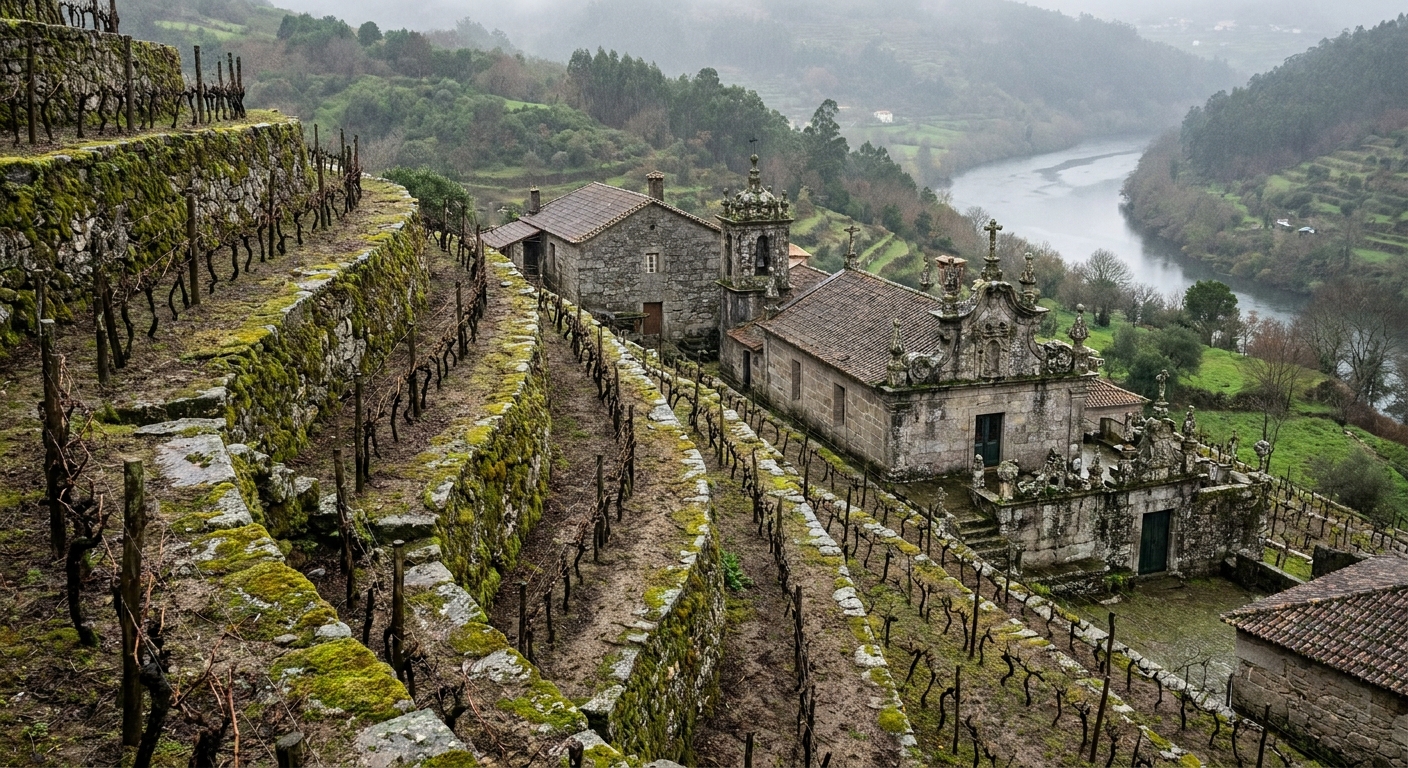
In March the vines are leafless, so from the road you are looking at engineering. Two thousand years of winemaking here have left two visibly different terrace systems on the same hillsides, and in full leaf they blur into one green slope. Now you can follow a wall line across an entire flank of the valley and see where one century stopped and the next began. Nobody charges for that, and no other season offers it as clearly.
The oldest terraces are the socalcos, cut before the phylloxera of 1860: narrow, irregular, buttressed by schist walls that need constant upkeep, each carrying only one or two rows of vines. The long, continuous, gently sloping terraces came with the rebuilding at the end of the 19th century and the start of the 20th, wider and tilted so the vines catch more sun, their monumental walls having changed the look of the whole valley. The quintas, a main house with winery and farm buildings, are thickest in the Upper Corgo and the Upper Douro.
Stone has no season, air does. The Marão and the Montemuro shelter this country from the harshest Atlantic winds, which is why 60.1°F afternoons are possible down among the terraces while the ridges above stay cold. The tributaries that shape the landscape, the Varosa, Corgo, Távora, Torto and Pinhão, run hard after a wet spell. And the valley’s fragility is on the record: torrential rain in late January 2001 badly damaged terraces, and UNESCO noted that returning parts of the vineyard to working order would take a special effort.
Free in March, and free the rest of the year: the roads, the viewpoints and the villages. White-walled villages sit midway up the slopes around an often imposing 18th-century parish church, orange groves, some of them walled, grow along the lower banks and beside the hillside watercourses among brushwood and scrub, and the old stone channels that collected water are still readable in places. We could not verify a free-admission day at any museum or estate this month, so we name none. Assume the landscape is the ticket and that anything with a door needs an appointment.
The Douro Valley in March: a two-day itinerary
Day one runs between a 6:40 am sunrise and a 6:39 pm sunset. Spend the first hour traveling, from Porto or from your quinta, because the valley sides hold the shadow anyway. Mid-morning, take the high road for the wide post-phylloxera terraces while the light climbs over the ridge. Eat late and outside if the sun holds, around 2 pm at the warmest hour. Keep the afternoon for the one estate visit you arranged in advance, then be on a viewpoint by 5:30 pm, an hour before the far bank goes dark.
Day two drops to the water: the Pinhão river valley and the Upper Corgo quintas, with a village stop for the 18th-century church and the walled orange trees below it. If the weather turns, and 3.2 March days bring 0.39 inch or more, invert the order. Cellars, a long lunch and the drive itself all work in rain. Wet schist terraces do not, and neither does a viewpoint in cloud. Porto is close enough that a washed-out afternoon can become a city one instead.
The Douro Valley in March vs February and April
| 1991-2020 normal, Vila Real | February | March | April |
|---|---|---|---|
| Average high | 54.0°F | 60.1°F | 63.3°F |
| Average low | 38.3°F | 42.1°F | 44.8°F |
| Precipitation | 3.29 in | 3.59 in | 3.34 in |
| Days with 0.04 in (1 mm) or more | 8.5 | 8.8 | 10.3 |
The temperature line only goes one way across the three: 54.0°F, 60.1°F and 63.3°F for the average high, 38.3°F, 42.1°F and 44.8°F for the low. March runs 6.1 degrees warmer by day than February and 3.2 cooler than April. Rain is less tidy. March is the wettest of the three by total at 3.59 inches, ahead of April’s 3.34 and February’s 3.29, yet April records the most wet days, 10.3 against March’s 8.8.
Move four weeks later and you gain warmth and lose sightlines: April is 3.2 degrees warmer by day, 2.7 warmer at night, and wet on 1.5 more days, with the vines starting to leaf and the terrace walls starting to disappear behind them. Move four weeks earlier and the afternoon average drops 6.1 degrees while the rain-day count falls only 0.3, nights near 38.3°F included. Our February page has that month in full.
Is March a good time to visit the Douro Valley?
Yes, if you came for the architecture of the valley rather than its vintage. Afternoons at 60.1°F, nine wet days in thirty-one, empty roads and cellars with nobody else in them suit drivers, walkers and photographers. No, if you came for a working vineyard or for heat. Nothing is being picked, nothing is being trodden, and a 42.1°F night at 561.5 m is a genuine night, not a cool evening.
Which month to prefer depends on which no applies. For the harvest, it is early autumn, and our harvest guide gives the timing. For warmth and longer evenings without the autumn crowd, go later in spring: April is already 3.2 degrees warmer by day and 2.7 at night. We hold no May normal for station 567, so we stop the comparison at April and leave the rest of the calendar to our Portugal best-time guide.
One thing this month has that no leafy month does: from a road above the terraces you can read 24,600 hectares of stonework as engineering, wall by wall, with nothing green in the way.
The last word
Book the estate visits before anything else, because in a month when the farms are farming that is the part nobody can arrange for you at short notice, then let the forecast choose the order of your two days. Carry one fact with you on the drive: port has been a defined and regulated wine since 1756, and since 2006 a body called the Douro Mission has been charged with safeguarding this landscape. Ask at the quinta who maintains the wall below the terrace. It is a live cost, and in March it is what they are doing.
Sources & data for this guide
- March normals, rain days and the 1 mm and 10 mm thresholds · IPMA (Instituto Português do Mar e da Atmosfera), 1991-2020 climate normals, station 567 Vila Real, altitude 561.5 m · checked Sep 23, 2026
- February and April normals used in the comparison · same IPMA station, same 1991-2020 period · checked Sep 23, 2026
- Sunrise 6:40, sunset 6:39 pm and 11 h 59 min of daylight on March 15 · sunrise-sunset.org, converted to local time · checked Sep 23, 2026
- Property of 24,600 ha and buffer of 225,400 ha, socalco and post-phylloxera terraces, quintas and villages, tributaries, orange groves, the January 2001 rain damage, the 2003 spatial plan and the 2006 Douro Mission, the 1756 regulation of port · UNESCO World Heritage Centre, file 1046, Alto Douro Wine Region · checked Sep 23, 2026
- Reserves: we could not verify a single quinta opening hour, tasting price, boat fare or train fare, so we quote none. We found no occupancy or room-rate series and no municipal lodging-tax rate, so we rank no month on price and give no percentage. No frost-day count and no water temperature reached us · noted Sep 23, 2026
To plan your stay
- Things to Do in the Douro Valley: Quinta Tastings, the River Train, Boats and Miradouros
- Douro Valley vs Alentejo: Monthly Temperatures, Rain Days and Daylight
- Best Time to Visit the Douro Valley: Month-by-Month Weather, Harvest Season and the Quiet Months
- The Douro Valley in February: Weather, Rain Days and How March Compares