
BRAGA · PORTUGAL · JANUARY
January hands Braga a 57.4°F afternoon, a 37.6°F night and 7.07 inches of rain. That is a real winter by Portuguese standards and a mild one by American ones: the granite stays wet, the light stays low from lunch onward, and the usable day is over by half past five.
None of that is a reason to cancel. It is a reason to book differently: a room with heating that works, a plan that puts the Bom Jesus climb in the early afternoon, and an indoor option that does not depend on the sky. Shift the trip four weeks either way and the arithmetic moves, though February moves it much further than December does.
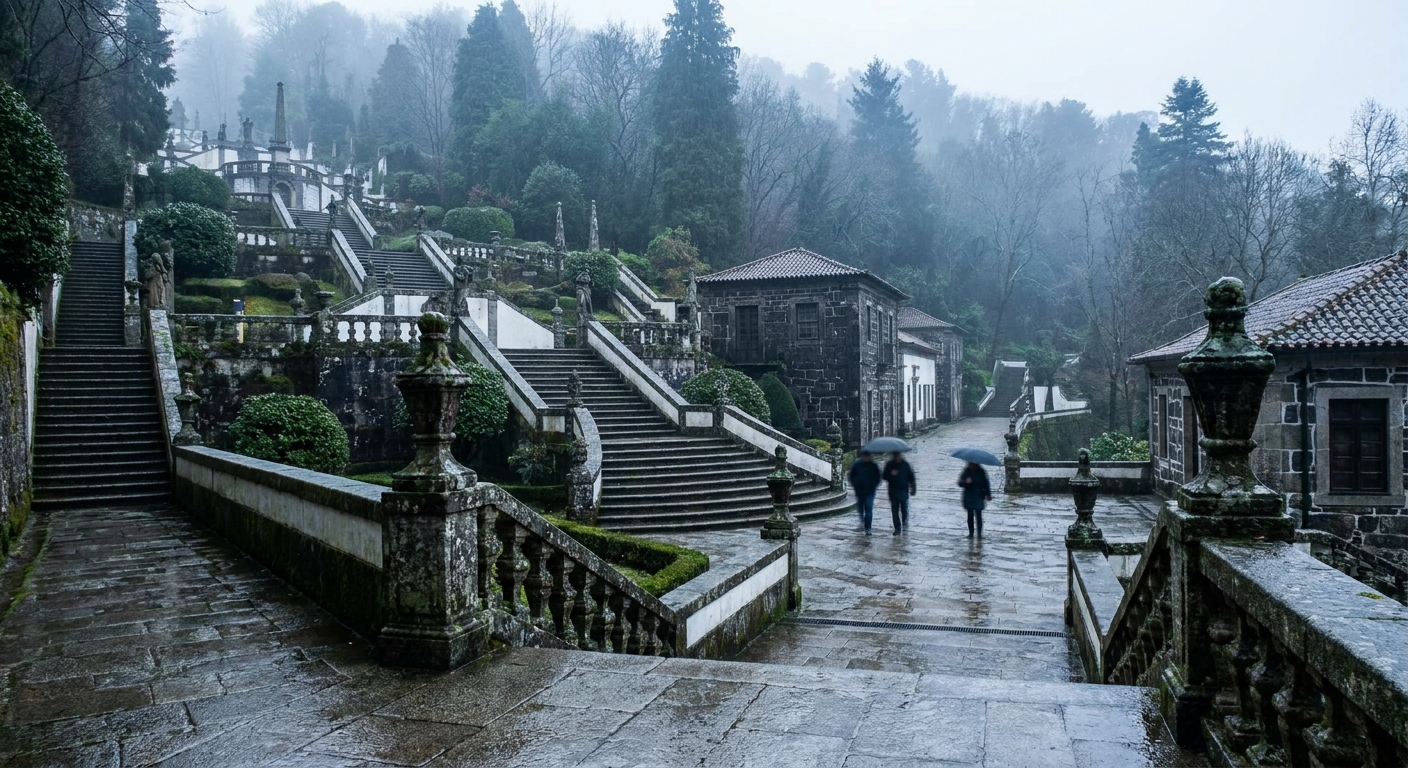
THE MONTH AT A GLANCE · BRAGA IN JANUARY
January gives Braga 57.4°F afternoons, 37.6°F nights and 7.07 inches of rain across 13.1 wet days, a fair trade if you take your outdoor block before the 5:29 p.m. sunset and keep an indoor one in reserve.
IPMA NORMALS 1991-2020 · STATION 622 BRAGA MERELIM · 9H 33M OF DAYLIGHT ON JAN 15
Go for: the Bom Jesus stairway at 57.4°F instead of summer heat, short train hops to Guimarães and Porto, and a university city that runs on local custom in midwinter.
Think twice before: stacking outdoor days back to back: 6.2 days in an average January drop 0.39 inch of rain or more, and the light is gone by 5:29 p.m.
Normals: IPMA station 622 Braga Merelim · Daylight: sunrise-sunset.org · full sources at the end
On this page
- Average highs, lows and rain days in JanuaryThe IPMA normals, 57.4°F and 7.07 inches
- How cold it gets at night, and what to wear37.6°F lows and a 19.8-degree swing
- Crowds and prices in JanuaryWhat we can and cannot verify
- Things to do in Braga in JanuaryBom Jesus, the Sé, Theatro Circo, the Roman baths
- A two-day plan built around a 5:29 p.m. sunsetTwo days, hour by hour
- January vs December and FebruaryHow the three months compare, in figures
- Is January a good month to go?Who should go, who should wait
The year-round Braga, neighborhoods and the Guimarães day trip included, sits in the city guide, and the country-wide calendar in our best-time verdict. January’s own arithmetic starts with the thermometer.
Braga weather in January: average highs, lows and rain days
| January at Braga Merelim | Value |
|---|---|
| Average high | 57.4°F (14.1°C) |
| Average low | 37.6°F (3.1°C) |
| Monthly precipitation | 7.07 in |
| Days with 0.04 in or more | 13.1 |
| Days with 0.39 in or more | 6.2 |
| Daylight on January 15 | 9 hr 33 min |
| Sunrise / sunset, January 15 | 7:56 a.m. / 5:29 p.m. |
Every figure here comes from one thermometer: IPMA station 622 at Braga Merelim, 68.4 m above sea level (224 feet), 1991-2020 normals. That is a measured station record, not a model grid cell. It also describes the valley floor and nothing else: the high ground north and east toward Gerês runs colder and far wetter, and a reading from the coast behaves differently again. Pack for a mountain trail on these numbers and you will be underdressed by the first switchback.
An average January records 13.1 days with at least 0.04 inch of rain, and 6.2 of those reach 0.39 inch or more. Translated into a week, something measurable falls roughly two days in five, and one day in five is a genuine soaking rather than a passing shower. Those thresholds are IPMA’s own, not the 0.10-inch cutoff American tables use, so the two counts are not interchangeable.
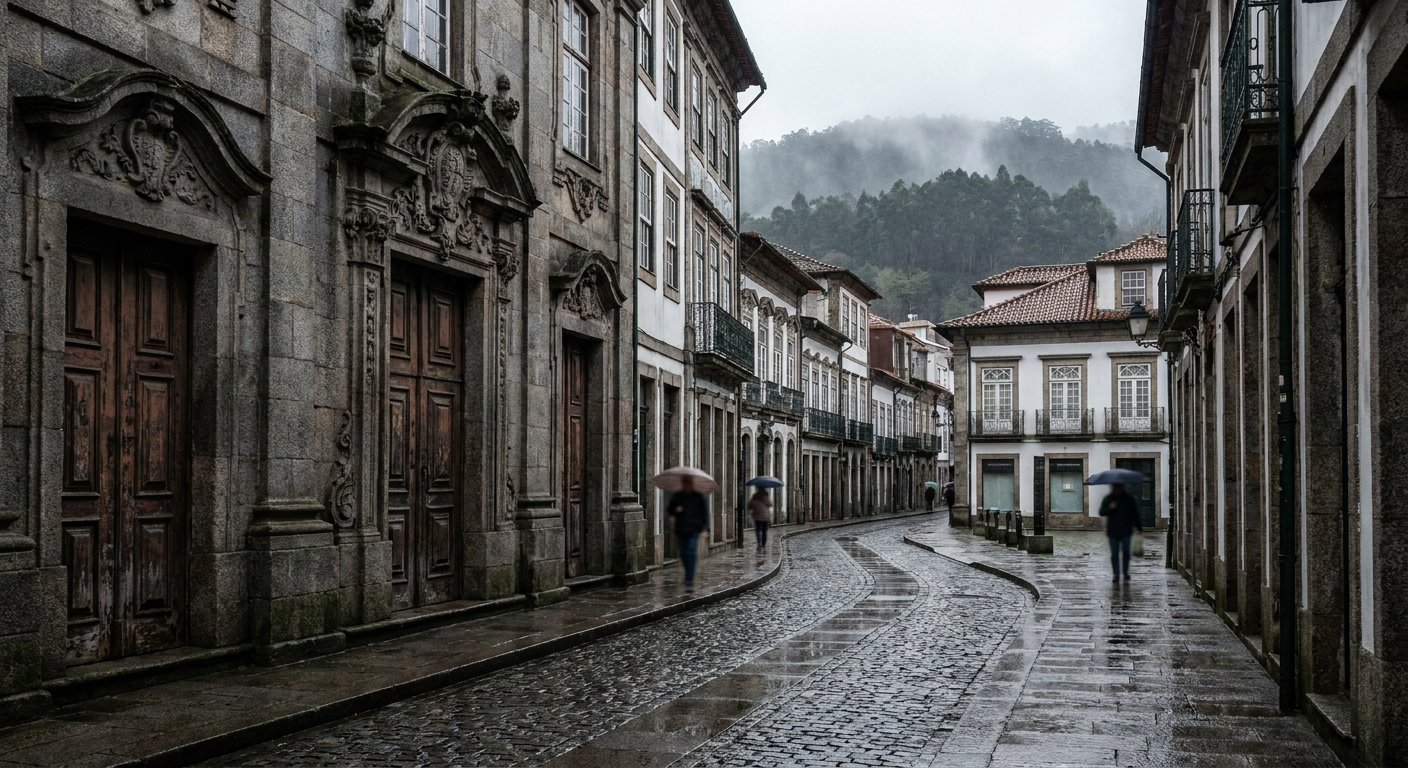
Between the 57.4°F afternoon and the 37.6°F night sits 19.8 degrees of swing, and that decides the suitcase more than the monthly rain total does. A warm mid-layer you can strip at noon, a waterproof shell rather than an umbrella, and shoes with grip: the old center is paved in granite, and granite under seven inches of monthly rain is slick. Our packing guide has the full list.
On January 15 the sun rises at 7:56 a.m. and sets at 5:29 p.m., which works out to 9 hours 33 minutes of daylight. Portugal runs on UTC in winter, so those clock times are the raw UTC values with nothing added. Outdoor light is effectively finished by half past five, and anything you want to see from the top of a stairway belongs in the early afternoon.
How warm is Braga in January?
The month averages a high of 57.4°F and a low of 37.6°F, which puts the round-the-clock mean near 47.5°F. Both of those are thirty-year averages of daily readings, so no single day owes you either one. Warm Atlantic spells push afternoons well past the average, and a clear northern airflow drags them under it.
In practice the day splits in two. At nine in the morning the thermometer sits nearer the night’s 37.6°F than the afternoon’s 57.4°F, so that is coat, hat and hands-in-pockets weather on a stone street. By two or three, with sun, the same street in shirtsleeves and a sweater is comfortable, and the Bom Jesus climb will overheat you inside ten minutes.
We found no frost-day count in the IPMA normals we read, so we give no number of nights below freezing. The average low of 37.6°F sits 5.6 degrees above it, and a monthly mean is not a floor: still, clear inland nights run several degrees under the average, and ice on a windshield in the Minho in January surprises nobody who lives there.
How busy is Braga in January? Crowds and prices
January falls in the middle of Portugal’s low season, after the New Year and well before Easter, which is a calendar fact rather than a price one. We found no occupancy series and no monthly hotel-rate series for Braga, so we crown no month the cheapest and quote no rate. What is safe to say is that Braga is a university and office city first: its winter restaurants lean on local custom, not on visitors.
We could not verify a booking lead-time series either, so we name no number of weeks in advance. The variable that genuinely moves in January is weather risk, and 6.2 heavy-rain days per month is the reason a refundable room beats a rigid bargain. Trains between Porto, Braga and Guimarães run frequently enough to be decided the night before, as our transport guide sets out.
We could not verify whether Braga levies a municipal lodging tax, or at what rate, so we give no percentage. Several Portuguese cities bill one per person per night at check-out, and the only reliable move is to ask the property directly when you reserve so the figure does not surprise you on the way out.
One line item changes January more than any other: heating. Older Portuguese buildings were not designed around cold, wet winters, and a room with a radiator that actually works, plus somewhere to dry a coat overnight, is worth paying up for in a month with 7.07 inches of rain. A view over the rooftops is not.
Things to do in Braga in January
The climb is what January allows and July argues with. Bom Jesus do Monte is a long uphill in the open, and taking it at 57.4°F is a different exercise from taking it in summer heat. The constraint is the clock, not the cold: with the sun down at 5:29 p.m., the month gives you one solid outdoor block and one indoor block per day, so pick both in advance.
Bom Jesus do Monte sits above the city to the east, pairing its zigzag baroque stairway with a water-counterweight funicular on the same slope. Down in the center, the Sé and its treasury museum anchor the old streets, Theatro Circo faces the Avenida da Liberdade, and the Jardim de Santa Bárbara sets formal beds against the walls of the Archbishop’s Palace. The Roman baths at Alto da Cividade are what remains above ground of Bracara Augusta.
The buildings are the same in January as in August. Everything around them is not: wet steps across 13.1 rain days are genuinely slippery, the gardens are bare rather than in flower, and at a 47.5°F daily mean the inside of an unheated stone church can feel colder at two in the afternoon than the street outside it. Keep the coat on indoors.
We could not verify any January-only free admission in Braga, so we name none. What costs nothing in any month is the walking: the granite lanes of the center, the Jardim de Santa Bárbara, the terrace at the top of the Bom Jesus stairway once your legs have paid for it, and the view back down the slope on one of the month’s clear afternoons.
Braga in January: a two-day itinerary
Day one runs off the 7:56 a.m. sunrise. Breakfast indoors, on the street by nine, when the air is still nearer 37.6°F than 57.4°F, and give the Sé and the surrounding lanes the morning. Take a long lunch while the afternoon warms. At two, go up to Bom Jesus on foot and ride the funicular back down, so the stairway happens in the warmest hours. Be back in the center before the 5:29 p.m. sunset.
Day two flips the order and starts indoors: the cathedral treasury, the market, Theatro Circo and the Avenida, then the Jardim de Santa Bárbara and the Roman baths once the sun is up over the rooftops. If the sky turns, and on 6.2 days in an average month it turns hard, keep everything within the center where the next doorway is a block away, or take the train to Guimarães and save the walking for the following clear afternoon.
Braga in January vs December and February
| IPMA 1991-2020, station 622 | December | January | February |
|---|---|---|---|
| Average high | 58.8°F | 57.4°F | 59.9°F |
| Average low | 38.7°F | 37.6°F | 38.1°F |
| Precipitation | 7.49 in | 7.07 in | 4.37 in |
| Days with 0.04 in or more | 13.3 | 13.1 | 9.6 |
Of the three, January is the coldest on both counts, 57.4°F by day against February’s 59.9°F, and 37.6°F by night against December’s 38.7°F. Rain is where the gap opens: February takes 4.37 inches over 9.6 wet days, which is 2.70 inches and 3.5 wet days less than January. As for water temperature, Braga is an inland city and we could not verify a sea-surface series for the nearest coast, so we give no sea temperature for Braga.
Push the trip four weeks forward and you gain 2.5 degrees on the afternoon, nearly three inches less rain and three and a half fewer wet days, with longer light on top. You lose almost nothing measurable: February’s night low of 38.1°F is half a degree off January’s. Pull the trip four weeks back into December instead and you buy 1.4 degrees of daytime warmth for an extra 0.42 inch of rain.
Is January a good time to visit Braga?
Yes, if your Braga is a walking city with long lunches, church interiors and one big climb, and you own a waterproof shell. A 57.4°F afternoon is comfortable for exactly that. No, if the trip depends on sitting outdoors, on gardens in flower, or on chaining three outdoor days without a fallback, because two days in five will have rain in them and one in five will have a lot of it.
If that second description is yours, wait for February. Same city, 59.9°F days, 4.37 inches of rain across 9.6 wet days, and the odds of a dry stretch improve rather than merely shift. December is the weaker swap: warmer by 1.4 degrees, wetter by 0.42 inch, and busier around the holidays for reasons that have nothing to do with Braga.
What January holds over both neighbors is the discipline it forces: 9 hours 33 minutes of daylight makes you choose one outdoor block a day and commit to it, and the climb to Bom Jesus is easier in this month’s air than in any warm one.
The last word
Decide on rain, not on temperature: December and January sit two-tenths of a wet day apart, 13.3 against 13.1, so choosing between them on the weather is choosing noise, while February drops to 9.6 and changes the trip. Whichever you book, take the stairway early in the afternoon, keep the treasury museum in your pocket for the day the sky goes gray, and check that the radiator works before you unpack.
Sources & data for this guide
- January normals, rain-day counts and station altitude (57.4°F / 37.6°F, 7.07 in, 13.1 and 6.2 days, 68.4 m) · IPMA, normais climatológicas 1991-2020, station 622 Braga Merelim · checked Sep 23, 2026
- December and February normals, same station and same period · IPMA 1991-2020 · checked Sep 23, 2026
- Sunrise 7:56 a.m., sunset 5:29 p.m. and 9 hr 33 min of daylight on January 15 · sunrise-sunset.org · checked Sep 23, 2026
- We found no occupancy series and no monthly hotel-rate series for Braga, so we crown no month cheapest and quote no rate.
- We could not verify a municipal lodging tax for Braga, so we give no percentage.
- We could not verify 2026 admission prices or winter hours for Bom Jesus do Monte, the Sé, Theatro Circo or the Roman baths at Alto da Cividade · confirm with the operators when you book.
- Site descriptions and the two-day sequence are editorial.
To plan your stay
- Best Time to Visit Braga: Month-by-Month Weather, Rain Days and the Low Season
- Braga in February: Weather, Rain Days and How It Compares to January and March
- Braga in December: Weather, Rain Days and How It Compares to November
- Braga in March: Weather, Rain Days and How It Compares to February and April