
ALBUFEIRA · MARCH · THE ALGARVE
By the middle of March the sun comes up at 6:40 in the morning and goes down at 6:40 at night, twelve hours to the minute. Afternoons average 66.0°F, more than three degrees up on February, and the cliff paths above town turn back into something you walk in a shirt. What the month holds back is the water. The sea off Albufeira averages 60.9°F, a shade cooler than February’s 61.3°F, because the Atlantic warms weeks behind the air.
Walkers, golfers and anyone who came for the coastline do well out of that gap. Anyone who booked an Algarve week picturing long swims does not. Those two facts decide almost everything else about a March trip here, from which hotel you pay extra for to whether you shift the whole thing to four weeks earlier or four weeks later.
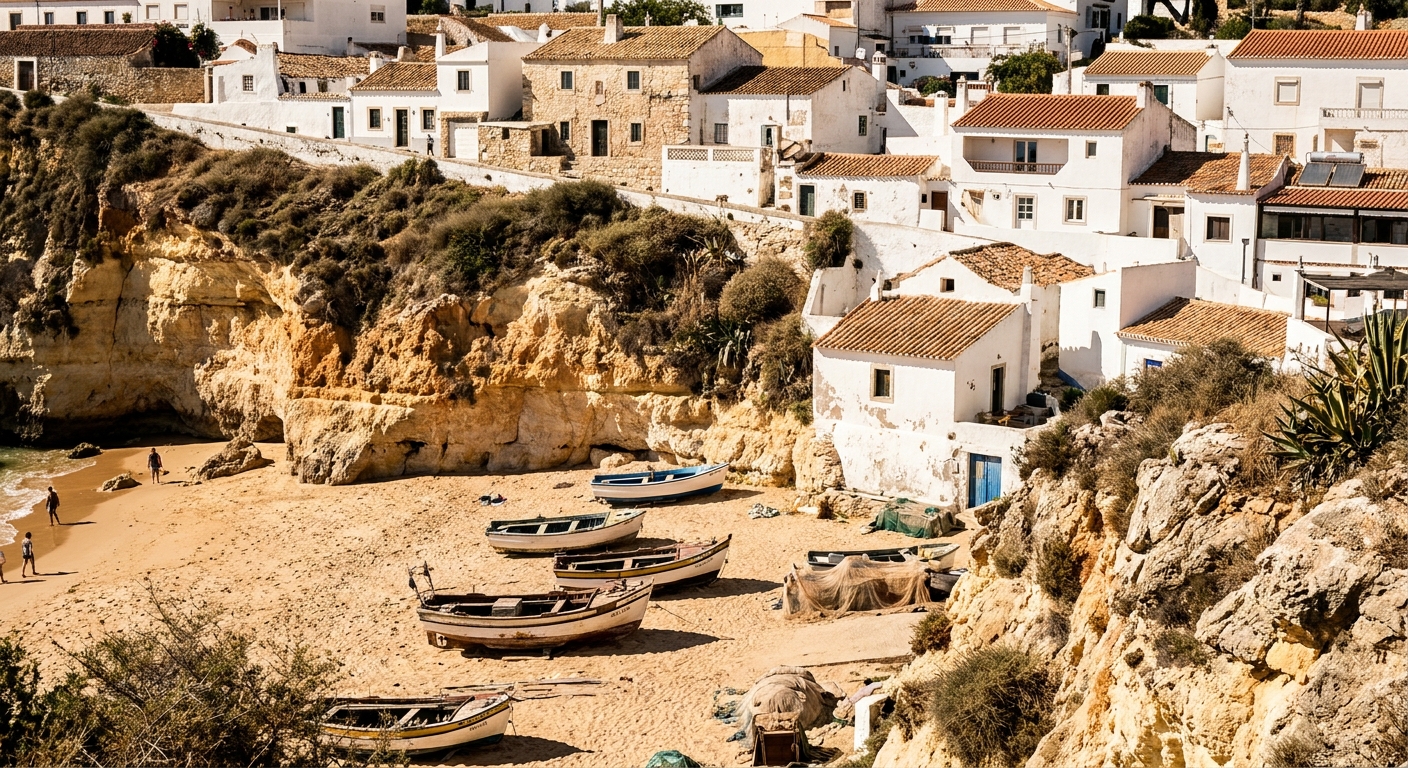
THE MONTH AT A GLANCE · ALBUFEIRA IN MARCH
March gives Albufeira 66.0°F afternoons, twelve hours of daylight and an Old Town you can cross at midday, and asks you to accept a 60.9°F sea in exchange.
AVG HIGH 66.0°F · AVG LOW 51.4°F · 5.6 WET DAYS · SEA 60.9°F · LOW SEASON
Go for: clifftop walking at 66.0°F, the Old Town without a queue, boat weather that costs low-season money, and light that lasts until 6:40 pm.
Think twice before: booking a swimming holiday. The sea averages 60.9°F, slightly below February’s 61.3°F, and April adds only 2.6 degrees.
Air: IPMA station 554, Faro, 1991-2020 · Sea: Open-Meteo Marine, 2015-2024 · full sources at the end
On this page
- Average highs, lows and rain days in March66.0°F days, 5.6 wet days
- Sea temperature in March60.9°F, and what it feels like
- How busy Albufeira is in MarchLow season, booking and the lodging tax
- Things to do in MarchFalésia, the Old Town, the marina
- A two-day plan for AlbufeiraTwo days built around a 6:40 pm sunset
- March, February or AprilHow the three months compare
- Is March a good time to visit?Who should go, who should wait
Every figure here comes from two very different instruments. The air normals are read at IPMA station 554 in Faro, a real thermometer 5.0 m above sea level at the eastern end of the Algarve, over 1991 to 2020. The water comes from a marine model, not a buoy. Albufeira sits further west along the same coast, so treat the air numbers as coastal Algarve rather than street-corner Albufeira, and treat none of them as a guide to the hills inland, which run colder and far wetter. For everything that is not dated to March, our Algarve guide carries it.
Albufeira weather in March: average highs, lows and rain days
| Measure | March | Where it comes from |
|---|---|---|
| Average high | 66.0°F (18.9°C) | IPMA station 554, Faro, 1991-2020 |
| Average low | 51.4°F (10.8°C) | IPMA station 554, Faro, 1991-2020 |
| Precipitation | 1.84 in | IPMA station 554, Faro, 1991-2020 |
| Days with 0.04 in (1 mm) or more | 5.6 | IPMA thresholds, not the US 0.10-inch count |
| Days with 0.39 in (10 mm) or more | 1.6 | IPMA thresholds |
| Sea surface | 60.9°F (16.1°C) | Open-Meteo Marine, mean of daily maxima 2015-2024 |
| Daylight, March 15 | 12h 00m | sunrise-sunset.org |
The air numbers belong to IPMA, Portugal’s national weather service, and to one station: number 554 at Faro, 5.0 m above the sea, averaged over 1991 to 2020. March there runs 66.0°F by day and 51.4°F by night. A mean is a mean, so half the afternoons beat 66.0°F and a few of them sit well under it, and the 1.84 inches of rain that the month carries do not fall evenly across thirty-one days.
Rain of 0.04 inch or more is recorded on 5.6 days in an average March, roughly one day in five. Only 1.6 of those reach 0.39 inch, the kind of downpour you sit out rather than walk through, which works out at about a one-in-three chance of drawing a heavy day inside a week-long stay. Note the thresholds: IPMA counts from 1 mm, while American tables usually start at 0.10 inch, so the two sets of wet-day figures are not interchangeable.
Subtract the low from the high and March leaves a 14.6-degree spread inside a single day. One layer carries you from late morning until the light starts to go, and then 51.4°F arrives on an unheated terrace at dinner. A fleece and long trousers in the day bag settle it, and a swimsuit is for the pool rather than the shoreline. Our packing guide has the rest of the list.
On March 15 the sun rises at 6:40 am and sets at 6:40 pm local time, twelve hours flat. That is enough light for a clifftop walk after a long lunch, which the December version of this town does not offer. Plan the last outdoor thing of the day to finish around 6:30 and expect the terrace to empty soon after, because the temperature drops with the sun rather than lagging behind it.
Can you swim in Albufeira in March? Sea temperature and what it feels like
The marine model puts the water off Albufeira at 60.9°F for March, averaged over 2015 to 2024. One detail changes how you read it: that figure is the mean of DAILY MAXIMA, the warmest point of each day, so it runs a shade above what a full 24-hour average would give. It also comes from Open-Meteo’s marine grid rather than from a thermometer someone reads, which makes it a softer number than the IPMA air normals above.
Swimmers arriving from a New England June will recognize 60.9°F immediately. For everyone else it is wetsuit water: a dip is available to anyone willing to shout about it, a swim needs neoprene, and children last about as long as it takes to photograph them. Hotel pools do the actual swimming in March, and the heated ones do it properly. Surfers and paddleboarders, who arrive dressed for it, treat the same number as a non-issue.
We found no wind or wave series for March off this stretch of coast, so we give no figures for either, and boat operators cancel on conditions we cannot forecast from a page. What the data does show is how slowly the water moves: 61.3°F in February, 60.9°F in March, 63.5°F in April, a band of 2.6 degrees across three months while the air climbs nearly seven.
How busy is Albufeira in March? Crowds, prices and the lodging tax
A 60.9°F sea does not fill a beach resort, and March in Albufeira shows it. The strip that queues in August has tables free at eight, and the Old Town squares are walkable at midday. We found no occupancy series and no monthly room-rate series for the town, so we crown no month cheapest and attach no percentage to the difference. What the weather table supports is simpler: the month brings the air up to 66.0°F while leaving the water roughly where February left it, and demand follows the water.
Book the car before the room. We hold no rate data for Albufeira, so any lead time is editorial judgment rather than measurement, and a few weeks out is usually enough for a bed in a month like this. The rental counters at Faro airport are the part that punishes late decisions, and the tolls and insurance traps that come with them are laid out in our car rental guide. The Faro page covers the airport end.
We could not verify whether a municipal lodging tax applies in Albufeira or at what rate, so we quote no per-night figure. Ask at check-in, and expect any such charge to be collected at the property rather than through the booking site.
Pay extra in exactly one place: the heated pool. With the Atlantic at 60.9°F, the pool is where anyone in your party actually swims, and an unheated one in March is decoration. A sea view costs more and delivers less in a month with 5.6 wet days. If the budget stretches to one upgrade, make it the water you can get into.
Things to do in Albufeira in March: Praia da Falésia, the Old Town and the marina
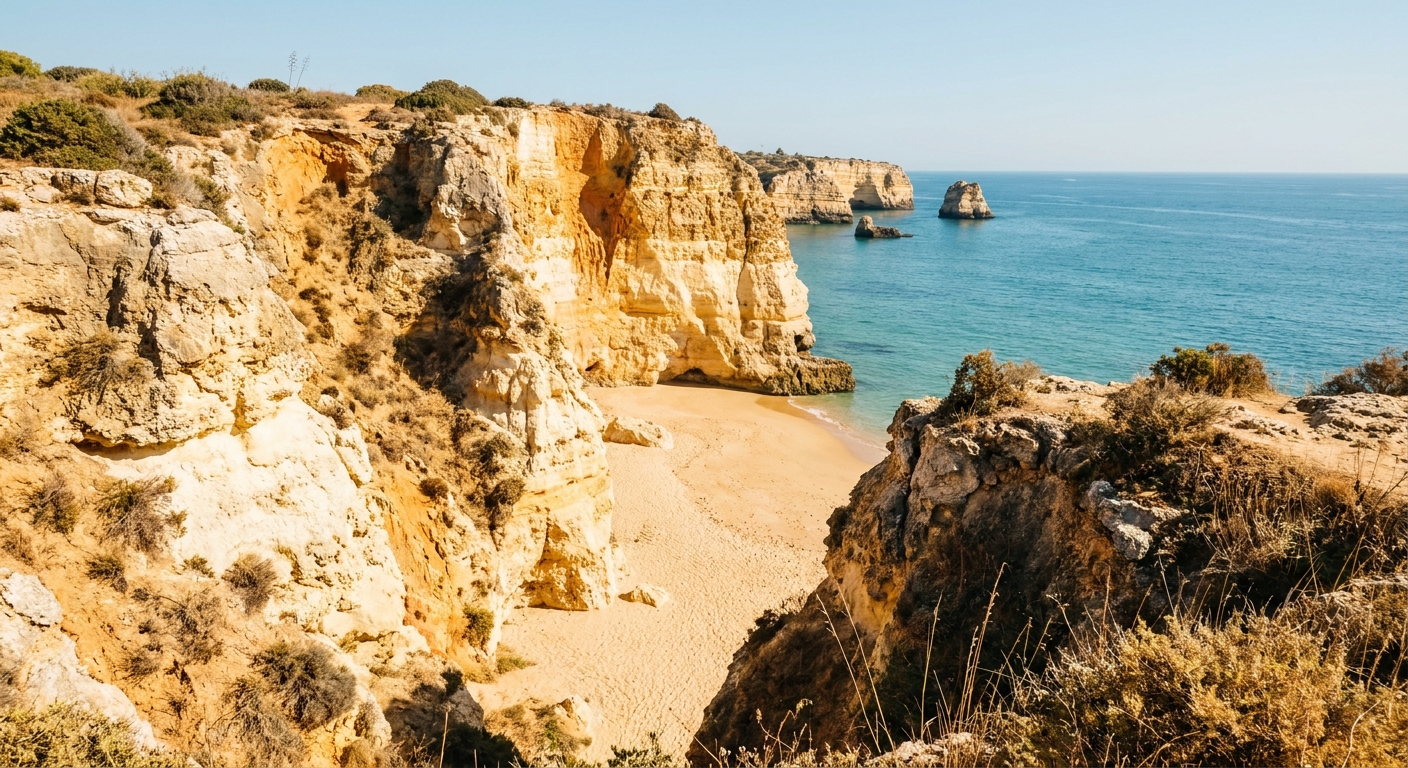
66.0°F on an exposed clifftop is walking weather, and that is what March does for Albufeira that high summer cannot. The coastal paths have no shade worth the name, the ochre cliffs hold heat, and twelve hours of daylight means you can do a long walk and still have the afternoon. Golfers get the same deal. The one thing the month removes is the beach day in its swimming sense.
The named targets: Praia da Falésia, the long ochre-cliff beach east of town, best walked at the waterline in one direction and returned along the top. Praia dos Pescadores, directly below the Old Town and reached through the tunnel cut into the cliff. Praia de São Rafael and Praia da Coelha to the west, small and rock-framed. And Marina de Albufeira, where the boats leave for the coast toward Benagil. We could not verify March sailing times or fares for the marina operators, so we quote none.
Across February, March and April the sea spans just 2.6 degrees while the air climbs 6.7, from 62.6°F to 69.3°F. That is why these places change character in March without changing temperature: the same beach that was a cold walk in February is a warm one now, and the water underfoot has barely noticed. Treat Falésia and Coelha as walking beaches, and keep the swimming ambitions for later in the year.
Free in March, as in every month: the beaches themselves, the clifftop paths between them, the Old Town square, and the 6:40 pm sunset from any western-facing edge of the cliffs. On the 1.6 days that bring 0.39 inch or more, the free list runs out fast, which is the argument for having one indoor plan per week ready before you arrive.
Albufeira in March: a two-day itinerary
Day one, start at nine rather than at first light: the 51.4°F night air needs a couple of hours of sun on it. Walk Praia da Falésia from the eastern end while the cliffs are lit, turn back inland for lunch around one, and give the Old Town and the cliff tunnel down to Praia dos Pescadores the mid-afternoon, when 66.0°F makes the stairs pleasant. Be somewhere west-facing by 6:20 pm for the 6:40 sunset, and have the fleece with you, because the terrace cools quickly after it.
Day two belongs to the marina: a morning boat along the cliffs if the operators are sailing, then São Rafael and Coelha on foot in the afternoon. If the sky turns, and one March day in five brings measurable rain, drive instead. Faro gives you an old town under cover in under an hour of road, and Carvoeiro works as a short wet-weather alternative. Keep the boat booking loose until you have seen the forecast for the second half of the week.
Albufeira in March vs February and April
| February | March | April | |
|---|---|---|---|
| Average high | 62.6°F (17.0°C) | 66.0°F (18.9°C) | 69.3°F (20.7°C) |
| Average low | 47.8°F (8.8°C) | 51.4°F (10.8°C) | 54.3°F (12.4°C) |
| Precipitation | 1.65 in | 1.84 in | 1.54 in |
| Days with 0.04 in or more | 5.4 | 5.6 | 5.3 |
| Sea surface (daily maxima) | 61.3°F | 60.9°F | 63.5°F |
Between February and April the average high climbs 6.7 degrees, and March at 66.0°F sits almost exactly halfway. Rain runs against that grain: March is the wettest of the three at 1.84 inches, against 1.65 in February and 1.54 in April, even though the count of wet days barely moves at 5.4, 5.6 and 5.3. The sea is the outlier. February’s 61.3°F is actually warmer than March’s 60.9°F, and only April breaks 63°F. Air figures are IPMA’s, sea figures the marine model’s.
Shift the trip four weeks later and you gain 3.3 degrees of afternoon, 0.30 inch less rain and 2.6 degrees of water, and you start sharing the coast with the spring arrivals. Shift it four weeks earlier and the afternoons drop 3.4 degrees and the nights 3.6, for a sea that is 0.4 degrees warmer, which is no reason at all to do it. The full February picture makes that case in detail.
Is March a good time to visit Albufeira?
Yes, for walkers, golfers, photographers and couples who want an Algarve town with room in it. Twelve hours of daylight, 66.0°F afternoons and a coastline you can have to yourself for stretches is a strong offer at low-season prices. No, for families whose whole idea of the trip is children in the sea, and no for anyone who cannot cope with 5.6 wet days and the odd washed-out afternoon.
If the trip is built around swimming, book April. Of the two neighboring months it is the only one that lifts both numbers, adding 3.3 degrees to the afternoon and 2.6 to the water, and it also brings the driest of the three months at 1.54 inches. Even then, 63.5°F is a brisk Atlantic, so the heated pool argument survives the move.
Of these three months, March holds the biggest single step up in afternoon warmth, 3.4 degrees over February, and it delivers that step to a town still running at low-season pace.
The last word
Book the room with the heated pool, keep the boat trip unbooked until you have seen the week ahead, and let the walking carry the trip. One number has not come up yet: March nights average 51.4°F against February’s 47.8, so dinner outdoors stops being an act of endurance and becomes merely brisk. Warmth arrives in the air first and the Atlantic follows weeks behind, which is the whole shape of March here. Pack the fleece for 6:40 pm, and ask the hotel whether the pool is heated before you pay for it.
Sources & data for this guide
- March, February and April air normals (highs, lows, precipitation) · IPMA, normais climatológicas 1991-2020, station 554 Faro, altitude 5.0 m · checked Sep 23, 2026
- Wet-day counts at the 1 mm (0.04 in) and 10 mm (0.39 in) thresholds · IPMA, same station and period · checked Sep 23, 2026
- Sea surface temperature, mean of daily maxima 2015-2024 · Open-Meteo Marine API · checked Sep 23, 2026
- Sunrise 06:40 and sunset 18:40 UTC on March 15, twelve hours of daylight, converted to local time · sunrise-sunset.org · checked Sep 23, 2026
- Scope caveat: the Faro station sits at the eastern end of the Algarve while Albufeira is central, and inland high ground is colder and considerably wetter than either.
- We could not verify a lodging tax rate, hotel occupancy or monthly room rates for Albufeira, nor March fares and sailing times for the marina operators, so we give no figures for any of them.
- Walking routes, beach descriptions and the two-day plan are editorial · hours, fares and boat schedules change, so check operators when you book.