
GUIMARÃES · SEPTEMBER · FIRST CAPITAL OF PORTUGAL
Average highs of 74.3°F, sunset at 7:45 p.m. on the 15th and 5.8 days of measurable rain: that is what September puts on the table in Guimarães. For a town whose whole pleasure is crossing it on foot, from the castle at the north end of the old walls to the monastic complex at the south, both standing since somewhere between 950 and 1498, those three numbers decide more than any list of sights.
What the month takes away is dryness. August runs 1.15 inches of rain across 3.2 wet days, September 2.69 inches across 5.8, and October leaves both behind at 5.86 inches and 11.1 wet days. September sits far nearer August than October, and that is the strongest single argument for these four weeks.
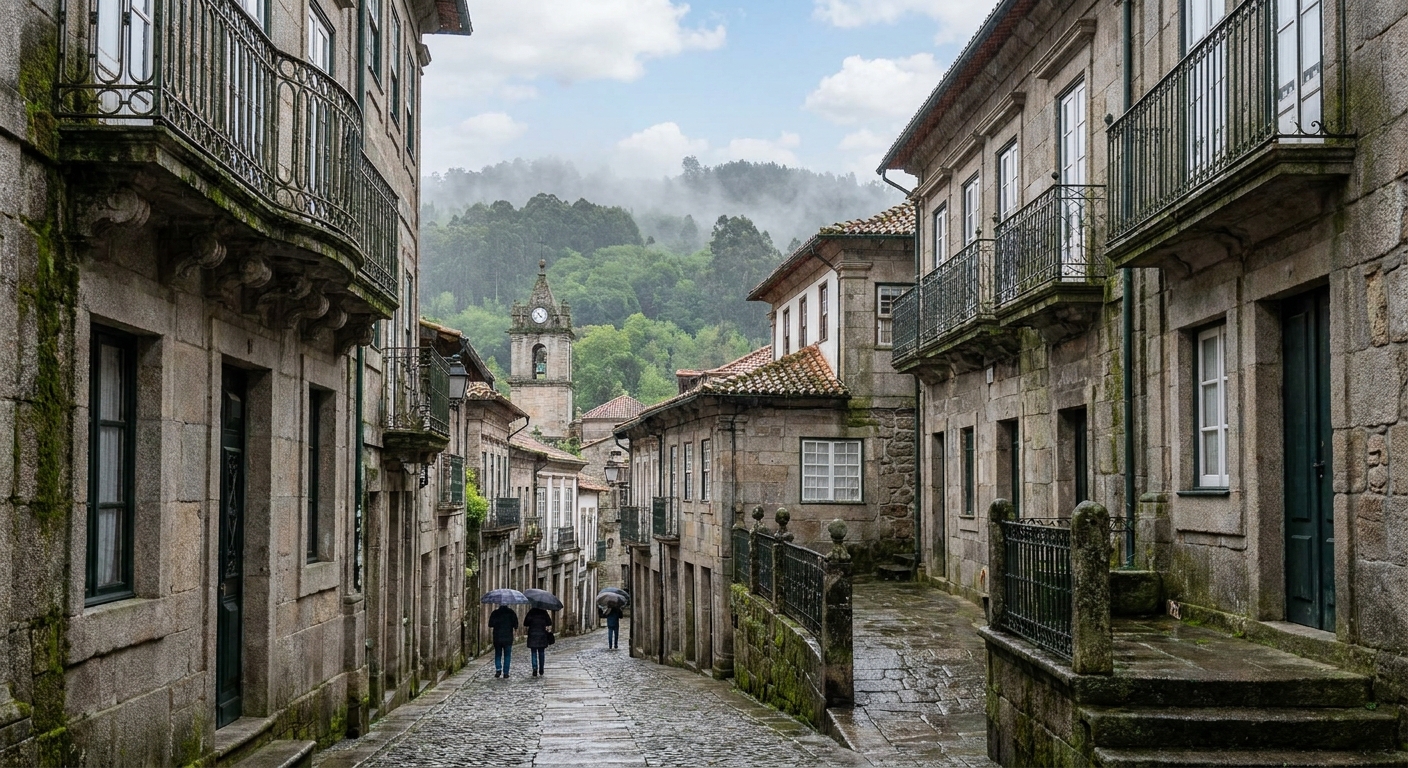
THE MONTH AT A GLANCE · GUIMARÃES · SEPTEMBER
September keeps almost all of August’s warmth, adds a shower pattern you can plan around, and hands you twelve and a half hours of daylight for a town you visit entirely on foot.
HIGH 74.3°F · LOW 58.6°F · 5.8 WET DAYS · SUNSET 7:45 P.M. ON THE 15TH
Go for: a full walking day across the 38.2-hectare UNESCO core, afternoons at 74.3°F, and evenings that stay light until 7:45 p.m.
Think twice before: leaving the rain shell at home. An average September delivers 2.1 days of 0.39 inch or more, and October nearly doubles the wet-day count to 11.1.
Climate: IPMA 1991-2020, station 545 Porto Pedras Rubras · Heritage: UNESCO World Heritage Centre, file 1031bis · full sources at the end
On this page
- September weather in GuimarãesHighs of 74.3°F and 5.8 wet days
- How warm the days and nights getA 15.7°F swing, dawn to afternoon
- Crowds, booking and the tourist taxWhat we can and cannot put a number on
- Things to do in Guimarães in SeptemberThe castle, the monastic pole and Couros
- A two-day plan for the historic centerTwo days, with the rain version
- September against August and OctoberHow the three months compare
- Is September a good time to go?Who should shift, and to which month
One thing to settle before any of it: every figure here comes from a single thermometer, and it is not in Guimarães. IPMA measures these normals at station 545, Porto Pedras Rubras, at 67.7 m on the coast, at the airport your flight probably lands at. Guimarães is inland, so its summer afternoons run warmer than that reading and its winter nights run colder. Take the numbers as the shape of the month. If your trip climbs into the high ground of the north, expect colder and far wetter than anything measured down here.
Guimarães weather in September: average highs, lows and rain days
| Measure | September (1991-2020) |
|---|---|
| Average high | 74.3°F (23.5°C) |
| Average low | 58.6°F (14.8°C) |
| Precipitation | 2.69 in (68.3 mm) |
| Days with 0.04 in or more | 5.8 |
| Days with 0.39 in or more | 2.1 |
| Daylight, Sep 15 | 12h 31m |
| Sunrise and sunset, Sep 15 | 7:14 a.m. · 7:45 p.m. local |
IPMA, Portugal’s national weather service, gives September a mean high of 74.3°F (23.5°C), a mean low of 58.6°F (14.8°C) and 2.69 inches (68.3 mm) of precipitation over the 1991-2020 period. Those come off a real instrument at a real station, not a reanalysis grid cell, and the distinction is worth carrying when you start comparing the tables that come up online. The gap between a station record and a modeled one runs to several degrees on the overnight minimum.
Five point eight wet days means measurable rain roughly one day in five, and 2.1 of them reach 0.39 inch or more: two genuine soakings in a normal September, the rest a matter of an hour under an awning. Read one caution into those counts. IPMA measures from 1 mm and 10 mm, while most American tables start counting at 0.10 inch, so the two sets of figures are not interchangeable and a lower US number does not mean a drier place.
Between the 58.6°F night and the 74.3°F afternoon sit 15.7°F, and inland the real gap is likely wider than the coastal station shows. That is a layering month rather than a summer-clothes month: short sleeves from eleven onward, something with sleeves for the first and last hours, a packable shell for the two heavy days, and flat soles for old stone streets. Our packing guide has the full Portugal list.
Light on September 15 runs 12 hours 31 minutes, sunrise at 7:14 a.m. and sunset at 7:45 p.m. local, and it shortens noticeably by the 30th. In practice you get a cool start at the castle end, a long usable afternoon, and dinner that begins while it is still bright. Anyone who has tried the same itinerary in December knows what four missing hours of daylight do to a hill town.
How warm is Guimarães in September?
The month runs from an average low of 58.6°F to an average high of 74.3°F, a spread of 15.7°F. August opens wider at 16.3°F (60.3 to 76.6) and October narrows to 14.1°F (55.2 to 69.3), so September keeps the shape of late summer while shaving 2.3°F off the top of the afternoon. Those are averages of a thirty-year record, not a forecast, and individual days will sit either side of them.
On the ground that means a sweater or a light jacket for the walk out at 7:14 a.m., nothing on your arms by mid-morning, and the jacket again once the sun goes at 7:45 p.m. Stone streets in the shade stay cooler than the number suggests, and the same stone makes an open square at three in the afternoon feel like the full 74.3°F. Plan the climbing for the morning and the sitting for the late afternoon.
Frost is not a September question here: we found no frost-night count in the normals we read, and the mean low sits 26.6°F above freezing. Swimming is not a Guimarães question either, since the town is inland and no sea figure belongs to it. We could not verify a sea series for the nearest stretch of coast, so we quote none, and when you do find one published as a monthly average, remember that it is usually an average of daily maxima, a little warmer than a true 24-hour mean.
How busy is Guimarães in September? Crowds, prices and the demand peak
We found no occupancy series and no monthly room-rate series for Guimarães, so we crown no month cheap or expensive. What we can name is the calendar: September closes Portugal’s summer season, and the country-wide view of when demand and rates move is laid out in our twelve-month verdict for Portugal. Anyone building a longer trip around these dates will find the shape of it in the guide to Porto and the north.
How far ahead rooms sell in September is something we could not verify, so we give no lead time in weeks. The practical move stands anyway: fix the nights inside the protected core first, because the inscribed property covers just 38.2 hectares and your whole walking day starts and ends inside it, then keep the rest of the itinerary loose. Most of the building stock in that perimeter is privately owned, and nineteen properties within it carry legal protection.
We could not verify a lodging-tax rate for Guimarães, so we quote no percentage. If a municipal tourist tax applies to your stay, it is settled at the property rather than folded into the rate you clicked, so ask at check-in and budget a small unknown. The rest of the money question, meals to car rental, sits in our Portugal cost guide, and the transatlantic half is in flights from the US.
One budget line genuinely changes the month, and it is the address. A bed inside those 38.2 hectares turns the hour after the 7:45 p.m. sunset into a stroll rather than a drive, and on the 2.1 days that drop 0.39 inch or more it turns a wrecked afternoon into a five-minute dash home. Everything else can be decided later, the car included. Our car guide covers the tolls before you pick one up.
Things to do in Guimarães in September
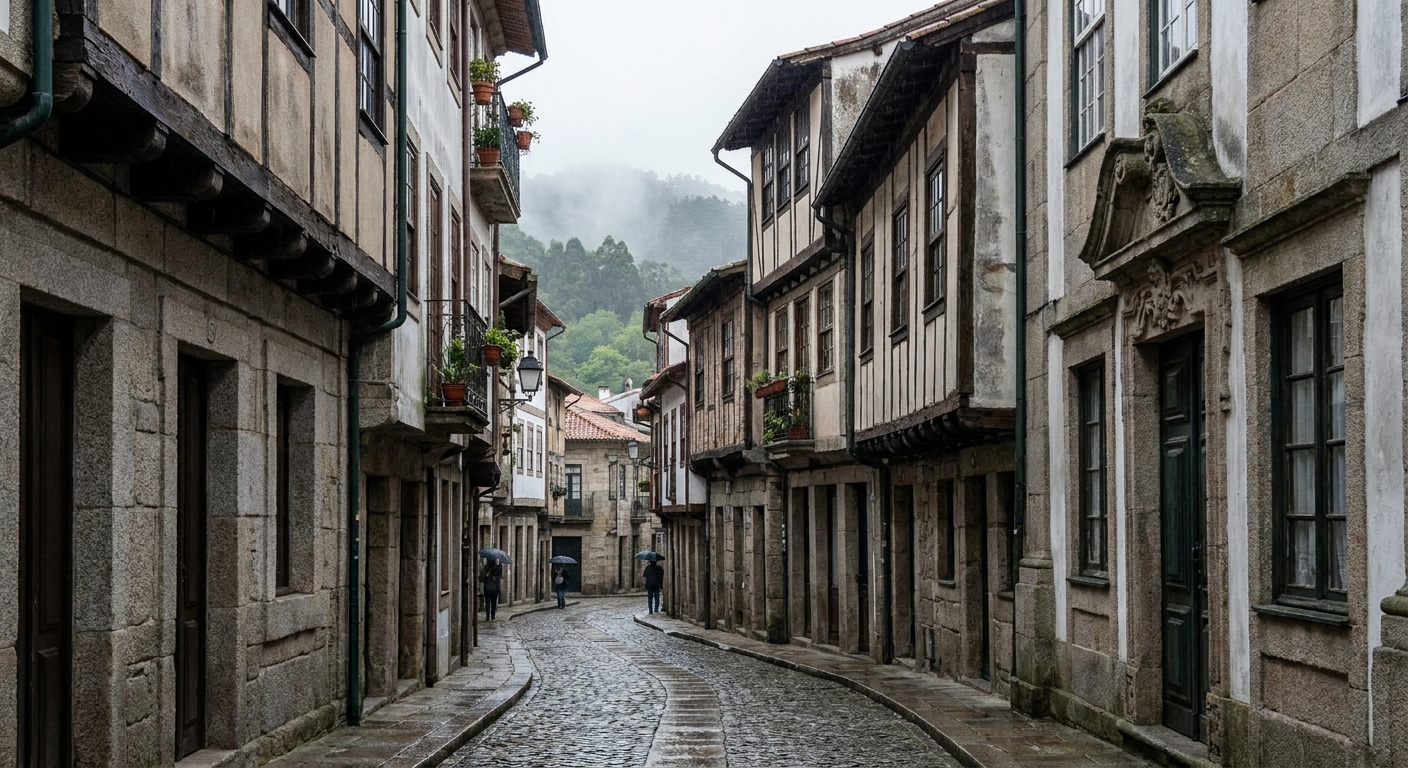
September opens a window October closes. With 5.8 wet days against October’s 11.1, and 12 hours 31 minutes of daylight on the 15th, a whole day on foot is a reasonable plan rather than a gamble. August is drier still at 3.2 wet days, but its afternoons run 76.6°F, and in a town of stone squares heat is harder to dodge than a shower.
The walled town grew around two poles, both in place between 950 and 1498: the castle to the north, the monastic complex to the south. Outside the walls, the Couros Zone takes its name from the leather tanning once practiced there, along with the river, and its tanneries, workers’ houses and open spaces date from the 19th and early 20th centuries. The inscribed property runs to 38.2 hectares with a 129.4-hectare buffer. We could not verify opening hours or admission prices for the castle, the palace or any other monument, so we quote none: check each one before you go.
Nothing in the stonework changes from month to month. The air does, and the 58.6°F to 74.3°F swing is exactly what makes a September day usable from the castle in the morning to the squares built out between 1498 and 1693 after lunch, with the medieval street layout underneath it all. One warning comes from the UNESCO file itself: the Couros Zone is flagged as needing an urgent conservation and rehabilitation strategy, and tourism-driven gentrification is named as a pressure on the property. Walk that quarter with a light step.
A large share of the visit costs nothing. Public spaces inside the perimeter belong to the municipality, so the medieval lanes, the squares of the 1498 to 1693 building campaign and the full 38.2-hectare circuit are free to walk, as are the outer quarters that grew around the Franciscan and Dominican complexes. In September that free walk is available from 7:14 a.m. to 7:45 p.m.
Guimarães in September: a two-day itinerary
Day one goes north to south. Sunrise at 7:14 a.m. puts the first hours near the 58.6°F low, the right temperature for the climb to the castle end of the walls. Mid-morning, drop through the lanes toward the monastic pole at the south, looking up at the granite ground floors carrying half-timbered upper stories. Take a long lunch while the thermometer works toward 74.3°F, then use the squares from four o’clock on, when the low sun does the flattering. Dinner outdoors stays light until 7:45 p.m.
Day two belongs to Couros and the edges: the tanneries, the workers’ housing, the river that carries the trade’s name, then the streets that grew outside the walls. If yours is one of the 2.1 days that drop 0.39 inch or more, flip the order and keep the morning to short hops inside the 38.2 hectares, where nothing is far from cover, saving the longer walking for the clearing. A settled-in rain day is also the day to take the train out; our Braga guide has the shape of that trip, and Porto is the other direction.
Guimarães in September vs August and October
| Measure | August | September | October |
|---|---|---|---|
| Average high | 76.6°F | 74.3°F | 69.3°F |
| Average low | 60.3°F | 58.6°F | 55.2°F |
| Precipitation | 1.15 in | 2.69 in | 5.86 in |
| Days with 0.04 in or more | 3.2 | 5.8 | 11.1 |
Temperature falls on a straight slope: highs go 76.6, 74.3, 69.3, a total of 7.3°F across eight weeks, with lows tracking it at 60.3, 58.6 and 55.2. Rain behaves differently. August at 1.15 inches and September at 2.69 belong to the same conversation, while October’s 5.86 inches over 11.1 days is a different season wearing the same jacket. There is no sea column to fill, since the town is inland and we verified no coastal figure.
Shift four weeks earlier and you buy 2.3°F on the afternoon and drop from 5.8 wet days to 3.2, at the cost of visiting in the middle of the summer season. Shift four weeks later and you give up 5.0°F by day and 3.4°F at night while the wet-day count climbs to 11.1, more than one day in three. Both neighbors have their own page: Guimarães in August and Guimarães in October.
Is September a good time to visit Guimarães?
Yes, for anyone coming to walk a medieval town founded in the 10th century and made the country’s first capital in the 12th. Afternoons at 74.3°F, nights at 58.6°F and twelve and a half hours of light are close to ideal for a place you cross on foot. No, if you need a guaranteed dry week, or if the trip is really about a beach, because this is an inland town and 2.69 inches of rain over 5.8 days is a real pattern rather than a rounding error.
If dry matters most, August is your month: 1.15 inches over 3.2 days, afternoons 2.3°F warmer. If you would rather trade heat for atmosphere, October is the other direction and water is the price, 5.86 inches over 11.1 days with highs down to 69.3°F. Anyone traveling with children who need a pool rather than a cloister should read the tradeoff in our family guide before booking these dates.
Across the three months, only September puts a 74.3°F afternoon and a rain total under three inches in the same square, and for a UNESCO core you walk end to end that combination is the one that counts.
The last word
Book the bed inside the walls, pack one shell for the 2.1 heavy days, and let the 7:14 a.m. sunrise set your climbing hour. One detail the UNESCO file states plainly, and it rewards a slow look upward: the local medieval method of a granite ground floor carrying a half-timbered story above traveled with the Portuguese to Africa and the New World, where it became a characteristic feature of colonial building. Raise your eyes to the second floors as you cross the squares, and you are looking at an export.
Sources & data for this guide
- September normals, high 74.3°F, low 58.6°F, 2.69 in · IPMA, climatological normals 1991-2020, station 545 Porto Pedras Rubras, altitude 67.7 m · checked Sep 24, 2026
- Wet-day counts at the 1 mm and 10 mm thresholds, 5.8 and 2.1 days · IPMA, same station and period · checked Sep 24, 2026. IPMA’s thresholds are not the 0.10-inch threshold used by most US tables.
- August and October normals used in the comparison · IPMA, same station and period · checked Sep 24, 2026
- Daylight of 12h 31m and sun times on September 15, converted from UTC to local time · sunrise-sunset.org · checked Sep 24, 2026
- Inscription, the 38.2-hectare property and 129.4-hectare buffer, the two poles, the Couros Zone, the nineteen protected properties and the conservation warning · UNESCO World Heritage Centre, file 1031bis · checked Sep 24, 2026
- We could not verify opening hours, admission prices, a lodging-tax rate or any occupancy series for Guimarães, so we quote none. The weather station sits at Porto’s airport on the coast, not in the town.