
COIMBRA · MARCH · 1991–2020 NORMALS
Coimbra’s March question is a packing question. Portugal’s national weather service records an average high of 66.4°F and an average low of 46.0°F for the month, with 2.97 inches of rain spread across 9.4 wet days: a cool, changeable spring in a town built on a hill, where the walk from the river up to the university gate is the day’s main exercise.
March gives you temperate walking and daylight that has caught back up with the night. It gives no guarantee of a dry afternoon. Four weeks later the days run 2.5°F warmer and the wet days climb to 10.6; four weeks earlier they run 4.9°F colder. Choosing between the three months is a real decision, and the figures below make it.
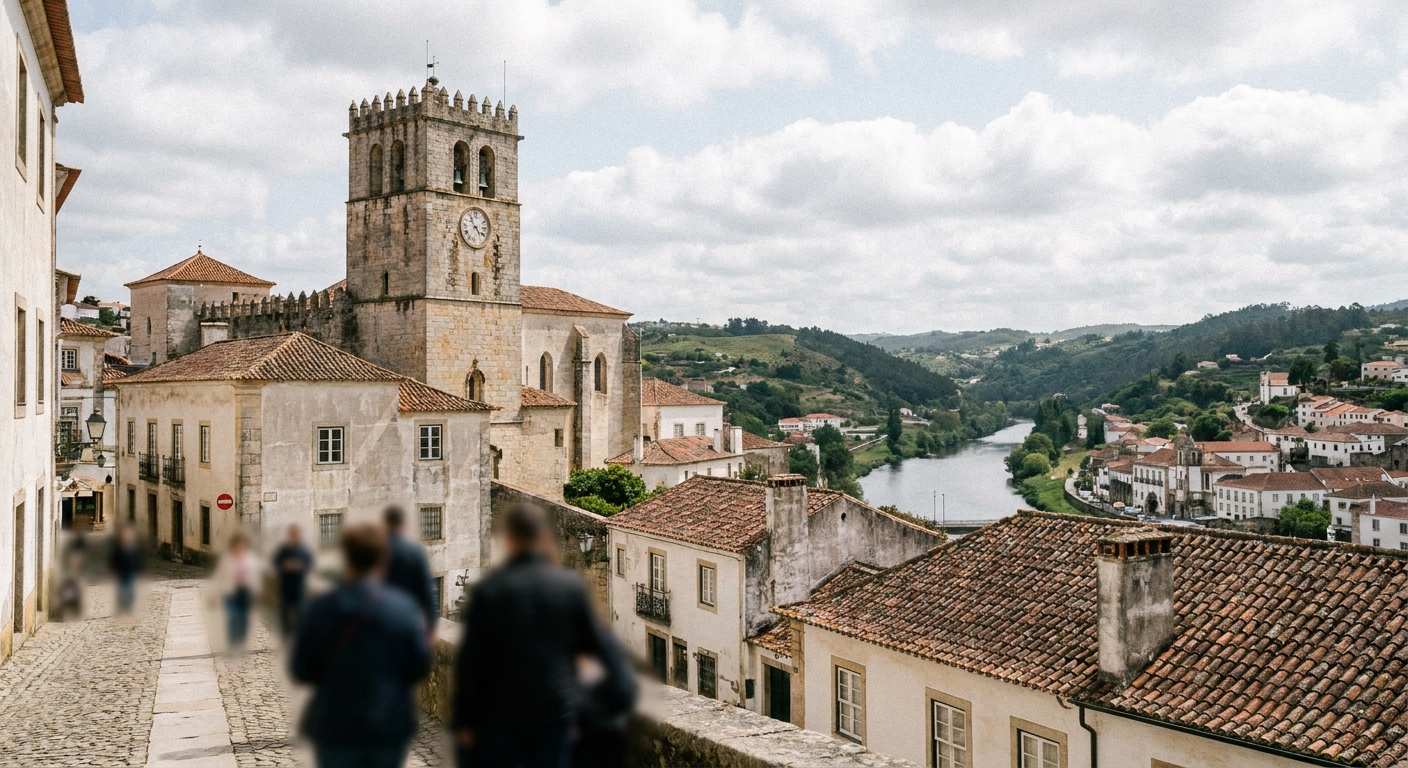
THE MONTH AT A GLANCE · COIMBRA IN MARCH
Two days and a rain shell cover Coimbra in March: 66.4°F afternoons, 46.0°F nights, 9.4 days of measurable rain, and an inscribed old town of 36.2 hectares you can cross on foot.
IPMA 1991–2020 NORMALS · STATION 707 COIMBRA BENCANTA · 9.4 RAIN DAYS
Go for: cool climbing weather in a hill town, 11 hours 59 minutes of daylight at mid-month, and a World Heritage core small enough to walk between showers.
Think twice before: packing for spring alone. Nights average 46.0°F, a 20.4°F drop from the afternoon high, and 2.4 days of the month bring 0.39 inch of rain or more.
Climate: IPMA station 707 Coimbra Bencanta, 1991–2020 · Property: UNESCO ref. 1387bis · full sources at the end
On this page
- Coimbra weather in MarchHighs, lows, 2.97 inches and 9.4 rain days
- How cold the nights get46.0°F before dawn, 66.4°F by mid-afternoon
- Crowds, prices and the lodging taxWhat we verified, and what we could not
- Things to do in Coimbra in MarchThe Joanine Library, Sofia Street, the Botanical Garden
- A two-day plan for a March weekendTwo days, hour by hour, plus the rain version
- March, February or April?How the three months compare, degree by degree
- Is March a good time to visit Coimbra?Our verdict, for and against
Coimbra itself, the shape of the town and the train in from Lisbon, belongs to the city guide, and the country’s twelve-month verdict sits on best time to visit Portugal. Everything here is dated: what March measures, what it costs you in wet afternoons, and whether February or April would serve your trip better.
Coimbra weather in March: average highs, lows and rain days
| Measure | March at Coimbra Bencanta |
|---|---|
| Average daily high | 66.4°F (19.1°C) |
| Average daily low | 46.0°F (7.8°C) |
| Day-to-night spread | 20.4°F |
| Precipitation, monthly total | 2.97 in |
| Days at 0.04 in (1 mm) or more | 9.4 |
| Days at 0.39 in (10 mm) or more | 2.4 |
| Daylight on March 15 | 11 h 59 m · 6:42 a.m. to 6:42 p.m. |
The IPMA, Portugal’s national weather service, publishes these March normals for station 707, Coimbra Bencanta, a thermometer at 26.6 meters in the Mondego valley: 66.4°F average high, 46.0°F average low, 2.97 inches of rain over the month, period 1991–2020. That is a real instrument, not a model grid cell averaged across a wide box, and the distinction shows when you compare tables. Every figure here comes from that valley station. The high ground east of town runs colder and far wetter, and the coast keeps its own weather, so do not pack for a mountain trail on a river-level reading.
Those 9.4 days use the IPMA’s threshold of 1 mm, 0.04 inch, not the 0.10-inch bar most US tables use, so the two counts do not swap. Read it as measurable rain on roughly three days in ten, with 2.4 days reaching 0.39 inch or more: about one March day in thirteen when the rain settles in rather than passes through. A four-night trip has good odds of one wet stretch and poor odds of four.
The 20.4°F gap between afternoon and dawn arrives every day, not just on cold snaps. Pack for both ends: a mid layer you carry at 3 p.m. and want at 8 a.m., a rain shell that folds into a daypack, and shoes that behave on wet stone stairs. The rest of the suitcase is covered in our Portugal packing guide.
On March 15 the sun rises at 6:42 a.m. and sets at 6:42 p.m. in local time, giving 11 hours 59 minutes of daylight, near enough to an even split. In practice you get two sights before lunch, a long afternoon outdoors, and a viewpoint at six with light still on the buildings. Dinner happens after dark either way.
How warm is Coimbra in March, and do the nights freeze?
The month’s two numbers are 66.4°F by day and 46.0°F by night, 20.4°F apart. Against February, the afternoon gains 4.9°F and the night 4.1°F. Against April, it gives up 2.5°F by day and 2.9°F after dark. In a month that swings twenty degrees between breakfast and late afternoon, the range does more to your day than the average does.
Morning starts near that 46.0°F low, so the first hour outside wants a real jacket rather than a sweater, and the shaded lanes below the hill hold the cold longer than the open riverbank. By mid-afternoon the same street reads near 66.4°F and the jacket is in the bag. Three layers, one of them carried by noon, is the working formula.
The IPMA normals give the monthly average low, but we could not verify a count of nights at or below 32°F at Coimbra Bencanta, so we print none. We also found no sea-surface series for the coast west of the city, so no water temperature appears here. Swimming in March is a beach-town question, and our Nazaré and Ericeira pages are where the Atlantic belongs.
How busy is Coimbra in March? Crowds, prices and the lodging tax
We found no occupancy series and no monthly room-rate series for Coimbra, so we crown no month cheap and none expensive. What we can say about March is calendar rather than money: it falls on the way into spring, ahead of the summer months, and inside the university’s working year. UNESCO records that the institution keeps its authenticity of use and its student traditions alive, which is the difference between a town in session and a monument with a turnstile.
No booking-window data for Coimbra beds reached us either, so we name no number of weeks. The lever we can name is geography. The inscribed property covers 36.2 hectares with an 80.8-hectare buffer, so “central” here means a very small area, and the hotels inside it are the ones that fill first for any weekend. Decide the address before you decide the date.
We could not verify a municipal lodging tax for Coimbra, so no per-night figure appears here and we invent none. Ask your hotel at the time of booking rather than discovering it on the bill, and keep the answer in the same column as parking and breakfast. Our Portugal trip cost page handles the wider budget.
The one place where spending more changes the month is the bed’s address. With 9.4 wet days on the record, a room inside the inscribed core removes two climbs a day and turns a rained-out afternoon into a ten-minute retreat instead of a taxi. Anywhere further out, the same afternoon costs a fare or a soaking. Where to stay in Portugal sets the wider pattern.
Things to do in Coimbra in March: the Joanine Library, Sofia Street and the Botanical Garden

March is the month for the climb. At 66.4°F the route up from the river to the Alta is a walk rather than a haul, and the month records 9.4 wet days against April’s 10.6, so the outdoor half of the visit has slightly better odds than four weeks later. February’s 61.5°F afternoons make the same stairs a colder proposition for the same effort.
UNESCO inscribed the University of Coimbra, Alta and Sofia, in 2013 under criteria (ii), (iv) and (vi), with a minor boundary modification in 2019: 36.2 hectares of core zone, an 80.8-hectare buffer, two components. The Alta holds the Royal Palace of Alcáçova, St Michael’s Chapel, the baroque Joanine Library and the colleges of Jesus, Holy Trinity, St Jerome, St Benedict, St Anthony of the Quarry and St Rita. The 18th century added the chemistry laboratories, the Botanical Garden and the University Press.
Interiors do not have seasons: the Joanine Library reads the same in March as in August. The air between the components does. Alta stands on the hill, Sofia Street lies below it, and the Cathedral of Santa Cruz, from the 12th century, stands among the university buildings, so the crossings are outdoor time and 2.4 days of the month deliver 0.39 inch or more. UNESCO flags a loss from the other direction too: the hilltop visibility that makes the university read as a citadel of learning has already been modified by large-scale building in the surrounding landscape.
Walking costs nothing, and in Coimbra that covers a lot of the list. Sofia Street is a public street, and its line of colleges (St Michael, the old Royal College of the Arts used by the Inquisition, Holy Spirit, Our Lady of Carmel, Our Lady of Grace, St Peter of the Third Order, St Thomas, New St Augustine, St Bonaventure) is façade work you read from the sidewalk. The University City built in the 1940s is part of the inscribed property too, not a modern annex to skip.
Coimbra in March: a two-day itinerary
Day one starts low. Out at 9 a.m., when the thermometer is still near 46.0°F, and walk Sofia Street end to end while the shade holds the cold: colleges, façades, no ticket, no queue. Climb to the Alta late morning, then give the afternoon to the university buildings and the Botanical Garden, when the reading is closest to 66.4°F. Sunset on March 15 falls at 6:42 p.m., so a viewpoint at six still has light on the stone. Dinner comes after dark, which in March is every night.
Day two takes the University City of the 1940s and the Cathedral of Santa Cruz, with the riverbank for whatever the afternoon leaves. If it turns out to be one of the 2.4 days that bring 0.39 inch or more, invert the order: interiors in the morning, the garden and the open walking moved to the slot you used on day one, and the rain shell kept on for the crossing between Alta and Sofia. Both versions are worth writing down before you leave the hotel.
Coimbra in March vs February and April
| Measure | February | March | April |
|---|---|---|---|
| Average high | 61.5°F | 66.4°F | 68.9°F |
| Average low | 41.9°F | 46.0°F | 48.9°F |
| Day-to-night spread | 19.6°F | 20.4°F | 20.0°F |
| Precipitation | 3.19 in | 2.97 in | 3.33 in |
| Days at 0.04 in or more | 8.6 | 9.4 | 10.6 |
All three columns come from the same IPMA station and the same 1991–2020 period, so nothing here is estimated. March lands in the middle on temperature and at the bottom on rainfall: 2.97 inches against February’s 3.19 and April’s 3.33. Wet days run the other way, rising steadily from 8.6 to 9.4 to 10.6. No sea-surface temperature could be verified for any of the three months, so the water stays out of the table.
Shift four weeks forward and you gain 2.5°F on the afternoon and 2.9°F on the night, at a cost of 1.2 more wet days and 0.36 inch more rain. Shift four weeks back and you save 0.8 wet days, then pay 4.9°F by day and 4.1°F after dark, with more rain falling on fewer dates. For a walking trip through a hill town, the March compromise is the least awkward of the three.
Is March a good time to visit Coimbra?
Yes, if your visit is an old town on foot and you can absorb rain when it lands. Afternoons at 66.4°F and 11 hours 59 minutes of daylight cover a two-day itinerary without hurry, and the inscribed core is 36.2 hectares, walkable in a weekend. No, if the trip depends on sitting outdoors: 9.4 days record measurable rain, 2.4 of them properly, and 46.0°F mornings send most American visitors indoors for breakfast.
If that verdict sends you elsewhere, move forward rather than back. April’s afternoons reach 68.9°F and its nights 48.9°F, the warmest of the three, and the bill is 1.2 more wet days plus 0.36 inch more rain. February goes the wrong way on almost everything, 61.5°F days and 41.9°F nights, with only 0.8 fewer days of rain to show for the discomfort.
What March holds that neither neighbor does: the lowest rain total of the three at 2.97 inches, days already 4.9°F warmer than February’s, and a wet-day count a full day under April’s 10.6.
The last word
Book the bed inside the 36.2 hectares and let the sky decide the order of your two days, not the order of your list. One fact we have kept back until now: the university has grown on that hill for more than seven centuries, installed in the Royal Palace of Alcáçova in 1537, and it set the institutional and architectural model for universities across the Lusophone world. March hands you that hill at 66.4°F, with the light lasting until 6:42 p.m.
Sources & data for this guide
- March normals (66.4°F / 46.0°F, 2.97 in) and station details, 707 Coimbra Bencanta at 26.6 m · IPMA climate normals 1991–2020 · checked Sep 23, 2026
- Rain-day counts, 9.4 days at 1 mm (0.04 in) and 2.4 days at 10 mm (0.39 in) · IPMA thresholds, not the 0.10-inch bar used by US tables · checked Sep 23, 2026
- February and April normals, same station and same period · IPMA · checked Sep 23, 2026
- Sunrise 6:42, sunset 6:42 and 11 h 59 m of daylight on March 15, converted to Europe/Lisbon · sunrise-sunset.org · checked Sep 23, 2026
- Inscription year and criteria, 2019 boundary modification, 36.2-hectare core zone, 80.8-hectare buffer, the two components and their buildings · UNESCO World Heritage Centre, ref. 1387bis · checked Sep 23, 2026
- No opening hour and no admission fee could be verified for the Joanine Library or any other building: UNESCO describes a property, it does not run visits · check the university’s own visitor information when you book
- We found no occupancy series, no monthly room-rate series and no municipal lodging-tax rate for Coimbra, so no price ranking and no percentage appear
- Itineraries, packing advice and the order of the two days are editorial · fares, hours and tickets change