
COIMBRA · FEBRUARY · 1991-2020 NORMALS
February hands Coimbra a mild, damp, unhurried month. The official normals put the average high at 61.5°F (16.4°C) and the average low at 41.9°F (5.5°C), with 3.19 inches of rain falling across 8.6 days. That is winter in the Mondego valley: sweater weather with a jacket in reserve, not a coat-and-gloves affair, and steep granite lanes that glisten more often than they dry.
The trade is light for company. The sun rises at 7:25 am and sets at 6:09 pm on February 15, which leaves 10 hours 44 minutes of usable day and pushes dinner well into the dark. In exchange you walk a 36.2-hectare World Heritage core in low-season weeks, and the city still sits on the main rail line between Lisbon and Porto if this is one stop in a longer trip (our getting-around guide has the services).
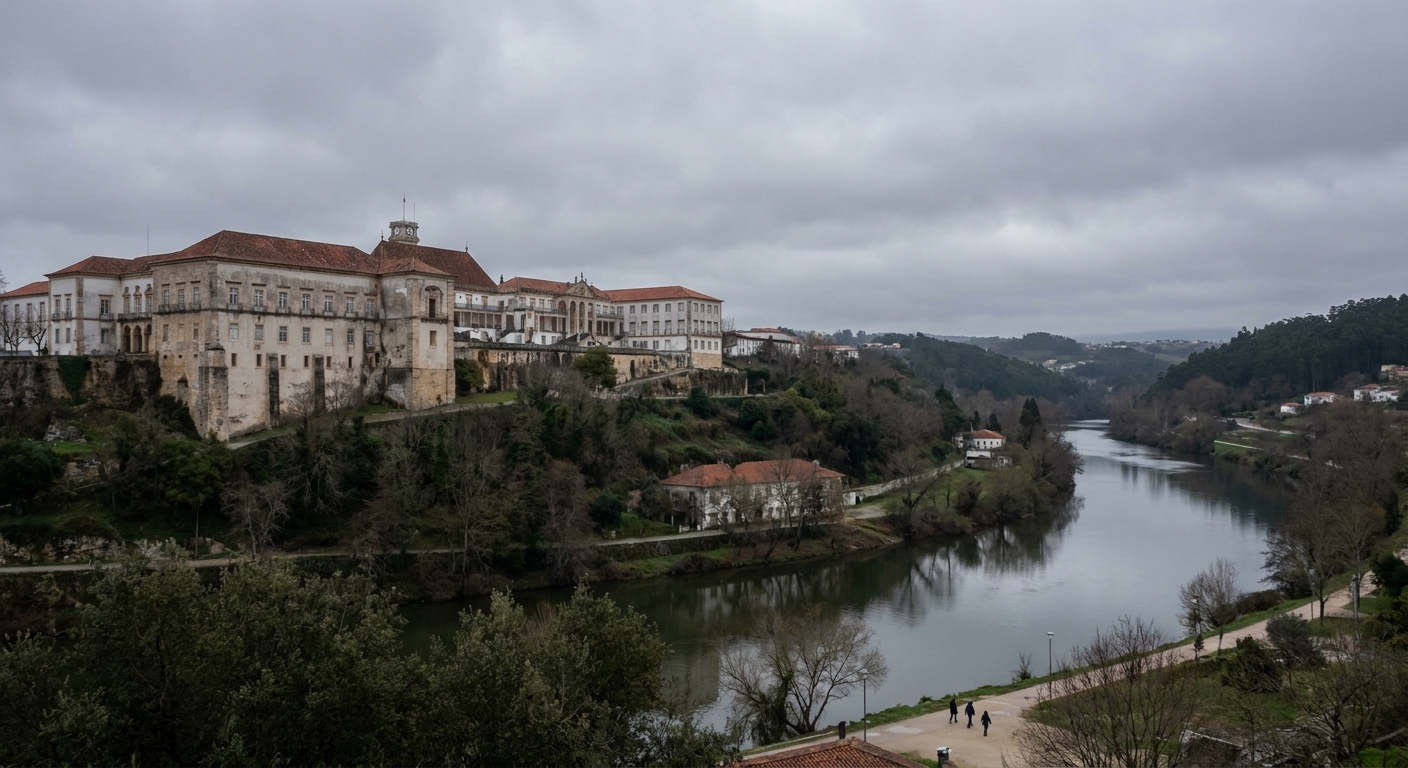
THE MONTH AT A GLANCE · COIMBRA · FEBRUARY
February gives Coimbra 61.5°F afternoons, 8.6 wet days and 10 hours 44 minutes of light: a strong month for the hill and its interiors, a weak one for anything built around water or long evenings.
IPMA STATION 707 BENCANTA · 8.6 WET DAYS · SUNSET 6:09 PM ON THE 15TH
Go for: the hilltop World Heritage core in low-season weeks, 61.5°F afternoons that make the climb pleasant, and interiors that turn a wet day into the right day.
Think twice before: building the visit around terraces or the coast: the light goes at 6:09 pm mid-month, and 2.7 days in an average February bring 10 mm (0.39 inch) of rain or more.
Climate: IPMA station 707 Coimbra Bencanta, 1991-2020 · Daylight: sunrise-sunset.org · Monuments: UNESCO file 1387bis · full sources at the end
On this page
- Coimbra weather in February61.5°F days, 3.19 inches of rain, 8.6 wet days
- How cold the nights get41.9°F on average, and no frost count we could verify
- Crowds, prices and the tourist taxLow-season weeks, and no rate series we trust
- Things to do in Coimbra in FebruaryThe Alta, Sofia Street and the Botanical Garden
- A two-day itinerarySunrise 7:25 am, sunset 6:09 pm, planned around both
- February vs January and March1.28 inches less rain than January, 4.9°F cooler than March
- Is February a good time to visit?Yes for the hill, no for the coast
The numbers below come from one thermometer in the Mondego valley, IPMA’s Bencanta station, and the monument facts from the UNESCO file on the University of Coimbra. Where we had no reading, we say so rather than round something up. January’s page is already up, and our best-time guide ranks all twelve months across the country.
Coimbra weather in February: average highs, lows and rain days
| Measure | February at Coimbra Bencanta |
|---|---|
| Average high | 61.5°F (16.4°C) |
| Average low | 41.9°F (5.5°C) |
| Precipitation | 3.19 in (81 mm) |
| Days with 1 mm (0.04 in) or more | 8.6 |
| Days with 10 mm (0.39 in) or more | 2.7 |
| Daylight on February 15 | 10h 44m · 7:25 am to 6:09 pm |
Every figure here comes from IPMA, the Portuguese national weather service, and from a single instrument: station 707 at Coimbra Bencanta, 26.6 m above sea level, on the 1991-2020 normals. That is a real thermometer rather than a model grid cell, and it sits on the valley floor. High ground inland runs colder and far wetter, and the coast keeps its own weather, so nobody should pack for a mountain trail on a Bencanta reading.
8.6 days with at least 1 mm (0.04 inch) works out to rain on roughly three days in ten, and 2.7 of them deliver 10 mm (0.39 inch) or more, the sort of afternoon that closes a walking plan down. Those are IPMA’s thresholds, not the 0.10-inch cutoff American tables use, so the counts do not line up with a US almanac. Read the month as nineteen or twenty drier days and a handful you will spend under a roof.
The gap between 61.5°F and 41.9°F is 19.6 degrees, and it shows up twice a day: cold stone at breakfast, shirtsleeve warmth by three on the sunny side of a street. Pack in layers rather than in weight. A rain shell, one warm mid-layer and shoes with grip cover it, that last item less optional than it sounds on granite that stays wet for hours after a shower. Our packing guide has the full list.
On February 15 the sun clears the horizon at 7:25 am and drops at 6:09 pm local time, leaving 10 hours 44 minutes between the two. Light, not temperature, is the constraint of the month. Put the outdoor half of the day before four o’clock while the low sun still reaches the river, and keep the library, the chapel and a long dinner for what comes after.
How warm is Coimbra in February? Daytime highs and night lows
The month’s two numbers sit 19.6 degrees apart: 61.5°F for the average afternoon, 41.9°F for the average night. Both are smoothed across thirty Februaries, so the warm spell and the cold snap are averaged out of them. The IPMA normals we read carry no record high and no record low for the station, and we will not invent either. Take 61.5°F as a midpoint. Your best afternoon will beat it, and a gray one will fall well short.
In practice that is two outfits in one day. At eight in the morning the Alta sits in shadow and the granite still holds the night, so the warm layer goes on for the climb. By mid-afternoon on a clear day the same stretch of Sofia Street is comfortable in a shirt. Dress for the evening you will have, not the afternoon you are in: once the sun goes at 6:09 pm the temperature heads back toward that 41.9°F floor.
On frost, we have the monthly mean low and nothing else: the IPMA series we read gives no count of nights at or below 32°F, so we print no frost figure for Coimbra. We also found no sea-surface series we trust for the coast an hour west, and where a water temperature is published as an average of daily maxima it reads warmer than a 24-hour mean, worth knowing before you compare two tables. Swimming is not the February question in a river city anyway.
How busy is Coimbra in February? Crowds, prices and the lodging tax
February falls in the quiet half of the Portuguese calendar, after the New Year weeks and before the Easter ones. Past that point of calendar, we found no occupancy series and no monthly room-rate series for Coimbra, so we crown no month cheapest and print no percentage. For what a week in the country runs at three spending levels, our trip cost page does that arithmetic nationally.
Weather should drive the booking more than demand does. With 8.6 wet days in an average February and 2.7 of them heavy, a refundable rate on a two-night weekend is worth more than an early non-refundable one, because you may want to swap your outdoor day. Ask whether the room is heated and how, since a February night in the valley averages 41.9°F. Our where-to-stay guide covers the regions.
We could not verify a municipal tourist tax for Coimbra, neither a rate nor whether one is charged at all, so no per-night figure appears above. Ask the property at booking and treat any number quoted elsewhere as unchecked by us. Nothing in our reading lets us add a euro to a nightly total.
One upgrade genuinely changes this month, and it is the address. The World Heritage core is a climb, with the Alta component on the ridge above the river, and a wet February day that includes two soaked ascents is a different day altogether. Sleeping inside the 36.2-hectare perimeter or its 80.8-hectare buffer takes one climb a day out of the equation.
Things to do in Coimbra in February: the Alta, Sofia Street and the Botanical Garden

Rain pushes you into the best part of Coimbra anyway. The property visitors come for, the University of Coimbra’s Alta and Sofia, was inscribed in 2013 under criteria (ii), (iv) and (vi), with a minor boundary change in 2019, and it is largely a set of interiors: the Royal Palace of Alcáçova, taken over by the university in 1537, St Michael’s Chapel, and the Joanine Library with its baroque decor. A 61.5°F afternoon also makes the climb up to them pleasant, which August does not.
The inscription is a serial property of two components inside the old town, 36.2 hectares of core with an 80.8-hectare buffer. Uphill, the Alta holds the palace, the chapel, the library and six colleges: Jesus, Holy Trinity, St Jerome, St Benedict, St Anthony of the Quarry and St Rita. Downhill runs Sofia Street with nine more, among them St Michael, Holy Spirit, Our Lady of Carmel, St Thomas and the old Royal College of the Arts used by the Inquisition. The 12th-century Cathedral of Santa Cruz stands among the university buildings.
Interiors read the same in February as in July; the air outside does not. The 18th century added the chemistry laboratories, the Botanical Garden and the University Press to the Alta, and the garden is the piece that moves with the season, under afternoons 4.9 degrees cooler than March’s. The University City built in the 1940s belongs to the inscribed property too, and it is walked rather than toured, which 10 hours 44 minutes of daylight will cut short.
We hold no opening hour and no admission fee for any of this, the Joanine Library included: UNESCO describes a property, it does not sell tickets, and our reading stopped there. Check the university’s own visitor pages before you climb. What costs nothing in any month is the walk, Sofia Street end to end and the ridge above the river, though UNESCO also flags that large-scale building around the hill has already modified the setting that made the university visible as a citadel of learning.
Coimbra in February: a two-day itinerary
Day one runs on the light. Sunrise at 7:25 am means a half-past-eight start is already bright, so climb to the Alta first and give the morning to the palace, the chapel and the library while the granite is cold and the ridge is quiet. Eat late and low in the town. Take Sofia Street downhill in the early afternoon, reading the college fronts, then be back on the ridge for the last hour before 6:09 pm and let the evening be dinner.
Day two goes to the Botanical Garden and the river bank, with the 1940s University City on the way if the sky holds. If it does not, and 2.7 days in an average February arrive with 10 mm (0.39 inch) or more, invert the order: the Cathedral of Santa Cruz, the Sofia Street colleges and a slower second hour indoors on the hill, with the outdoor half moved to whichever afternoon clears. Trains out to Porto or Lisbon make either day a workable arrival or departure.
Coimbra in February vs January and March
| Measure | January | February | March |
|---|---|---|---|
| Average high | 59.0°F (15.0°C) | 61.5°F (16.4°C) | 66.4°F (19.1°C) |
| Average low | 41.4°F (5.2°C) | 41.9°F (5.5°C) | 46.0°F (7.8°C) |
| Precipitation | 4.47 in (114 mm) | 3.19 in (81 mm) | 2.97 in (75 mm) |
| Days with 1 mm (0.04 in) or more | 11.3 | 8.6 | 9.4 |
Rain is where the three months separate. January delivers 4.47 inches over 11.3 wet days, February 3.19 inches over 8.6, March 2.97 inches over 9.4, so February has the fewest wet days of the three while March holds the least total water. Daytime temperature climbs steadily, 59.0°F to 61.5°F to 66.4°F, while the nights barely move between January and February, 41.4°F against 41.9°F, before jumping 4.1 degrees into March. No sea temperature enters this comparison, because we found no series we trust for the coast.
Shift four weeks later and you buy 4.9 degrees of afternoon and 0.22 inch less rain, at the cost of 0.8 more wet days and the beginning of the spring travel season. Shift four weeks earlier and January charges 1.28 inches more rain across 2.7 extra wet days for an afternoon 2.5 degrees colder, which is a thin trade unless your dates are set by someone else. The full year, ranked, sits in our best-time guide.
Is February a good time to visit Coimbra?
Yes, if your Coimbra is the hill. Interiors by the dozen, a 61.5°F afternoon for the climb and 8.6 wet days you can plan around make a solid winter city break, especially for readers and for anyone who dislikes queuing. No, if the trip is built on water, terraces or long evenings, because the day is over at 6:09 pm mid-month and the coast an hour west is out of season.
When the answer is no, go in March rather than January. Four weeks later you get the warmest afternoons of the three, 66.4°F, the least rain, 2.97 inches, and nights 4.1 degrees milder. Later spring sits outside the three months compared here, and the national ranking covers it.
What February holds over both neighbors is simple to state: the fewest wet days of the winter, 8.6, with afternoons already 2.5 degrees above January’s.
The last word
Book the bed for the slope and let the forecast decide the order of your two days. One fact we have kept back: the university has grown on that hill for more than seven centuries, starting as a late-13th-century academy before it moved into the Royal Palace of Alcáçova in 1537, and UNESCO records that its ceremonial and student traditions remain in use, which is why the Alta in February is a working campus carrying a World Heritage label rather than a museum behind a rope. Bring shoes with grip and a jacket that sheds rain.
Sources & data for this guide
- February normals and rain days (61.5°F high, 41.9°F low, 3.19 in, 8.6 days at 1 mm, 2.7 days at 10 mm) · IPMA 1991-2020 normals, station 707 Coimbra Bencanta, 26.6 m · checked Sep 23, 2026
- January and March normals used in the comparison table · same IPMA 1991-2020 series, station 707 · checked Sep 23, 2026
- Sunrise 7:25 am, sunset 6:09 pm and 10h 44m of daylight on February 15 · sunrise-sunset.org, converted to Europe/Lisbon · checked Sep 23, 2026
- Inscription year and criteria, 2019 boundary change, 36.2 ha core and 80.8 ha buffer, the two components and their buildings · UNESCO World Heritage Centre, file 1387bis · checked Sep 23, 2026
- We could not verify an opening hour or admission fee for the Joanine Library or any other university building, a municipal tourist tax rate, an occupancy or room-rate series, or any February event date, so we give none of them · checked Sep 23, 2026
- Pacing, packing and itinerary advice is editorial; hours, fees and rail services change · confirm with the university and the operator before you travel.