
SINTRA · PORTUGAL · THE 12-MONTH VERDICT
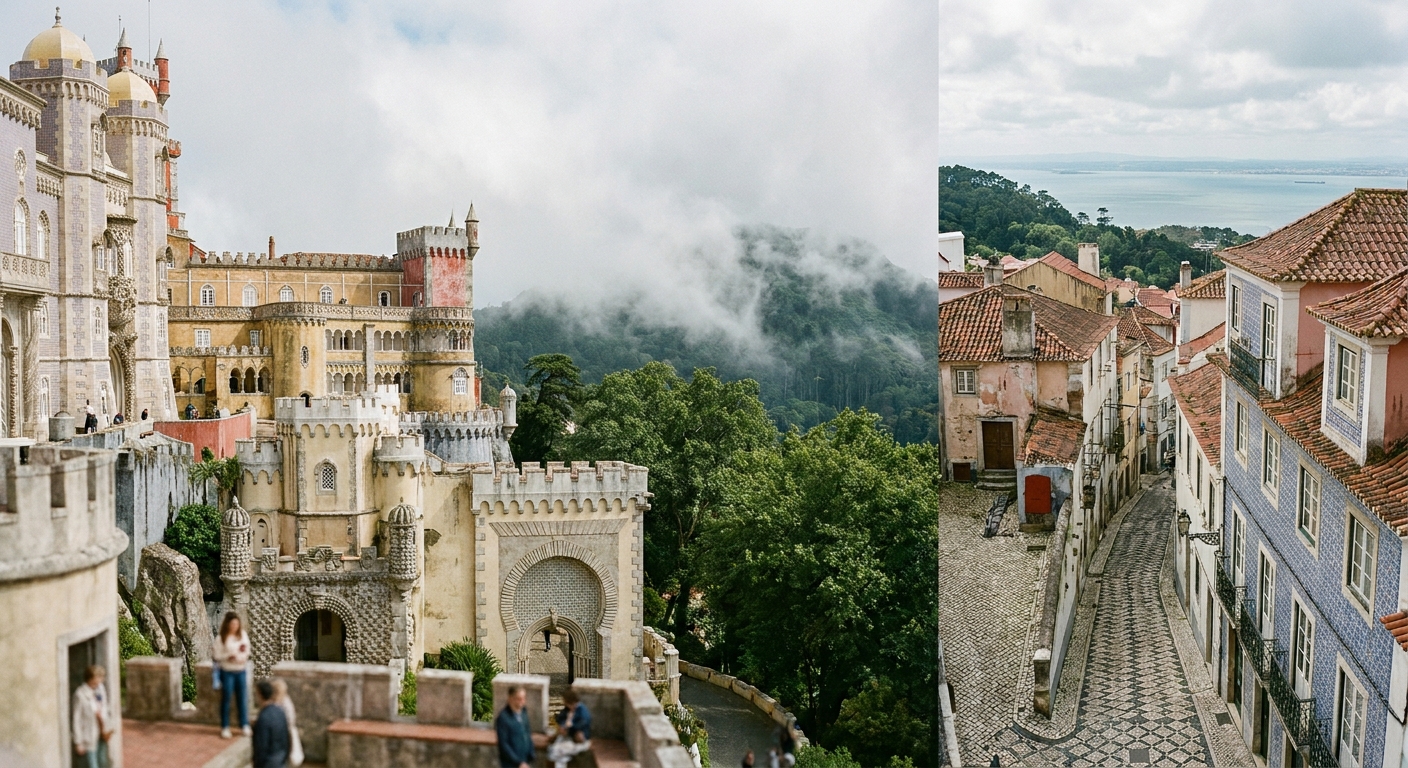
The palaces are why people come: Pena’s painted towers on the ridge, the Moorish castle walls running along it, the spiral initiation well at Quinta da Regaleira in the woods below. The hill they stand on is the complication. Damp Atlantic air lifts over the Serra de Sintra, condenses, and stays. A morning that starts clear in Lisbon can put you inside a cloud on the Pena terraces by ten o’clock.
So the question is not only which month is warm. It is which month gives long daylight, firm ground on the park paths, and a fair chance that the view from the ramparts is a view. The normals below were measured at a real thermometer that is not on the hill, and that distinction runs through everything that follows. May is the short answer, for reasons that come down to 5.7 wet days and fourteen hours of light.
THE YEAR AT A GLANCE · SINTRA
Come in May: 73.0°F days, 2.00 inches of rain across the whole month and 14 hours 21 minutes of daylight on the 15th, with the first half of September as the warm-weather alternative.
BEST MONTH: MAY · WETTEST: NOVEMBER, 4.51 IN · DRIEST: JULY, 0.11 IN · NORMALS FROM LISBON’S AIRPORT, 20 KM AWAY
Go for: May, when rain totals 2.00 inches over 5.7 days at 1 mm or more and the sun sets at 8:43 p.m. local time on the 15th.
Think twice before: booking November, the wettest of the twelve months at 4.51 inches, with 3.9 days at 10 mm or more and 10 hours 6 minutes of light on the 15th.
Normals: IPMA 1991-2020, station 579 Lisboa Gago Coutinho · Daylight: sunrise-sunset.org · full sources at the end
On this page
- Month-by-month highs, lows and rainfallThe twelve-month table
- The single best month to visit SintraMay, 73.0°F and 5.7 wet days
- How hot Sintra gets in July and August84.2°F, and the nights
- The quietest weeks of the Sintra yearMid-January to mid-February
- The month to avoid in SintraNovember, 4.51 inches
- Are April, May, September and October worth it?The shoulder verdict
- When to visit Portugal overallThe national 12-month view
Most travelers meet Sintra as a day off a Lisbon trip: a commuter train out after breakfast, two palaces, a train back before dinner. That works, and the weather makes it fragile, because one low-cloud morning takes the ridge view with it and there is no second try. A night in Sintra town buys you the next morning, and it matters most between October and February. For the train and the airport link, see the Lisbon guide.
Sintra weather month by month: highs, lows and rainfall
| Month | Avg high | Avg low | Rainfall | Days ≥ 1 mm | Days ≥ 10 mm |
|---|---|---|---|---|---|
| January | 57.9°F | 46.0°F | 3.78 in | 9.9 | 3.3 |
| February | 60.3°F | 47.1°F | 2.80 in | 7.8 | 2.4 |
| March | 65.1°F | 50.5°F | 2.63 in | 7.2 | 2.3 |
| April | 67.8°F | 53.2°F | 2.50 in | 7.7 | 2.1 |
| May | 73.0°F | 57.4°F | 2.00 in | 5.7 | 1.9 |
| June | 79.0°F | 61.7°F | 0.53 in | 2.0 | 0.4 |
| July | 82.9°F | 64.4°F | 0.11 in | 0.4 | 0.1 |
| August | 84.2°F | 65.3°F | 0.20 in | 1.0 | 0.1 |
| September | 80.2°F | 63.3°F | 1.41 in | 3.7 | 1.3 |
| October | 72.7°F | 58.8°F | 4.05 in | 8.3 | 2.8 |
| November | 63.7°F | 52.2°F | 4.51 in | 9.3 | 3.9 |
| December | 58.8°F | 47.7°F | 3.94 in | 9.7 | 3.5 |
July collects 0.11 inches of rain across the entire month and records 0.4 days at 1 mm or more. November collects 4.51 inches on 9.3 such days. Between those two poles the year is lopsided rather than symmetrical: rain eases gently from January to May, falls off a cliff in June, and comes back all at once in October.
June is where the dry season starts in earnest, at 0.53 inches and 2.0 wet days against May’s 2.00 inches and 5.7. October is where it ends, at 4.05 inches on 8.3 wet days, nearly three times September’s 1.41 inches, with average highs down 7.5°F from September’s 80.2°F to 72.7°F. Nothing else in the table moves that fast.
November is the wettest of the twelve months, 4.51 inches of it, and it also carries the year’s heaviest soaking days, 3.9 at 10 mm or more. For anyone whose plan is the walking, the climb up through the park to Pena, the ramparts, the sunken lanes at Regaleira, that is the month that costs shoe leather. For a visitor booking two palace interiors and a long lunch, 63.7°F days and a proper jacket carry it.
Every figure here comes from IPMA’s 1991-2020 normals at station 579, Lisboa Gago Coutinho, an instrument at 103.9 m of altitude, roughly 20 km from Sintra and well below the ridge. The Sintra hill makes its own cloud and sits several degrees colder and much mistier than that reading. The rain-day counts use the Portuguese service’s own thresholds, 1 mm (0.04 inch) and 10 mm (0.39 inch). They do not convert to the 0.10-inch counts printed in American tables.
When is the best time to visit Sintra?
Take May. Average highs reach 73.0°F, nights hold at 57.4°F, and the month totals 2.00 inches of rain spread over 5.7 days at 1 mm or more. On May 15 the hill gets 14 hours 21 minutes of daylight, with sunset at 8:43 p.m. local time. That is one palace in the morning, the ridge walk after lunch, and an evening in Sintra town with light still in it.
April looks close on the table and is not. Its highs run 5.2°F lower at 67.8°F, it takes 2.50 inches over 7.7 wet days, and mid-April gives an hour and four minutes less daylight than mid-May. June goes drier still at 0.53 inches, but 79.0°F afternoons arrive alongside the European summer vacation calendar, and the hill’s paths are steep enough that four degrees matter.
Dedicated month pages for Sintra are not published yet, so the detail sits elsewhere for now: our 12-month verdict for Portugal sets the national calendar around this hill, and the packing list covers the shell you want on the ridge in any month. Fix one thing before you fly: palace tickets, booked for the first slot of the day.
How hot does Sintra get in summer?
August is the warmest of the twelve months at an average high of 84.2°F, with July just behind at 82.9°F. Nights stay up too: August averages a low of 65.3°F and July 64.4°F, against 46.0°F in January. Rain effectively stops, at 0.11 inches and 0.4 wet days in July, 0.20 inches and 1.0 day in August. Mid-August still delivers 13 hours 43 minutes of light, sunset at 8:32 p.m. local time.
Those are air temperatures and nothing more. We could not read a humidity, wind or sea-temperature series measured to the same standard for Sintra, so we quote none of the three, and the Atlantic damp the hill is known for stays a description rather than a number. The station note is blunt about the rest: the ridge runs colder and mistier than the airport, so an afternoon reading 84.2°F down by the runway can be several degrees cooler on the Pena terrace, and gray with it.
When is Sintra quietest?
Sintra’s quiet stretch is a calendar fact before it is a weather one. The low season runs from November through February, and the weeks from mid-January to mid-February fall between the New Year holiday and the Carnival and Easter breaks, which is the only gap of that length in the European travel year. January brings 3.78 inches of rain over 9.9 wet days with 57.9°F highs, February 2.80 inches over 7.8 days with 60.3°F.
What that window buys is room to move and an unhurried plan: a Regaleira morning taken slowly, the ridge walk to Pena after lunch, a night in Sintra town instead of the six o’clock train back to Lisbon. Light comes back quickly, too, a full hour between January 15 (9 hours 48 minutes) and February 15 (10 hours 48 minutes), and February’s rain falls nearly a full inch short of January’s, 2.80 inches against 3.78.
January records rain on 9.9 days, the most of any month, and 3.3 of those reach 10 mm or more. The sun sets at 5:39 p.m. local time on the 15th, which ends anything on the ridge well before dinner, and nights average 46.0°F, the coldest reading of the twelve. The hill’s cloud is at its most stubborn in these weeks: the Pena terraces can hand you a parapet and a wall of gray where the Atlantic should be.
Which month should you avoid in Sintra?
November takes 4.51 inches of rain, the wettest of the twelve months, across 9.3 wet days, and 3.9 of those reach 10 mm or more, the year’s highest count of soaking days. Daylight on November 15 runs 10 hours 6 minutes and the sun is gone at 5:24 p.m. local time. Walkers on the Serra paths and anyone who came for the view from the ramparts should skip it. A visitor with two palace interiors booked will find it merely damp.
It is still nearly six degrees warmer by day than the depth of winter, 63.7°F against January’s 57.9°F, and 9.3 wet days out of thirty leave roughly two thirds of the month dry at the 1 mm threshold. Book the indoor mornings first, keep the ridge walk as the thing you do on the first clear afternoon, and pack the shell rather than the umbrella, because the wind on that hill will take it.
Is the shoulder season worth it in Sintra?
The shoulder months are April and May on the way up, September and October on the way down. Measured against August’s 84.2°F, September gives up 4.0°F at 80.2°F and takes on 1.21 inches more rain, 1.41 against 0.20. May sits 11.2°F below August at 73.0°F and 1.80 inches above it. October lands 11.5°F below August with 3.85 inches more rain.
What the shoulder gives back is walkable weather with real daylight attached. September 15 still carries 12 hours 29 minutes of light, sunset at 7:45 p.m. local time, and only 3.7 days of the month see rain at all. May pairs 5.7 wet days with 14 hours 21 minutes of daylight, which is the kind of day where the castle ramparts before lunch and Regaleira afterward both fit without a watch.
October is where the trade turns. Its 4.05 inches is nearly three times September’s 1.41, its 8.3 wet days more than double September’s 3.7, and mid-October runs 1 hour 15 minutes shorter than mid-September, with the sun down at 6:59 p.m. local time. Average highs slide to 72.7°F, a shade under May’s 73.0°F, for twice the rain.
Take the early shoulder over the late one. May matches October’s temperature almost exactly, 73.0°F against 72.7°F, with 2.6 fewer wet days and three hours more daylight on the 15th. If the trip is locked to autumn, aim at the first half of September, where 80.2°F highs and 3.7 wet days still read like summer, and treat late October as a two-palace, one-lunch plan with the walking penciled in rather than promised.
The last word
Book May, take the first ticket slot of the day, and carry a shell you can walk uphill in, because the ridge writes its own weather whatever the airport thermometer reports. And if May is already spoken for, look at March before you look at October: 2.63 inches of rain over 7.2 wet days, half a day fewer than April’s 7.7, with daylight crossing twelve hours on the 15th and the sun setting at 6:45 p.m. local time.
Sources & data for this guide
- Monthly normals 1991-2020, highs, lows and precipitation · IPMA, station 579 Lisboa Gago Coutinho, altitude 103.9 m · checked Sep 12, 2026
- Rain-day counts at the 1 mm (0.04 inch) and 10 mm (0.39 inch) thresholds · same IPMA series · checked Sep 12, 2026
- Daylight length, sunrise and sunset for the 15th of each month · sunrise-sunset.org, converted to Portuguese local time · checked Sep 12, 2026
- Scope caveat: the station stands about 20 km from Sintra at Lisbon’s airport and far below the ridge, the hill runs colder and mistier, and we found no long-run official series measured on the hill itself · checked Sep 12, 2026
- We hold no visitor-count, hotel-price, humidity or sea-temperature series for Sintra, so quiet weeks are described by the calendar only and no month is called cheap or busy on figures we do not have.
- Palace opening hours and ticket rules change · check the operators when you book.