
SINTRA · FEBRUARY · THE MONTH GUIDE
February gives Sintra a normal high of 60.3°F (15.7°C), a normal low of 47.1°F (8.4°C) and 2.80 inches of rain spread over 7.8 days. That makes a cool, green, walkable month on a hill built for walking, and the published price list carries no seasonal tier: 12 EUR for the Park of Pena, 20 EUR for park and palace together, 13 EUR for the National Palace down in the town.
The light runs short. On February 15 the sun rises at 7:26 am and sets at 6:14 pm, 10 hours 48 minutes end to end, and the gates shut inside that window: last admission at Pena Palace is 17:30, the same at the Moorish Castle. Add the cloud the Serra manufactures for itself, colder and mistier than anything measured down at the coast, and February becomes a month of nine o’clock starts.
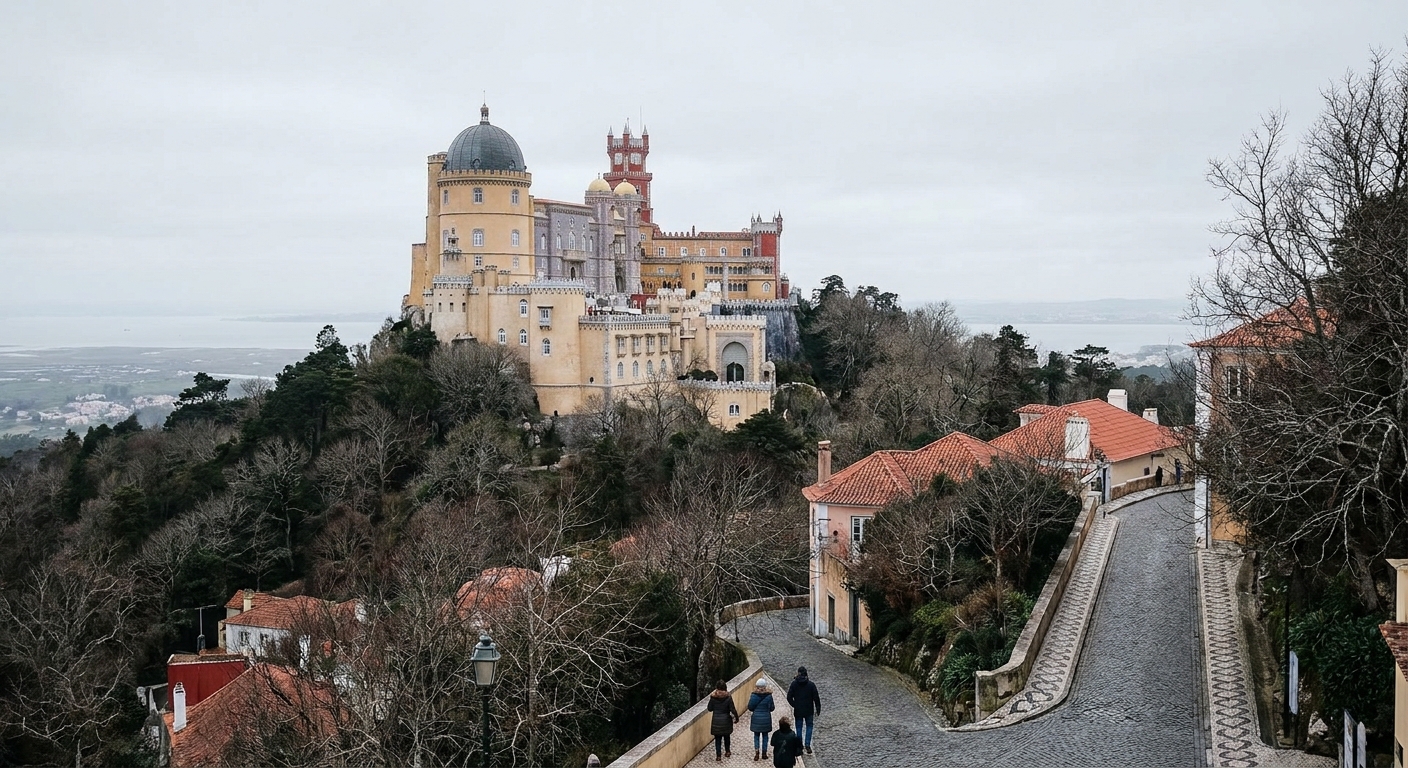
THE MONTH AT A GLANCE · SINTRA IN FEBRUARY
February buys a cool, uncrowded-feeling hill and a 26 percent drop in rainfall from January, at the cost of short afternoons that end with last admissions before sunset.
LOW SEASON BY THE CALENDAR · 7.8 RAIN DAYS · LAST ADMISSION 17:30 AT PENA PALACE
Go for: the uphill day at 60.3°F, Monserrate’s 3,000 exotic species with room to stand in front of them, and a price list that never moves.
Think twice before: planning anything after 5 pm on the hill, or counting on a swim: we could not verify a sea temperature for this coast.
Climate: IPMA station 579, 1991-2020 · Tickets and hours: Parques de Sintra · Daylight: sunrise-sunset.org · full sources at the end
On this page
- Sintra weather in FebruaryHighs of 60.3°F, lows of 47.1°F, 7.8 rain days
- How cold the mornings getA 13.2°F gap between dawn and mid-afternoon
- Ticket prices and how busy it isPena from 12 EUR, Monserrate 12 EUR, the Capuchos 11 EUR
- Things to do in Sintra in FebruaryPena’s 210-hectare park, Monserrate, the Moorish Castle
- A two-day plan for 10 hours 48 minutes of lightDay one on the hill, day two at Monserrate and Cabo da Roca
- February, January or March?How the three months compare, degree by degree
- Is February a good time to visit Sintra?Who should go now, who should wait for March
Two days fill February in Sintra without strain, and both of them begin at 9:00, when the Park of Pena opens its gate. For the palaces described rather than dated, our Sintra guide does that job, and the month before it is covered in January. Anyone still choosing a season can weigh the whole calendar in the twelve-month verdict for Portugal.
Sintra weather in February: average highs, lows and rain days
| February normal | Value |
|---|---|
| Average high | 60.3°F (15.7°C) |
| Average low | 47.1°F (8.4°C) |
| Precipitation | 2.80 in |
| Days with 0.04 in (1 mm) or more | 7.8 |
| Days with 0.39 in (10 mm) or more | 2.4 |
| Daylight on February 15 | 10 h 48 min |
| Sunrise / sunset, February 15 | 7:26 am / 6:14 pm |
Every figure here comes from IPMA, the Portuguese national weather service, and from one real thermometer rather than a model grid cell: station 579, Lisboa Gago Coutinho, at 103.9 meters, on the 1991-2020 normals. That instrument sits about 20 km away at Lisbon’s airport and a long way below the town. The Serra makes its own cloud and runs several degrees colder and much mistier than the table above, so pack for the hill and treat 60.3°F as the generous end of the day.
An average February records measurable rain on 7.8 days, roughly one day in four, and a real soaking of 0.39 inch or more on 2.4 of them. IPMA counts with its own thresholds, 1 mm and 10 mm, not the 0.10-inch line American tables use, so these counts do not swap with a US almanac. On the ground it means most days stay dry at street level while the top of the hill disappears into cloud for an hour or two and comes back.
Dawn and mid-afternoon are 13.2°F apart, and both ends of that gap matter on a day that climbs several hundred feet. A fleece under a waterproof shell handles the 47.1°F start, the shell comes off by lunchtime, and it goes back on the moment the mist arrives. Shoes with grip earn their place on wet cobbles and wet granite steps. Our Portugal packing list covers the rest of the winter kit.
On February 15 the sun clears the horizon at 7:26 am and drops at 6:14 pm, 10 hours 48 minutes of usable light. The Park of Pena takes its last admission at 18:00, fourteen minutes before that sunset, the palace at 17:30, and the Moorish Castle at 17:30 as well. Anything planned after five o’clock has to happen at street level, where the National Palace of Sintra stays open until 18:30.
How warm is Sintra in February?
The month’s normal high is 60.3°F and its normal low 47.1°F, a spread of 13.2°F across an average day. That high sits 2.4°F above January’s 57.9°F and 4.8°F below March’s 65.1°F, so February is the middle rung of a slow winter climb rather than a turning point. The lows move less: 1.1°F above January, 3.4°F below March.
In practice you leave the hotel in a jacket and finish the morning carrying it. Mid-afternoon at 60.3°F is comfortable for a long uphill walk and slightly cold for sitting still, which is why the cafés in the town center fill after 4 pm rather than at lunchtime. Interiors in the palaces are unheated stone, so the layer you shed outdoors goes back on indoors.
We could not verify a count of nights at or below freezing for Sintra, so we give none, and the monthly mean low of 47.1°F is measured at the airport station, not on the ridge. We also found no sea-surface series for the coast below the Serra, so no water temperature appears here. If you find one elsewhere, check whether it averages daily maxima, since that method reads warmer than a 24-hour mean.
How busy is Sintra in February? Crowds, ticket prices and booking
February falls in the low season by the calendar, and that is as far as our data reaches: we found no occupancy series and no monthly room rates for Sintra, so we crown no month cheap and no month expensive. The prices we can quote are the ones Parques de Sintra published on 22 September 2026, and they carry no seasonal tier. The Park of Pena is 12 EUR, the Essential visit to park and palace 20 EUR, the Full Tour 45 EUR, and children under 6 enter free.
No capacity cap and no timed-entry rule reached us from an operator page, so we give no number of weeks to book ahead. What genuinely needs scheduling in February is the closing sequence. Pena’s park stops admitting at 18:00 and its palace at 17:30, the Moorish Castle at 17:30, the Convent of the Capuchos at 17:30, and Cabo da Roca’s lighthouse courtyard at the same hour. Build the day forward from 9:00 instead of backward from dinner.
We could not verify a Sintra lodging-tax rate, so we give no percentage and no per-night amount. The published reductions are narrow ones: the Moorish Castle charges 12 EUR for adults and 10 EUR for visitors aged 6 to 17 and for those over 65, Monserrate 12 EUR for adults, the Convent of the Capuchos 11 EUR, and the National Palace of Sintra 13 EUR for its Essential visit.
One line on the bill changes a February day more than the others: the 4.50 EUR round-trip transfer between Pena’s park entrance and the palace door. On a morning with the cloud sitting on the hill, that buys you a dry arrival. The 8 EUR step from the 12 EUR park ticket to the 20 EUR Essential visit buys the second thing February can take away, which is somewhere indoors when the mist refuses to lift.
Things to do in Sintra in February: Pena, Monserrate and the Moorish Castle
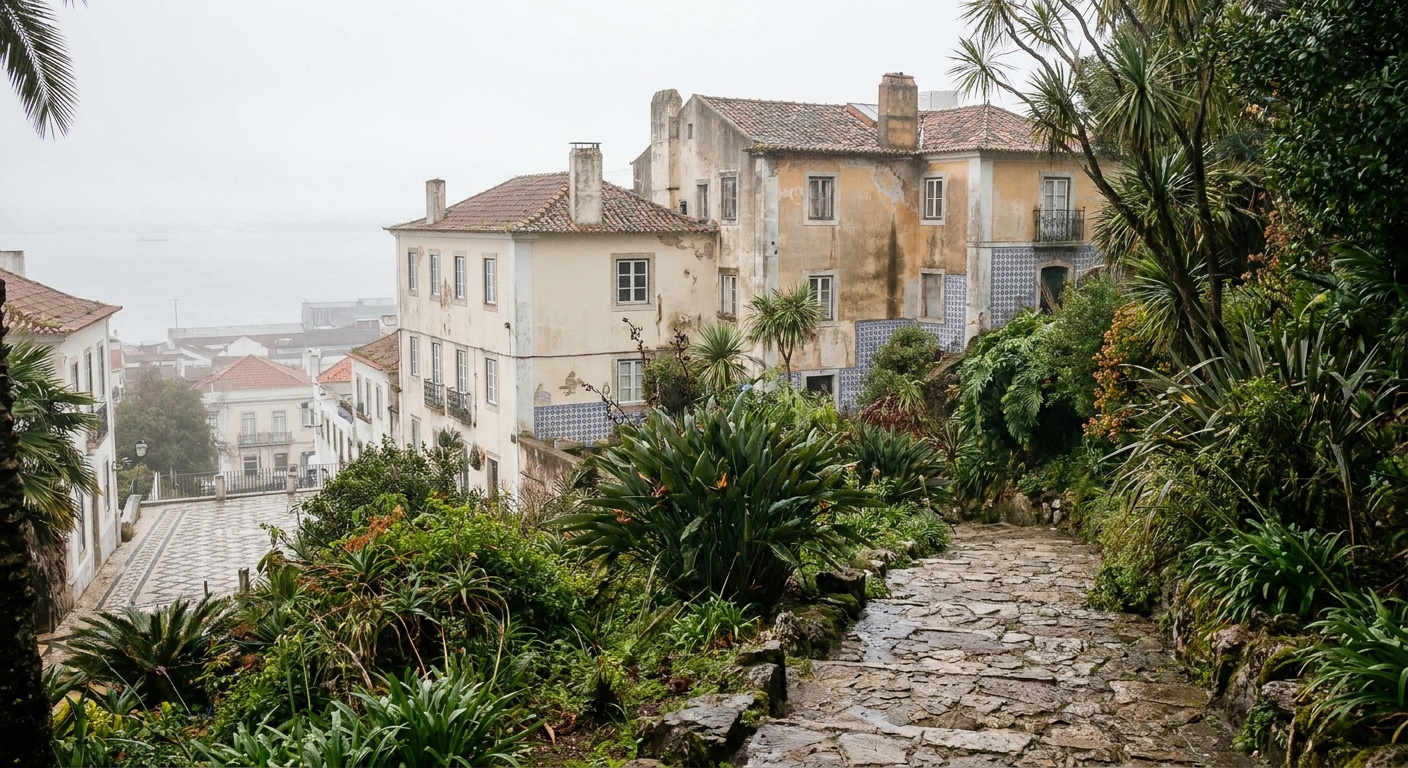
Uphill days work better in February than in January: 7.8 days of measurable rain against 9.9, and 2.80 inches against 3.78. A 60.3°F afternoon is walking weather in a way that a summer one is not, and most of what makes Sintra famous has no roof over it. The cultural landscape inscribed by UNESCO in 1995 covers 946 hectares, all of it inside the Sintra-Cascais Natural Park and classified as a National Monument since 1994.
The Park of Pena runs to 210 hectares behind a stone wall, takes in the Tapada do Mocho and the Moorish Castle, and was planted from around 1840 by Ferdinand II with species brought from North America, Asia and New Zealand. Entry is 12 EUR for the park, 20 EUR with the palace. Monserrate covers 50 hectares on the northern slopes of the Serra, holds over 3,000 exotic species and costs 12 EUR, with the park open 09:00 to 19:00 and the palace 09:30 to 18:00.
Those gardens were laid out after a careful reading of the microclimatic zones of the ground, and the planting does not change with the calendar. The air does. A 47.1°F dawn and a 60.3°F ceiling mean you can cross all 50 hectares of Monserrate at your own speed and still have the legs for the Convent of the Capuchos, open 09:00 to 17:30 at 11 EUR, before the light goes at 6:14 pm.
Villa Sassetti costs nothing and opens 10:00 to 18:00, sixteen minutes short of the February 15 sunset. The gardens of the National Palace of Sintra are free as well, and the palace itself, in the middle of town, stays open until 18:30, which makes it the natural last stop of a short day.
Sintra in February: a two-day itinerary
Day one belongs to the hill. Be at Pena’s park gate for 09:00, take the 4.50 EUR round-trip transfer if the cloud is down, and be at the palace door when it opens at 09:30. Come back through the 210 hectares on foot, drop into the Moorish Castle before its 17:30 cutoff, and finish in the town at the National Palace, 13 EUR and open until 18:30. Sunset at 6:14 pm arrives while you are still at street level, which is the point of the order.
Day two heads to the northern slopes: Monserrate from 09:00, then the Capuchos at 11 EUR, and Cabo da Roca’s lighthouse for the 5 EUR courtyard visit or 10 EUR up the tower, all three shutting between 17:30 and 18:00. If one of the month’s 2.4 heavy days lands on you, swap the order and spend the middle of it under a roof at Monserrate’s palace until 18:00 and the National Palace until 18:30. We could not read a bus timetable inside the Serra, so check how to get around Portugal before committing to the outer two.
Sintra in February vs January and March
| January | February | March | |
|---|---|---|---|
| Average high | 57.9°F (14.4°C) | 60.3°F (15.7°C) | 65.1°F (18.4°C) |
| Average low | 46.0°F (7.8°C) | 47.1°F (8.4°C) | 50.5°F (10.3°C) |
| Precipitation | 3.78 in | 2.80 in | 2.63 in |
| Days with 0.04 in or more | 9.9 | 7.8 | 7.2 |
| Sea temperature | not verified | not verified | not verified |
All three columns come from the same IPMA station and the same 1991-2020 period, so the gaps are real rather than estimated. February drops 0.98 inch of rain and 2.1 wet days from January while adding 2.4°F to the afternoon. March adds another 4.8°F and shaves 0.6 of a rain day. No sea-surface figure reached us for any of the three months, so that row stays empty rather than guessed.
Shifting four weeks forward to March buys warmth and very little extra dryness, since the rain has already done most of its falling by the end of February. Shifting back to January costs 2.4°F and returns two wet days a week. What we cannot promise you is a quieter hill in February, because we found no occupancy series for Sintra, and the ticket prices at Pena, Monserrate and the Capuchos are identical in all three months anyway.
Is February a good time to visit Sintra?
Yes for walkers. If the reason you are coming is the 210 hectares of Pena’s park, the 50 at Monserrate and the climb between them, February hands you cool air, green ground and 7.8 rain days you can plan around. No if your day starts slowly, because a 6:14 pm sunset and a 17:30 last admission punish a late breakfast, and no if you wanted to swim, which nothing in our sources supports for this coast.
March is the fallback. It runs 4.8°F warmer by day, 3.4°F warmer at night, drops to 2.63 inches of rain over 7.2 days, and asks the same 12 EUR at the Pena park gate. The trade is that everything gets marginally more comfortable and nothing gets cheaper.
Of these three months, February is the pivot: rainfall falls 26 percent from January while March’s warm afternoons are still four weeks off, which puts the whole outdoor half of Sintra in reach for the price of a fleece.
The last word
Book two days, start both at 9:00, and let the closing times write the rest of the schedule. One fact to carry into the decision: the landscape you spend those two days walking through was inscribed by UNESCO in 1995 under criteria (ii), (iv) and (v), 946 hectares of it wrapped in a buffer zone of 3,641 more, and Parques de Sintra runs eleven sites inside and around it, from the Queluz gardens to the lighthouse at Cabo da Roca. February is the month you can cross a decent share of that on foot.
Sources & data for this guide
- February normals (high 60.3°F, low 47.1°F, 2.80 in) and rain-day counts at the 1 mm and 10 mm thresholds · IPMA, 1991-2020 climate normals, station 579 Lisboa Gago Coutinho, altitude 103.9 m · checked Sep 22, 2026
- January and March normals used in the comparison table · same IPMA station, same 1991-2020 period · checked Sep 22, 2026
- Daylight of 10 h 48 min, sunrise 07:26 UTC and sunset 18:14 UTC on February 15, converted to local time · sunrise-sunset.org · checked Sep 22, 2026
- Opening times and ticket tiers for Pena, the Moorish Castle, Monserrate, the Convent of the Capuchos, the National Palace of Sintra, Villa Sassetti and the Cabo da Roca Lighthouse · Parques de Sintra – Monte da Lua, « Opening Times and Prices » · checked Sep 22, 2026
- Inscription in 1995 under criteria (ii), (iv) and (v), property of 946 ha and buffer zone of 3,641 ha, Park of Pena at 210 ha, Monserrate at 50 ha and its 3,000 species · UNESCO World Heritage Centre, file 723 · checked Sep 22, 2026
- What we could not verify: no train fare and no journey time between Lisbon and Sintra from an operator page, no bus timetable inside the Serra, no sea-surface temperature for this coast, no lodging-tax rate, no occupancy or room-rate series. The station thermometer sits 20 km away at Lisbon’s airport and well below the town, so the hill reads colder and mistier than every figure here.