
WEKIWA SPRINGS · FLORIDA · THE 12-MONTH VERDICT
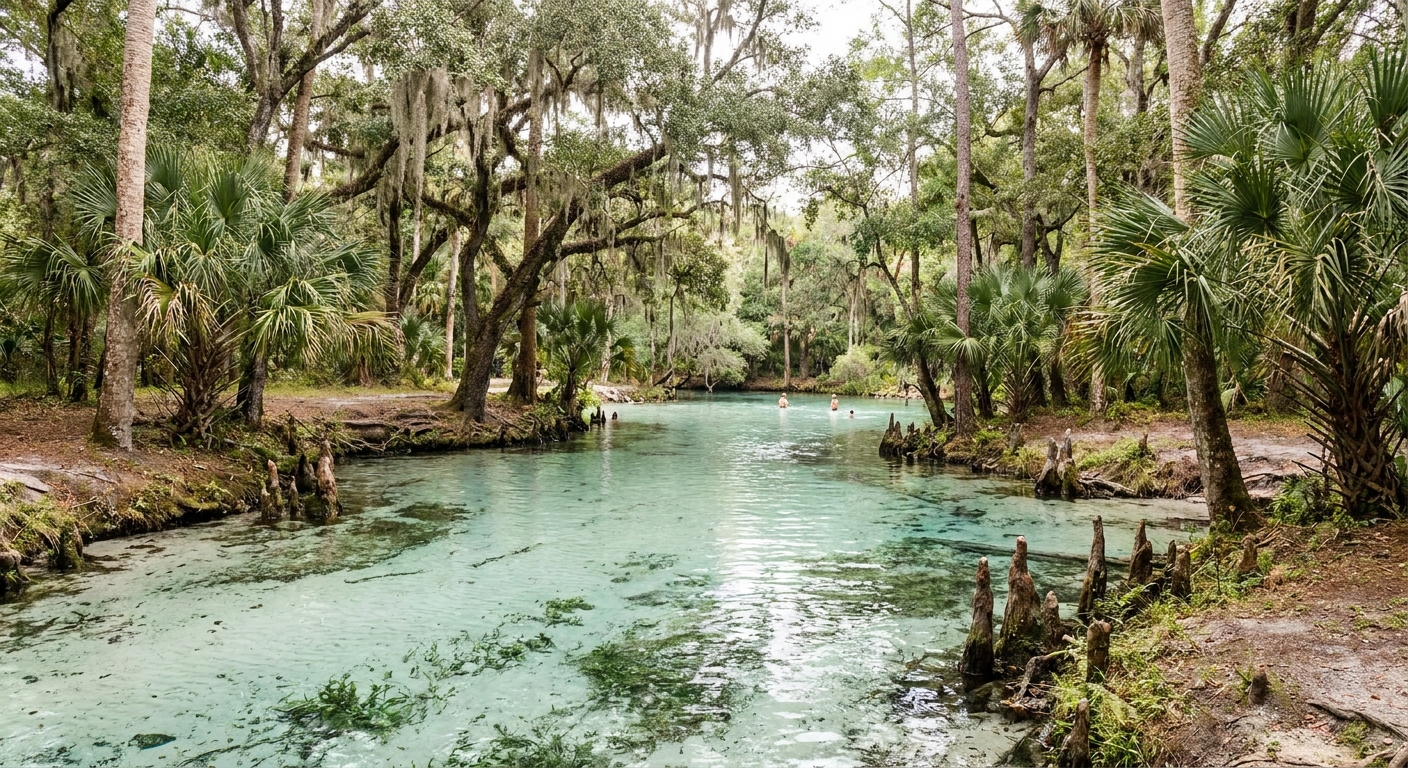
Wekiwa Springs sells one thing twelve months a year: clear, constant water in a bowl of oaks and palmettos north of Orlando. The water holds its temperature all year. The air over it does nothing of the kind. July averages an afternoon high of 92.0°F and January 71.8°F, and June drops 8.05 inches of rain on the same picnic tables that stay dry through most of November, when the gauge records 1.79 inches.
That gap decides the visit more than any packing list. Most visitors fly into Orlando (MCO), keep a base in the city, and drive out for a morning swim or a paddle down the Wekiva River, so the booking question is which weekend, not how many nights. April and November come out of the table below in good shape. June does not, and the numbers for why are unusually blunt.
THE YEAR AT A GLANCE · WEKIWA SPRINGS
Come in April for warm air and little rain, or in November for the driest month of the year. Skip June unless a soaking afternoon is part of the plan.
BEST: APRIL & NOVEMBER · WETTEST: JUNE, 8.05 IN · AIR NORMALS FROM ORLANDO INTL AP, 44 KM AWAY
Go for: April afternoons at 83.6°F with 2.58 inches of rain across the whole month, and November mornings in a month that records 0.10 inch on just 3.0 days.
Think twice before: booking a June or July weekend. Each averages 11.5 days with at least 0.10 inch of rain, and June alone averages 2.5 days of an inch or more.
Air normals 1991-2020 · NOAA NCEI station USW00012815, Orlando Intl AP · daylight from sunrise-sunset.org · full sources at the end
On this page
- The 12-month table of highs, lows and rainMonth by month, with the numbers
- One month to bookApril, and why not May
- Summer highs and overnight lowsJuly at 92.0°F
- Quiet weeks at the springNovember and early December
- The month to avoidJune, 8.05 inches of rain
- Shoulder months against high summerMarch and October compared to July
Reaching the spring from an Orlando base turns this into a question of which day of the trip to spend here, rather than how many nights to add to the itinerary. The drive is short enough that a washed-out morning can be traded for the next one, and short enough that a mid-afternoon storm simply ends the day early. Our Florida driving guide covers the rental and toll layer that comes with any Central Florida day trip.
Wekiwa Springs weather month by month: highs, lows and rainfall
| Month | Avg high | Avg low | Rain | Days ≥ 0.10 in | Daylight (15th) |
|---|---|---|---|---|---|
| January | 71.8°F | 49.5°F | 2.48 in | 4.0 | 10h 33m |
| February | 74.9°F | 52.4°F | 2.04 in | 3.8 | 11h 14m |
| March | 78.9°F | 55.8°F | 3.03 in | 4.0 | 12h 02m |
| April | 83.6°F | 60.7°F | 2.58 in | 3.9 | 12h 55m |
| May | 88.4°F | 66.3°F | 4.02 in | 5.7 | 13h 38m |
| June | 90.8°F | 71.6°F | 8.05 in | 11.5 | 14h 01m |
| July | 92.0°F | 73.2°F | 7.46 in | 11.5 | 13h 50m |
| August | 91.6°F | 73.7°F | 7.69 in | 11.5 | 13h 12m |
| September | 89.6°F | 72.4°F | 6.37 in | 9.2 | 12h 22m |
| October | 84.7°F | 66.2°F | 3.46 in | 5.3 | 11h 31m |
| November | 78.3°F | 58.2°F | 1.79 in | 3.0 | 10h 45m |
| December | 73.8°F | 52.9°F | 2.48 in | 3.7 | 10h 22m |
Nine of the twelve months hold their afternoon high between 71.8°F and 89.6°F, and eight of them stay under 4.10 inches of rain. The year’s shape is therefore a long flat stretch interrupted by a four-month bulge from June to September, when both the heat and the water falling out of the sky arrive together.
The switch happens between May and June. May records 4.02 inches over 5.7 days at 0.10 inch or more. June doubles the count to 11.5 days and 8.05 inches, a jump of 4.03 inches in four weeks. The return trip is slower: September still runs 6.37 inches over 9.2 days, and only October brings the table back down to 3.46 inches and 5.3 rain days.
June is the hardest month for anyone whose date is fixed, and for campers and paddlers in particular: 2.5 days of an inch or more, the highest count in the table, against 0.5 in November. July is harder for anyone planning to be out of the water at midday, with the year’s top high of 92.0°F and 11.5 rain days of its own. Swimmers care least about either, which is the point of the place.
Every figure here comes from NOAA’s 1991-2020 monthly normals for station USW00012815 at Orlando International Airport, about 44 km (27 miles) from the spring, and the normals below describe the air, not the water. The spring itself has no season, which is why this calendar works differently from a beach’s. A rain day counts any calendar day recording at least 0.10 inch, and the inch-or-more counts are the heavy ones.
When is the best time to visit Wekiwa Springs?
April. The month averages a high of 83.6°F and a low of 60.7°F, spreads 2.58 inches of rain across 3.9 days at 0.10 inch or more, and gives 12 hours 55 minutes of daylight on April 15, with the sun up at 6:58 am and down at 7:53 pm local time. Warm enough that climbing out of cool spring water feels like relief instead of a shock, dry enough that a planned Saturday usually survives.
May looks similar in a brochure and is not: it adds 4.8°F to the afternoon (88.4°F against 83.6°F), 1.44 inches of rain (4.02 against 2.58) and 1.8 more rain days (5.7 against 3.9). March runs the other way, cooler at 78.9°F and slightly wetter at 3.03 inches, with 1.1 days of an inch or more against April’s 0.6.
April sits at the tail of Florida’s dry season, which our state calendar runs from November through April, and it lands after March, the month when spring break fills the beach towns and the theme parks. For a week that pairs the spring with Orlando, the family guide carries the rest of the planning.
How hot does Wekiwa Springs get in summer?
July tops the table at 92.0°F, August follows at 91.6°F and June at 90.8°F. The overnight figures matter more for anyone sleeping outside: four months average above 71°F after dark, June at 71.6°F, July at 73.2°F, August at 73.7°F and September at 72.4°F. Set that against January’s 49.5°F and the summer night stops being a detail. Afternoon heat is also why the spring fills earliest in exactly these months.
What the normals here do not carry is humidity. We pulled highs, lows, precipitation and rain-day counts from NCEI, and no dew point or heat index series came with them, so no number for either appears here. The rain-day counts are the closest proxy the table offers: 11.5 days a month with at least 0.10 inch through June, July and August, which is the same air that makes a 91.6°F August afternoon feel like more.
When is Wekiwa Springs quietest?
Quiet here follows school calendars and Florida’s own travel season. The reliably thin weeks are the first half of November, the stretch between Thanksgiving and the Christmas holidays, and late January into early February once New Year traffic clears and before spring break starts. We had no attendance series for the park, so this is a calendar statement rather than a count, and there is no cheapest month to name: no price data for the park was available to us.
Those weeks buy the driest air of the year. November averages 1.79 inches over 3.0 rain days, the lowest figures in the table on both counts, with an afternoon high of 78.3°F. Daylight on November 15 runs 10 hours 45 minutes, sun up at 6:47 am and down at 5:33 pm local, which still covers a morning paddle, lunch under the oaks and a walk before the light goes.
The losses are mornings and hours. February bottoms out at 52.4°F overnight, January at 49.5°F with 1.1 nights at or below 32°F, against 0.3 such nights in December and 0.2 in February. Getting into constant-cool water when the air is in the low 50s is a different sport from doing it in April. December 15 gives 10 hours 22 minutes of daylight, 3 hours 39 minutes less than June 15.
Which month should you avoid at Wekiwa Springs?
June, and specifically for the traveler who cannot move a date: campers, paddlers heading down the Wekiva, and anyone driving out on the one free Saturday of a trip. The month averages 8.05 inches of rain over 11.5 days at 0.10 inch or more, and 2.5 days of an inch or more, the highest count of any month against 0.5 in November and February. June 1 also opens the Atlantic hurricane season, as our Florida calendar sets out.
June still has an argument. It carries the longest day of the year, 14 hours 01 minute on June 15, with sunrise at 6:26 am and sunset at 8:26 pm local, so a 5:00 pm arrival after a storm has cleared leaves three usable hours. Central Florida rain arrives mostly as afternoon convection rather than all-day gray, and with the air at 90.8°F, cool water is worth the drive more in June than in any other month.
Is the shoulder season worth it at Wekiwa Springs?
March, April, October and November are the shoulder months here. October runs 7.3°F cooler than July (84.7°F against 92.0°F), with 4.00 inches less rain (3.46 against 7.46) and 6.2 fewer rain days (5.3 against 11.5). March sits 12.7°F below August (78.9°F against 91.6°F) and 4.66 inches drier (3.03 against 7.69).
The gain is everything that happens out of the water. October mornings average 66.2°F, 7.5°F below August’s 73.7°F, which turns the trails, the picnic area and a slow paddle back upriver into something you do willingly rather than quickly. Fewer heavy days also means fewer plans scrapped: 0.9 days of an inch or more in October, against 2.3 in August.
The cost is daylight. October 15 gives 11 hours 31 minutes against July 15’s 13 hours 50 minutes, a loss of 2 hours 19 minutes, with sunset moving from 8:26 pm in mid-June to 6:56 pm in mid-October. March 15 runs 12 hours 02 minutes, 1 hour 59 minutes short of June 15, and March carries 1.1 inch-days, the wettest of the four shoulder months on that measure.
If the dates can move a little, move them to April or October and accept the shorter evening. If the choice is between a shoulder weekend and a summer one for swimming alone, the shoulder wins on rain, on heat and on heavy days, and loses only on hours of light. Summer keeps its case for one group: people arriving after work who want to still be in the water at eight.
The last word
Book April if you get one shot, November if you want the driest air of the year, and treat June as a month for swimmers rather than campers. The month nobody puts on a shortlist is February: 74.9°F afternoons, 2.04 inches of rain over 3.8 days, and 0.2 nights at freezing against January’s 1.1, with 11 hours 14 minutes of daylight on the 15th. Cool water in cool air, an empty parking lot, and Orlando an easy drive back.
Sources & data for this guide
- Monthly normals 1991-2020: highs, lows, precipitation, rain-day and freeze-night counts · NOAA NCEI, station USW00012815, Orlando Intl AP, about 44 km from the spring · checked Sep 12, 2026
- Sunrise, sunset and daylight length on the 15th of each month · sunrise-sunset.org, UTC values converted to local time · checked Sep 12, 2026
- Florida dry season (Nov-Apr), hurricane season dates and the afternoon-storm pattern · our Florida calendar · checked Sep 12, 2026
- Water temperature at the spring itself: no measurement series was available to us, so no figure is given here. Every temperature above is air, measured at the airport station.
- Attendance and quiet-week patterns are editorial: no visitor-count or price series for Wekiwa Springs State Park was available to us. Park hours, entry fees and capacity closures change · check the park before you drive.