
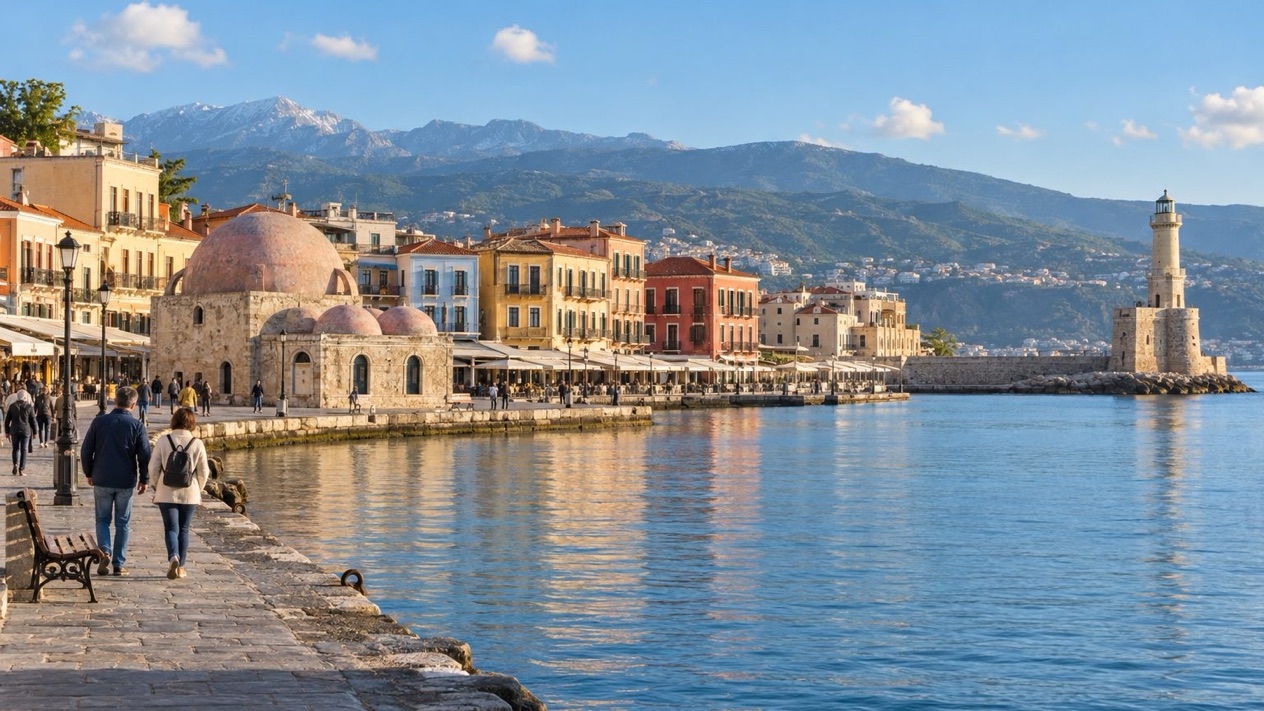
Chania is a Venetian harbor town on Crete's northwest coast, all pastel waterfront houses, narrow alleys and a lighthouse that turns to silhouette at sunset. It suits people who like to wander, eat well and swim in the afternoon, and who would rather not be rushed.
The rhythm is simple. Mornings are for coffee and a walk. Midday is for the water or a long lunch, then a siesta when the heat bears down. Evenings belong to the harbor: in July the sun doesn't set until around 9 p.m., the shoreline turns pink and purple, and the shops reopen as the town wakes up again.
Where should you stay in Chania?
The Old Town
Many first-time visitors enjoy the Old Town because the harbor, the cobbled lanes, the shops and plenty of restaurants are a few minutes' walk away, and so is the main bus station, which makes day trips easy without a car. Cars are kept out of the center, so there's little traffic noise, and parking is a headache if you bring one. The streets are lively and Friday nights can get loud, so pack earplugs and look for reviews that praise the soundproofing.
Options run from restored stone guesthouses steps from the waterfront to boutique hotels and roomy apartments with balconies or terraces.
Near the beach
If your trip is mostly about swimming, base yourself closer to the sand. Nea Chora sits roughly a 20-minute stroll from the Old Town, so you can spend the morning on the sand and still be back at the harbor in time for dinner. Golden Beach and Platanias are well connected by public bus, an easy choice if you don't want a car.
A beach resort outside town
A resort about a 40-minute drive from Chania gives you pool days and a beach a minute from your room. It works best as a few nights paired with a night or two in the Old Town, and a rental car makes exploring from there far easier. Treat it as a break from sightseeing, not a base for it.
What are the best things to do in Chania?
Walk the Venetian Harbor and out to the lighthouse
The harbor dates to the 14th century, built for trade and as protection against pirate raids, and its lighthouse is the emblem of the town. A stroll along the sea wall ends at its foot. You can't go inside, but the view back over the port is the reward, and at night, with city lights on calm water, it's the one you'll photograph.
The walk takes longer than it looks. There's no shade, the stones are uneven and the path gets busy, so wear proper shoes, bring water and snacks, use a restroom before you set off, and go early in summer.
For sunset, the bars along the harbor give you a front-row seat; arrive a little early if you want a table at the water's edge. For something more natural, head west of the harbor, where people gather with their own drinks and waves hit the rocks.
Get lost in the old quarters
Wandering the historic districts of Topanas, Splantzia, Ovraiki and Kasteli is a journey through time. Byzantine and Arab, Venetian and Ottoman rule all left their mark on the architecture, and history seems to peel off the sandy yellow and orange walls. Splantzia is a maze of alleys, outdoor cafes and restaurants around the Church of St. Nicolas, and once spring arrives, pink bougainvillea blooms along the walls. Down at the harbor, the Küçük Hasan Mosque now houses an art gallery worth a peek.
Wandering counts as a real activity here. Sit with a coffee, browse the gift shops and let the afternoon go. The Municipal Market is a landmark for locals and visitors alike. Local boutiques sell linen and other Greek-made clothing, often pricey but beautifully made, and other shops sell silver jewelry made on the island. Many will come down a little if you haggle, and card machines are everywhere, so cash is rarely needed.
Further east, the historic quarter of Halepa is lined with grand 19th-century mansions.
Visit the Archaeological Museum
The harbor won't give you Crete's deep history; this museum will. It reopened in a new building just outside the Old Town and holds Minoan finds alongside Cycladic, Greek, Hellenistic and Roman pieces. Look for the scales known as the "Weighing of the Souls." Since 2025, the Minoan palace of Kydonia in Chania has been a UNESCO World Heritage site.
Full admission is €15 and reduced is €8. Entry is usually free on a set list of dates: March 6, April 18, May 18, the last weekend of September, October 28 and every first Sunday from November 1 to March 31. The museum is at Skra 15 (phone 28210 23315), served by local bus lines 11, 18 and 23; Line 11 to Chalepa, getting off at stop 492 Venizelos House, is the recommended route.
See the ruins of Aptera
Roughly 9 miles (15 km) east of Chania, this ancient city holds ruins from Minoan, Greek and Roman times, among them a theater, Roman cisterns and the Agios Ioannis Theologos monastery. The views take in the White Mountains on one side and Souda Bay on the other, with olive groves in between.
Admission is €10, or €5 reduced, and the free days are the same as the museum's. The site is usually open 8 a.m. to 8 p.m. from mid-April through August, then closes half an hour earlier every two weeks through the fall, down to 6 p.m. in late October, so check the current hours before you go.
Hike a gorge or taste wine
Samaria is the big one: about 10 miles (16 km) of rugged trail through towering cliffs and mountain scenery. Transport can be arranged through KTEL, and it's a long day, so plan something lighter afterward.
For something shorter, the 2.8-mile (4.5 km) out-and-back trail from Gouverneto Monastery passes Katholiko Monastery and Arkoudospilio, the Bear Cave, before ending at a secluded beach. The trailhead is about 35 minutes by car from the center, so driving is the easiest way there.
Less than 10 minutes from the trailhead, Agia Triada Monastery rises from its vineyards, still home to working monks. Its shop sells their olive oil, wine, honey and vinegar, and the cellars offer tastings. If you'd rather not drive after wine, take a full-day wine tour instead.
Take a day trip or two
Rethymno, Crete's third-largest city, lies 37 miles (60 km) east, one to two hours by bus. Its Venetian Old Town has a huge fortress, a lighthouse and narrow alleys often shaded in the afternoon heat, and by day it can feel less touristy than Chania.
Paleochora, on the south coast, sits on a small peninsula with a beach on either side, a little fortress and plenty of good-value traditional restaurants with a relaxed feel in the evenings. It's about 1.5 to 2 hours by bus, and many visitors like it enough to wish they had stayed overnight.
Lake Kournas, one of the island's best-known lakes and often described as its only natural one, is 29 miles (47 km) away.
What are the best beaches in Chania?
Nea Chora, for an easy afternoon
Nea Chora is the beach for a lazy day when you don't want a bus. It's mostly sand with a few stones, and the stones are mild enough that water shoes aren't needed. Calm water and a strip of restaurants and fish tavernas just behind the beach make it an easy place to spend the afternoon. It's touristy because of those amenities, but pleasant. If you rent sunbeds, you'll be expected to order a drink from the restaurant that runs them.
Golden Beach and Agii Apostoli, for sheltered coves
Golden Beach, also called Yannis Beach, is mostly sand with some pebbles, set in a cove that protects swimmers. Agii Apostoli, known as Iguana Beach, is one cove further and nearly identical. Both have small restaurants, and vendors walk the sand selling fresh fruit. A cheap bus runs from the main station, and the fare is the same whichever stop you choose, or walk the shoreline if you're up for more than 30 minutes each way.
Elafonissi, for clear turquoise water
Elafonissi, about 47 miles (75 km) southwest, is known for its pink sand and shallow lagoon, which is lovely for swimming and snorkeling. It's packed in July, so go very early or visit in the shoulder months. The drive takes at least an hour and 15 minutes. Public buses also run, and an organized bus tour guarantees your seat and spares you the hassle.
Balos and the quieter alternatives
Balos Lagoon, on the Gramvousa Peninsula about 31 miles (50 km) out, has turquoise water and big views.
Kedrodasos is far quieter with few amenities, so bring snacks. Episkopi, visible from the Rethymno bus, is a calm stretch of sand with good facilities, but buses on that route fill up and sometimes turn people away, so a car makes it much easier.
What should you eat in Chania?
Cretans love their cheese, and local mizithra turns up everywhere. Start the day with bougatsa: phyllo tossed paper-thin, wrapped around mizithra, baked and dusted with sugar or cinnamon. Bougatsa Chania has been making it every morning since 1922.
Seafood is the order of the day; just make sure it's well cooked, since undercooked calamari happens. Ask for the baklava even if you don't see other tables ordering it; the staff at one taverna said diners tend to order whatever they see around them. Retsina and ouzo are good nearly everywhere, and when the midday heat hits, stalls and little bars in the Old Town serve fresh fruit juice.
Harbor restaurants vary. Some are excellent, with live music and a warm atmosphere. Others are tourist traps, especially those with someone outside coaxing you in. Book an upmarket harbor place like Salis for a special night, eat at a plain fish taverna like Neoria for simple, fresh cooking, and look in the back streets for traditional spots such as Enetikon, known for its moussaka. Gyros make an easy first meal after a late flight.
How many days do you need in Chania?
Five days covers the harbor, the Old Town, a beach day, a big day out and Rethymno. Seven adds Aptera, Halepa or Paleochora.
Day 1: The harbor
Arrive, drop your bags and walk the Venetian Harbor, out to the lighthouse if the heat allows. Find a table at the water for sunset and stay for dinner.
Day 2: Old Town and the museum
Start with bougatsa and coffee, then spend the morning in Splantzia and the other old quarters. Visit the Archaeological Museum, take a midday break, and browse for silver jewelry and clothing when the shops reopen. Eat somewhere traditional on the back streets.
Day 3: Beach day
Walk to Nea Chora and spend the day swimming, with lunch at a fish taverna, or head to Golden Beach for a change. End with a drink west of the harbor as the waves hit the rocks.
Day 4: Samaria Gorge or Elafonissi
Choose one. After Samaria you'll be tired, so eat simply. Elafonissi is easier if you set out early, since the trip takes a while and parking in Chania Town can be tricky. If you rent a car for the day, an automatic makes narrow mountain roads much easier.
Day 5: Rethymno
Take a morning bus, explore the fortress and the shaded alleys, have lunch and head back by evening. Or swap in the full-day wine tour.
Days 6 and 7: Slow down or go south
Add Aptera and Halepa, or go to Paleochora for two or three quiet nights by the sea.
When is the best time to visit Chania?
The weather is at its best from May through October. July and August are the busiest months and can be oppressively hot, so book summer rooms early. May, June, September and October bring fewer crowds and a more leisurely pace, and spring adds bougainvillea in bloom. Forest fires are common in the dry summer months and occasionally close roads, so check conditions before a long drive.
How do you get to Chania and around?
Chania Airport (CHQ) sits about 9 miles (14 km) from the center on the Akrotiri peninsula, a flight of about 55 minutes from Athens. A taxi into town takes under 30 minutes, and the green KTEL buses are much cheaper but slower. The bus stops running late at night, and taxis hold firm on their prices once it does, so after a late arrival plan on a cab.
Ferries from Piraeus usually sail overnight, take around 8 to 9.5 hours and arrive at Souda port, about 4 miles (6.5 km) from town, where cruise ships also dock. The Piraeus to Chania line has been temporarily suspended, so check its status before planning around it. Kissamos port, about 25 miles (41 km) west, also receives ferries from Piraeus.
Once you're in town, you can do without a car. KTEL buses run to Rethymno, the airport, Paleochora and the Samaria Gorge. Check the current schedule on the KTEL site and buy tickets in advance to secure your preferred time. Summer brings plenty of buses, but timetables get rigid outside peak season. Be sure to carry the right ticket and validate it, since fines on Greek public transport can reach up to 60 times the basic fare. A rental car is the best way to reach Crete's remote corners, but a taxi is often easier than driving into the historic center.
What should Americans know before going?
The U.S. State Department says U.S. citizens may enter Greece without a visa for up to 90 days for tourism or business. Your passport should have at least three months of validity beyond your planned departure date, and one reported lost or stolen will get you turned away. Be ready to show proof of sufficient funds and a return ticket if asked, and carry your passport or other photo ID at all times.
Greece is generally safe, though petty crime is common in popular tourist spots, and thieves have been known to break into rental cars for passports and luggage, so it's wise to keep valuables with you. Strikes and demonstrations can disrupt flights, ferries, buses and taxis with little notice. Behind the wheel, using a phone is illegal and police run random alcohol tests. Private hospitals in Greece usually ask for proof of adequate insurance or cash before admitting a patient, and many care providers accept only cash, so travel insurance is worth sorting out before you leave.
To rent a car, Greek law requires a valid U.S. driver's license plus an international driver's permit, so get the permit before you fly, even if the rental company doesn't ask to see it.
Sources
- oopsibookedagain.com (https://www.oopsibookedagain.com/blog/things-to-do-chania-old-town), checked October 18, 2026
- thetravelpsychologist.co.uk (https://thetravelpsychologist.co.uk/things-to-do-in-chania-town/), checked October 18, 2026
- foratravel.com (https://www.foratravel.com/guides/8NYFVF/chania-charm-a-luxe-guide-to-crete-greeces-coastal-jewel-taylre-arnold), checked October 18, 2026
- dontdreamjusttravel.com (https://www.dontdreamjusttravel.com/chania-greece/), checked October 18, 2026
- theculturemap.com (https://theculturemap.com/chania-travel-guide-crete/), checked October 18, 2026
- U.S. Department of State (https://travel.state.gov/content/travel/en/international-travel/International-Travel-Country-Information-Pages/Greece.html), checked October 15, 2026
- e-ktel.com (https://www.e-ktel.com/en/), checked October 15, 2026
- Visit Greece (GNTO) (https://www.visitgreece.gr/en/islands/crete/chania), checked October 15, 2026
- minoan.it (https://www.minoan.it/en/11-uncategorized/165-timetable-ferry-piraeus-chania), checked October 15, 2026
- anek.gr (https://www.anek.gr/en-gb/destinations/chania), checked October 15, 2026
- Hellenic Ministry of Culture, Odysseus (http://odysseus.culture.gr/h/1/eh155.jsp?obj_id=16001), checked October 15, 2026
- U.S. Department of State (https://travel.state.gov/content/tsg_aem/us/en/home/international-travel/travel-advisories/destination.grc.html), checked October 15, 2026
All our pages
When to go
- Best Time to Visit Chania: September and May, With Early June Close Behind
- Chania in January: Epiphany at the Harbor, Winter Weather and What to Do
- Chania in February: Weather, Carnival Season, Cretan Food and What to Do
- Chania in March: Weather, Carnival Season and What to Do
- Chania in April: Weather, Sea Temperature, Easter Season and What to Do
- Chania in May: Weather, Sea Swims, Old Town Walks and a Two-Day Plan
- Chania in June: Weather, Swimming, Old Town Walks and a Two-Day Plan
- Chania in July: Weather, Swimming, Old Town Evenings and a Two-Day Plan
- Chania in August: Weather, Sea Temperature, the Dormition Feast and a Two-Day Plan
- Chania in September: Weather, Swimming and Things to Do
- Chania in October: Ohi Day, Sea Swims, the Old Town and Weather
- Chania in November: Weather, Sea Swims, Old Town Walks and a Two-Day Plan
- Chania in December: Weather, Winter Swims, Christmas Lights and a Two-Day Plan
Things to do
- Things to Do in Chania: The Harbor, the Beaches and a Few Good Detours
- Day Trips from Chania: Rethymno, Arkadi Monastery, Plakias and the Gorges of Sfakia
- 3 Days in Chania: Old Town, Harbour, Archaeological Museum and an Elafonisi Day Trip
- Chania Beaches: Where to Swim and How to Reach Them
- The Chania Lighthouse: The Old Harbor Walk, Venetian Setting and Best Seasons
- The Old Venetian Harbor of Chania: Waterfront Walks, Old Town Lanes and the Best Seasons
Where to stay
- Chania Hotels: Where to Stay in Crete's Historic Port Town
- Where to Stay in the Chania old town: Harbour, Splantzia, Topanas and the Nea Hora End
Getting there
- How to Get to Chania: Flying, Ferry and Everything Between
- Chania Airport (CHQ): Getting In, Getting Around, Getting Out
- Chania to Balos: Getting There, Driving Papers and Your Options
- Chania to Elafonisi: Driving With an IDP, the Old Town Start and Chania's Place on Crete
- Chania to Samaria Gorge: Driving, the International Driver's Permit and Where to Base Yourself in Chania