
A morning in the old town of Chania starts with the scrape of café chairs on stone and the smell of coffee drifting out of doorways along the harbour. A few alleys away, bougainvillea spills over the wall of a Venetian mansion, and by evening the lanes fill with the clatter of plates and the sound of Cretan lyra music from a taverna terrace. The choice is which corner of this maze to wake up in: the harbour front, the quarters behind it or the western edge by the sea.
What is the best area to stay in the Chania old town?
For a first visit, the streets around the Venetian harbour put you in the middle of everything the old town is known for, while Topanas and Splantzia suit travelers who want the same alleys with a more residential rhythm, and the western end of the old town is the pick for anyone who wants the beach at Nea Hora within a walk.
Chania is a port town on the northwest coast of Crete, and its old town is centred around the harbour. Behind that waterfront stretches a maze of alleys and houses that reflect a Venetian and Turkish past. That layering is exactly what separates one area from the next.
Near the harbour you are surrounded by the stage set: the mosque with its domed roof on the quay, the lighthouse at the end of the breakwater and the long line of waterfront restaurants. Step a few streets inland and the scene changes to stone houses, small churches, craft shops and corner kafenia (coffee houses) where the regulars have their own tables.
If you are planning around the ancient world, the old town is a good base because the Minoan palace of Kydonia in Chania has been a UNESCO World Heritage site since 2025, and the town itself carries Venetian mansions, old hammams, minarets and churches within a few turns of each other. Sightseeing here is a matter of wandering, so any area of the old town puts you inside the subject.
For a trip built around beaches, the western end of the old town is the logical corner, since Nea Hora is the nearest beach to the old town and a walk from its west end. For budget travelers, the guesthouses and simple rooms that sit in the inner lanes tend to give a better feel for local life than the front row on the water.
For families, a street with a little breathing room and a plaza close by matters more than a harbour view. For nightlife, the harbour and the lanes just behind it are where the evening gathers, and the same streets are the ones to avoid if you want your window to stay still after dinner.
Food shapes the choice too. The harbour is lined with tavernas serving grilled fish, Cretan salad with its barley rusk, and plates of local cheese with honey.
The inner quarters are where you find the small places for dakos, kalitsounia (little cheese pastries), snails, boureki (a baked dish of zucchini, potato and cheese) and a carafe of raki poured at the end of the meal. Staying near the table you prefer saves a lot of back-and-forth through the alleys.
Last, the old town is not the whole of Chania. The wider city and the regional unit lie around it, and Chania sits at the western end of Crete, about 43 miles west of Rethymno and about 90 miles west of Heraklion. That makes the old town a base from which the west of the island opens up, and a place to come back to in the evening for dinner rather than a place you leave after breakfast.
The best areas to stay in the Chania old town
The Venetian harbour
Rooms here are in old harbour houses converted into boutique hotels and apartments, many with tall shuttered windows and stone walls. Mornings belong to the café tables and the first walkers along the quay, and evenings to the restaurants that set tables out to the water’s edge.
This area suits first-time visitors who want to step out of the door and be in the scene, couples after a view and anyone who likes to be near the tavernas. Its limit is the same as its strength: it is the center of evening life, so the window over the quay is also a window over the dinner crowd. The airport is outside the old town and the alleys are for feet, so the harbour works best when you treat it as a place to arrive once and then walk from.
A tip: ask for a room set back from the front row if you want the view without the table noise, or choose one of the buildings just behind the waterfront, where the same stone and the same light come with a quieter lane outside.
Topanas, the Venetian quarter
Topanas is where Venetian mansions line the alleys, with carved doorways, inner courtyards and balconies that hang over the street. The quarter has the old-town atmosphere in its fullest form: stone-built lanes, bougainvillea on the walls, small churches and the occasional fountain. Many of the lodgings are restored mansions turned into boutique hotels and guesthouses, with rooms that keep beams, arches and thick stone walls.
It suits couples, travelers who care about architecture and anyone who wants to feel the old town at a slower pace than the waterfront. Dinner is a walk away along the lanes, and the harbour is close enough for an evening stroll but not outside your door. Because the alleys are narrow and stone-paved, a rolling suitcase is something to think about when you choose the exact street.
A tip: look for a courtyard room if the listing has one. In a quarter of mansions, a courtyard with a lemon tree or a vine gives you breakfast outside without leaving your door.
Splantzia, around the plane-tree square
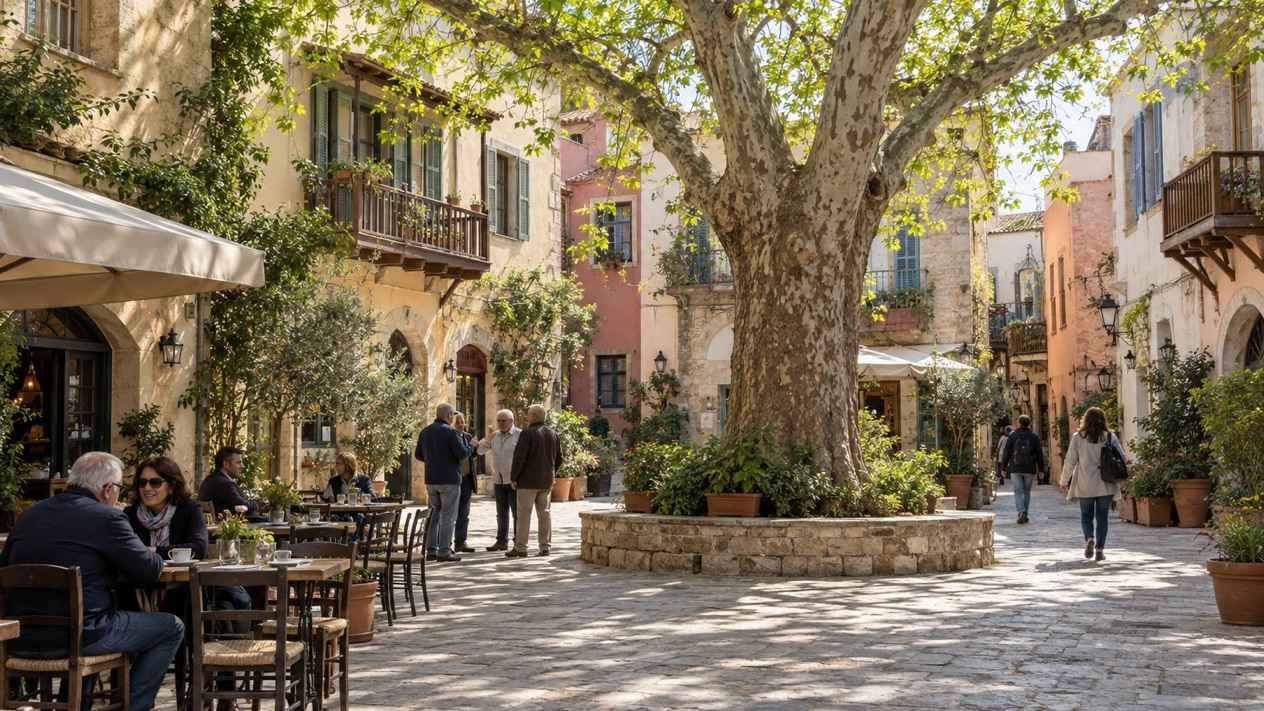
Splantzia is the old Ottoman quarter, centered on a small square with a plane tree and a church, and it feels lived in. Locals sit at the cafés and tavernas on the square, and the lanes around it are lined with old houses, a minaret and a few workshops. The lodging here is mostly guesthouses, small hotels in restored houses and apartments in older buildings, often at a slight distance from the harbour crowd.
The harbour is a walk away, which gives you the choice of joining the evening scene or leaving it. A tip: the square itself fills with tables at mealtimes, so pick a room on a side lane if you like to sleep with the shutters open.
The western end, toward Nea Hora
The west end of the old town is the stretch that leads toward the sea walls and out to Nea Hora, the nearest beach to the old town and a walk from its west end. Lodging here mixes small hotels, apartments and guesthouses set in older houses, with a slightly more residential feel than the harbour. Cafés and tavernas sit along the lanes, and the sea is never far.
For anyone who needs the harbour at their door, it is a step back from the busiest waterfront. A tip: after a day at the beach, the walk back along the edge of the old town ends in alleys that are already part of your evening, and that is a good reason to pick a room on this side.
The Chania old town areas compared
| Area | Best for | Feel | What is around |
|---|---|---|---|
| Venetian harbour | First visit, couples, nightlife | Waterfront with restaurants and boats | Mosque on the quay, lighthouse, tavernas |
| Topanas | Architecture, couples | Venetian mansions and stone lanes | Courtyards, small churches, fountains |
| Splantzia | Budget, local life | Old Ottoman quarter around a plane-tree square | Cafés, minaret, workshops |
| West end toward Nea Hora | Beach and old town together, families | Residential edge of the old town | Nea Hora beach, a walk from the west end |
The main trade-off is between the stage and the lived-in lanes. The harbour gives you the view, the restaurants and the late evening, and in exchange the window may look over the dinner crowd.
Topanas and Splantzia give you the stone alleys, the mansions and the corner cafés, and in exchange you walk to the water. The west end gives you the beach, and in exchange you are a step from the center of the evening scene.
Think about what you will do most. If it is sleeping well after long days, choose a side lane in Topanas or Splantzia. If the sea matters, go west. In every case the whole old town is a maze of alleys, so no spot is far from the others, and an early dinner on the waterfront is possible from any of these bases.
Nightlife deserves its own thought. The harbour and the lanes just behind it are where bars and late tables gather, while Splantzia has a more neighborhood feel with the square as its center. Travelers who love music and late dinners will like the first. Travelers who want the old town to quiet down at night will do better in the inner lanes of Topanas or on the western side.
How to choose your hotel in the Chania old town
In the old town of Chania, the hotel you pick is usually a restored old house. Venetian mansions, Ottoman-era buildings and stone houses have been turned into boutique hotels, guesthouses and apartments, and the character of the building matters more than any brand. Thick stone walls, arched ceilings, wooden beams and inner courtyards are the details to look for in photos, since they tell you what kind of building you will sleep in.
A boutique hotel in a mansion suits couples and anyone who likes a reception desk and a breakfast room. A guesthouse suits travelers who want a smaller, more personal stay.
An apartment suits families and longer stays, since it gives you a kitchen and more room, and it lets you shop in the covered market and cook with what you find. Villas and village houses belong more to the countryside around Chania than to the alleys of the old town, so for the old town itself, expect houses, rooms and apartments.
Distance is about position within the maze. The old town is centred around the harbour, and Nea Hora, the nearest beach, is a walk from the west end of the old town.
Look at where the lodging sits relative to the waterfront and to the western edge, because that tells you how much you will walk to the sea, to dinner and to the places you came to see. The airport lies outside the old town, so the first question on arrival is how you reach your street rather than which area you picked.
Families and anyone with limited mobility should think about the alleys. They are stone-built, with the uneven surfaces that come with a Venetian and Turkish layout, and a hotel on a wider lane or near the harbour front may suit a stroller or a cane better than a house at the end of a narrow passage. Ask where exactly the entrance is and what the last stretch looks like before you book.
Finally, match the building to your evening. A room facing a lane with tavernas will carry the sounds of dinner, while a room around a courtyard will hold the quiet of the stone. The old town has hammams, minarets and churches scattered through its alleys, so almost any base gives you something to see in the first ten steps from your door.
Good to know before you go
Chania sits on the northwest coast of Crete, at the western end of the island, about 43 miles west of Rethymno and about 90 miles west of Heraklion. The old town is a port quarter built around its harbour, and its alleys are made for walking between your lodging, the tavernas and the sights. Since 2025 the Minoan palace of Kydonia in Chania has been a UNESCO World Heritage site, a reason to read the town’s layers as you walk.
Sources
- Visit Greece (GNTO), Chania (https://www.visitgreece.gr/islands/crete/chania/), checked October 12, 2026
- Wikipedia, Chania (https://en.wikipedia.org/wiki/Chania), checked October 12, 2026
- Wikivoyage, Chania (https://en.wikivoyage.org/wiki/Chania), checked October 12, 2026