
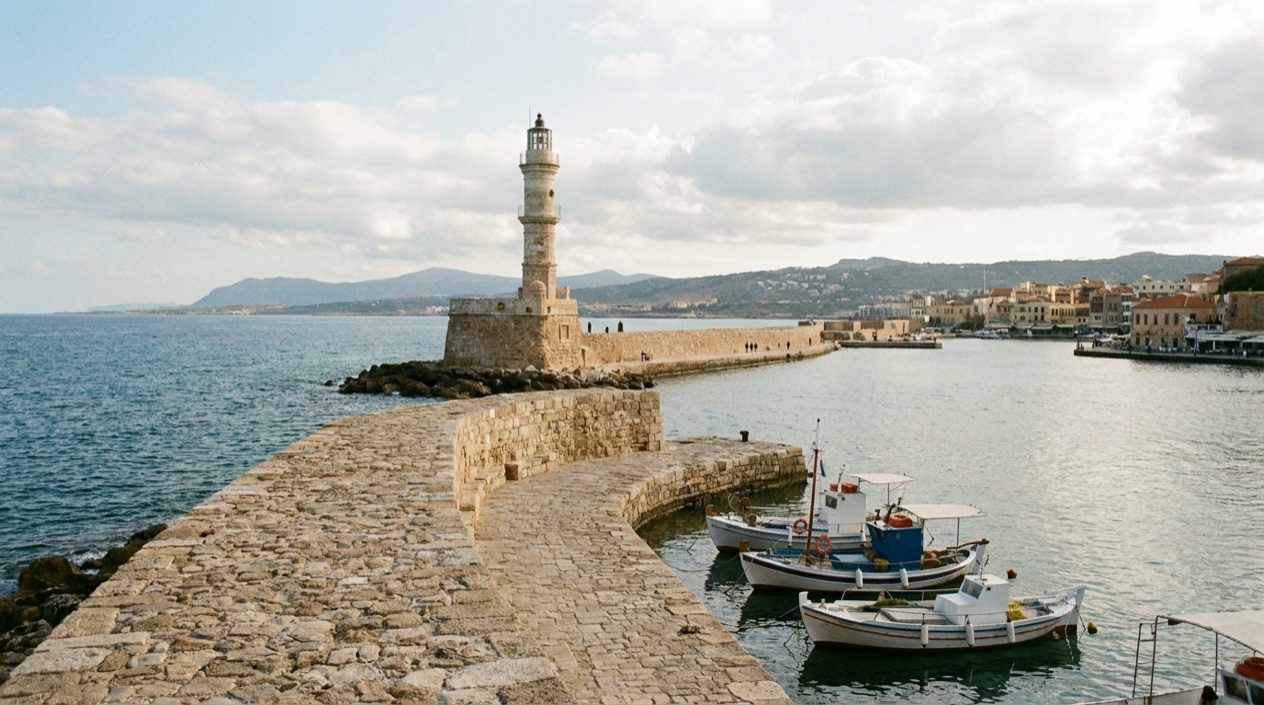
At the end of the old harbor of Chania, the lighthouse stands where the stone breakwater runs out into the sea, and the cafés, fishing boats and Venetian arcades of the waterfront fall behind you one by one. From a distance it is a slim tower at the tip of a long pier, and it grows larger with every step. A visit here is a stroll along the harbor edge with the old town curving behind you, a place to look back at the city rather than a site with a ticket booth.
Is visiting the Chania lighthouse worth it?
Yes, if you like to see a town from the water’s edge, and it suits almost anyone already spending time in the old town of Chania.
What sets it apart from other places nearby is the setting. The old town is a maze of alleys and houses reflecting a Venetian and Turkish past, and the harbor is its center.
The lighthouse is the point where that harbor ends and the open sea begins. Other sights in town are enclosed by walls, museums or narrow streets. Here the horizon opens, and you see the whole waterfront, with its mansions, minarets and churches, laid out in one line.
It is also a good way to understand how the city was built. The old town was once surrounded by Venetian fortifications, begun in 1538, and the harbor mole is part of the same story of a port that needed protecting and guiding ships in. Walking out along the pier puts that history in front of you without a single sign to read.
Treat it as one of the best-placed moments in a day in Chania, tied to the harbor cafés, the old town alleys and the evening light on the water.
What to see at the Chania lighthouse
The lighthouse is only the end point of a longer walk. The things worth looking at come in sequence, from the harbor front to the tip of the pier.
The tower and the pier
The tower rises at the seaward end of the breakwater, a slender shape against the sky and the open water. The pier leading to it is a stone path with the sea on both sides, and you feel the change in air as you move away from the sheltered harbor. Fishing boats and small craft pass close by, and the sound of the waterfront fades behind you.
Look at the stonework and the way the tower sits on its base, and notice how it serves as a marker for the harbor mouth. Visitors simply photograph it from the waterfront, but walking out to it gives you the sense of how exposed this point is to the sea.
The view back over the old town
From the end of the pier, turn around. The old town of Chania is centered around the harbor, and from here you see the curve of the waterfront with its Venetian mansions, the minarets that recall the Ottoman centuries, and the church roofs rising behind the quay. It is a view that explains the city in one glance.
Take your time over it. The buildings change in tone as the light moves, and the cafés along the front become tiny from this distance. This is the moment to pick out the places you plan to visit next, the alleys with bougainvillea and the fountains with Ottoman inscriptions that lie behind the waterfront.
The harbor front on the way out
The approach is part of the visit. The harbor is lined with tavernas and cafés where you can sit over a coffee or a plate of seafood meze before or after the walk. Fishermen mend nets, boats rock at their moorings, and the old Venetian arcades give the quay its character.
Tavernas here serve grilled fish, fried small fish, cheese pies and dishes built on local olive oil and greens, along with raki, the clear spirit that often arrives at the end of a meal. Pair the lighthouse walk with a table facing the water and you have the shape of a typical evening in Chania.
How to get to the Chania lighthouse
The lighthouse stands at the harbor of Chania, a port town on the northwest coast of Crete, so you reach it from the old town itself. Chania is located at the western end of the island, and everything starts from the city.
From the airport, Chania International Airport (CHQ) lies on the Akrotiri Peninsula, 8.7 miles from the city.
If you are coming from elsewhere on the island, Chania is about 43 miles west of Rethymno and about 90 miles west of Heraklion. Once in the city, the lighthouse is reached along the old harbor, with the old town behind you and the sea ahead.
Staying in or near the old town puts the harbor at your doorstep. Nea Hora, the nearest beach to the old town, is a 1-km walk from its west end, which gives you a sense of how the waterfront stretches along this part of the coast. Combine the two in the same outing if you like, with the lighthouse at one end and the beach at the other.
When to visit the Chania lighthouse
The warm period from April to October is when the harbor area is especially popular, and that is the season when the waterfront is at its liveliest. Chania has a hot-summer Mediterranean climate, with sunny dry summers and mild rainy winters, so the walk is possible in any month, but the experience changes with the season.
| Month | Average high (°F) | Average low (°F) | Rain (inches) | Rain days |
|---|---|---|---|---|
| January | 57.7 | 47.1 | 5.65 | 14.3 |
| April | 68.4 | 53.8 | 1.48 | 5.9 |
| July | 88.5 | 72.0 | 0.13 | 1.0 |
| October | 75.2 | 62.1 | 3.10 | 8.4 |
In July the days are hot and almost rainless, so the exposed pier asks for sun protection and a hat, and the sea beside you is a welcome sight. April and October sit in a gentler range, with warm afternoons and a few rainy days, which suits a long walk along the breakwater.
January is the wet month, with many days of rain, so a rain jacket belongs in the bag and the pier is best left for a clear spell. Winter in Chania is mild, and the harbor has a quieter, more local feel, though the old town cafés are still there to shelter in.
People simply fold the walk into a day in the old town, between a coffee and a meal on the waterfront.
Tips for your visit
Bring comfortable shoes for the stone pier, sunglasses for the glare off the water, and a camera for the view back at the old town. In the hot months, add sun protection and water. In the wetter months, a rain jacket is the plain consequence of the many days of rain.
The lighthouse pairs naturally with the rest of the old town. Behind the harbor lie stone-built alleys with bougainvillea, Venetian mansions, old hammams and churches, and the quarter of Topanas, popular especially from April to October. Spend time among these streets before or after the walk to the end of the pier.
If you want a swim, Nea Hora, the nearest beach to the old town, lies a 1-km walk from its west end. For a longer outing in the city, Chania’s new Archaeological Museum is located at 15 Skra Str. Chalepa, and the Minoan palace of Kydonia has been a UNESCO World Heritage site since 2025.
Mobility and family needs are best judged on the spot, looking at the pier and the quay as you reach them.
Good to know before you go
The harbor is lined with cafés and tavernas, so there is no need to carry much more than water and a light bag. Chania sees extreme heat at times, and the record high reached 44.3 °C (111.7 °F) on 1 July 2021, so on summer days keep the walk to the cooler moments of your plan. Winter can bring snow to the city, as it did on 8 January 2017, though that is rare.
Sources
- Wikipedia, Chania (https://en.wikipedia.org/wiki/Chania), checked October 12, 2026
- Visit Greece (GNTO), Chania (https://www.visitgreece.gr/islands/crete/chania/), checked October 12, 2026
- Wikivoyage, Chania (https://en.wikivoyage.org/wiki/Chania), checked October 12, 2026
- Hellenic National Meteorological Service (HNMS), climatological normals 1991-2020 for Souda station (https://www.emy.gr/climatic-data), monthly mean daily maximum and minimum; rain from the ECMWF ERA5 reanalysis, 1991-2020, grid cell of Chania (Open-Meteo), checked October 12, 2026
- ECMWF ERA5 reanalysis 1991-2020, grid cell of Chania (Open-Meteo), checked October 12, 2026