
The first morning in Chania starts at the old harbour, where the Egyptian lighthouse stands at the end of the breakwater and the café chairs are being set out along the quay. Coffee comes with a glass of water and a small sweet, and the alleys behind the waterfront slowly fill with the sound of shutters. Three days here give you the Venetian and Ottoman old town, a museum, the western beaches and the mountains behind them, at a pace that still leaves room for long lunches.
Is three days enough in Chania?
Three days is enough for a first visit, especially if you like to wander old streets, eat well and add one big outing to the coast. You can cover the harbour, the historic districts, the new Archaeological Museum, a beach near town and one day trip into western Crete without hurrying from one sight to the next.
What three days leave out is most of the region around the city. The Samariá Gorge, the beach at Falasarna, the lagoon at Balos and the islands of Gramvousa each deserve a day of their own.
If you have a fourth or fifth day, spend it on one of those rather than on a second round of the old town. With a week, Crete itself opens up, and the towns of Rethymno and Heraklion become possible stops along the island’s north coast.
The plan below puts the old town on the first two days and gives the third to the road. That order lets you learn the layout of the city before you leave it, and it gives you a familiar harbour to come back to for the last evening.
Day 1 in Chania
Begin at the old harbour, the most recognizable point in the city, and walk out toward the Egyptian lighthouse. The quay is lined with Venetian buildings, and the water on one side and the stone façades on the other tell you quickly what kind of town this is. Sit down for a coffee with a view of the sea before you go anywhere else.
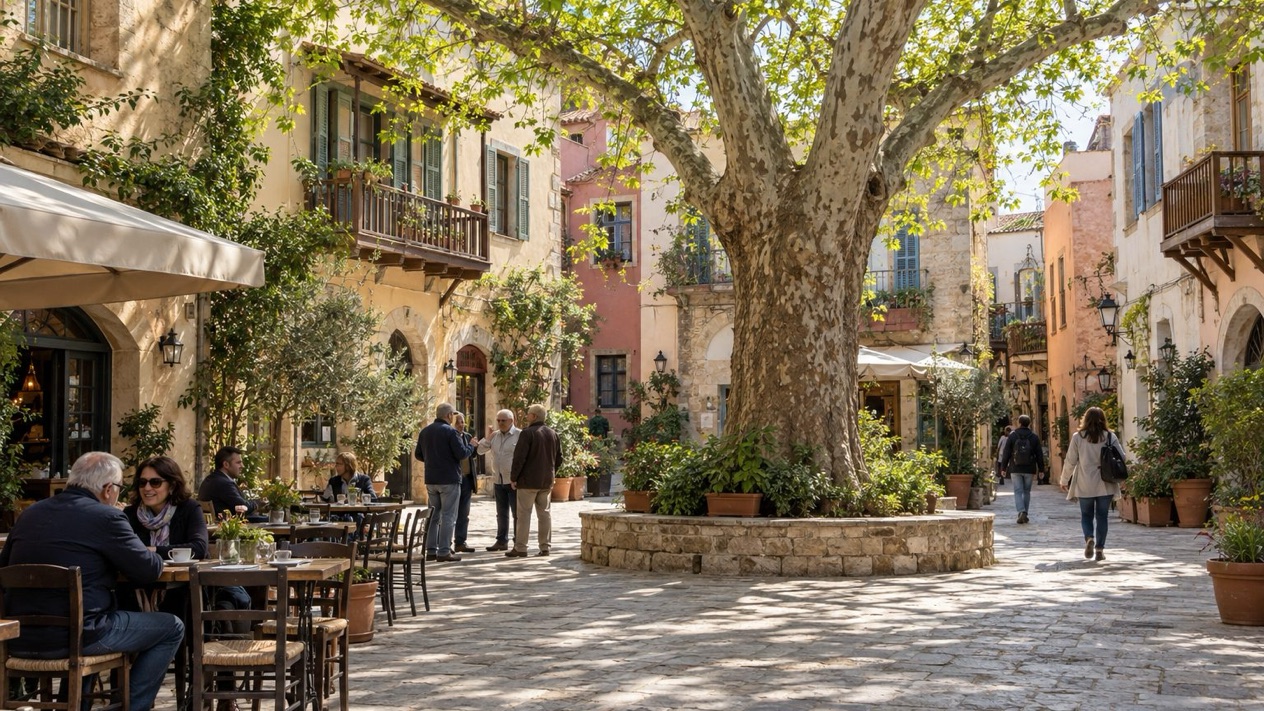
In the afternoon, step into the maze of the old town. Chania’s alleys are stone-built and hung with bougainvillea, and between the Venetian mansions you find old hammams, minarets, churches and fountains carrying Ottoman inscriptions.
Wander the districts of Topanas and Kasteli, where the layers of Venetian and Turkish history sit side by side. Lunch can be a taverna in a side street, with a plate of dakos (barley rusk with tomato and cheese), local cheese pies and a bottle of Cretan wine.
For the evening, return to the waterfront. Tavernas along the harbour serve grilled fish and seafood, and the lit façades make a slow walk around the curve of the quay worthwhile after dinner. A small glass of raki, the clear Cretan spirit, often arrives at the end of the meal. Keep the rest of the night free, because the first day is mostly about getting your bearings and letting the town set the pace.
Day 2 in Chania
Spend the morning in Chalepa, at the new Archaeological Museum at 15 Skra Str. It replaces the former Archaeological Museum of Chania, and it is the place to put the city in context before you see more of it. Chania also lies on the site of the Minoan palace of Kydonia, which became a UNESCO World Heritage site in 2025, so the museum gives the background for the ground you have been walking on.
After the museum, go back into the old town for the districts you skipped yesterday. Splantzia and Ovraiki are part of the same web of lanes, and each has its own churches, small squares and houses that reflect the Venetian and Turkish past.
This is a good stretch for browsing shops that sell olive oil, honey, wine and citrus products, since olives, citrus, avocados, dairy and honey are all part of the farming around Chania. Lunch can be a simple meze spread of cheeses, greens and olives.
In the afternoon, head west on foot from the end of the old town to Nea Hora, the nearest beach to the old town. Swim if the sea invites you, or simply sit at a café with a drink and look out over the water.
In the evening, consider a performance. Chania has five cinemas, three of them open-air, and the Municipal and Regional Theatre of Crete is the city’s most important theatre group. A late dinner can follow in a taverna away from the harbour.
Day 3 in Chania
Give the third day to Elafonisi, in the west of the Chania region. It is a protected nature reserve, and when the weather is fine it is possible to walk from Crete to Elafonisi through shallow water.
You leave town by road, and the day belongs to the coast, so bring a swimsuit and sun protection. If you would rather go to the mountains, the Samariá Gorge is a National Park and a Biosphere Reserve in southwest Crete, though it asks for a day of its own.
Back in Chania, the last evening is the one to spend slowly. Walk the harbour again now that you know its corners, and look for the Egyptian lighthouse from the quay where you started. Dinner can be the meal you have been saving for: a table in a restaurant in the old town with Cretan dishes built on olive oil, greens, lamb, fresh cheese and honey for dessert.
If you still have energy afterward, return to a side street in Topanas or Splantzia for one more glass of raki or a Cretan wine. Then finish with a final stroll along the water. The quay that was just a place for coffee on the first morning now has a familiar shape, and that is the real return on three days here.
Where to stay for three days in Chania
For this plan, the old town around the harbour makes the best base. The old town is centered on the harbour, and the historic districts of Topanas, Splantzia, Ovraiki and Kasteli are all there to be wandered. You step out of your door into the alleys and the harbour on the first and the last day, and you pass through the district again on your way to and from the museum.
Staying in a Venetian mansion or an old stone house fits the setting, since the old town is full of that kind of building. Rooms in the lanes behind the harbour give you the character of the place, while rooms right on the waterfront put the lighthouse and the café life on your doorstep.
Travelers who put the beach first may prefer the area toward Nea Hora, at the western end of the old town, so the sea is close at hand. Those who arrive by air and want to be near the airport will find it on the Akrotiri Peninsula, a bit northeast of the city. For a three-day plan built around the harbour and the alleys, though, the old town gives you the most of Chania for the least movement.
What to skip if you only have three days in Chania
Skip a second city on Crete. Rethymno is about 43 miles from Chania and Heraklion about 90 miles, and a transfer to either would use up a day that the old town and the west coast reward better. Crete is large, and a plan that crosses it in three days becomes mostly a matter of road time.
Skip the idea of combining two big excursions. Samariá Gorge, Balos with the Gramvousa islands, Falasarna and Elafonisi are all in the Chania region, and each is a full outing. Choosing one is better than rushing through two. The Gramvousa islands are two small uninhabited islands off the Gramvousa Peninsula, and Agria Gramvousa, the wilder one, has been called False Gramvousa. That kind of trip rewards a day to itself.
Skip the extra museums and archive visits unless one really draws you. The Historical Archive in Chania is the second most important in Greece, which is a strong reason to go if documents interest you, but it will not fit around the Archaeological Museum and the old town in the same short stay. Use the time instead for a second long lunch, a swim at Nea Hora and one more evening on the harbour.
Skip a second island altogether. Chania is on the northwest coast of Crete, and the island itself is more than enough for three days. A ferry trip elsewhere would trade a day on Crete for a day of travel.
Getting around Chania in three days
Most of the plan is on foot. The old town is a maze of alleys around the harbour, and you move between its districts and the waterfront by wandering. Nea Hora, the nearest beach to the old town, is reached on foot from the west end of the old town, so a swim fits into Day 2 without a change of transport.
The new Archaeological Museum is in Chalepa, at 15 Skra Str, so it is a separate stop from the harbour and the old town. Day 3 leaves the city by road toward Elafonisi, in the west of the Chania region.
You arrive by air at Chania International Airport (CHQ), which is on the Akrotiri Peninsula a bit northeast of the city. Chania sits on the northwest coast of the island, and other towns on Crete, such as Rethymno and Heraklion, are reached by road. For this plan, though, you stay within the city and its immediate surroundings, and the walking is the main way of seeing it.
Good to know before you go
Greece uses the euro, and in the old town you will move between harbour cafés, side-street tavernas and small shops that sell olive oil, honey and wine. The summer season from April to October is hot and dry with clear skies, and it is often relieved by a seasonal north wind called the Meltemi.
In July the average high reaches the high 80s with almost no rain, so sun protection belongs in your bag. In January the average high stays in the upper 50s and rain falls on many days, so a rain jacket is the useful thing to bring then.
Sources
- Visit Greece (GNTO), Chania (https://www.visitgreece.gr/islands/crete/chania/), checked October 12, 2026
- Wikipedia, Chania (https://en.wikipedia.org/wiki/Chania), checked October 12, 2026
- Wikivoyage, Chania (https://en.wikivoyage.org/wiki/Chania), checked October 12, 2026
- Wikipedia, Samaria Gorge (https://en.wikipedia.org/wiki/Samaria_Gorge), checked October 12, 2026
- Wikipedia, Elafonisi (https://en.wikipedia.org/wiki/Elafonisi), checked October 12, 2026
- Wikipedia, Balos Lagoon (https://en.wikipedia.org/wiki/Balos_Lagoon), checked October 12, 2026
- Wikipedia, Falasarna (https://en.wikipedia.org/wiki/Falasarna), checked October 12, 2026
- Hellenic National Meteorological Service (HNMS), climatological normals 1991-2020 for Souda station (https://www.emy.gr/climatic-data), monthly mean daily maximum and minimum; rain from the ECMWF ERA5 reanalysis, 1991-2020, grid cell of Chania (Open-Meteo), checked October 12, 2026
- ECMWF ERA5 reanalysis 1991-2020, grid cell of Chania (Open-Meteo), checked October 12, 2026
- Wikipedia, ANEK Lines (https://en.wikipedia.org/wiki/ANEK_Lines), checked October 12, 2026
- Wikipedia, Blue Star Ferries (https://en.wikipedia.org/wiki/Blue_Star_Ferries), checked October 12, 2026