
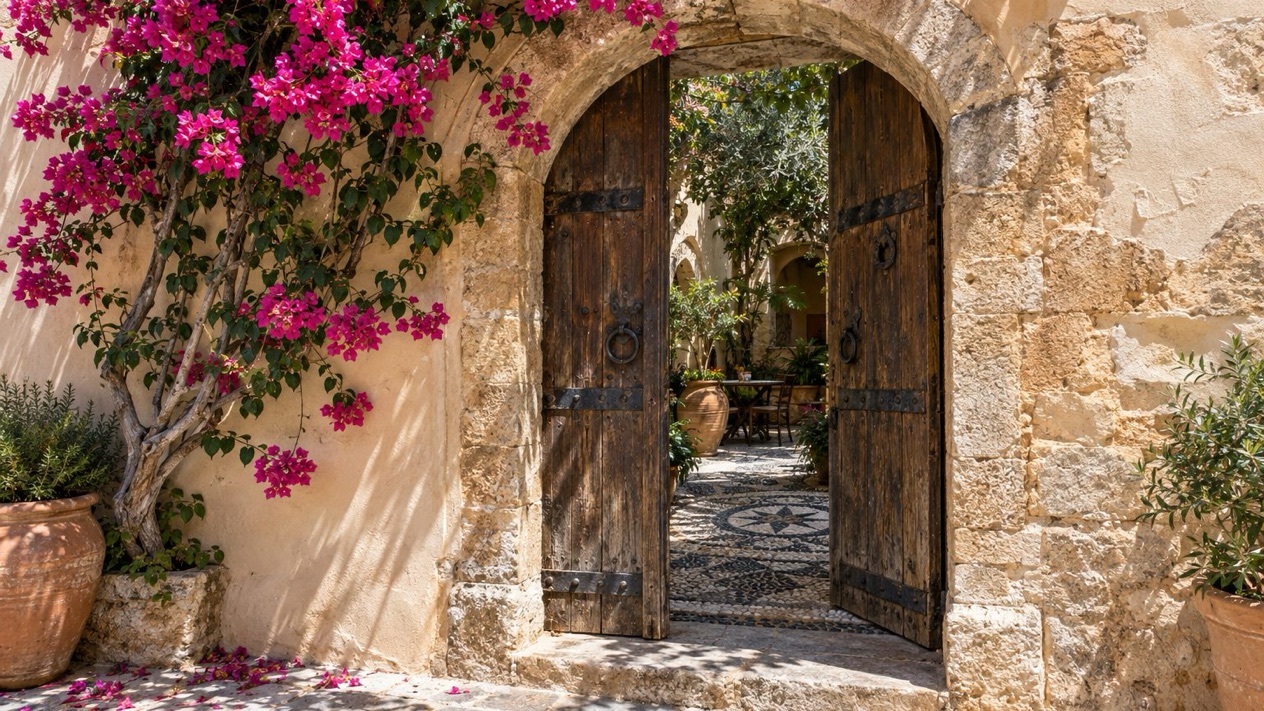
You step off the bus or out of the taxi and the old harbor opens in front of you: stone quays, a lighthouse at the end of the breakwater, and the smell of grilled fish and coffee drifting from the tavernas along the water. Behind the waterfront, the alleys of the old town fold into one another, with Venetian mansions, minarets and bougainvillea spilling over the walls. Chania rewards a little preparation, from the passport to the euro notes in your pocket to the way the weather changes between winter and summer.
What should you know before visiting Chania?
Four things matter most here: a passport in good order, a pocket of euros, a rain jacket or sun protection depending on the month, and a willingness to slow down to the pace of the harbor. Everything else is a matter of taste. Chania is a port town on the northwest coast of Crete, and its old town is a maze of alleys that reflect both a Venetian and a Turkish past.
What surprises first-time visitors is how many layers share the same few streets. A church stands beside a former hammam, a minaret rises above a row of Venetian houses, and fountains carry Ottoman inscriptions.
The historic districts of Topanas, Splantzia, Ovraiki and Kasteli can all be wandered through, and each has its own feel. Splantzia gathers tables under its trees, Topanas climbs behind the harbor with old mansions, and Kasteli sits on the hill above the water.
The second surprise is that Chania is more than a pretty waterfront. It is a working city and the capital of its regional unit, with a municipal theatre company, a historical archive and a new Archaeological Museum in the Chalepa area.
Since 2025, the Minoan palace of Kydonia in Chania has also been a UNESCO World Heritage site, which gives the city a past that long predates the Venetians. Agriculture and tourism are the two main sources of wealth, and the olives, citrus, wine, honey and dairy of the region turn up on the table at almost every meal.
The third surprise is the sheer reach of the island. Chania lies at the western end of Crete, about 43 miles west of Rethymno.
Heraklion is about 90 miles to the east, so the city feels like its own center of gravity rather than a suburb of the big port. Tourism has developed rapidly here since the early 1970s, yet the old harbor still has the look of a town that lived for centuries from trade and the sea.
Entry, customs and paperwork
According to the U.S. State Department, U.S. citizens may enter Greece without a visa for stays of up to 90 days for tourism or business. That covers a long vacation on Crete with room to spare.
The passport is the document that counts. The State Department recommends that U.S. citizens have at least three months of validity beyond your planned departure date for entry into Greece. Greek law itself requires only three months beyond the intended departure date, so the recommendation is the more cautious reading.
A passport that has been reported lost or stolen is a problem at the border. U.S. citizens traveling on such a passport will not be permitted entry into Greece and may be returned to their original departure point, even if they have since found it. Anyone who has reported a passport missing and then recovered it should replace it before the trip.
Money, cards and tipping
Chania uses the euro, the same currency as the rest of Greece. Each euro is divided into 100 cents, so the small change in your pocket is made of cent coins. The banknotes come in denominations of €5, €10, €20, €50, €100, €200 and €500. In everyday life you will mostly handle the smaller notes and coins, whether you are buying a pastry at a bakery, a bag of oranges at a market stall or a coffee on the harbor.
The things you are likely to buy reflect the region’s farming. Olive oil, honey, wine, cheese and citrus are all products of the Chania countryside, and the shops of the old town are full of them. Avocados are another local crop, and dairy shows up in the cheeses and yogurt on breakfast tables. These make easy souvenirs to carry home, and they are a good way to taste the area beyond the restaurants.
When the bill comes at a taverna, leaving a little extra for the person who looked after your table is a common gesture in many countries and a pleasant one here too. Treat it as a habit of courtesy rather than a fixed amount. Carrying a few small notes for such moments is simpler than counting out coins at the end of a long meal.
Getting around and staying connected
The old town of Chania is centered around the harbor, and its historic districts are the places you wander on foot, with the alleys leading from one quarter to the next. Nea Hora, the nearest beach to the old town, lies at the west end of Old Town. It sits at the end of the waterfront, so a day can move from harbor to sand without leaving the city.
Chania sits on the northwest coast of Crete, about 43 miles west of Rethymno and about 90 miles west of Heraklion. Those two cities are the neighbors you will hear about when you plan excursions along the north coast of the island. Between them and Chania lies a long stretch of coast, with olive groves and villages in between.
Visitors who arrive by their own boat have one more detail to know. Boats arriving in Greek waters must pay the TEPAI boating tax on the day of arrival, and the fine for not paying is high. The tax must be paid for each calendar month a boat stays in Greece, so a long stay in the harbor means paying again each month.
Health, water and the weather
The weather decides most of what you pack. The summer season, from April to October, is hot and dry with clear skies, often relieved by a seasonal north wind called the Meltemi.
July is the clearest example, with long dry spells and sun protection earning its place in the bag. Winter is a different city, with rain on many days and the harbor under gray skies, so a rain jacket is the sensible companion from January.
| Month | Average high (°F) | Average low (°F) | Precipitation (inches) | Days with rain of at least 0.04 inch |
|---|---|---|---|---|
| January | 57.7 | 47.1 | 5.65 | 14.3 |
| April | 68.4 | 53.8 | 1.48 | 5.9 |
| July | 88.5 | 72.0 | 0.13 | 1.0 |
| October | 75.2 | 62.1 | 3.10 | 8.4 |
April is mild, with a few showers and long stretches of open sky, a good month for walking the old town. October is still warm, but the rain starts to return, with a handful of wet days to plan around. Between those seasons, the layers in your bag matter more than any single forecast.
A sun hat, sunglasses and sunscreen make sense from spring through autumn, and the summer heat is a good reason to plan the day around shade and the water. The U.S. Department of State notes that petty crime is common in Greece, especially in popular tourist locations, which is worth keeping in mind in the busiest parts of the old town.
Local customs and etiquette
Greetings come first. A friendly kalimera (good morning) or efharisto (thank you) goes a long way, and people usually warm to any attempt at Greek. Cretans have a reputation for hospitality, and it is not unusual for a taverna owner to bring a small plate of fruit or a glass of raki, the strong local spirit, after a meal. Accepting it graciously is part of the experience.
Meals are unhurried. Dishes arrive in the middle of the table to be shared, in the style of meze, and a meal can stretch for hours. Cretan cooking leans on what the region grows, so you will meet olive oil, honey, cheese, greens and citrus again and again. Dakos, a rusk topped with tomato and soft cheese, is a typical starter, and kalitsounia, small cheese or herb pies, are a regional specialty.
Coffee has its own culture. At a kafenio, the traditional coffeehouse, men and women linger over a small cup or a tall iced frappe for as long as they like, and nobody hurries the table. In the afternoon, the pace of the streets slows, and many people rest before the evening, when the harbor fills again with strollers.
When visiting churches and monasteries, people tend to lower their voices and move with respect, and many visitors keep photography discreet inside. The old town’s mix of Venetian and Ottoman buildings means that a former mosque or hammam may stand a few steps from an active church, so a quiet attitude suits all of them.
Good to know before you go
The U.S. State Department rates Greece Level 1: Exercise Normal Precautions.
The season shapes the trip. The Meltemi arrives in the hot, dry months and can cool the afternoons, while winter brings rain on many days. Marijuana is illegal in Greece, and photographing military installations is prohibited and may lead to arrest, so keep the camera away from anything of that kind around Souda Bay. Keep your passport in a safe place with your other travel papers, and enjoy the harbor at its own slow pace.
Sources
- Visit Greece (GNTO), Chania (https://www.visitgreece.gr/islands/crete/chania/), checked October 12, 2026
- Wikipedia, Chania (https://en.wikipedia.org/wiki/Chania), checked October 12, 2026
- Wikivoyage, Chania (https://en.wikivoyage.org/wiki/Chania), checked October 12, 2026
- U.S. Department of State, Greece travel information, local laws and special circumstances (https://travel.state.gov/content/travel/en/international-travel/International-Travel-Country-Information-Pages/Greece.html), checked October 12, 2026
- Wikipedia, Euro (https://en.wikipedia.org/wiki/Euro), checked October 12, 2026
- Wikivoyage, Greece (https://en.wikivoyage.org/wiki/Greece), checked October 12, 2026
- U.S. Department of State, Greece travel advisory (https://travel.state.gov/content/travel/en/international-travel/International-Travel-Country-Information-Pages/Greece.html), checked October 12, 2026
- U.S. Department of State, Greece travel information, entry and exit requirements (https://travel.state.gov/content/travel/en/international-travel/International-Travel-Country-Information-Pages/Greece.html), checked October 12, 2026
- Hellenic National Meteorological Service (HNMS), climatological normals 1991-2020 for Souda station (https://www.emy.gr/climatic-data), monthly mean daily maximum and minimum; rain from the ECMWF ERA5 reanalysis, 1991-2020, grid cell of Chania (Open-Meteo), checked October 12, 2026
- ECMWF ERA5 reanalysis 1991-2020, grid cell of Chania (Open-Meteo), checked October 12, 2026