
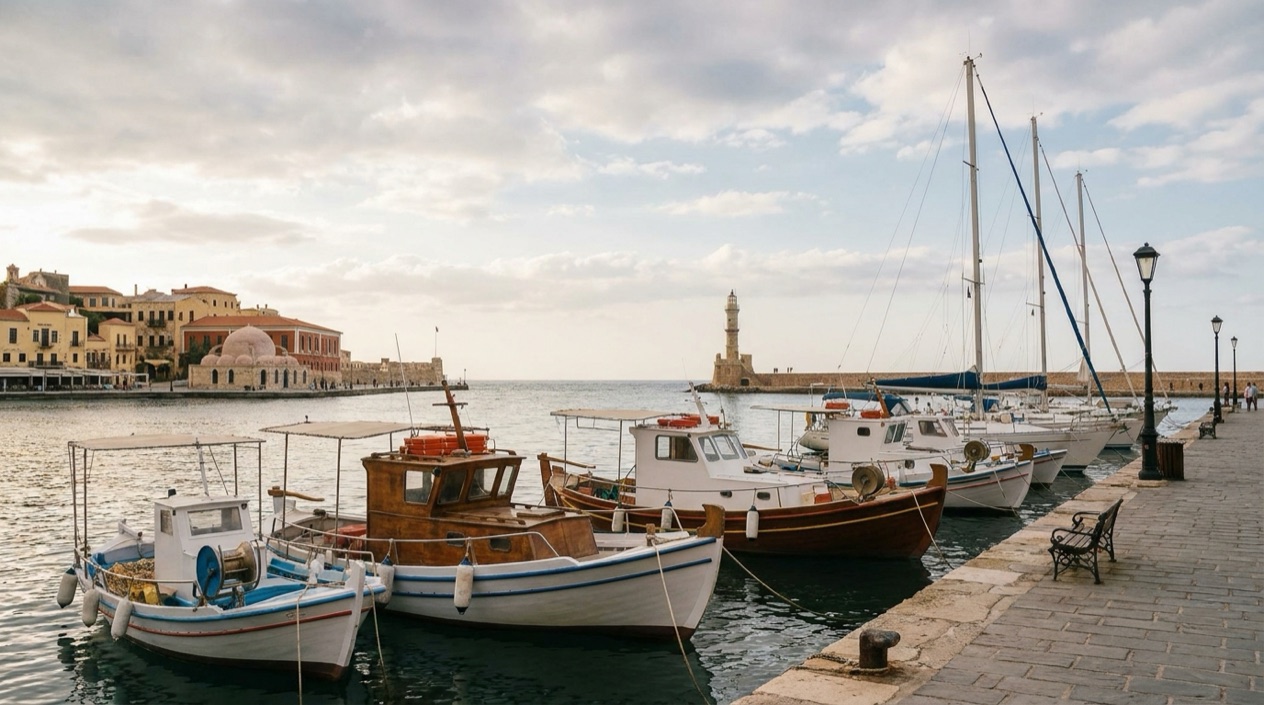
The harbor of Chania opens in front of you as a wide curve of stone quays, with tavernas setting out tables and fishing boats rocking beside the pleasure craft. Behind the waterfront, tall Venetian mansions lean over the lanes of the old town, and the smell of grilled fish and coffee drifts along the edge of the water. This is a visit made on foot, with no ticket and no schedule, in the oldest part of a port town on the northwest coast of Crete.
Is visiting the Venetian Harbor of Chania worth it?
The harbor is the center of the old town, and everything around it is a maze of alleys and houses that reflect both a Venetian and a Turkish past.
What sets it apart from other old ports on Crete is how much of the story is still readable in the stone. Venetian mansions stand next to old hammams (Ottoman bathhouses), minarets and churches, and the alleys carry bougainvillea and fountains with Ottoman inscriptions. Rather than one grand sight, you get a whole quarter where each corner belongs to a different century, and the harbor ties it together.
It also works as a base for the rest of the visit. Cafés and tavernas line the water for a long lunch, shops fill the lanes behind, and the city around the old town gives you museums and a beach to add.
If you want a place to sit with a coffee and let an afternoon pass, the quay does that well. If you want a checklist of ruins, you will find the harbor more of a stroll than a site.
What to see at the Venetian Harbor of Chania
The waterfront and its tavernas
The quay is the heart of the visit. Fishing boats and yachts share the water, and the curve of the harbor gives you a long line of facades to look along, with mansions in faded colors rising from the edge. Walk the full curve slowly and the view keeps changing, as the old buildings, the masts and the sky rearrange themselves.
Tavernas and cafés face the water, which makes this the natural place to try Cretan dishes such as dakos (barley rusk topped with tomato and soft cheese), grilled fish, and a glass of raki, the local spirit often poured at the end of a meal. Sit facing the boats and let the pace of the place set yours.
The alleys of the old town
Step one street back from the water and the mood changes. The old town is a maze of stone-built alleys, with bougainvillea spilling over walls and small fountains that carry Ottoman inscriptions. The pattern of the lanes is irregular, so it is easy to drift from one corner to the next without a plan.
Look up as you walk. Venetian mansions show their carved doorways and balconies, and between them you find old hammams, minarets and churches, evidence that the town passed through Venetian and Turkish hands. Each building tells a small part of that story, and the harbor is never far.
The old fortifications and the Venetian past
The old town was once surrounded by Venetian fortifications, which began to be built in 1538. The walls shaped the town you walk through today, and the harbor was the working edge of the same Venetian port. Keeping that in mind changes how you read the quay, as a place built for ships, trade and defense.
Later chapters left their mark too. In 1898 the Great Powers made Chania the capital of the semi-autonomous Cretan State, and Crete’s union with Greece followed on 1 December 1913. The harbor town you see carries all of these layers at once, which is part of what makes a slow walk here more than a pretty view.
Nea Hora and the Archaeological Museum
Two additions sit close to the harbor. Nea Hora, the nearest beach to the old town, is a 1-km walk from the west end of Old Town, which makes it a natural finish for a day that began on the quay.
For a deeper look at the past, Chania’s new Archaeological Museum is at 15 Skra Str. Chalepa. Since 2025 the Minoan palace of Kydonia in Chania has been a UNESCO World Heritage site, a reminder that the town’s story reaches back well before the Venetians.
How to get to the Venetian Harbor of Chania
The harbor is in the old town of Chania, a port town on the northwest coast of Crete, at the western end of the island. Once you are in the city, the old town is centered around the harbor, so the water is the landmark to head for.
Chania International Airport (IATA code: CHQ) sits on the Akrotiri Peninsula, 8.7 miles from Chania. That is the airport for the city, and from there you continue into town to reach the old harbor.
Coming from elsewhere on Crete, Chania is about 43 miles west of Rethymno and about 90 miles west of Heraklion. Both distances are measured along the island’s north side, and they tell you where Chania sits in relation to the island’s other main towns.
Once you arrive, the visit is on foot. The alleys of the old town gather around the waterfront, and Nea Hora is a 1-km walk from the west end of Old Town. Beyond that, the places you will want, the quay, the lanes and the mansions, are all part of the same walk.
When to visit the Venetian Harbor of Chania
The warm period from April to October is when the old town fills with visitors, and the harbor area is popular through those months. Chania has a hot-summer Mediterranean climate, with sunny dry summers and mild rainy winters, so the season you choose shapes how the waterfront feels.
| Month | Average high (°F) | Average low (°F) | Precipitation (in) | Days with rain (1 mm or more) |
|---|---|---|---|---|
| January | 57.7 | 47.1 | 5.65 | 14.3 |
| April | 68.4 | 53.8 | 1.48 | 5.9 |
| July | 88.5 | 72.0 | 0.13 | 1.0 |
| October | 75.2 | 62.1 | 3.10 | 8.4 |
April is mild, with enough dry days to enjoy the quay at a walking pace. July is hot and almost without rain, so the sun on the stone is strong and you will want shade and water close by. A record high of 111.7°F was once reached in the city, a reminder that midsummer can be extreme.
October stays warm enough to sit outside, though rain becomes more frequent as the month goes on, so a light rain jacket earns its place. Snow is rare, but it has covered the whole city and the old harbor, most recently on 8 January 2017.
Tips for your visit
In the warm months, add sun protection, because the quay offers little cover on a bright day. In the rainy months, a rain jacket suits the many wet days.
Plan the visit around the waterfront first, then fold in the alleys behind it. A slow loop along the curve of the harbor, followed by a wander through the lanes, gives you the main parts of the old town without needing a list of stops.
Combine the harbor with the other places close by. Nea Hora, the nearest beach to Chania Old Town, is a 1-km walk from the west end of Old Town, and Chania’s new Archaeological Museum is at 15 Skra Str. Chalepa, which gives the day a second theme beyond the Venetian and Ottoman streets.
Take time at the table as well. A meal facing the boats is part of the visit, and it is where the harbor feels most like a living port rather than a monument. Let the meal set the rhythm, and use the old town’s lanes to walk it off afterward.
Good to know before you go
The harbor is an open waterfront in the middle of a town of about 111,375 inhabitants, so it is a place of everyday life as much as a sight. In the hottest months, bring water and sun protection for the quay, and in the wet months, expect rain on many days.
Sources
- Wikipedia, Chania (https://en.wikipedia.org/wiki/Chania), checked October 12, 2026
- Visit Greece (GNTO), Chania (https://www.visitgreece.gr/islands/crete/chania/), checked October 12, 2026
- Wikivoyage, Chania (https://en.wikivoyage.org/wiki/Chania), checked October 12, 2026
- Hellenic National Meteorological Service (HNMS), climatological normals 1991-2020 for Souda station (https://www.emy.gr/climatic-data), monthly mean daily maximum and minimum; rain from the ECMWF ERA5 reanalysis, 1991-2020, grid cell of Chania (Open-Meteo), checked October 12, 2026
- ECMWF ERA5 reanalysis 1991-2020, grid cell of Chania (Open-Meteo), checked October 12, 2026