
On the first of January, Chania’s bakeries and homes turn out the vasilopita, the New Year cake with a coin baked inside, and a slice is cut for each person at the table.
January in this port town on the northwest coast of Crete is a month of citrus on the trees, olive oil on the table and a harbor you can look at without a crowd. It suits anyone who would rather taste and wander than lie on a beach.
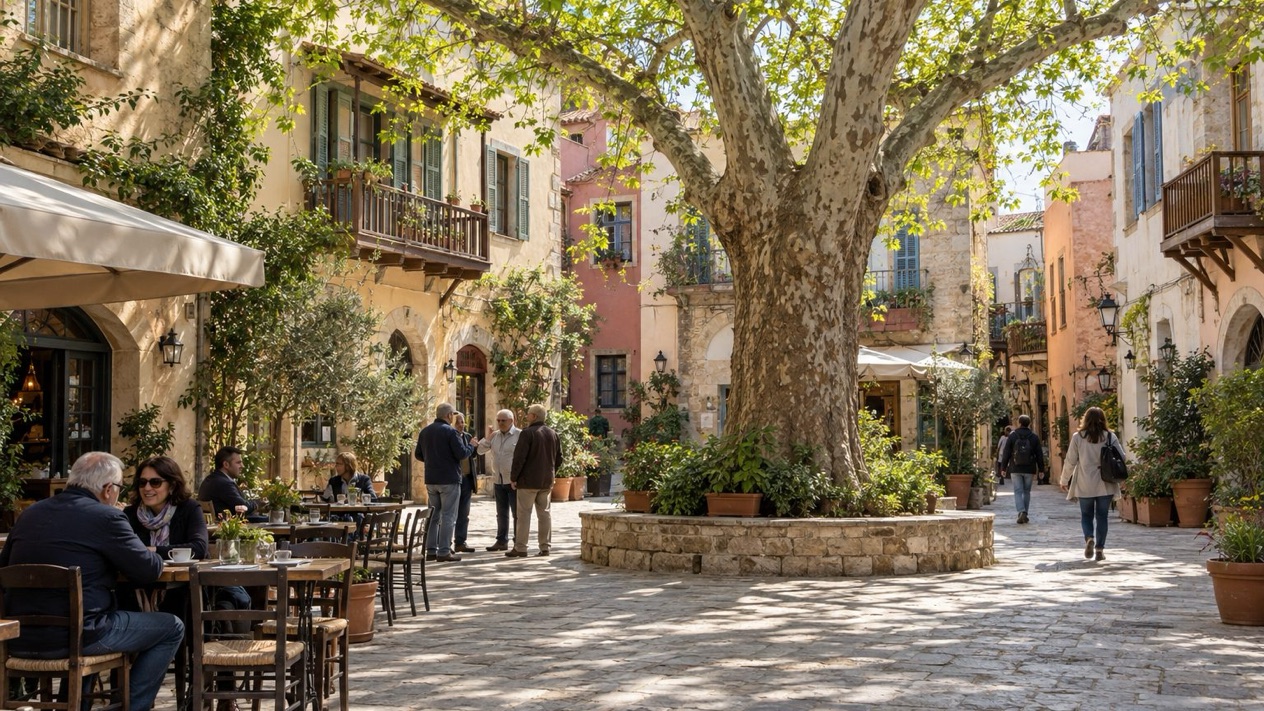
What is the weather like in Chania in January?
January in Chania is cool and damp rather than cold, a winter of sweaters and rain jackets, with the sea still holding some of the warmth of summer.
| Month | Average high (°F) | Average low (°F) | Precipitation (in) | Days with 1 mm or more of precipitation | Daylight on the 15th | Sea (°F) |
|---|---|---|---|---|---|---|
| December | 60.4 | 50.0 | 6.24 | 15.0 | 9 h 46 min | 66.0 |
| January | 57.7 | 47.1 | 5.65 | 14.3 | 10 h 00 min | 63.4 |
| February | 58.5 | 46.8 | 4.97 | 13.1 | 10 h 51 min | 61.5 |
Rain is the thing to plan around. More than half the days of the month bring measurable rain, so an umbrella or a proper rain jacket earns its place in the bag, and a plan for indoor hours is worth having. The old town’s stone lanes and the harbor front get wet like any port, and shoes with a grip make the smooth paving easier to trust.
Daytime temperatures sit in the high 50s, which is comfortable for sightseeing in a sweater and a light waterproof layer. Sun protection is not the concern it is in summer, though sunglasses still help when the sky clears over the water.
Daylight is short compared with summer, so the hours for sightseeing outdoors are fewer and dinner comes with the lamps already lit along the waterfront.
Can you swim in Chania in January?
A swim in January is a bracing dip rather than a long soak, with the sea near Chania averaging 63.4°F.
Nea Hora is the beach nearest to the old town, and it is where a winter swimmer would head first. Around Epiphany, the harbor itself becomes a place for swimming of a ritual kind, when the cross is thrown into the water and the bravest dive in to retrieve it. That is a tradition to watch from the quay, with a coffee in hand afterward.
If you want to get wet, a short dip followed by a hot drink at a seafront cafe makes the most of the month. For anything longer, the rain and the cooler air will make you think twice, and a walk along the shore is a pleasant alternative. Boat trips and beach outings further afield are not something to build the stay around in this season.
What to do in Chania in January
The calendar of the month begins with New Year’s Day on January 1, when families gather for the vasilopita and the coin in the cake is said to bring luck to whoever finds it. Shops and restaurants around the old town keep a holiday pace, and the harbor is a place for long coffees. Epiphany on January 6 follows with the Blessing of the Waters, one of the best-loved scenes of the Greek winter, played out on the harbor front.
January is also a month for eating. Olive trees and citrus are the two most common crops around Chania, and in winter the orange and mandarin trees carry fruit, which shows up in the juice, the sweets and the salads. Wine, dairy, honey and avocados are also important products of the area, so a table of local cheeses, thyme honey and a carafe of local wine is a good way to spend a wet afternoon.
Winter cooking in Crete leans toward the hearty: stews of lamb or goat, rice and pulses simmered in broth, pies filled with fresh cheese and greens, and the barley rusk salad called dakos with tomato and soft cheese. Tsikoudia, the clear grape spirit also called raki, is poured at the end of a meal, often with a small plate of fruit or sweets that comes without being asked.
The old town and the Venetian harbor
The old town of Chania is centered around the harbor and is a maze of alleys and houses that reflect its Venetian and Turkish past. In January this is the place to spend your wandering hours, drifting between the waterfront, the lanes of the Splantzia quarter and the lighthouse at the harbor mouth. The Venetian harbor, with its row of arcaded buildings, is as good a view in winter as in any season.
The Topanas district is especially popular during the warm period from April to October, which means that in January it has a different feel, with the old stone houses and their courtyards looking much as they do for the people who live there. Stop in a kafenio, a traditional coffeehouse, for a Greek coffee or a hot chocolate while the rain passes. The covered Agora, the municipal market with its stalls of cheese, olives, honey and spices, is a good place to take shelter and to shop for edible souvenirs.
Museums and the Historical Archive
A rainy day in January is the moment for Chania’s museums. The new Archaeological Museum stands on Skra Street in the Chalepa district, and it replaces the former Archaeological Museum of Chania. It is a place to see what the western end of Crete has left behind, and it gives context to the Venetian and Ottoman layers you have been walking through.
The Historical Archive in Chania is the second most important in Greece, a reminder that this town was a seat of government as well as a port. Even if you do not read the documents, the building and its story add to the picture of a city that has had many rulers.
The Samariá Gorge and the wider landscape
In January, it is more a name to read about and look at on a map than a plan for the week, and the town itself offers plenty to fill your days. The countryside around Chania, with its olive groves and citrus orchards, can be enjoyed from the window of a car or on a stop at a village taverna.
A two-day itinerary for Chania in January
Day 1 belongs to the old town and the harbor. Start with a Greek coffee and a pastry on the waterfront, then wander the lanes of Splantzia and Topanas, stopping where a courtyard or a church draws you in. Midday is the time for the covered Agora, where a bite of cheese pie and a handful of olives make a quick lunch while you shop for honey and herbs to take home.
In the afternoon, follow the harbor front to the lighthouse and the Venetian arsenals, and let the light dim over the water. With daylight short in January, plan your outdoor sightseeing for the earlier hours and keep the evening for a taverna dinner of grilled fish, stewed meat or a plate of meze, the small shared dishes, with a glass of local wine. Finish with a tsikoudia, which the house will often bring for you.
Day 2 takes you out of the old town. Begin at the new Archaeological Museum in Chalepa, then continue to the Nea Hora beach, the nearest to the old town, for a look at the sea and a coffee in one of the cafes there. A brave swimmer can take a quick dip, and everyone else can enjoy the view from the shore.
If the weather turns, the rain card is simple. Spend the hours in the museum and in the kafenia, then return to the Agora for lunch under cover.
In the afternoon, a long meal at a taverna with a pot of stew and a carafe of wine makes a wet day feel like the point of the trip. If the sky clears, the harbor front is the place to be at dusk, when the lamps come on.
Is Chania busy in January?
January is the slow season in Chania, a stretch when the town belongs more to the people who live there than to visitors.
Agriculture and tourism are the two main sources of wealth in Chania, and the Topanas district is especially popular from April to October. January falls well outside that warm period, which means the tourist side of the economy is at its lowest, while the olive harvest and the citrus season belong to the farming side. The old town keeps working through the winter, with its kafenia, bakeries and tavernas serving locals as much as visitors.
The Technical University of Crete, the Mediterranean Agronomic Institute of Chania and the Chania branch of the Technological Educational Institute of Crete are all located in the greater area of Chania, which is part of why the town has a life beyond tourism. Students and researchers give the cafes and tavernas a steady crowd even when few visitors are around.
For the traveler, this means a town on its own rhythm, where the festivals of New Year’s Day and Epiphany are local celebrations first. Every Sunday is a public holiday in Greece under Greek law, so the pace is slower on that day, and shops and some businesses follow a holiday schedule.
What to pack for Chania in January
Pack for damp, cool days spent mostly outdoors, with room for a dinner in a warm taverna.
- A waterproof jacket with a hood, because more than half the days of the month bring rain.
- Shoes with a good grip, for the smooth stone paving of the old town when it is wet.
- A warm sweater or fleece, for evenings by the harbor.
- A compact umbrella for the stretches between cafes and museums.
- Swimwear and a towel, for a brave dip at Nea Hora or a hotel pool.
- Sunglasses, for the days when the clouds break over the water.
Good to know before you go
January in Chania means rain, short daylight and a calendar built around two holidays. New Year’s Day on January 1 is a public holiday in Greece, and every Sunday of the year is one as well under Greek law, so expect a slower pace on those days. Epiphany on January 6 is the other fixed date of the month, with the Blessing of the Waters at the harbor.
With rain on most of the month’s days, keep an indoor plan ready for each day, whether a museum, the Agora or a long lunch. The sea is cool, so swimming is an option for a quick dip and not the main plan.
Chania in January vs December and February
Moving the trip four weeks earlier brings you to December, with a sea that is still a few degrees warmer and the rain falling on slightly more days. The days are at their shortest, and the holiday season brings Christmas lights and festive meals to the old town. Someone who wants a swim, even a short one, will find December a little kinder.
Moving four weeks later brings you to February, when the rain is lighter and the days stretch noticeably longer. The sea is cooler still, so swimming is even less of a plan, but the extra daylight gives you more time for the old town and the museums. New Year’s Day and Epiphany will be behind you, so the festivals of January are not part of the visit.
Choose January if the vasilopita and the Epiphany ceremony at the harbor are what you came for, and if a slow, rainy winter in a working town appeals. Choose December for the holiday atmosphere and a slightly warmer sea, and February for longer days and a bit less rain.
Is January a good time to visit Chania?
Yes, if you want a winter trip built around food, history and local celebrations, and no if you are looking for beach days and long hours in the sun.
Those who care about food will enjoy the winter table, with its citrus, honey, cheeses and stews, and the glass of tsikoudia that ends the meal. Travelers who live for swimming and sunbathing should pick another month.
On arrival, head straight to the harbor and the lanes of the old town to get your bearings, and pick a taverna for the first evening. What is special about January in Chania is the sight of the harbor on Epiphany, a cross turning in the air before it hits the water, and the cake with the coin on New Year’s Day.
Sources
- Hellenic National Meteorological Service (HNMS), climatological normals 1991-2020 for Souda station (https://www.emy.gr/climatic-data), monthly mean daily maximum and minimum; rain from the ECMWF ERA5 reanalysis, 1991-2020, grid cell of Chania (Open-Meteo), checked October 12, 2026
- ECMWF ERA5 reanalysis 1991-2020, grid cell of Chania (Open-Meteo), checked October 12, 2026
- Open-Meteo Marine API, mean 2022-2024, checked October 12, 2026
- Computed from the date and the latitude of the place (sunrise equation, solar elevation -0.833 degrees), October 12, 2026
- Wikipedia, Climate of Greece (https://en.wikipedia.org/wiki/Climate_of_Greece), checked October 12, 2026
- Wikipedia, Christmas in Greece (https://en.wikipedia.org/wiki/Christmas_in_Greece), checked October 12, 2026
- Wikipedia, Public holidays in Greece (https://en.wikipedia.org/wiki/Public_holidays_in_Greece), checked October 12, 2026
- Wikipedia, Geography of Greece (https://en.wikipedia.org/wiki/Geography_of_Greece), checked October 12, 2026
- Wikivoyage, Chania (https://en.wikivoyage.org/wiki/Chania), checked October 12, 2026
- Wikipedia, Chania, section Culture (https://en.wikipedia.org/wiki/Chania#Culture), checked October 12, 2026
- Wikipedia, Chania, section Economy (https://en.wikipedia.org/wiki/Chania#Economy), checked October 12, 2026
- Wikipedia, Chania, section Education and research (https://en.wikipedia.org/wiki/Chania#Education_and_research), checked October 12, 2026
- Wikipedia, Chania, section Geography (https://en.wikipedia.org/wiki/Chania#Geography), checked October 12, 2026
- Wikipedia, Samaria Gorge (https://en.wikipedia.org/wiki/Samaria_Gorge), checked October 12, 2026