
FLORIDA · GINNIE SPRINGS · 72.7 °F
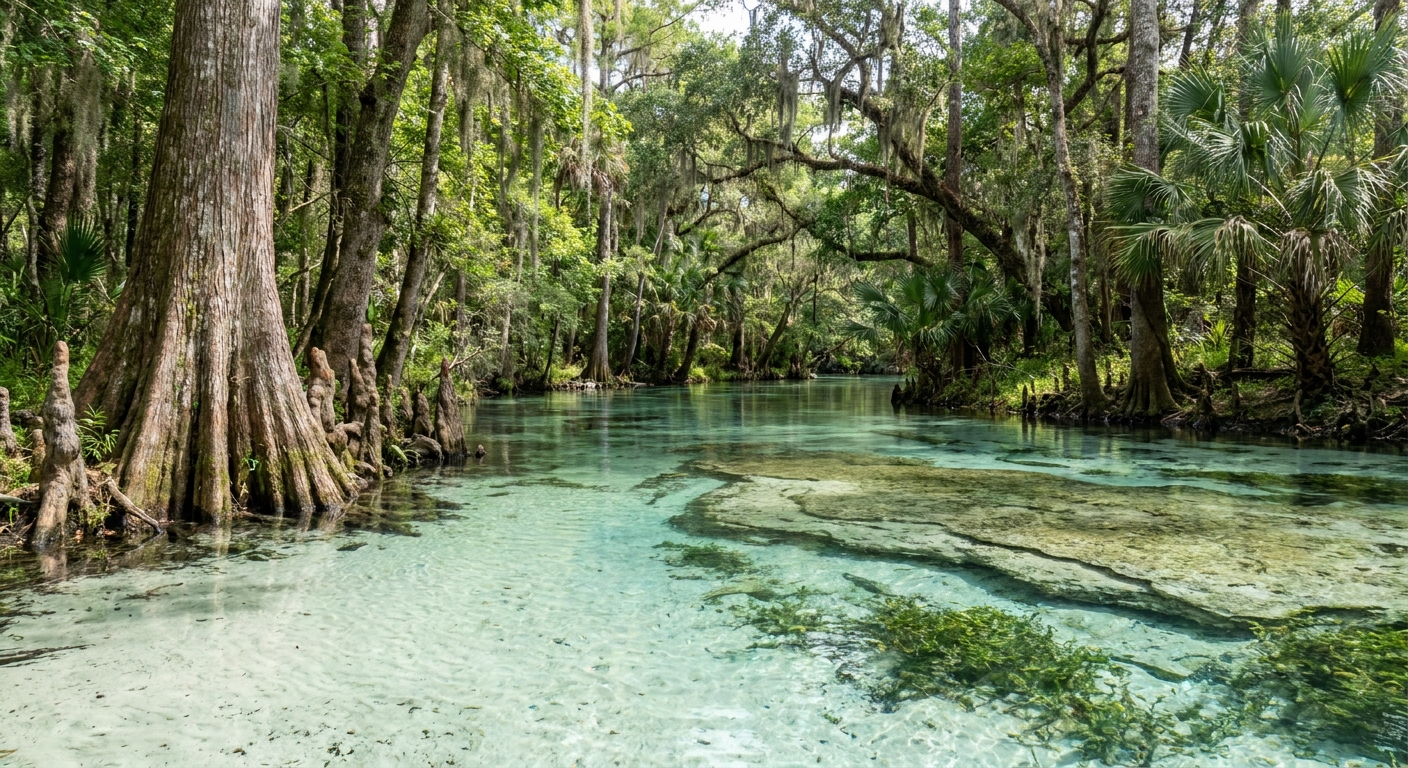
Slide off the ladder at Ginnie Springs and the first thing you notice is how little the water hides. Sand, limestone ledges, a bass hanging in the current a few feet under your fins: the spring pushes water up so clear that depth stops reading as depth. The run carries all of it east into the Santa Fe River, where the clear column meets tea-colored river water and the two take their time about mixing.
The spring sits on private land near High Springs, in north Florida’s cave country, and that one fact reshapes the planning. Prices, rules and hours belong to the owner rather than to the state park system, and our sources carry none of them. What the state does supply is a water temperature, a legal category and a compliment, and all three are worth having before you drive.
THE SPRING AT A GLANCE · GINNIE SPRINGS
Clear 72.7 °F water on private land beside the Santa Fe, with cavern and cave diving the state itself rates among Florida’s best: go for the water, and call the owner for anything involving money or a clock.
72.7 °F (22.6 °C) ON 11 SEP 2026 · PRIVATE PROPERTY · CAVERN AND CAVE DIVING
Go for: water clear enough to watch your own shadow travel across the sand, a cavern the Florida DEP puts in the same sentence as Peacock Springs, and a run you can float with a mask on your face.
Think twice before: budgeting from a price you found for a state park. This is private property, and the two do not share a rate sheet.
Temperature: USGS station 02322400 · Diving: Florida DEP, Visit a Spring · Legal category: Florida Statutes 373.802(5) · full sources at the end
On this page
- Water temperature at Ginnie Springs72.7 °F, and why it holds all year
- Swimming and floating the spring runThe boils, the shallow tail, the river line
- Cavern and cave diving certificationThe Ballroom, the Devil’s system, the cards you need
- Busy weekends and quiet morningsWhat fills the run, and what we could not count
- Is Ginnie Springs worth the drive?The verdict, with its two reservations
- Other Florida springs to swim inThe statewide springs guide
One piece of Florida law hovers over every conversation about this place. The statutes protect a category called Outstanding Florida Springs: every historic first-magnitude spring, as the Florida Geological Survey determines them, plus six more named by hand in the text. Whether any given spring belongs on that list is the Survey’s determination, not a calculation you or we can run from a single day’s gauge reading, so treat the category as a definition rather than a label to hand out.
How cold is Ginnie Springs?
On 11 September 2026 the USGS gauge at station 02322400 read 72.7 °F (22.6 °C). That is cool enough to catch your breath on the way down the ladder and never cold enough to keep you out. It reads close to that every day of the year, because a spring has no seasons. The air above it does, so the identical 72.7 °F lands as a cold plunge on an August afternoon and as a mild bath in January. One caveat worth carrying: that figure is an instantaneous reading, a snapshot rather than an annual average.
Can you swim at Ginnie Springs?
The swimming splits in two. Over the boils the water is deep, glassy and briefly shocking, and a mask turns the whole thing from a swim into a window onto the limestone. Downstream the run shallows and moves, so floating it asks nothing of you beyond steering clear of the cypress roots, and it ends where the Santa Fe takes over and the visibility drops away. Families tend to camp out in the warm shallow tail rather than over the vents.
What we cannot give you is the cost of the day or the hour the gate opens. Neither figure appears in any source we were able to read on 11 September 2026, and a rate quoted for a state park such as Ichetucknee or Rainbow Springs does not transfer to ground the state does not run. Call the operator first, and ask specifically about tubes, coolers and glass before you load the car. Our Florida springs guide sets out how the public sites differ.
What is there to do at Ginnie Springs?
| What you came for | Where it happens | What it takes |
|---|---|---|
| Float the run | From the head spring down to the Santa Fe | A tube, a mask and a little steering |
| Snorkel a vent | Over the boils, looking straight down | Mask and the patience to hover still |
| Cavern dive | The Ballroom, daylight in view throughout | Open-water certification, a briefed buddy |
| Cave dive | The Devil’s system, past the daylight | Full cave certification, redundant gas and lights |
| Warm back up | The bank and the shade above the run | A towel, and air warmer than 72.7 °F |
Florida’s Department of Environmental Protection names Ginnie Springs, alongside Peacock Springs, among the most popular and interesting springs diving destinations in Florida. That is the state describing a private property, and it tells you who else will be in the parking area: this is a training ground as much as a swimming hole. The Ballroom, the big room under the head spring, is the cavern everyone means when they say they dove here, with daylight in sight the whole way.
No tank is required to understand the place. A mask and a tube cover the majority of visits, the shallow end of the run suits swimmers who are not confident in deep water, and the shade along the bank does the rest of the work on a hot afternoon. Families building a north Florida day around it will find the broader logistics in our Florida with kids guide.
Behind the Ballroom the Devil’s system runs on into the dark, and cave diving is a separate sport from the reef dive you did in the Keys. It asks for full cave certification, redundant lights and gas, and a continuous guideline back to open water. Divers without that training stay in the cavern zone, where the exit is visible. The clarity that makes snorkeling here extraordinary is exactly what makes the overhead look casual from the outside, and the overhead is no place to improvise.
How busy does Ginnie Springs get?
Crowds here track the air, not the water. Since the gauge sits near 72.7 °F in February and in July alike, divers turn up all year while swimmers and tubers arrive when the afternoon gets uncomfortable. Summer weekends carry the heaviest load, March adds spring break to the mix, and the long holiday Saturdays sit at the top of that curve.
Early is the whole strategy. The first hour of the day is when the surface is still flat, when the vents have not been stirred into a cloud of fine sand, and when a diver can get a photograph without a tube drifting through the frame. By mid-afternoon in July the run is a social occasion, which is a fine thing to join and a poor thing to stumble into expecting silence.
Cool-weather weekdays are the other answer. November through April is Florida’s dry season, the swimming crowd thins out, and the water is identical to the water in August. Divers know this, which is why the cavern stays busy in months when the picnic tables are empty. The state’s wider seasonal pattern sits in our month-by-month Florida guide.
We have no attendance figure and no capacity number for this property. Nothing in our sources counts cars, campers or swimmers, so we will not tell you what time a gate fills on a July Saturday. A phone call on the morning you plan to go, plus a second spring marked on the map, costs less than a wasted drive across the Suwannee valley.
Is Ginnie Springs worth visiting?
Sources & data for this guide
- Water temperature 72.7 °F (22.6 °C), instantaneous reading · U.S. Geological Survey, National Water Information System, station 02322400 Ginnie Springs · read 11 September 2026
- Definition of Outstanding Florida Springs, first-magnitude springs as determined by the Florida Geological Survey plus six named in the text · Florida Statutes 373.802(5) · read 11 September 2026
- Ginnie Springs and Peacock Springs described among Florida’s springs diving destinations · Florida Department of Environmental Protection, Visit a Spring · read 11 September 2026
- No entrance fee, opening hour or manatee count is published here because none appears in our sources: floridastateparks.org returned 403 to automated reads on 11 September 2026, and the FWC manatee page renders client-side · checked 11 September 2026
- Descriptions of the run, the river line and the diving zones are editorial. A private property sets its own prices and rules, and they change · confirm with the operator before you drive.
Yes, for the water, with two conditions attached. The 72.7 °F reading and the clarity above the vents deliver on every photograph you have seen of the place, and no amount of company in the run takes that away. The conditions are that you check the practicalities with the owner yourself, and that you choose your hour rather than your day.
Divers get the strongest case. A state agency putting this spring in the same sentence as Peacock Springs is a meaningful endorsement of the cavern and the training around it, and cave country’s short drives mean a weekend here rarely involves one site alone.
Snorkelers and floaters get a slightly different trip. Bring a mask even if you only intend to drift, because the interesting half of this spring happens below your waist and the surface view understates it badly.
Skip it if your plan depends on a fixed budget worked out in advance, or on solitude in July. Private ground means the rules and the price come from one phone call, not from a park service page, and the run on a hot weekend afternoon is a crowd scene in beautiful water.
One last practical trick: the gauge is public. Pull up USGS station 02322400 the night before you drive and read the temperature yourself, then pack for the number you see rather than the season. It will look a great deal like 72.7 °F, because it always does, and the shock at the ladder will be the air’s fault. From there, the rest of the springs are an easy morning’s drive in any direction.