
GINNIE SPRINGS · FLORIDA · JULY
The pleasure of Ginnie Springs in July is that two thermometers a few feet apart refuse to agree. The air above the run averages a high of 91.1°F this month. The spring itself was reading 72.7°F when the USGS gauge was checked on September 11, 2026, and it reads close to that in January, in April, in October.
That 18.4°F step down is the month’s whole proposition, and July charges for it: 6.68 inches of rain spread over 10.5 measurable days, nights that never drop below a normal low of 71.6°F, and the thick of the American school break. What comes back is light. On July 15 you get 13 hours and 55 minutes of it, with the sun still above the trees at 8:30 p.m.
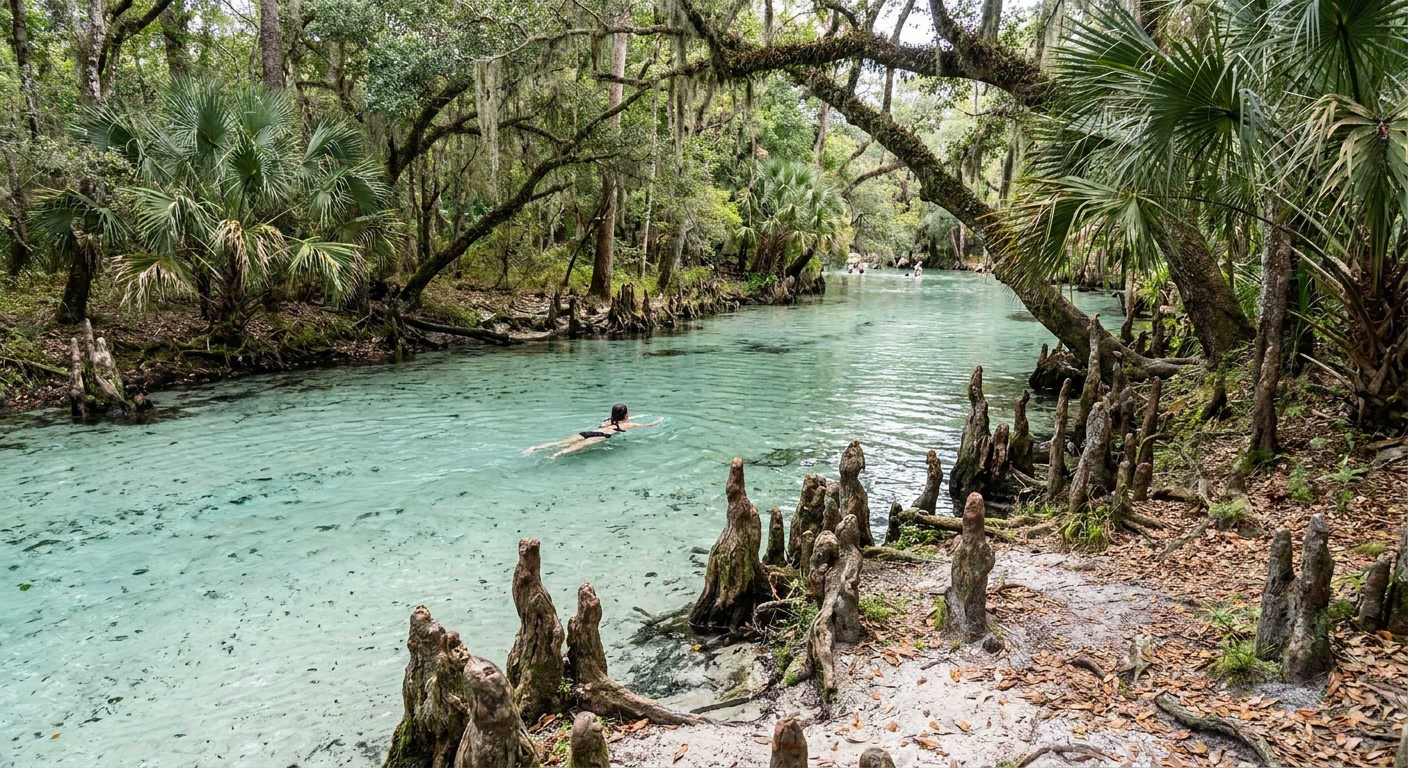
THE MONTH AT A GLANCE · GINNIE SPRINGS · JULY
July gives the warmest afternoons of the three midsummer months over a spring that sits near 72.7°F all year, and charges for it in rain days and school-holiday company.
AVG HIGH 91.1°F · SPRING WATER ABOUT 72.7°F · 10.5 WET DAYS · 13H 55M OF DAYLIGHT
Go for: a 72.7°F swim under a 91.1°F sky, evening light that holds until 8:34 p.m., and dive water Florida’s own environmental agency puts on its shortlist.
Think twice before: planning a dry afternoon. July records at least 0.10 inch on 10.5 days, and an inch or more on 1.9 of them.
Air: NOAA NCEI 1991-2020, Gainesville Rgnl AP · Water: USGS gauge 02322400 · full sources at the end
On this page
- Ginnie Springs weather in July91.1°F highs, 6.68 inches of rain
- Spring water temperature in summer72.7°F on the USGS gauge
- Crowds and costs in JulyDemand, taxes and what we could not verify
- Things to do in JulySwimming, diving and the late light
- A two-day July planHour by hour, around the afternoon rain
- July, June or August?How the three months compare
- Is July a good month to visit?Yes for swimmers, no for dry afternoons
Drive times, tolls and rental rules sit in our getting-around guide, and beds across the state in where to stay. What the date changes is air, water, light and rain, and those four are below.
Ginnie Springs weather in July: average highs, lows and rain days
| Measure | July | Where the figure comes from |
|---|---|---|
| Average high | 91.1°F | NOAA NCEI 1991-2020, Gainesville Rgnl AP |
| Average low | 71.6°F | same station |
| Precipitation | 6.68 in | same station |
| Days with 0.10 in or more | 10.5 | same station |
| Days with 1 in or more | 1.9 | same station |
| Spring water | about 72.7°F (22.6°C) | USGS gauge 02322400, read Sep 11, 2026 |
| Daylight, July 15 | 13h 55m · 6:39 a.m. to 8:34 p.m. | sunrise-sunset.org |
Every air figure here comes from one real thermometer: NOAA’s National Centers for Environmental Information, 1991-2020 monthly normals, station USW00012816 at Gainesville Regional Airport, roughly 48 miles from the spring. Not a reanalysis grid cell, and not a reading taken at the water’s edge. July there averages a high of 91.1°F, a low of 71.6°F and 6.68 inches of rain. Those numbers describe the air you stand in between swims. The water underneath keeps its own counsel.
The rain arrives in installments. 10.5 July days record at least 0.10 inch, which works out to something measurable roughly one day in three, and 1.9 days record a full inch or more. Call that two afternoons in a typical July that will empty a picnic table and fill a cooler lid. Most of the rest comes down hard for half an hour and moves off, the standard summer pattern we set out in our Florida timing guide.
Day to night, the swing is 19.5°F, and the low end of it is 71.6°F. Nobody needs a jacket in July at this latitude. The bag that works is a dry towel per person per swim, a long-sleeve rash guard for the hours between eleven and four, water shoes for limestone edges, and a second set of dry clothes for the drive home. Cotton dries slowly in this humidity, so the spare shirt matters more than the extra sweater you won’t open.
On July 15 the sun comes up at 6:39 a.m. and goes down at 8:34 p.m. Eastern Daylight Time, 13 hours and 55 minutes between them, per sunrise-sunset.org. That back end is the underrated part of the month: at seven in the evening the parking lots thin out, the air has come off its peak, and you still have an hour and a half of usable light in the water.
How warm is Ginnie Springs in July?
Three numbers, and only two of them belong to July. The air peaks at a normal 91.1°F in mid-afternoon and bottoms at 71.6°F before dawn. The spring read 72.7°F (22.6°C) at USGS gauge 02322400 on September 11, 2026. That last one is a single instantaneous reading, not a monthly average of daily maxima, and the distinction is the good kind of pedantry: an ocean figure drifts several degrees across the year, while a spring run holds close to the same temperature every day of it.
In practice, the morning is the easy entry. At 7 a.m. the air is around 71.6°F and the water is 72.7°F, so nobody gasps. By three in the afternoon you are stepping out of 91.1°F into 72.7°F, an 18.4°F drop that catches your breath for about four seconds and then feels like the best decision of the week. Swimsuit and a sun shirt cover the day. Divers logging an hour down there feel 72.7°F very differently from a swimmer logging ten minutes, and dress accordingly.
Freezing nights: none. The July normal low is 71.6°F, and we hold monthly normals rather than a night-by-night record, so we give no count of extremes either way. The only cold thing in a July visit is the water, and what makes it feel colder than its 72.7°F is the 18.4°F you just left behind on the bank.
How busy is Ginnie Springs in July? Crowds, prices and the demand peak
July falls in the middle of the American school break, and spring traffic in north Florida follows the school calendar more closely than it follows the thermometer. That much is the calendar talking. On money, we have to be straight: we found no occupancy series and no monthly rate data for Ginnie Springs, so we crown no month cheap and no month expensive, and you will not find a peak-season percentage in the paragraphs below.
Booking behaves the same way. We could not verify the site’s reservation window, its capacity, its check-in times or whether weekends sell out ahead, so we will not invent a number of weeks. The workable move is the boring one: reserve refundable nights, confirm directly with the operator before you drive, and treat a Tuesday as a materially different experience from a Saturday in the second week of July.
On lodging tax, same answer. We could not verify a county rate, so we give no percentage. If you want the statewide shape of what a Florida week costs, our trip-cost guide handles the three tiers, and it will not pretend to price this particular gate.
There is one line where spending more genuinely changes July, and it is shade. A site with real tree cover, or a room with air conditioning back toward High Springs and Gainesville, turns the 91.1°F block of the afternoon from an ordeal into a nap. Everything else about the month is free or fixed.
Things to do in Ginnie Springs in July
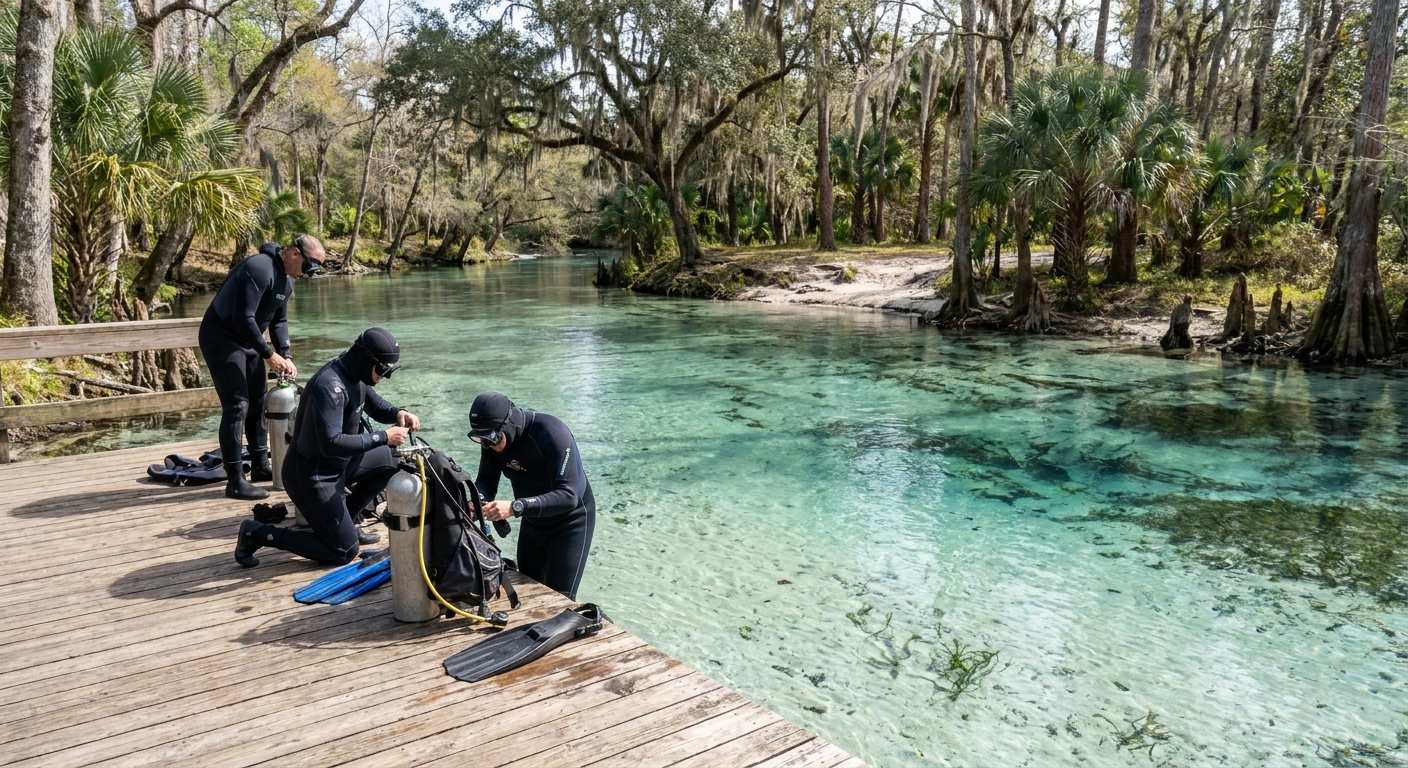
July does one thing June and August cannot quite match: it puts the warmest average afternoon of the three over water that has not moved. At 91.1°F against 72.7°F, the contrast is at its widest of the midsummer set, and the month adds the evening to go with it. A 7:30 p.m. swim in a 13-hour-55-minute day is a July privilege; by the end of October that same swim happens in the dark.
The named draw is the diving. Florida’s Department of Environmental Protection lists Ginnie Springs, alongside Peacock Springs, among the most popular and interesting springs diving destinations in the state, and the gauge that gives us 72.7°F sits right here as station 02322400. On the practical side we came up empty: no entrance fee, no opening hour and no manatee count could be read from official sources, so call before you plan a dawn arrival.
What the month changes is entirely above the surface. Across June, July and August the average high moves from 90.3°F to 91.1°F to 90.5°F while the spring sits near 72.7°F throughout. The season, in other words, lives in the air and in the light, and the swim you get in July is the swim you would get in February with a coat waiting on the bank.
Free things are harder to promise, because we could not verify the fee structure at all. What July hands over at no charge is the daylight: 13 hours and 55 minutes on the 15th, sunrise at 6:39 a.m. for anyone who likes an empty bank, and usable light until 8:34 p.m. for anyone who would rather sleep in and stay late.
Ginnie Springs in July: a two-day itinerary
Day one. Sunrise is 6:39 a.m., so a 7:30 arrival buys you cool air at 71.6°F and quiet water. Swim from eight to eleven while the air climbs toward its 91.1°F normal, eat under cover from noon, then give the middle of the afternoon to shade, a book and a nap rather than a hike. Back in the water at four, when the surface air has come off its peak and the 18.4°F drop feels less like a slap. Out at 8:15 p.m., with the light going at 8:34.
Day two runs the same clock, minus the discovery. Build the flexible part around the rain: with 10.5 wet days in an average July, the odds of one soaked afternoon across two days are real, and 1.9 days a month bring an inch or more. If the sky stacks up after lunch, drive the 48 miles toward Gainesville for an indoor hour and come back at five. The water is 72.7°F in the rain too, which is the argument for waiting it out rather than driving home.
Ginnie Springs in July vs June and August
| June | July | August | |
|---|---|---|---|
| Average high | 90.3°F | 91.1°F | 90.5°F |
| Average low | 69.5°F | 71.6°F | 72.0°F |
| Precipitation | 7.56 in | 6.68 in | 6.40 in |
| Days with 0.10 in or more | 11.0 | 10.5 | 10.4 |
| Spring water | about 72.7°F | about 72.7°F | about 72.7°F |
All three air figures come from the same NOAA station and the same 1991-2020 period, so they compare cleanly. July owns the warmest afternoons at 91.1°F, June the coolest nights at 69.5°F, August the driest total at 6.40 inches and the fewest wet days at 10.4. The rain gap between June and July is nearly nine tenths of an inch. The water column is the flat one: a single gauge reading of 72.7°F stands for all three months, because the spring does not keep a calendar.
Shift four weeks back to June and you gain a dawn that is 2.1°F cooler, plus the longest days of the year; you give up 0.88 inch of extra rain and half a wet day. Shift four weeks forward to August and you gain the driest month of the set and lose 0.4°F off the afternoon, while nights warm to 72.0°F, which is the first time all summer the air at dawn is warmer than the water.
Is July a good time to visit Ginnie Springs?
Yes, if your trip is built around getting in the water. A 91.1°F afternoon is the best possible excuse for a 72.7°F spring, and the light holds until 8:34 p.m. so the day has two swims in it. No, if you need dependable dry hours on the bank, or if crowds spoil the thing for you: this is peak school-holiday season, and 10.5 days of measurable rain is not a rumor.
If that second description fits, take August over July. It is the driest of the three midsummer months at 6.40 inches, its 10.4 wet days are the fewest, and it surrenders only 0.4°F of afternoon warmth. Push further and the school pressure comes off entirely after mid-August, while the spring keeps reading what it always reads.
What July alone delivers is the widest gap of the summer between the air you walk through and the water you fall into, stretched across 13 hours and 55 minutes of daylight.
The last word
Pick a weekday, be in the water by ten, and call the operator for hours and admission before you load the car, because we could not read either from an official source. One piece of context worth carrying in: Florida law keeps a protected category called Outstanding Florida Springs, covering every historic first-magnitude spring the Florida Geological Survey recognizes plus six named by hand in statute 373.802(5). We did not verify which list this particular spring sits on. The aquifer feeding it is the reason a July afternoon can hand you 91.1°F and 72.7°F in the same minute.
Sources & data for this guide
- July air normals (91.1°F high, 71.6°F low, 6.68 in), plus June and August figures · NOAA NCEI monthly normals 1991-2020, station USW00012816, Gainesville Rgnl AP, FL US · checked Sep 24, 2026
- Rain-day counts (10.5 days at 0.10 in or more, 1.9 days at 1 in or more) · NOAA NCEI, same station and period · checked Sep 24, 2026
- Daylight, sunrise 6:39 a.m. and sunset 8:34 p.m. on July 15, converted to Eastern Daylight Time · sunrise-sunset.org · checked Sep 24, 2026
- Spring water 72.7°F (22.6°C), a single instantaneous reading · USGS National Water Information System, station 02322400 · read Sep 11, 2026
- Outstanding Florida Springs category · Florida Statutes 373.802(5), leg.state.fl.us · checked Sep 24, 2026
- Ginnie Springs and Peacock Springs named among the state’s springs diving destinations · Florida Department of Environmental Protection, Visit a Spring · checked Sep 24, 2026
- We could not verify an entrance fee, an opening hour or a manatee count: floridastateparks.org returned 403 to automated reads and the FWC manatee page renders client-side · noted Sep 11, 2026
- The air normals are measured about 48 miles from the spring, and they describe the air only · fees, hours and reservation rules change, so confirm with the operator when you book.
To plan your stay
- Best Time to Visit Ginnie Springs: Monthly Highs, Rainfall and the Month to Skip
- Ginnie Springs in June: Weather, Water Temperature, Crowds and Prices
- Ginnie Springs in August: Weather, Water Temperature and How It Compares to July and September
- Ginnie Springs in May: 87°F Air, 72°F Spring Water and 4.5 Rain Days