
GINNIE SPRINGS · NOVEMBER · NORTH FLORIDA
The USGS gauge in the spring read 72.7°F (22.6°C) on September 11, 2026, and it reads close to that in February, in July and in the second week of November. Spring water has no season. The air above it does: NOAA’s 1991-2020 normals for the nearest official station give November an average high of 74.7°F and an average low of 50.6°F, against 82.1°F and 60.6°F in October.
That drop of 7.4°F by day and a full 10.0°F at night changes the swim far more than it changes the water. A 72.7°F pool feels warm when you step in at eight in the morning under air near 50.6°F, and neutral when you climb out at three. Add 1.79 inches of rain across the month and a 5:36 p.m. sunset on November 15, and you get short, bright, uncrowded swims with a cold walk back to the car at either end.
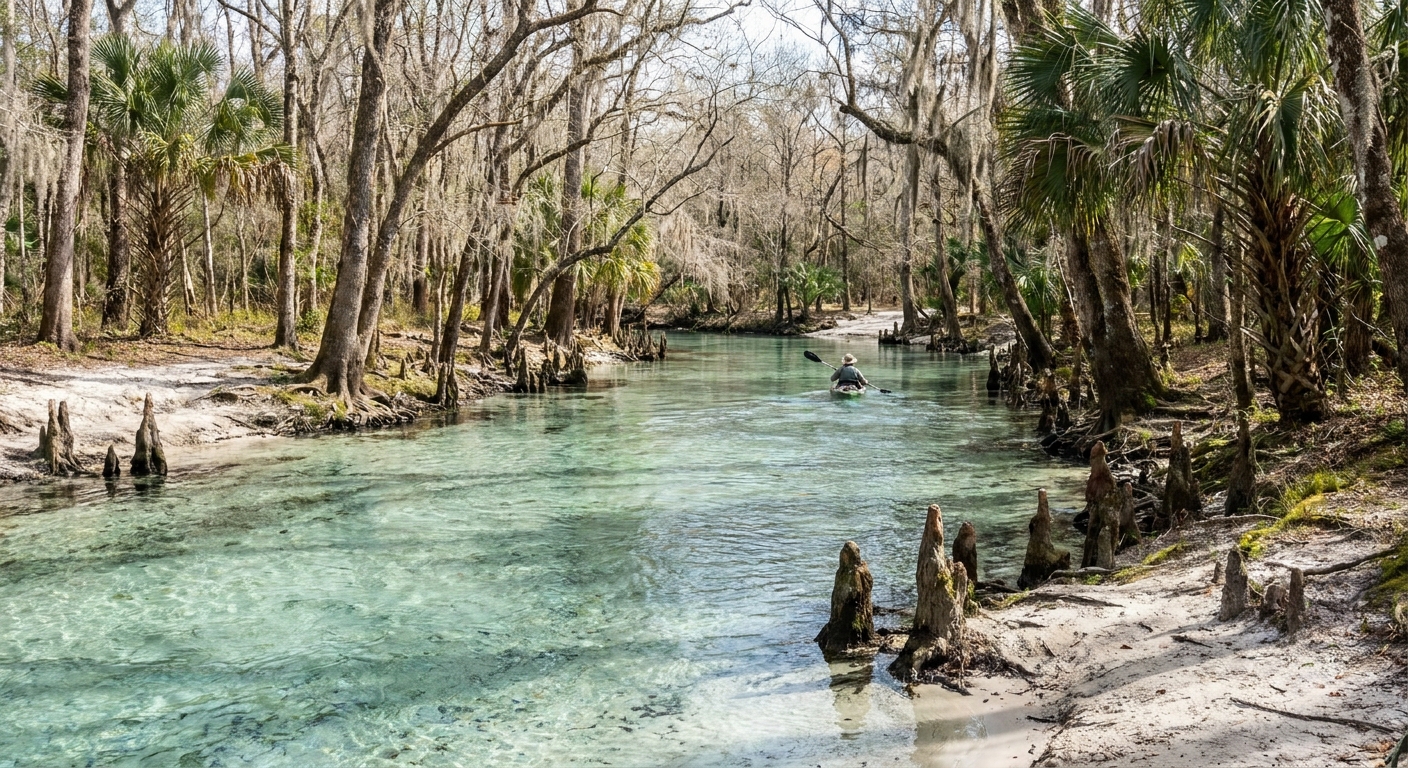
THE MONTH AT A GLANCE · GINNIE SPRINGS
November holds the spring near 72.7°F while the air settles at a 74.7°F average high, so swims are short, quiet and dry, and the drive out starts before 5:36 p.m.
NOAA 1991-2020 NORMALS · 3.0 RAIN DAYS · 10H41 OF DAYLIGHT ON NOV 15
Go for: spring water near 72.7°F while the air cools, the driest of the three fall months at 1.79 inches against October’s 2.68 and December’s 2.88, and afternoons warm enough to dry off outside.
Think twice before: planning a full day in a swimsuit. The normal low is 50.6°F, one average November night reaches 32°F or below, and the light goes at 5:36 p.m.
Air: NOAA NCEI 1991-2020, Gainesville Regional Airport · Water: USGS station 02322400 · full sources at the end
On this page
- Ginnie Springs weather in November74.7°F days, 3.0 rain days, 10h41 of light
- What to wear morning and afternoonThe 24.1°F swing and the one freeze night
- Crowds and prices in NovemberWeekdays, weekends and the fee we could not verify
- Things to do at the spring in NovemberDiving, the tube run and the 72.7°F gauge
- A two-day plan around a 5:36 p.m. sunsetDay one and day two, hour by hour
- November, October or December?How the three months compare on air, rain and water
- Is November the right month for this trip?Who it suits, and when October does better
Florida law shelters every historic first-magnitude spring as an Outstanding Florida Spring, under Statute 373.802(5), and that protection holds in June exactly as it does in November. The normals below are the part of the trip that has a season, and they were not measured at the water’s edge.
Ginnie Springs weather in November: average highs, lows and rain days
| November at Ginnie Springs | Figure |
|---|---|
| Average high | 74.7°F |
| Average low | 50.6°F |
| Monthly precipitation | 1.79 in |
| Days with 0.10 in or more | 3.0 |
| Days with 1 in or more | 0.5 |
| Nights at 32°F or below | 1.0 |
| Daylight on November 15 | 10h 41m · 6:54 a.m. to 5:36 p.m. |
| Spring water, USGS gauge 02322400 | 72.7°F (22.6°C), single reading |
Every air figure here comes from one thermometer: NOAA NCEI’s 1991-2020 monthly normals for station USW00012816, Gainesville Regional Airport, about 48 miles from the spring. That matters twice over. It is a station record rather than a reanalysis grid cell, so these are measurements and not model output. And it is 48 miles away on an open airfield, so read the numbers as regional air, never as a reading taken beside the water.
Measurable rain falls on 3.0 days in an average November, at 0.10 inch or more, and only 0.5 day brings a full inch, which works out to a proper soaking in one November out of two. The month’s total, 1.79 inches, is the lowest of the fall stretch. In practice that reads as a band passing through rather than a washed-out day: you wait it out in the car or underwater, and the afternoon generally comes back.
Between the 50.6°F night and the 74.7°F afternoon lies 24.1°F of daily swing. Pack for both ends of it: fleece and long pants for the first hours, a T-shirt for the middle of the day, and more towels than seem reasonable. A dry change of clothes matters more here in November than in July, because the air that dries you at two in the afternoon will not do the job at nine in the morning.
Daylight on November 15 runs 10 hours 41 minutes, from a 6:54 a.m. sunrise to a 5:36 p.m. sunset in local time. The usable water hours are narrower than that. Air climbs to its normal high in the early afternoon, so the comfortable swimming block falls roughly between 11 a.m. and 4 p.m., and anything scheduled after five happens in headlights.
How warm is Ginnie Springs in November?
A normal high of 74.7°F and a normal low of 50.6°F give the month a 24.1°F daily range. October’s is narrower at 21.5°F, and December matches November at 24.1°F from a lower base of 69.3°F and 45.2°F. The spring holds near 72.7°F through all three. That reading came off the USGS gauge as an instantaneous measurement on September 11, 2026, not a monthly mean and not an average of daily maxima, so treat it as one snapshot of a year-round constant.
Morning swims begin with the water 22.1°F warmer than the air, so the shock is in stepping out, not in stepping in. By mid-afternoon the two are within two degrees of each other and getting wet stops being an event at all. Divers planning a second tank in a day usually want neoprene for it. Everyone else wants a hooded sweatshirt waiting on the bank and shoes that survive a wet walk.
One night in an average November reaches 32°F or below at the Gainesville station. That is a frost risk for anyone sleeping outdoors. The water never approaches it. We could not verify camping fees, opening hours or a reservation policy for the spring, so if a November night in a tent is the plan, call ahead and carry a bag rated well below 50°F.
How busy is Ginnie Springs in November?
We found no occupancy series and no monthly room-rate series for this corner of north Florida, so we crown no month cheap and no month expensive. The calendar still says something useful. November follows the summer school break, the normal high has fallen 7.4°F from October, and the visitors who came for a warm hour on the bank have largely stopped coming. Divers have not.
Without an occupancy figure we will not invent a booking window in weeks. The constraint we can name is the day of the week: a Saturday in the middle of a 74.7°F stretch is the busiest thing this month produces, and the identical water on a Tuesday comes with fewer cars in the lot. We could also not verify an entrance fee, an opening hour, or whether November weekends need a reservation, since Florida’s park site returned an error to our automated reads on September 11, 2026. Phone the operator before you drive.
We could not verify a lodging-tax rate for the county either, so no percentage comes from us. Rates around the springs vary by property and by season, and a fee quoted for another Florida spring does not transfer to this one. If you are pricing a whole Florida trip rather than a day at one pool, our cost guide breaks the state into three tiers.
The upgrade that genuinely changes a November day is neoprene. At 72.7°F the water is swimmable without a wetsuit and comfortable for far longer with one, and that gap decides whether you get one dive or three. After that, spend on dry warmth above the surface: a second towel, a windproof layer, a thermos. Nothing rentable moves the 50.6°F morning.
Things to do in Ginnie Springs in November
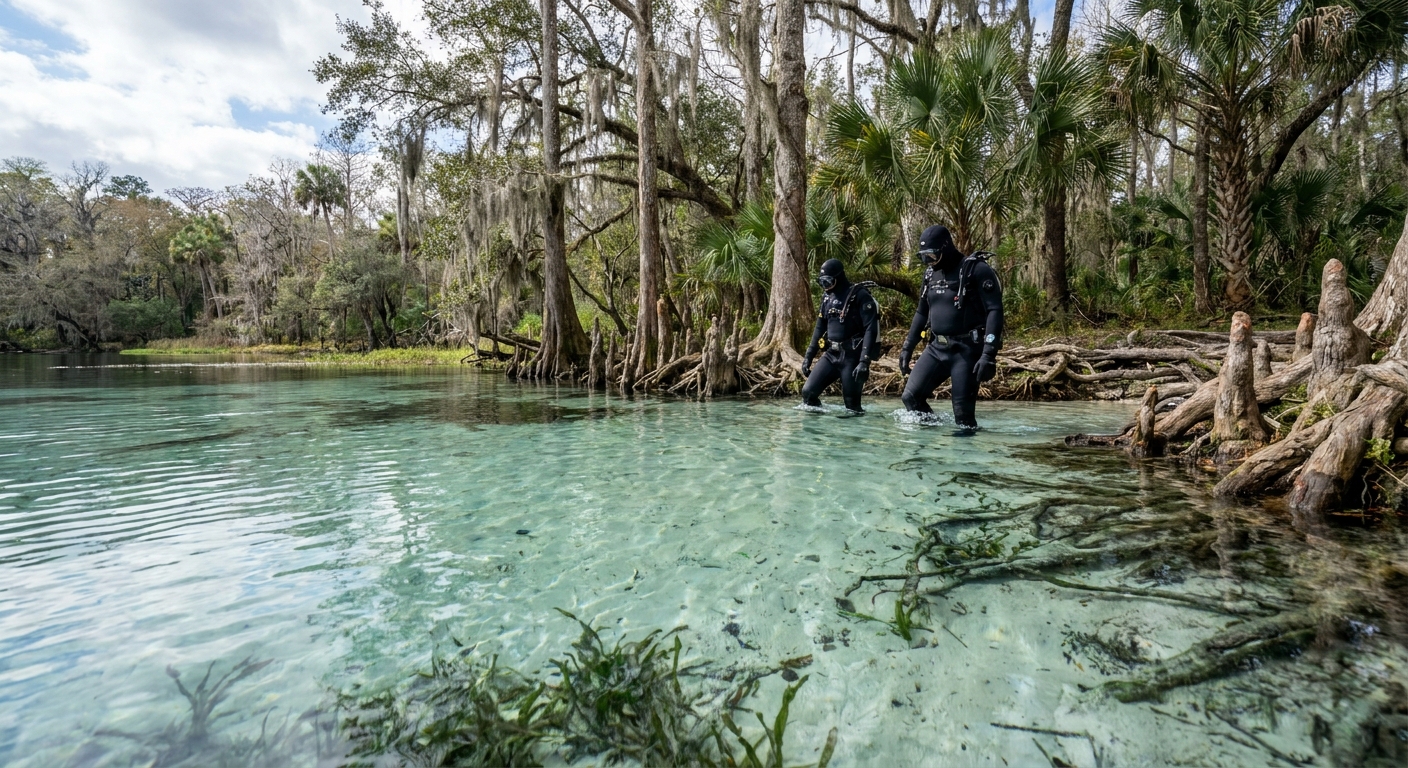
November hands you the driest of the three fall months: 1.79 inches against October’s 2.68 and December’s 2.88, over 3.0 wet days against 4.0 and 4.5. Put that beside a 74.7°F afternoon and the walk from the parking area stops being a sweat, the tube run stops being shoulder to shoulder, and the picnic table dries out between showers. The water is the same 72.7°F it would be in August.
Florida’s Department of Environmental Protection names Ginnie Springs, alongside Peacock Springs, among the most popular and interesting springs diving destinations in the state, and diving is the one activity here that the month barely touches. The only measurement our sources carry for the spring itself is the USGS gauge, station 02322400, at 72.7°F (22.6°C). We found no entrance fee, no opening hour and no manatee count for this site. Manatees are a Crystal River winter story, and our manatee guide handles that trip.
Run the contrast across the three months and the spring stays put while the air moves around it. In October, 72.7°F water under an 82.1°F afternoon reads as relief. November brings the air down to 74.7°F, within two degrees of the pool, and the water reads as neutral. By December the ranking has flipped: the spring runs 3.4°F warmer than the normal high of 69.3°F, and stepping in becomes the warmest thing you do all day.
We could not verify any free day, free hour or local discount at the spring, so we promise none. What November gives at no cost is the light: 10 hours 41 minutes of it on the 15th, low over clear water through the middle of the day, with the last of it gone by 5:36 p.m., which is when the lot empties.
Ginnie Springs in November: a two-day itinerary
Day one starts later than a summer day would. Sunrise at 6:54 a.m. arrives with the air near its 50.6°F normal low, so there is no prize for being early. Be at the water by ten, walk the bank while the air climbs, take a first swim at eleven and eat dry at one. Keep the long swim or the second dive for the window between two and half past three, when the air is closest to 74.7°F. Out of the water by four, changed and packed before the 5:36 p.m. sunset.
Day two runs the same clock with one swap: put the dive first if you brought tanks, because a surface interval at two in the afternoon beats one at nine in the morning by roughly twenty degrees of air. If the sky turns, remember the shape of November rain, 3.0 days at 0.10 inch and 0.5 at an inch or more. A band passes, the water holds 72.7°F throughout, and the hour you spend standing wet in 50-something air is the only casualty. Drive times and Florida’s toll quirks live in our getting-around guide.
Ginnie Springs in November vs October and December
| October | November | December | |
|---|---|---|---|
| Average high | 82.1°F | 74.7°F | 69.3°F |
| Average low | 60.6°F | 50.6°F | 45.2°F |
| Precipitation | 2.68 in | 1.79 in | 2.88 in |
| Days with 0.10 in or more | 4.0 | 3.0 | 4.5 |
| Spring water | about 72.7°F, no seasonal cycle | about 72.7°F, no seasonal cycle | about 72.7°F, no seasonal cycle |
October runs 7.4°F warmer by day and a full 10.0°F warmer at night than November, and pays for it with 2.68 inches of rain over 4.0 wet days. December drops 5.4°F at both ends, to 69.3°F and 45.2°F, and turns wetter still at 2.88 inches over 4.5 days. November takes the middle on temperature and the bottom on rain, at 1.79 inches over 3.0 days. The spring reads about 72.7°F through all three.
Shift four weeks earlier and you buy an 82.1°F afternoon and 60.6°F evenings, at the cost of one extra wet day and 0.89 inch more rain. Shift four weeks later and you give up 5.4°F of afternoon and take on 1.5 extra rain days, but you gain the one thing November cannot offer: water warmer than the air, by 3.4°F on the normals. Our October page runs the same numbers a month earlier.
Is November a good time to visit Ginnie Springs?
For divers, for anyone who prefers a quiet bank, and for visitors who would rather cross the lot without sweating, November is a straightforwardly good month: 74.7°F afternoons, 1.79 inches of rain across four weeks, water at 72.7°F. For a family picturing a whole day in swimsuits on a towel, it is not. The morning normal is 50.6°F and the light goes at 5:36 p.m.
If that is the trip you had in mind, take October instead. It delivers 82.1°F days and 60.6°F nights, warm enough that 72.7°F water reads as cold when you get in, and it charges one more wet day plus 0.89 inch of rain for the privilege. For the rest of the state month by month, the statewide calendar makes the wider comparison.
Among these three months, only November puts the air and the spring within two degrees of each other, 74.7°F above and 72.7°F below, so for a few hours after noon there is no temperature line to cross.
The last word
Pick a weekday, aim the swim at the middle of the day, and bring twice the dry clothes you think you need. One practical thing before you drive: the gauge that produced the 72.7°F figure, USGS station 02322400, publishes its readings openly, so you can check the water the morning you leave. The air you cannot check in advance, though the normals say 74.7 and 50.6.
Sources & data for this guide
- November air normals, 1991-2020: 74.7°F high, 50.6°F low, 1.79 in, 3.0 days at 0.10 in, 0.5 day at 1 in, 1.0 night at 32°F or below · NOAA NCEI monthly normals, station USW00012816, Gainesville Regional Airport, FL US, about 48 miles from the spring · checked Sep 24, 2026
- October and December normals (82.1/60.6/2.68 in and 69.3/45.2/2.88 in) · same NOAA NCEI 1991-2020 series · checked Sep 24, 2026
- Daylight, sunrise and sunset on November 15 (10h 41m, 6:54 a.m. to 5:36 p.m. local) · sunrise-sunset.org · checked Sep 24, 2026
- Spring water at 72.7°F (22.6°C), single instantaneous reading, not a monthly mean · USGS National Water Information System, station 02322400 Ginnie Springs · checked Sep 24, 2026
- Outstanding Florida Springs definition · Florida Statutes 373.802(5) · checked Sep 24, 2026
- Ginnie Springs and Peacock Springs as diving destinations · Florida DEP, Visit a Spring · checked Sep 24, 2026
- What we could not verify: entrance fee, opening hours, reservation policy, camping rates, county lodging tax, manatee counts. floridastateparks.org returned a 403 to our automated reads on September 11, 2026, and FWC’s manatee pages render client-side. Call the operator before you drive.