
FLORIDA · GINNIE SPRINGS · MARCH
March is the month the air catches up with the water. The spring read 72.7°F when the USGS gauge in it was checked on September 11, 2026, and it reads close to that every day of the year. March air averages a 75.8°F high, so for a few hours each afternoon the water is the coolest thing around, and at dawn, with the average low at 49.7°F, it is easily the warmest.
What March charges for that is rain: 3.49 inches, more than February or April, spread over 5.3 days that record at least a tenth of an inch. It also charges a cold start to the morning. If you want the spring itself explained rather than dated, the main Ginnie Springs guide handles the year as a whole.
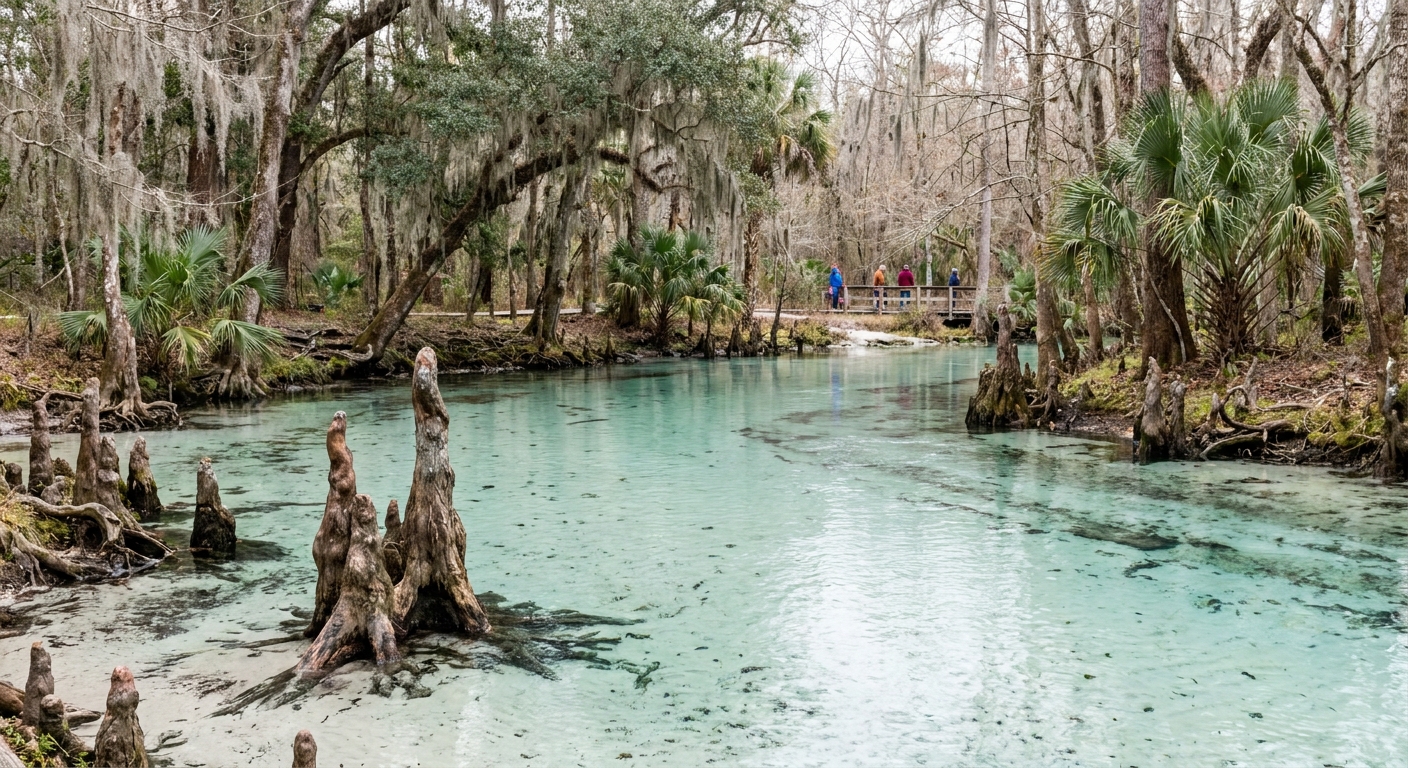
THE MONTH AT A GLANCE · GINNIE SPRINGS
March hands you 75.8°F afternoons over a spring that never leaves the low 70s, and bills you 3.49 inches of rain for it, the wettest of the three spring months.
AIR 75.8°F / 49.7°F · SPRING 72.7°F · 5.3 WET DAYS · 12H 02M OF LIGHT ON MAR 15
Go for: diving and long snorkel sessions in a wetsuit, warm afternoons without summer heat, and a camping weekend whose water temperature is known in advance.
Think twice before: planning a swimsuit-only trip with small children, or budgeting to the dollar: we could not verify a gate price or an opening hour, so we quote neither.
Air: NOAA NCEI 1991-2020, Gainesville Regional Airport · Water: USGS gauge 02322400 · full sources at the end
On this page
- Ginnie Springs weather in March75.8°F days, 49.7°F nights, 3.49 inches
- Rain days in March5.3 days at a tenth of an inch or more
- Is the spring water cold in March?72.7°F, and it reads that all year
- Crowds and prices in MarchSpring break, and the numbers we could not verify
- Things to do at the spring in MarchSwimming, diving and Florida’s own verdict on it
- A two-day plan for March7:38 a.m. to 7:40 p.m., hour by hour
- March, February or April?How the three months compare, in figures
- Is March a good time to go?Yes with a wetsuit, no in a swimsuit
One caveat worth reading first: every air figure here comes from a single official thermometer at Gainesville Regional Airport, about 48 miles (78 km) from the spring, while the water figure comes from a gauge standing in the spring itself. The air normals describe North Florida. The water number describes Ginnie.
Ginnie Springs weather in March: average highs, lows and rain days
| March at Ginnie Springs | Figure |
|---|---|
| Average high | 75.8°F |
| Average low | 49.7°F |
| Precipitation | 3.49 in |
| Days with 0.10 in or more | 5.3 |
| Days with 1 in or more | 1.0 |
| Nights at 32°F or below | 1.2 |
| Daylight on March 15 | 12h 02m |
| Spring water (gauge reading) | 72.7°F (22.6°C) |
NOAA’s National Centers for Environmental Information publish the 1991-2020 normals for station USW00012816 at Gainesville Regional Airport: an average high of 75.8°F, an average low of 49.7°F and 3.49 inches of precipitation for the month. That is a real station record rather than a modeled grid cell, and it sits 48 miles away over the same flat pine country. Read it as the regional signal for your drive and your campsite, not as a measurement taken at the water’s edge.
Rain arrives on 5.3 days in an average March, counting days that record at least a tenth of an inch, and 1.0 of those days puts down an inch or more. Measurable rain lands roughly one day in six, in other words, and most of it passes through in an afternoon. Being rained on while already submerged costs nothing. The drive in, the tent and the gear bags are what the wet days actually complicate.
Between the 49.7°F night and the 75.8°F afternoon lies a spread of 26.1°F, and packing has to cover both ends of it. A fleece and long pants for the first two hours after sunrise, shorts by lunch, and a towel that dries rather than one that stays damp in a cool trunk. Two sets of dry clothes per person per day is not overpacking in March.
On March 15 the sun is up for 12 hours 02 minutes, rising at 7:38 a.m. and setting at 7:40 p.m. local time, according to sunrise-sunset.org. Daylight saving time has already moved the evening: a session that starts at four still has three hours of light behind it, and dinner happens after dark rather than during it.
How warm is Ginnie Springs in March?
Two numbers do the work. The average March afternoon reaches 75.8°F; the average March dawn bottoms out at 49.7°F. The spring sits between them at 72.7°F, which means the air beats the water for only a few hours around mid-afternoon and loses to it for the other twenty. That reading is a single instantaneous USGS measurement taken on September 11, 2026, not a monthly average of daily maxima, and the gauge reads close to it year round.
In practice you dress for two days inside one. Morning calls for a jacket over the swimsuit and shoes you can stand around in. From about noon the jacket goes in the bag. For time spent in 72.7°F water rather than a quick dip, a 3 mm shorty or full suit turns a twenty-minute swim into a three-hour one, and in March nobody sunbathes dry in ten minutes the way they do in July.
Frost still turns up: an average March records 1.2 nights at 32°F or below. That is a camping problem, not a swimming problem, since the spring holds its temperature through any cold snap North Florida can produce. Bring a sleeping bag rated well below what a Florida trip suggests, and check the forecast for the night before you drive rather than the day you swim.
How busy is Ginnie Springs in March?
March is when American school and college spring breaks land, and North Florida’s springs sit within a few hours’ drive of a lot of campuses and a lot of families. We found no occupancy series and no nightly rate calendar for Ginnie, so we crown no month cheap and no month expensive. What can be said from the calendar alone: the demand in March comes from time off, not from weather.
That changes the booking order rather than the budget. Weekend nights are the scarce unit in a spring-break month, and a Tuesday-to-Thursday trip is the single easiest lever on the whole trip. We could not verify a campsite count or a booking window, so we will not invent a number of weeks: call or book online as soon as your dates are fixed, and treat a March Saturday as the hardest night of the year to add late.
We could not verify a lodging-tax rate for the county either, so no percentage appears in this section. If you are building the full budget rather than the spring day, our Florida trip-cost guide carries the state-level pieces, and where to stay covers the towns within range.
One line genuinely changes March, and it is neoprene. Renting or buying thermal protection is the difference between three short swims and a full day in the water at 72.7°F, and it matters more in March than in April, when the 81.5°F air makes drying off between dips easy again.
Things to do in Ginnie Springs in March
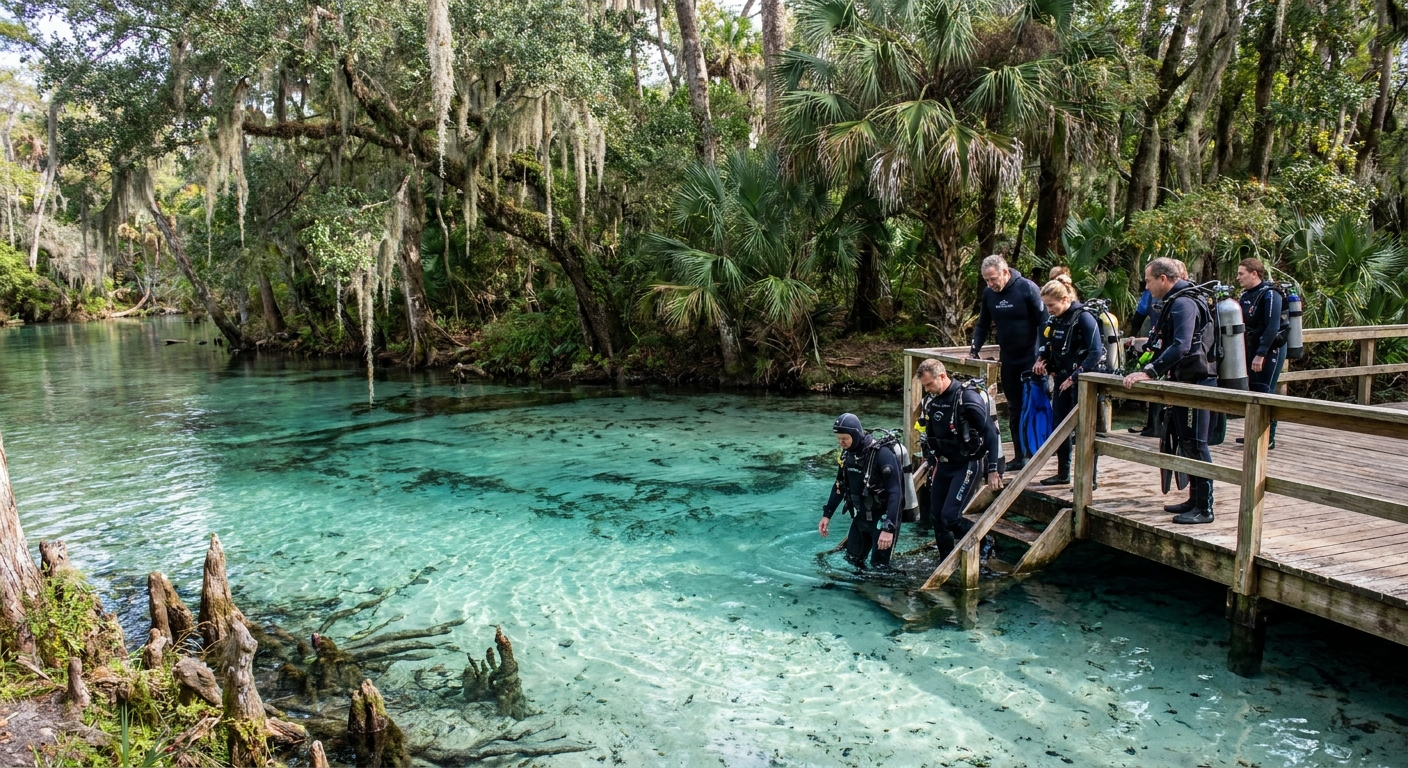
March allows one thing February does not: standing around wet. February’s average high of 70.9°F runs below the spring’s own temperature, so the air offers no reward for climbing out. March’s 75.8°F runs above it. That single crossing is what turns a February dip into a March day, and it applies to every activity that involves an exit ladder, a picnic table or a paddle.
Diving is the headline. The Florida Department of Environmental Protection names Ginnie Springs, alongside Peacock Springs, among the most popular and interesting springs diving destinations in the state. Florida law also maintains a protected class called Outstanding Florida Springs, defined in Statute 373.802(5) as every historic first-magnitude spring plus six named by hand in the text; we could not verify whether Ginnie’s own vents fall inside that definition, so we claim no status for it. The USGS keeps station 02322400 in the water year round.
The water is the constant here and the air is the variable, so the season lives entirely in the gap between them. In March that gap runs from 23°F of water advantage at dawn to about 3°F of air advantage at the daily peak. Swimming, snorkeling and tubing all get easier as the day goes on, which is the opposite of how a Florida summer day works.
We could not verify any free-admission day, discount or off-peak rate at the spring, so we name none. The one thing March gives away is evening: 12 hours 02 minutes of daylight on the 15th, with light on the water until 7:40 p.m.
Ginnie Springs in March: a two-day itinerary
Day one works backward from the afternoon. Arrive between 9 and 10 with the jacket still on, set up camp while the air is in the fifties, and save the first entry for around 11, when the air has climbed past the water. Put the long session between 1 and 4 p.m., at the top of the 75.8°F curve. Be dry and changed by five, because the last two hours of light are also the two hours when the temperature starts down toward 49.7°F.
Day two repeats it an hour earlier so the drive home has daylight. If one of the month’s 5.3 wet days lands on you, the swimming plan survives intact and the camping plan does not: pack the dry bags before you get in the water, and keep Gainesville, 48 miles off, as the fallback for a roof. Getting between the two needs a car, as our Florida getting-around guide spells out.
Ginnie Springs in March vs February and April
| February | March | April | |
|---|---|---|---|
| Average high | 70.9°F | 75.8°F | 81.5°F |
| Average low | 45.9°F | 49.7°F | 55.5°F |
| Precipitation | 2.67 in | 3.49 in | 2.74 in |
| Days with 0.10 in or more | 4.1 | 5.3 | 3.8 |
| Spring water | No seasonal swing | No seasonal swing | No seasonal swing |
March sits 4.9°F above February by day and 5.7°F below April, with nights climbing from 45.9°F to 49.7°F to 55.5°F across the three. It is also the wettest of the trio on both counts: 3.49 inches against 2.67 in February and 2.74 in April, and 5.3 wet days against 4.1 and 3.8. The water ignores all of it and holds near 72.7°F through the whole span.
Shifting four weeks forward buys a lot and costs little on paper: April adds 5.7°F of afternoon, drops three quarters of an inch of rain, removes the freeze risk and keeps the same water. Shifting back to February saves nothing on rain and hands you afternoons cooler than the spring. The real argument for March is the one the numbers cannot see, which is that March is the week most American families actually have free.
Is March a good time to visit Ginnie Springs?
Yes for divers, snorkelers and anyone who owns or will rent a wetsuit: the water is exactly what it is in August, and the air is finally warm enough to make getting out pleasant. No for a swimsuit-and-towel trip with small children, for anyone counting on drying off in ten minutes, and for a traveler with free dates who would rather not gamble on 5.3 wet days.
If the dates are yours to pick, take April. An 81.5°F average high, 55.5°F nights, 2.74 inches of rain and 3.8 wet days beat March on every line, with no change in the water at all. Our Florida timing guide puts that choice in the context of the whole state.
What March alone gives: the month the afternoon air crosses the spring, with February’s 70.9°F average high sitting below the water and March’s 75.8°F sitting above it.
The last word
Fix two things before you leave and March takes care of itself: the neoprene question, and where you sleep if the sky opens. An average March delivers one full day of an inch of rain or more, the kind that soaks a tent and a trunk in a single afternoon, so have the drive to Gainesville or a roof already picked. The spring will be 72.7°F either way, and it will be that again in February, in July, and on the coldest night of the year.
Sources & data for this guide
- March air normals (75.8°F high, 49.7°F low, 3.49 in, 5.3 days at 0.10 in, 1.0 day at 1 in, 1.2 nights at 32°F) · NOAA NCEI monthly normals 1991-2020, station USW00012816, Gainesville Regional Airport, FL, about 48 miles from the spring · checked Sep 24, 2026
- February and April normals used in the comparison · same NOAA NCEI 1991-2020 series, same station · checked Sep 24, 2026
- Daylight on March 15 (12h 02m; sunrise 11:38 UTC, sunset 23:40 UTC, converted to local time) · sunrise-sunset.org · checked Sep 24, 2026
- Spring water at 72.7°F (22.6°C), an instantaneous reading rather than a monthly average · U.S. Geological Survey, National Water Information System, station 02322400 Ginnie Springs · checked Sep 24, 2026
- Outstanding Florida Springs, definition and the six springs named in statute · Florida Statutes 373.802(5) · checked Sep 24, 2026
- Ginnie Springs and Peacock Springs named among Florida’s most popular springs diving destinations · Florida Department of Environmental Protection, Visit a Spring · checked Sep 24, 2026
- We could not verify an entrance fee, an opening hour or a manatee count: floridastateparks.org returned 403 to automated reads and the FWC manatee page renders client-side · checked Sep 24, 2026. No price and no wildlife count appear above.
- Packing, timing and booking advice is editorial; fees, hours and campground rules change · check the operator before you drive.