
GINNIE SPRINGS · FEBRUARY · 1991-2020 NORMALS
The spring does not keep a calendar. A USGS gauge sitting in the water at Ginnie Springs, station 02322400, read 72.7°F (22.6°C) on September 11, 2026, and it reads close to that every day of the year. February changes the other half of the equation. Air normals for the area put the average afternoon at 70.9°F and the average night at 45.9°F, so the water you slide into is warmer than the air you climb back out to.
That trade has a price and a bonus. February is the driest of the three winter months here, 2.67 inches across 4.1 wet days, against 3.29 inches in January and 3.49 in March. It is also the month that hands you 2.8 nights at or below freezing and only 11 hours 11 minutes of daylight on the 15th, with the sun gone by 6:20 p.m. Pack for the air, not for the water.
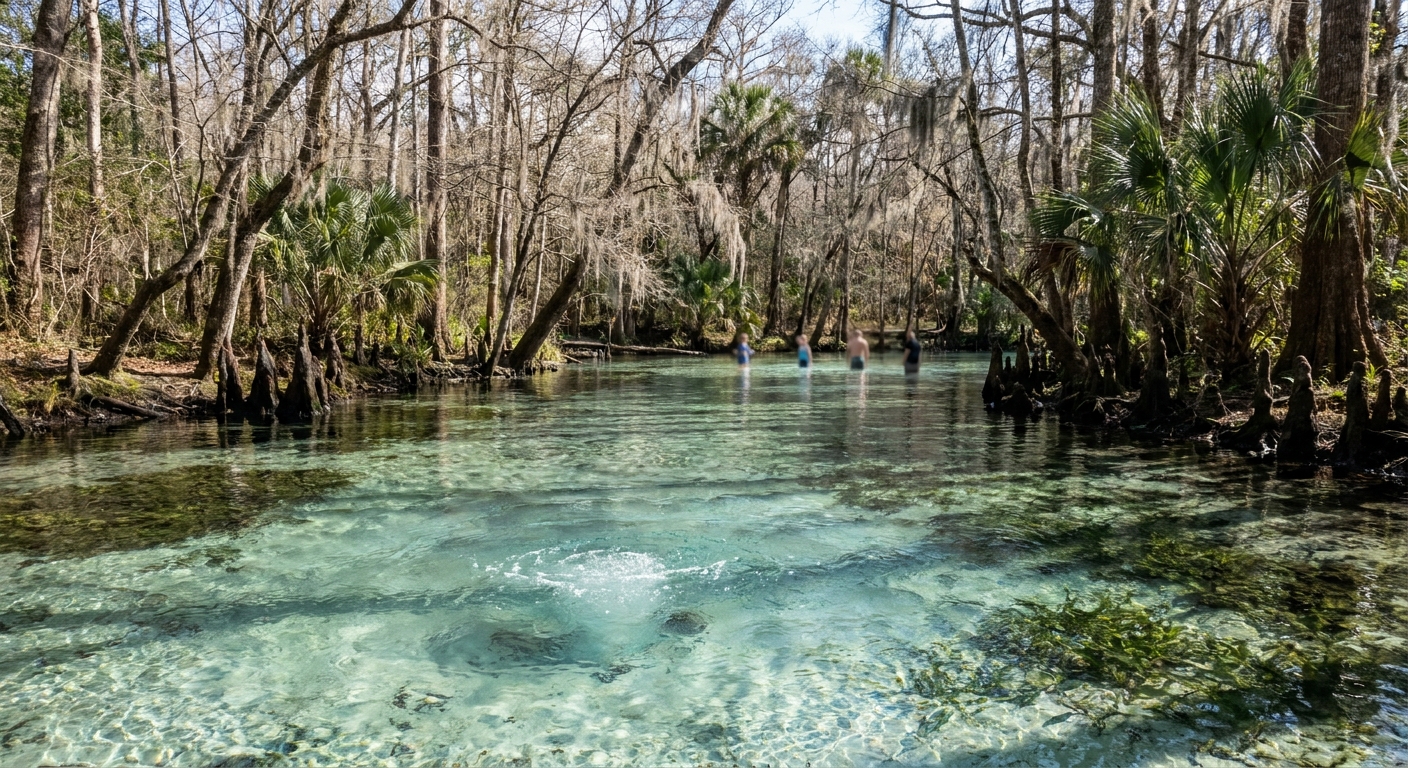
THE MONTH AT A GLANCE · GINNIE SPRINGS · FEBRUARY
February pairs the driest air of the winter with spring water near 72.7°F, which means a short warm window in the middle of the day and a cold change of clothes at either end of it.
AVG HIGH 70.9°F · AVG LOW 45.9°F · WATER NEAR 72.7°F · 11H11M OF DAYLIGHT ON THE 15TH
Go for: diving and snorkeling in water that never changes, in the driest month of the winter, with the afternoon air close to the temperature of the spring itself.
Think twice before: planning sunbathing days or tent nights, with 2.8 February nights at or below 32°F and darkness at 6:20 p.m.
Air: NOAA NCEI 1991-2020, Gainesville Rgnl AP · Water: USGS station 02322400 · full sources at the end
On this page
- February highs, lows and rain days70.9°F afternoons, 4.1 wet days
- How cold the water and the nights get72.7°F water, 45.9°F dawns
- Crowds, prices and the lodging taxWhat we verified and what we could not
- Things to do at the spring in FebruaryDiving, snorkeling and the air gap
- A two-day February planTwo days built around a 6:20 p.m. sunset
- February vs January and MarchMarch runs 4.9°F warmer and wetter
- Is February a good time to go?Yes for divers, no for sunbathers
Everything below is dated to February. Directions, what the spring is like in general and how it fits a longer drive belong to the main Ginnie Springs guide and to our statewide calendar, which sets February inside Florida’s dry season.
Ginnie Springs weather in February: average highs, lows and rain days
| Measure | February |
|---|---|
| Average high | 70.9°F |
| Average low | 45.9°F |
| Precipitation | 2.67 in |
| Days with 0.10 in or more | 4.1 |
| Days with 1 in or more | 0.7 |
| Nights at or below 32°F | 2.8 |
| Daylight on Feb 15 | 11h11m · 7:09 a.m. to 6:20 p.m. |
| Spring water | 72.7°F · instantaneous reading, Sep 11, 2026 |
The normals above come from NOAA’s NCEI series for 1991-2020 at Gainesville Regional Airport, station USW00012816, a real thermometer roughly 48 miles from the spring rather than a model’s grid cell. February there averages a high of 70.9°F, a low of 45.9°F and 2.67 inches of precipitation. Every one of those figures describes the air. The water underneath has no season at all, and reading an airport normal as the condition at the swim steps is the one confusion worth clearing up before you pack.
Measurable rain falls on 4.1 days in an average February, about one day in seven. The count starts at 0.10 inch, so it catches a shower that crosses at breakfast as well as a gray afternoon that never lifts. Rain rarely ends a spring day, since you are already wet. What suffers is the towel, the dry clothes and the drive home in damp shoes, and February at least gives you fewer of those days than either neighbor month.
Dawn and mid-afternoon sit 25.0°F apart, 45.9°F to 70.9°F. Two outfits, then: fleece and a warm hat for the first hours, something short-sleeved for the middle of the day, and a full change of dry clothes kept in the car rather than in a bag on the bank. A second towel is not luxury in a month whose average night reads 45.9°F. Flip-flops on a 46-degree morning are a small, avoidable misery.
On February 15 the sun rises at 7:09 a.m. and sets at 6:20 p.m. Eastern, giving 11 hours 11 minutes of daylight. The usable part is narrower than that. The air spends the morning climbing toward its 70.9°F average and cools quickly once the sun drops behind the trees, so the swimming belongs to the middle of the day and the driving to the dark end of it.
How warm is Ginnie Springs in February?
The USGS gauge in the spring, station 02322400, read 72.7°F on September 11, 2026. That is a single instantaneous reading rather than a monthly mean, and we found no February series to set beside it, but a spring of this kind holds close to that number all year. Against February air the figure does real work: the water runs 1.8°F above the average afternoon high of 70.9°F, and 26.8°F above the average dawn temperature of 45.9°F.
In practice, 72.7°F is cool enough to catch your breath on entry and never cold enough to keep you out. Snorkelers in swimwear alone measure their sessions in minutes. A shorty or a full wetsuit turns those minutes into an hour, which is why divers treat this month as ordinary and swimmers treat it as a dare. Morning calls for the fleece between dips; by 3 p.m. the air is usually close to the temperature of the water.
Frost is part of the deal. NOAA counts 2.8 nights in an average February at or below 32°F, roughly one night in ten. Those nights reach a tent, a cooler left open and a wetsuit hung in a truck bed. They never reach the spring, so a hard freeze changes your sleeping arrangements and your first hour of the morning, not the swim.
How busy is Ginnie Springs in February? Crowds, prices and the demand peak
February falls inside Florida’s dry season, November through April, as our state orientation lays out. For the spring itself we found no monthly visitor counts and no rate series, so we crown no month busy and no month cheap. The dated fact we can give is the air: February runs 4.9°F cooler than March, the month when spring break arrives in Florida and the state’s warm-weather places fill up.
That argues for booking late rather than early. The water is a constant, so the only variable worth watching is the forecast, and ten days out you can see whether a front is about to drop the night to 32°F. Four weeks out you cannot. If a refundable rate exists at your price, take it, and keep the drive flexible enough to shift a day either way.
We could not verify a local lodging-tax rate, so we give no percentage. Two of our usual sources failed on September 11, 2026: floridastateparks.org answered our automated reads with a 403, and the FWC manatee page renders client-side. We therefore verified no gate price, no opening hour and no manatee number. Call ahead for the current admission, and build the rest of the budget from our Florida cost guide.
One line item genuinely changes February: thermal kit. A wetsuit instead of a rash guard converts a five-minute snorkel into an afternoon in 72.7°F water, and a heated room instead of a tent covers the 2.8 nights at or below 32°F. Where to put that room is a separate question, and it is the one place where spending more buys a different month.
Things to do in Ginnie Springs in February
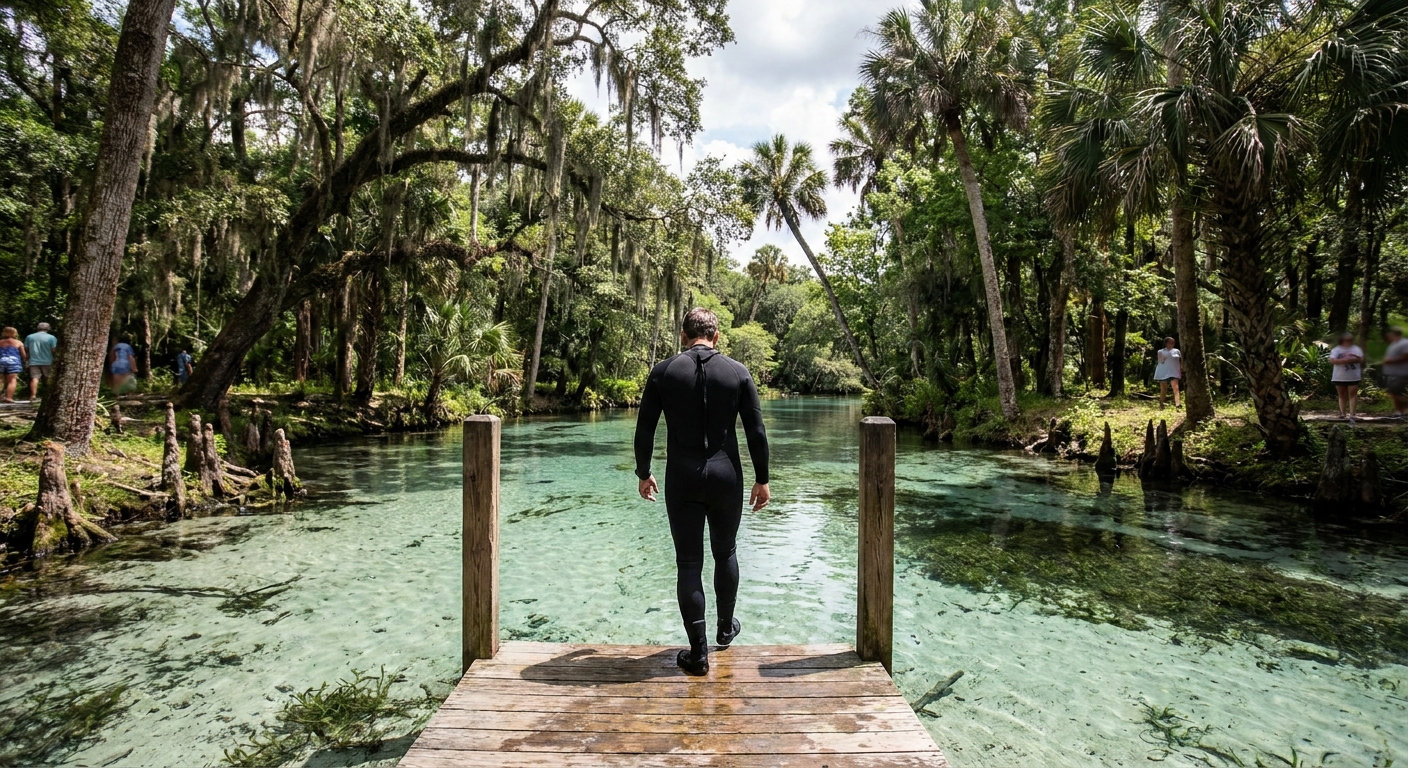
July gives you a hot bank and cool water. February inverts it, and that inversion is the month’s whole offer: a long session underwater followed by air that averages 70.9°F rather than a Florida summer afternoon. The 25.0°F daily swing concentrates everything worth doing between late morning and about four, which is a shorter day than summer and a far more comfortable one on the surface.
The state has its own view of what this water is for. Florida’s Department of Environmental Protection names Ginnie Springs, alongside Peacock Springs, among the most popular and interesting springs diving destinations in Florida. Florida law backs that with a protected class called Outstanding Florida Springs, defined in Statutes 373.802(5) as every historic first-magnitude spring the Florida Geological Survey identifies, plus six springs named by hand in the statute. The gauge in the basin, station 02322400, supplies the only temperature figure we trust: 72.7°F.
What February moves is the air above all of that, never the water inside it. March afternoons average 75.8°F, a full 3.1°F warmer than the spring, so you surface into warmth. February afternoons average 70.9°F, 1.8°F cooler than the water, and February dawns sit 26.8°F below it. The exit, not the entry, is what separates these months.
We verified no entrance fee and no free-admission day, so we promise neither. What costs nothing in February is the light itself, 11 hours 11 minutes of it on the 15th, and a bank that dries off faster than a summer one. For the rest of the region’s winter list, including the manatee season elsewhere in the state, start with our Florida things-to-do guide and the manatee guide.
Ginnie Springs in February: a two-day itinerary
Day one starts later than you think. Sunrise is 7:09 a.m., but the air leaves an average 45.9°F and needs the morning to reach 70.9°F, so arrive around 10, set up, and put the first swim at noon. Run the long session from noon to 3, the warmest stretch of the day. Change into dry clothes by 4, well before the light goes, and be off the road or at dinner by the 6:20 p.m. sunset.
Day two flips the order: the second morning is for the gear-heavy part, since a wetsuit makes 10 a.m. as workable as 1 p.m., leaving the afternoon free to drive on. If rain arrives on one of the month’s 4.1 wet days, keep the swim and move the picnic, because 72.7°F water does not care about a shower. If a freeze arrives instead, push everything an hour later and treat the change of clothes as the whole logistical problem. Drive times across the state sit in our getting-around guide.
Ginnie Springs in February vs January and March
| Month | Avg high | Avg low | Precipitation | Days ≥ 0.10 in | Spring water |
|---|---|---|---|---|---|
| January | 67.1°F | 42.6°F | 3.29 in | 5.2 | near 72.7°F |
| February | 70.9°F | 45.9°F | 2.67 in | 4.1 | near 72.7°F |
| March | 75.8°F | 49.7°F | 3.49 in | 5.3 | near 72.7°F |
Read the columns and February’s case makes itself. It runs 3.8°F warmer by day than January and 3.3°F warmer by night, while taking 0.62 inch less rain and 1.1 fewer wet days. March adds another 4.9°F to the afternoon and 3.8°F to the night, and charges 0.82 inch more rain and 1.2 more wet days than February. The water column is flat on purpose: the spring holds near 72.7°F through all three, which is why the air is the only thing being compared.
Shift four weeks forward and you buy an afternoon that finally beats the water, 75.8°F against 72.7°F, plus longer light and a friendlier exit from the spring. You pay in rain days and in company, since March is Florida’s spring-break month. Shift four weeks back and January hands you the coldest dawns of the three at 42.6°F for no gain in dryness, which makes it the weakest trade on the table.
Is February a good time to visit Ginnie Springs?
Yes, if you come with a wetsuit and a plan for the middle of the day. Divers and snorkelers get the month’s best deal: unchanged 72.7°F water, the driest air of the winter at 2.67 inches, and an afternoon within two degrees of the water temperature. No, if the picture in your head involves lying on a towel in the sun or sleeping outside, because 45.9°F nights and 2.8 freezes will edit that picture for you.
If the answer lands on no, go in March. It is the warmest of the three by a clear margin, 75.8°F by day and 49.7°F at night, and the extra rain, 3.49 inches over 5.3 days, costs a swimmer very little. The compromise is company, since March is when Florida’s warm-weather places fill for spring break.
What no other month here matches is February’s combination: the driest air of the winter and the fewest wet days of the three, on top of water that never varies.
The last word
Decide on the thermal kit first and the dates second, because the spring holds 72.7°F whatever week you pick and only your exit from it changes. One figure we have kept back until now: an average February records 0.7 day with an inch or more of rain, so a genuine soaking is the exception rather than the pattern, and most trips lose nothing to the sky. Put the towels and the dry clothes in the car rather than on the bank, and aim the long swim at noon.
Sources & data for this guide
- February normals (70.9°F / 45.9°F / 2.67 in), wet days and freeze nights · NOAA NCEI monthly normals 1991-2020, station USW00012816, Gainesville Regional Airport, FL · checked Sep 24, 2026
- January and March normals used in the comparison table · same NOAA NCEI 1991-2020 series, not estimates · checked Sep 24, 2026
- Daylight, sunrise 7:09 a.m. and sunset 6:20 p.m. on February 15 · sunrise-sunset.org · checked Sep 24, 2026
- Spring water at 72.7°F (22.6°C) · U.S. Geological Survey, National Water Information System, station 02322400 Ginnie Springs, instantaneous reading · checked Sep 24, 2026
- Outstanding Florida Springs class · Florida Statutes 373.802(5) · checked Sep 24, 2026
- Ginnie Springs and Peacock Springs as springs diving destinations · Florida Department of Environmental Protection, Visit a Spring · checked Sep 24, 2026
- Admission, opening hours and manatee counts: floridastateparks.org returned 403 to our automated reads and the FWC manatee page renders client-side, so we verified no fee, no hour and no manatee figure · checked Sep 24, 2026
- The air thermometer sits about 48 miles from the spring; normals describe the air, never the water · confirm current admission and hours with the operator before you drive.