
FLORIDA · GINNIE SPRINGS · JUNE
On September 11, 2026 the USGS gauge sunk in the spring read 72.7°F, and it reads close to that every day of the year, because a spring has no seasons. The air above it does. June averages a high of 90.3°F against 87.4°F in May, and that 17.6°F difference between a hot afternoon and cool water is what fills the lot in summer.
June averages 7.56 inches of rain, more than May’s 3.08 and more than July’s 6.68, and 11 days in an average June record at least a tenth of an inch. Two of them bring an inch or more. Sunrise comes at 6:28 a.m. and the light holds until 8:34 p.m. on the 15th, so a wet hour rarely costs a whole day. For everything that isn’t a question of date, our Ginnie Springs guide takes over.
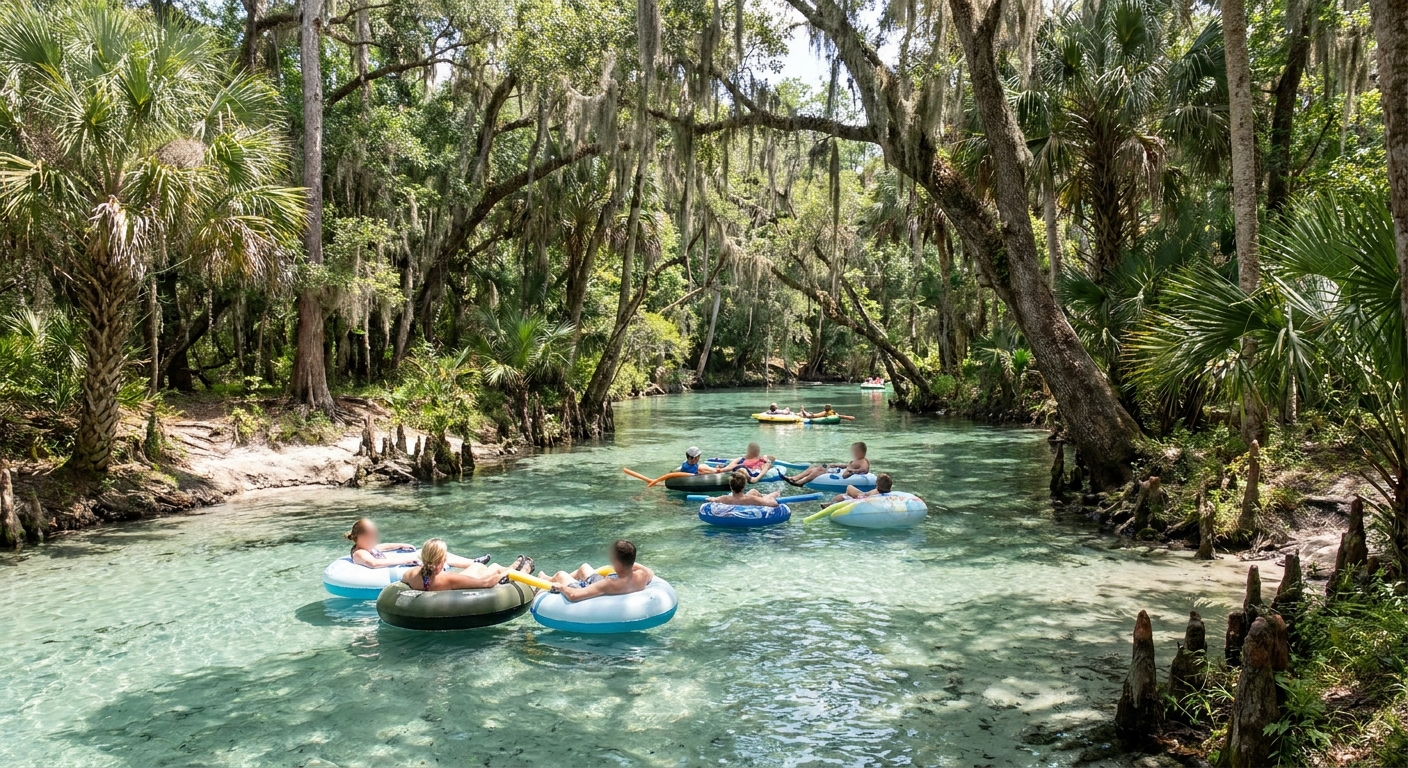
THE MONTH AT A GLANCE · GINNIE SPRINGS
June opens the widest everyday gap between hot air and 72.7°F spring water, and charges 7.56 inches of rain for it.
AIR 90.3°F / 69.5°F · WATER 72.7°F · 11 WET DAYS · 14H 06M OF DAYLIGHT
Go for: swimming and diving while the air sits at 90.3°F, the year’s longest days, and light on the water until 8:34 p.m.
Think twice before: fixing a dry-weather itinerary: 11 days in an average June get at least 0.10 inch, and 2.1 get an inch or more.
Air: NOAA NCEI 1991-2020, Gainesville Regional Airport · Water: USGS gauge 02322400 · full sources at the end
On this page
- June weather at Ginnie Springs90.3°F highs, 7.56 inches, 11 wet days
- How cold the spring water is72.7°F on the USGS gauge
- Crowds and prices in JuneWhat we could and could not verify
- Things to do in JuneThe spring run, the divers, the long evenings
- A two-day plan for JuneTwo days built around a 6:28 a.m. sunrise
- June against May and JulyHow the three months compare
- Is June the month to book?Our verdict, and the month to switch to
Two numbers do most of the deciding: 90.3°F in the air, 72.7°F in the water. The rest of the month is rain and light.
Ginnie Springs weather in June: average highs, lows and rain days
| June normal | Value |
|---|---|
| Average high | 90.3°F |
| Average low | 69.5°F |
| Rainfall | 7.56 in |
| Days with 0.10 in or more | 11.0 |
| Days with 1 in or more | 2.1 |
| Daylight, June 15 | 14h 06m |
| Sunrise / sunset, June 15 | 6:28 a.m. / 8:34 p.m. |
| Spring water | 72.7°F |
The air figures come from NOAA NCEI’s 1991-2020 monthly normals for station USW00012816, Gainesville Regional Airport, about 48 miles from the spring. That is a thermometer on a runway rather than a reanalysis grid cell, and it is the closest official record we could read. Every figure here for temperature and rain describes the air: 90.3°F by day, 69.5°F before dawn, 7.56 inches over the month. The water is measured separately, by a USGS gauge in the spring itself.
Eleven days in an average June record at least 0.10 inch, so roughly one day in three arrives wet somewhere in it. Only 2.1 days average an inch or more, which is the difference between a storm that clears the deck for an hour and one that ends the swimming. North Florida runs on the state’s wet-season pattern, with the heavy hours stacked in the afternoon. Our best-time guide puts the May-to-October window in context.
Between the 90.3°F afternoon and the 69.5°F dawn sits 20.8°F, a wider daily swing than most people pack for. A towel hung out overnight will not be dry at 6:30 a.m. Carry a second one, a long-sleeve layer for the first hour, and more drinking water than looks reasonable, because the humidity in a Florida June does more damage than the number on the thermometer.
June 15 gives 14 hours 6 minutes of daylight, sunrise at 6:28 a.m. and sunset at 8:34 p.m. local time, per sunrise-sunset.org. That is enough light for two swims with the worst hours skipped in between. Anything you start at 6 p.m. still has two and a half hours of daylight behind it.
How warm is Ginnie Springs in June?
72.7°F. That is what USGS station 02322400 read in the spring on September 11, 2026, and it is a single instantaneous reading rather than a monthly mean of daily maxima. Sea-surface tables are usually built the second way, and they run a shade warm as a result. The distinction matters less here than on any coast, because the spring holds close to that figure all year while the air above it climbs from 87.4°F in May to 91.1°F in July.
At 8 a.m., with the air near its 69.5°F low, 72.7°F water is a decision you take slowly. By 2 p.m., with the air at 90.3°F, the same water is relief and the 17.6°F gap does all the work. Take the cold-shock moment in the morning and save the long floats for the afternoon. Anyone staying in past an hour will want a rash guard or a thin wetsuit top, June or not.
The month’s average low is 69.5°F, nearly 38 degrees above freezing, so frost is not a June question here. We have no daily extremes series for the station, so we give no count of the coldest or hottest individual nights, only the 1991-2020 monthly averages above.
How busy is Ginnie Springs in June: crowds and prices
June falls inside the American school break, a calendar fact rather than a price series. We found no occupancy figures and no monthly room rates for the area, so we crown no month expensive and none cheap. What we can say about the three summer months is that they share one weather pattern, and that June is the wettest of them at 7.56 inches.
That leaves the booking question more open than we would like. We could not verify a capacity cap, a reservation window or an opening hour from a primary source, so we will not invent a number of weeks in advance. Call before you commit to a summer Saturday, and treat a Friday or a Monday as the flexible version of the same trip. Our Florida trip-cost guide handles the parts of the budget that do carry published numbers.
We could not verify a lodging-tax rate for the county, so we give no percentage. Assume a tax line on any room you book in Florida and read it on the confirmation before you sign.
Money buys one genuinely useful thing in a 90.3°F month: somewhere shaded to sit out noon to 4 p.m. A site or a rental with cover beats any upgrade closer to the water, and it is the difference between two swims and one. We could not verify an entrance fee, so we cannot price that trade for you. Families juggling the same shade-and-water logistics will find the rest in our Florida with kids guide.
Things to do in Ginnie Springs in June
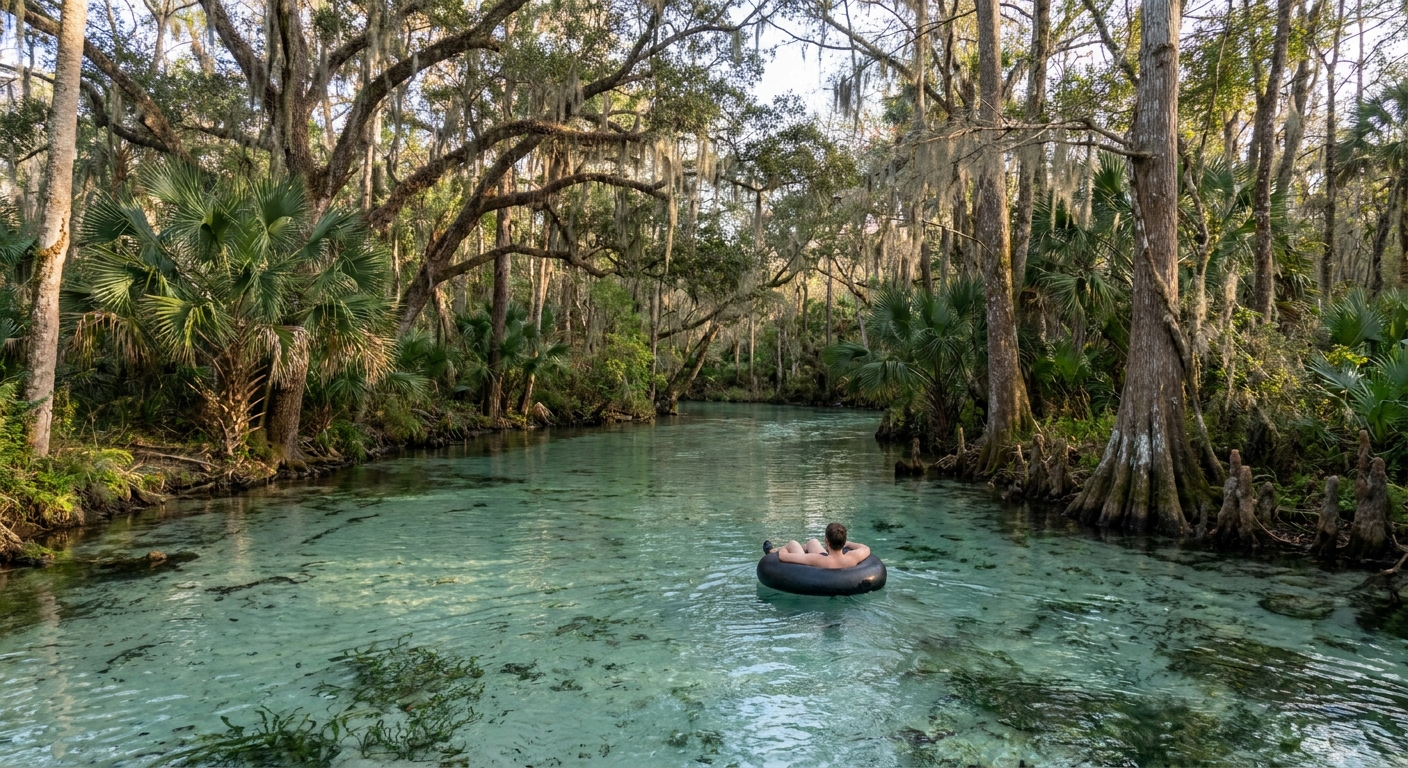
June averages 90.3°F by day against water at 72.7°F, a difference of 17.6°F. May cannot match that afternoon heat at 87.4°F, and July’s extra 0.8°F changes nothing you would plan around. Add the year’s longest days, 14 hours 6 minutes on June 15, and the month gives more usable hours in the water than the two either side of it.
USGS station 02322400 sits in the spring and read 72.7°F on September 11, 2026. Florida’s Department of Environmental Protection, in its own directory of springs to visit, names Ginnie Springs alongside Peacock Springs among the most popular and interesting springs diving destinations in the state. That puts cavern and cave divers in the same water as tubers on a June Saturday. Manatees belong to another season and another spring, and our manatee guide covers them.
Nothing about 72.7°F changes between January and June. What changes is what you climb back out into. In May the average low is 62.6°F and the air tops out at 87.4°F, so the swim reads as bracing and the walk to the car reads as cool. In June the midday gap widens to 17.6°F, and the walk back is the uncomfortable half of the trip.
You pay nothing for the extra daylight: 14 hours 6 minutes on the 15th, with usable light on the water until 8:34 p.m. Beyond that we can promise nothing free, because we could not read a single published fee or hour from a primary source. Florida’s state park site returned a 403 to our automated reads on September 11, 2026, and we would rather say so than copy a price off a forum.
Ginnie Springs in June: a two-day itinerary
Day one, cut against the heat. Sunrise is 6:28 a.m., so arriving by eight buys two cool hours before the 90.3°F part of the day starts building. Swim first, eat late, and give noon to 4 p.m. to shade, a dry shirt and the cooler. Back in the water at five. The light holds until 8:34 p.m., long enough for a second swim and dinner afterward.
Day two, assume weather. Eleven days in an average June take at least 0.10 inch and 2.1 take an inch or more, with the heavy hours usually in the afternoon, so front-load the morning again. If a storm builds, the water is still 72.7°F and an hour of rain costs an hour. If it settles in for the day, the car becomes the plan, and our things-to-do guide and getting-around guide carry the indoor and long-drive options.
Ginnie Springs in June vs May and July
| Normal | May | June | July |
|---|---|---|---|
| Average high | 87.4°F | 90.3°F | 91.1°F |
| Average low | 62.6°F | 69.5°F | 71.6°F |
| Rainfall | 3.08 in | 7.56 in | 6.68 in |
| Days with 0.10 in or more | 4.5 | 11.0 | 10.5 |
| Spring water | No seasonal swing | 72.7°F on the gauge | No seasonal swing |
May runs 87.4°F by day and 62.6°F at night on 3.08 inches of rain across 4.5 wet days. June jumps to 90.3°F and 69.5°F on 7.56 inches across 11.0 wet days. July adds almost nothing to the heat at 91.1°F and gives 0.88 inch of rain back at 6.68 inches over 10.5 wet days. The water reads 72.7°F through all three, because the spring has no seasonal cycle.
Move four weeks back and you gain 4.48 inches of dry weather and 6.5 fewer wet days, and you lose 2.9°F of afternoon heat. That heat is what makes 72.7°F water feel like a reward instead of a dare. Move four weeks forward and the rain eases slightly while nights warm to 71.6°F and days gain 0.8°F. Neither shift is dramatic. The choice comes down to May’s dry mornings against June’s long evenings.
Is June a good time to visit Ginnie Springs?
Yes, for anyone whose trip is the water. June puts the widest everyday difference between air and spring on the calendar, 17.6°F at midday, with 14 hours of light to spend in it. No, for anyone who needs a fixed outdoor schedule or who has one afternoon and cannot afford to lose it. Eleven wet days and 2.1 with an inch or more make any single plan a coin toss.
If that is you, take May instead: 3.08 inches rather than 7.56, 4.5 wet days rather than 11, and afternoons at 87.4°F that are still hot enough to earn the swim. The trade is 62.6°F mornings and days that have not reached their longest yet.
No other month pairs the year’s longest days with water at 72.7°F and a 90.3°F afternoon waiting on the bank, sunset at 8:34 p.m. on the 15th.
The last word
Decide two things before you book: where you will spend noon to 4 p.m. in the shade, and what the trip looks like on the one wet afternoon in three. Then one piece of Florida law worth carrying with you. Statute 373.802(5) protects what it calls Outstanding Florida Springs, every historic first-magnitude spring as the Florida Geological Survey determines them, plus six more written into the text by hand. The gauge in the water posts a fresh reading all year, and 72.7°F is what it said on September 11, 2026. Check it the morning you drive.
Sources & data for this guide
- June, May and July air normals (1991-2020) · NOAA NCEI monthly normals, station USW00012816, Gainesville Regional Airport, FL US, about 48 miles from the spring · checked Sep 24, 2026
- Rain days at 0.10 in and 1.00 in · NOAA NCEI monthly normals, same station · checked Sep 24, 2026
- Daylight, sunrise and sunset on June 15 · sunrise-sunset.org, converted to local time · checked Sep 24, 2026
- Spring water at 72.7°F (22.6°C) · U.S. Geological Survey, National Water Information System, station 02322400 Ginnie Springs, instantaneous reading · checked Sep 24, 2026
- Outstanding Florida Springs definition · Florida Statutes 373.802(5) · checked Sep 24, 2026
- Springs diving destinations wording · Florida Department of Environmental Protection, Visit a Spring · checked Sep 24, 2026
- Editorial admission: floridastateparks.org returned a 403 to our automated reads and myfwc.com’s manatee pages render client-side, so we could not verify an entrance fee, an opening hour or a manatee count · Sept 11, 2026
- Plans and packing advice are editorial; fees, hours and closures change · check the operator when you book.