
On a February evening in Tokyo, a shrine courtyard fills with people holding little paper cups of roasted soybeans, and someone in an oni mask gets pelted with beans while the crowd shouts for devils to go out and fortune to come in. Steam rises from oden stalls and ramen counters, and the plum trees in shrine gardens begin to open their first pale flowers. This is Tokyo in the cold, bright middle of winter, a month of hot food, early blossoms and old seasonal rituals, before the cherry trees take over the city’s attention.
What is the weather like in Tokyo in February?
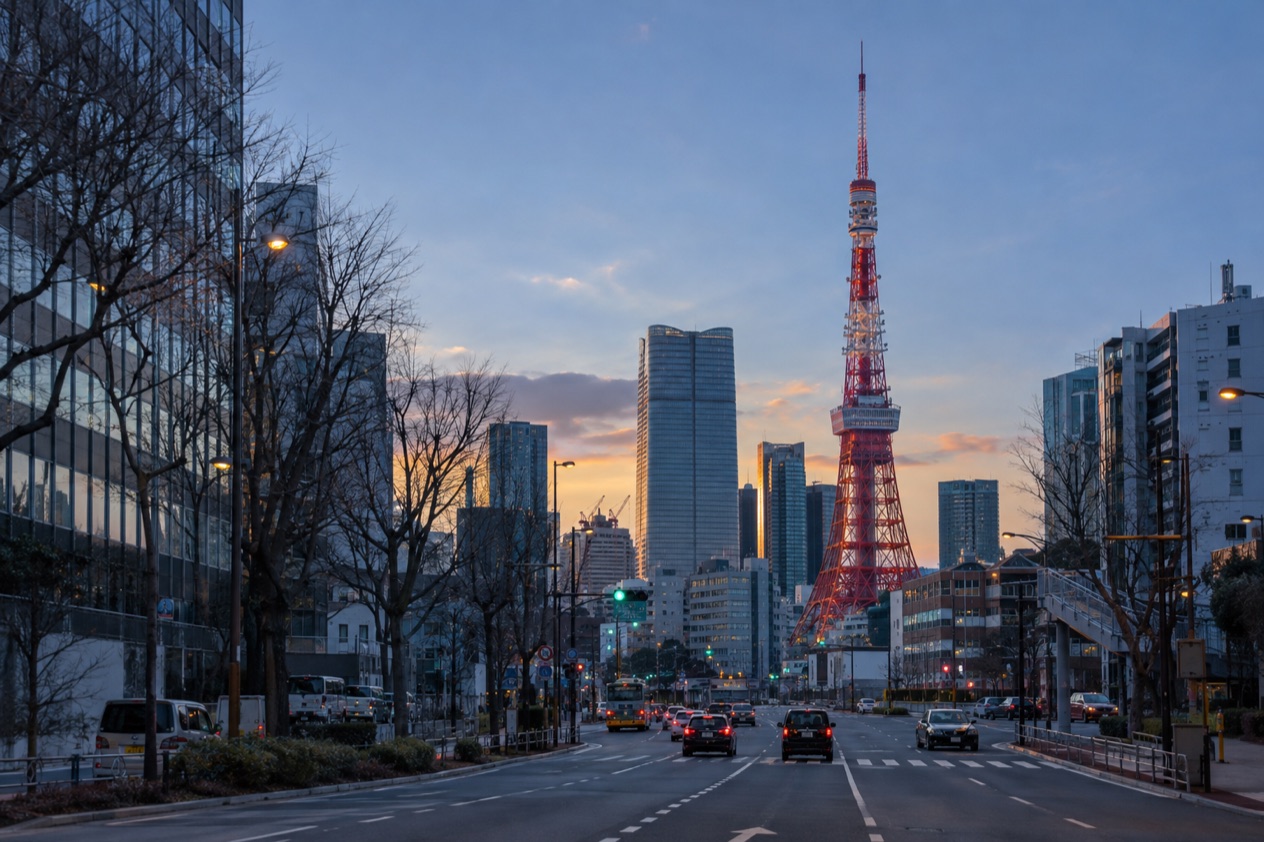
February in Tokyo is cold but not harsh: coat weather, with long stretches of clear skies and only a handful of wet days.
| Month | Average high (°F) | Average low (°F) | Precipitation (in) | Days with 1 mm or more of precipitation | Hours of sunshine | Daylight on the 15th |
|---|---|---|---|---|---|---|
| January | 49.6 | 34.2 | 2.35 | 4.5 | 193 | 9 h 59 min |
| February | 51.6 | 35.8 | 2.22 | 5.2 | 170 | 10 h 52 min |
| March | 57.6 | 41.0 | 4.57 | 9.2 | 175 | 11 h 54 min |
What this means on the street is simple: you want a proper winter coat, a scarf and closed shoes, with layers you can peel off once you step into a warm train car, a department store or a restaurant. Mornings and evenings feel colder than the daytime figures suggest, especially in the shade between tall buildings.
Rain is not the main worry this month. Wet days are few, and when precipitation does come it can arrive as cold rain or as sleet. Snow shows up on about three days of an average February and rarely settles in the city, though a forecast of heavy snow can disrupt trains. A compact umbrella is enough for most days.
The light is the quiet gift of the month. Days are noticeably longer than in January, so you can fit a full afternoon of sightseeing before dusk, and the low winter sun gives temple roofs and park lawns a clean, sharp look. By the end of the month the evenings stay light a little longer, which makes the walk from a museum to dinner feel less like a dash through the dark.
What to do in Tokyo in February
February in Tokyo is shaped by three things: a ritual that marks the turn toward spring, the first blossoms of the year, and a long list of dishes built to warm you up. Between them, the city is a good one for moving from indoors to outdoors and back, with a shrine visit in the afternoon and a steaming bowl by dark.
Farther north, the season is a different one entirely. In winter, heavy snow regularly covers the mountains and northern regions of Japan, while most major cities rarely see it.
The Sapporo Snow Festival takes over Hokkaido’s capital for seven days in February, across three sites at Odori, Susukino and Tsudome, and ski resorts in Hokkaido and the high mountains of Nagano are in their peak months of January and February. Tokyo is where you watch that winter from a distance and enjoy the clear days.
Setsubun and the bean-throwing ritual
Setsubun falls in early February, on the eve of the traditional beginning of spring, and it is the month’s best-loved tradition. The main ritual is mamemaki: roasted soybeans, called fukumame, are thrown out the front door or at a family member wearing an oni (demon) mask, with the shout of ‘Oni wa soto! Fuku wa uchi!’ (Devils out! Fortune in!).
At home, families do it in the doorway. At shrines and temples around the city, the same ritual becomes a public event, with priests, costumed oni and handfuls of beans or small gifts tossed to onlookers. Walking into a temple precinct on that day, you will see people leaning forward with open hands and children shrieking at the masks.
Afterward comes the eating. It is customary to eat the roasted soybeans, one for each year of your life plus one extra for good luck in the coming year, counting age in the traditional way called kazoedoshi. Many households also eat a thick sushi roll for the occasion, which you may see stacked in supermarkets and convenience stores around that time.
Plum blossoms and daffodils
Before the cherry trees, there are plums. Prunus mume typically flowers from January until late February in East Asia, so by the last weeks of the month Tokyo’s shrine and garden plum trees are in flower, following the pattern that cherry blossoms come after the plums.
The flowers are small, often white or pink, and their scent carries on cold air. Shrines with plum groves, such as Yushima Tenjin, are natural places to look for them.
For a bigger sweep of color, Kasai Rinkai Park holds a daffodil festival each February, with narcissus blooms laid out against views of Tokyo Bay. It is the largest daffodil festival in Tokyo’s public parks, and it suits a slow afternoon outside, with a thermos or a hot drink from a vending machine. Bring a hat and gloves, since open ground by the bay can feel colder than the city streets.
Plum viewing is quieter than the cherry blossom parties of spring. Hanami, the pastime of flower-viewing, is mainly tied to the sakura in late March and early April, but a plum walk in February gives you a preview of the same habit: slow strolling, camera in hand, a pause for tea or sweets.
Hot pots, noodles and winter sweets
February is the month to eat in a way that heats you from the inside. Nabe, the communal hot pot simmered at the table, is the obvious choice, and so are bowls of ramen, udon in hot broth and oden, the simmered assortment of daikon radish, eggs, fish cakes and tofu that appears at stalls and convenience-store counters. Izakaya, the casual pubs, serve grilled skewers and warm sake, and a night spent in one is a very Tokyo way to spend a cold evening.
Sweet things lean toward the season too. Strawberries are a winter fruit in Japan, and they turn up in daifuku (rice cakes filled with sweet bean paste), in parfaits and on cakes at department store counters. Amazake, a warm, lightly sweet rice drink, is sold at some shrines in winter, and a cup in your hands helps while you wait out a ceremony.
Temples, shrines and indoor days
Year-round sights work well in February because the air is cold and the skies are often clear. Senso-ji in Asakusa, with its shopping lane leading to the temple hall, is a pleasant place to pair with hot snacks. Meiji Jingu, set in a wooded park, suits a winter walk beneath bare branches and evergreens. The Yamanote Line loop circles the central districts, so a day can move between neighborhoods without losing the thread.
When the weather turns gray or wet, Tokyo has a large supply of indoor options: museums, department stores with their food halls, bookshops, arcades, and covered shopping streets. February is a month where you can plan one outdoor highlight per day and keep the rest flexible.
A two-day itinerary for Tokyo in February
Day 1 begins in Asakusa, early enough to see the temple approach as the shops open their shutters. After Senso-ji, a bowl of hot noodles or a tempura lunch in the old neighborhood keeps you warm, and from there the afternoon heads to a park where plum trees may be opening, such as the grounds around a shrine like Yushima Tenjin. The light is lower in winter, so keeping outdoor stops in the early and middle afternoon makes sense.
As the sun drops, move indoors. A museum in Ueno or a department store food hall fills the early evening, and dinner can be a hot pot or an izakaya meal of grilled skewers and warm sake. If rain or sleet arrives, trade the park for covered arcades and museum galleries.
Day 2 starts at Meiji Jingu, walking through the wooded approach while the air is still crisp. From there it is a short step into Harajuku’s side streets for a coffee or crepe, then on to Shibuya and its crossing for a look at the city at full speed. Lunch can be ramen or a set meal in a department store restaurant floor.
In the afternoon you have a choice. Kasai Rinkai Park gives you the daffodils and the view over Tokyo Bay, which suits a clear day. If the weather is poor, stay in Shinjuku among its big stores and observation points, then finish with dinner in one of the lantern-lit lanes of izakaya. Either way, leave the evening for something hot to drink before the night turns cold.
Is Tokyo busy in February?
February is Tokyo’s coldest stretch, and it sits before the big blossom season rather than inside it. Cherry blossoms come from late March to early April, so the largest flower-viewing gatherings belong to the weeks after this month.
What February brings instead is a run of seasonal events: the Setsubun bean-throwing at shrines and temples, the daffodil festival at Kasai Rinkai Park, and plum blossoms in gardens toward the end of the month. These give the city a lively, local feel, with families, office groups and friends gathering around rituals and flowers rather than around a single headline attraction.
The mood in the streets is that of a city in winter routine. People move fast between warm interiors, steam rises from food stalls, and the cold pushes the evening crowd toward izakaya and hot pot restaurants. Because the days are short, the late afternoon and evening are when neighborhoods like Shinjuku and Shibuya feel most energetic.
The ski season runs from December into April and is at its peak in January and February in Hokkaido and the high mountains of Nagano, so the winter-sports crowd is a feature of those regions rather than of Tokyo itself.
What to pack for Tokyo in February
Pack for cold air outside and heated rooms inside, with layers that come on and off easily.
- A warm winter coat, since mornings and evenings feel colder than the daytime figures, especially in the shade.
- Thin layers such as a sweater and a long-sleeved shirt, for the heated trains and stores.
- A scarf, gloves and a hat for shrine courtyards, the bay at Kasai Rinkai Park and evening walks.
- Waterproof, closed shoes for cold rain, sleet or the occasional snow day.
- A compact umbrella for the wet days that do come.
- Shoes that slip on and off easily, since temples and restaurants often ask you to remove them.
Good to know before you go
February is a winter month, not a typhoon or rainy-season one, so the practical points are about cold and snow. In Tokyo, snow generally falls in January and February, though it rarely settles, and railway companies may schedule planned suspensions of train services in advance if strong winds or heavy snow are forecast. On a day with snow in the forecast, it is wise to have an indoor plan ready.
Setsubun is a festive day at shrines and temples, so expect the grounds to be busy with ritual events when it comes. Daffodils and plums are seasonal, so the exact state of the blooms varies from one winter to the next.
Tokyo in February vs January and March
Moving the trip four weeks earlier puts you in January, when Tokyo is at its coldest, with days that are shorter than in February and a little more sunshine. Plum blossoms are only beginning, and the Setsubun ritual and the daffodils have not arrived yet. Ski resorts are in their peak period, which matters if your trip combines the capital with snow country.
Moving four weeks later puts you in March, which is milder, with highs noticeably warmer and more rain falling over more days. The plums give way to cherry blossoms: first bloom usually arrives around the last week of March, and full bloom comes around the end of the month, though it shifts from one spring to the next. Daylight stretches past eleven hours and the city starts to feel like spring.
Stay with February if you want the Setsubun ritual, daffodils and early plums, along with clear winter days and hot-pot dining. Shift to March if you want mild weather and the chance of cherry blossoms, accepting more rain. Choose January if snow country and winter sports are the main event of your trip.
Is February a good time to visit Tokyo?
Yes, for travelers who like cold, bright days, hot food and seasonal rituals, and who do not mind bundling up. February suits people who want to see the city doing its winter routines, such as a bean-throwing ceremony at a temple, a bowl of ramen after a walk, and a first look at plum blossoms.
It is a weaker fit for anyone hoping for cherry blossoms or warm spring weather, since those belong to late March and April. If you dislike cold evenings, a different month will feel more comfortable.
On arrival, start with a shrine or temple visit while the light is clear, then plan a hot meal for the evening. Keep one indoor option in your pocket for a sleet day. February’s particular pleasure in Tokyo is the small signs of spring arriving in the cold: soybeans flying at a temple gate, a first plum in bloom, and a field of daffodils beside the bay.
Sources
- Japan Meteorological Agency (JMA), Normal values 1991-2020, monthly (https://www.data.jma.go.jp/stats/etrn/view/nml_sfc_ym.php?prec_no=44&block_no=47662), station Tokyo, elevation 25 m, checked October 11, 2026
- Computed from the date and the latitude of the place (sunrise equation, solar elevation -0.833 degrees), October 11, 2026
- Wikipedia, Setsubun (https://en.wikipedia.org/wiki/Setsubun), checked October 11, 2026
- Japan National Tourism Organization, festivals and events (https://www.japan.travel/en/see-and-do/festivals-and-events/), checked October 11, 2026
- Sapporo Snow Festival official website (https://www.snowfes.com/english/), checked October 11, 2026
- Wikipedia, Sapporo Snow Festival (https://en.wikipedia.org/wiki/Sapporo_Snow_Festival), checked October 11, 2026
- Japan National Tourism Organization, winter in Japan (https://www.japan.travel/en/guide/winter-guide/), checked October 11, 2026
- Japan National Tourism Organization, skiing and snowboarding in Japan: regions, resorts, seasons (https://www.japan.travel/en/sports/snow/), checked October 11, 2026
- Wikipedia, Climate of Japan (https://en.wikipedia.org/wiki/Climate_of_Japan), checked October 11, 2026
- Japan National Tourism Organization, flowers by season: cherry blossom, plum, wisteria, hydrangea, where and when (https://www.japan.travel/en/see-and-do/flowers/), checked October 11, 2026
- Wikipedia, Prunus mume (https://en.wikipedia.org/wiki/Prunus_mume), checked October 11, 2026
- Japan National Tourism Organization, skiing guide (https://www.japan.travel/en/guide/skiing/), checked October 11, 2026
- Wikipedia, List of ski areas and resorts in Japan (https://en.wikipedia.org/wiki/List_of_ski_areas_and_resorts_in_Japan), checked October 11, 2026
- Japan National Tourism Organization, weather and seasons in Japan (https://www.japan.travel/en/plan/weather/), checked October 11, 2026
- GO TOKYO, best things to do and see in Tokyo in February (https://www.gotokyo.org/en/story/guide/february/index.html), checked October 11, 2026
- Japan Meteorological Agency, cherry blossom first-bloom dates 2021-2026 and 1991-2020 normal (https://www.data.jma.go.jp/sakura/data/sakura003_07.html), checked October 11, 2026
- Japan Meteorological Agency, cherry blossom full-bloom dates 2021-2026 and 1991-2020 normal (https://www.data.jma.go.jp/sakura/data/sakura004_07.html), checked October 11, 2026
- GO TOKYO, Tokyo in spring (https://www.gotokyo.org/en/story/guide/spring/index.html), checked October 11, 2026
- GO TOKYO, Tokyo in summer (https://www.gotokyo.org/en/story/guide/summer/index.html), checked October 11, 2026
- GO TOKYO, Tokyo in winter (https://www.gotokyo.org/en/story/guide/winter/index.html), checked October 11, 2026
- Wikipedia, Tokyo (https://en.wikipedia.org/wiki/Tokyo), checked October 11, 2026
- Wikivoyage, Tokyo (https://en.wikivoyage.org/wiki/Tokyo), checked October 11, 2026