
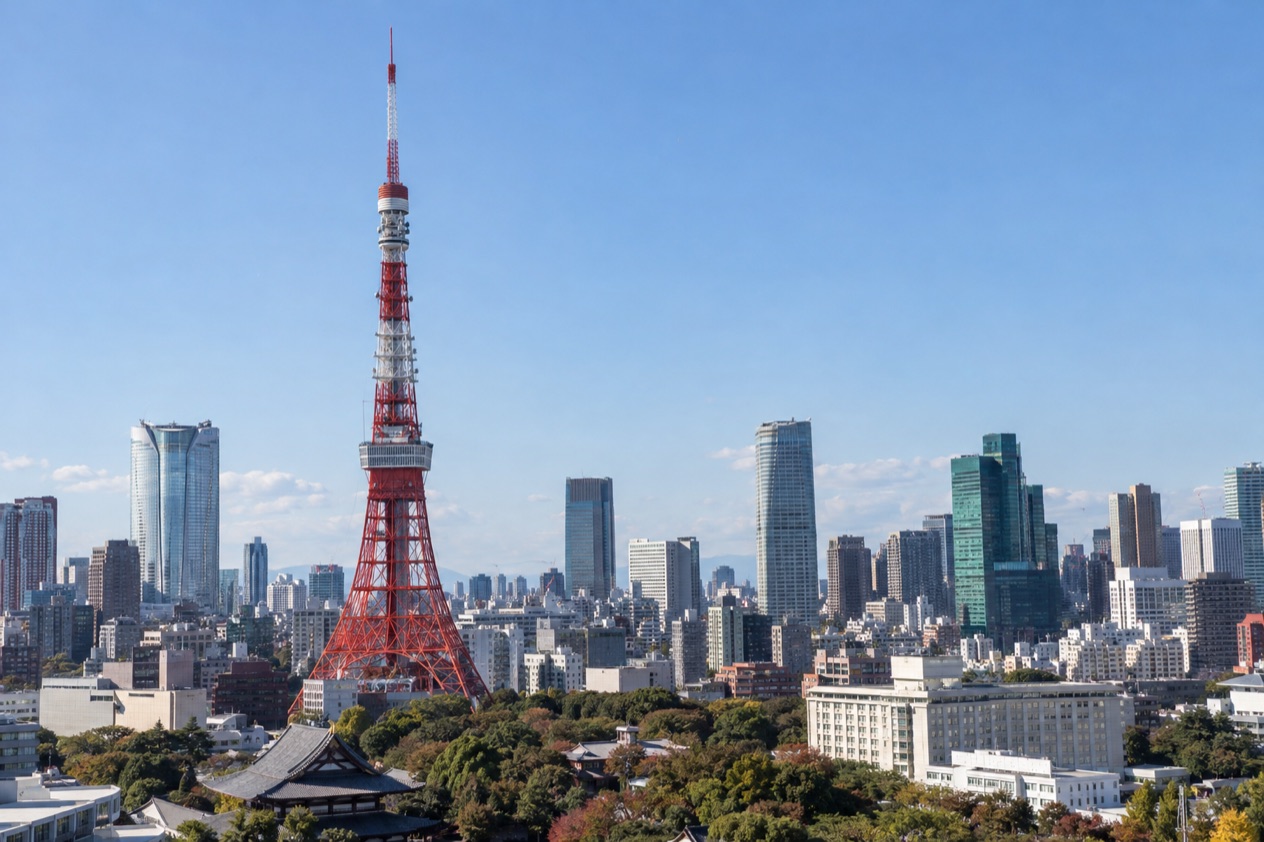
The tower rises from the green of Shiba-koen, its lattice legs spreading wide, and at night the whole frame glows a warm orange against the dark. Walk up to its base and you look straight into the steel, then through the doors of FootTown and into the elevators. It is a visit built around height, a view over Tokyo Bay and the city, and a landmark that has watched over Minato for decades.
Is visiting Tokyo Tower worth it?
Yes, for anyone who likes to understand a big city from above before walking its streets, and for travelers who enjoy a landmark with a clear personality. Tokyo Tower is a communications and observation tower in the Shiba-koen district of Minato, and it was inspired by the Eiffel Tower in Paris. That French lineage shows in the lattice of steel, but the color, the setting and the atmosphere are entirely its own.
What sets it apart from other viewpoints in the city is the way it combines a classic tower with a full building at its feet. FootTown holds restaurants, gift shops and other attractions, and RED° Tokyo Tower, billed as Japan’s largest esports park, fills a good part of it. You can pair a look over the skyline with a meal, some souvenir shopping or a game session, all in one place.
It also has a lived-in, human quality. There is a small shrine, Tower Daijingu, an annual festival in May, and an outside staircase that people climb on weekends and holidays to earn a certificate. Travelers who prefer modern glass skyscrapers may find the steel frame charming rather than thrilling, while those who like a landmark with a story will find plenty to enjoy.
Nearby districts add to the outing. Roppongi and Akasaka are close by in Tokyo, and Ginza, with its high-end restaurants and luxury shops, makes a natural contrast to the tower’s more relaxed spirit.
What to see at Tokyo Tower
The Main Deck
The Main Deck is the heart of the visit, a two-story observatory at 150 meters (490 feet). Elevators from the first floor of FootTown carry visitors up to it, and once there you can circle the windows and look out across Minato and the wider city toward Tokyo Bay. Tokyo sits on the bay in the Kanto region, and the tower gives you a sense of how the city spreads out around it.
Take your time on both levels. Each floor frames the city a little differently, and the shift from daylight to dusk to lamp-lit streets is part of the pleasure. It suits couples, friends and families who want a clear picture of the capital without a long outing.
The Top Deck
Higher up, the smaller Top Deck sits at 249.6 meters (819 feet), also called the Special Observatory. It requires another ticket on top of the Main Observatory entry, bought for the transfer from the Main Deck. The deck was closed in 2016 and reopened on March 3, 2018, after renovations.
The extra height gives a broader sweep of the skyline and a more intimate, compact space than the Main Deck below. Travelers who want the highest point of the tower will want to add it, while those happy with a good view from 150 meters can skip it and spend the time elsewhere.
FootTown and RED° Tokyo Tower
At the foot of the tower stands FootTown, a five-story base building with restaurants, gift shops and other attractions. It is where you enter before taking the elevators, and it works as a small destination in itself, with places to eat and shelves of souvenirs shaped like the tower.
RED° Tokyo Tower, billed as Japan’s largest esports park, occupies roughly one-third of the first and third floors and the entirety of the floors above. It adds a playful, modern side to a landmark from another era, and it is a good option for travelers who enjoy games and screens.
The outside staircase and Tower Daijingu
On weekends and holidays, visitors can walk the outside staircase of about 660 steps to the Main Deck, for the same entry fare as the elevator, and earn a certificate. It gives a different feel to the structure, since you move through the open steelwork rather than rising in a closed car.
Tower Daijingu is the shrine at the tower, and every May the Sawai Inari Shrine holds an annual festival there with ceremonial prayers for construction-related safety. It is a quiet reminder that this great steel structure has its own ritual life.
Hours, tickets and rules
The tower works in two stages: you reach the Main Deck from the first floor of FootTown, and you pay for a separate ticket to continue up to the Top Deck. The outside staircase is open to walkers only on weekends and holidays, at the same entry fare as the elevator.
| Site | Access |
|---|---|
| Main Deck (150 m) | Elevators from the first floor of FootTown |
| Top Deck (249.6 m) | Separate ticket from the Main Observatory |
| Outside staircase (about 660 steps) | Weekends and holidays only, same fare as the elevator |
The staircase leads to the Main Deck only, and walkers earn a certificate. The Top Deck is reached by buying another ticket from the Main Observatory. These are the rules the tower lays out for visitors.
When to visit Tokyo Tower
Tokyo Tower changes its color through the year, which gives you a reason to choose your moment. From October 2 to July 6 it is lit by sodium vapor lamps that give it an orange glow, and from July 7 to October 1 metal halide lamps turn it white. Evening visits catch the lighting at its most striking, and the city lights come on beyond the windows as you look out.
Spring and autumn bring the mildest weather. In April, highs average in the mid-60s with lows near 50, and rain falls on around nine or ten days, usually in passing spells. October is a little warmer, with highs in the low 70s, but it is also a wetter month, with rain on about ten days and fewer hours of sun, so a gray day is a real possibility.
Summer is hot and humid. In July, highs average in the mid-80s with lows in the low 70s, and humidity sits high, so the air-conditioned observation decks feel like a relief. Clear winter air is a good match for a viewpoint.
May is the month for the Tower Daijingu festival, with its ceremonial prayers for construction safety. The outside staircase is open on weekends and holidays, so those days suit anyone who wants to climb.
Tips for your visit
Plan the visit around three possible parts: the Main Deck, the Top Deck and FootTown. A traveler who only wants a look at the city can stop at the Main Deck, while someone with more time can add the Top Deck, a meal in FootTown or a session at RED° Tokyo Tower. Weekend and holiday visitors who feel energetic can take the staircase up instead of the elevator.
The tower combines well with a day in Roppongi and Akasaka. Roppongi Station is served by the Tokyo Metro Hibiya Line and the Toei Oedo Line, Nogizaka Station by the Chiyoda Line, and Roppongi-Itchome Station by the Namboku Line. From Shibuya Station, those districts can be reached in about 10 minutes by train.
It is an upscale downtown area with high-end restaurants and luxury shops, and nearby Nihonbashi is known for its rich heritage and is the main financial district of Japan. A day that starts with the shopping streets and ends with the orange glow of the tower makes a pleasant arc.
For arrivals from abroad, the nearest airports to Tokyo are Haneda Airport (officially Tokyo International Airport) and Narita Airport, Japan’s largest international airport. Families can enjoy the gift shops and the game floors, and the elevator route keeps the Main Deck open to all, while the staircase is a weekend choice for those who want it.
Good to know before you go
Tokyo is the capital of Japan and the most populous metropolitan area in the world, so the area around the tower is lively at most hours. October is wetter than many months, and an umbrella is a sensible companion on a gray day, though the decks and FootTown give you plenty to do under cover. Bring comfortable shoes if you plan to take the staircase on a weekend or holiday.
Sources
- Wikipedia, Tokyo Tower (https://en.wikipedia.org/wiki/Tokyo_Tower), checked October 11, 2026
- Japan National Tourism Organization, Tokyo (https://www.japan.travel/en/destinations/kanto/tokyo/), checked October 11, 2026
- Japan Meteorological Agency (JMA), Normal values 1991-2020, monthly (https://www.data.jma.go.jp/stats/etrn/view/nml_sfc_ym.php?prec_no=44&block_no=47662), station Tokyo, elevation 25 m, checked October 11, 2026
To plan your stay
- Best Time to Visit Tokyo: Cherry Blossoms, Autumn Leaves, Weather by Month and Festivals
- Where to Stay in Tokyo: Shinjuku, Shibuya, Asakusa, Ginza and Roppongi
- Tokyo from the airport: Narita and Haneda, the Skyliner, Local Trains and Taxis
- Know Before You Go to Tokyo: Entry, Money, Getting Around and Local Etiquette