
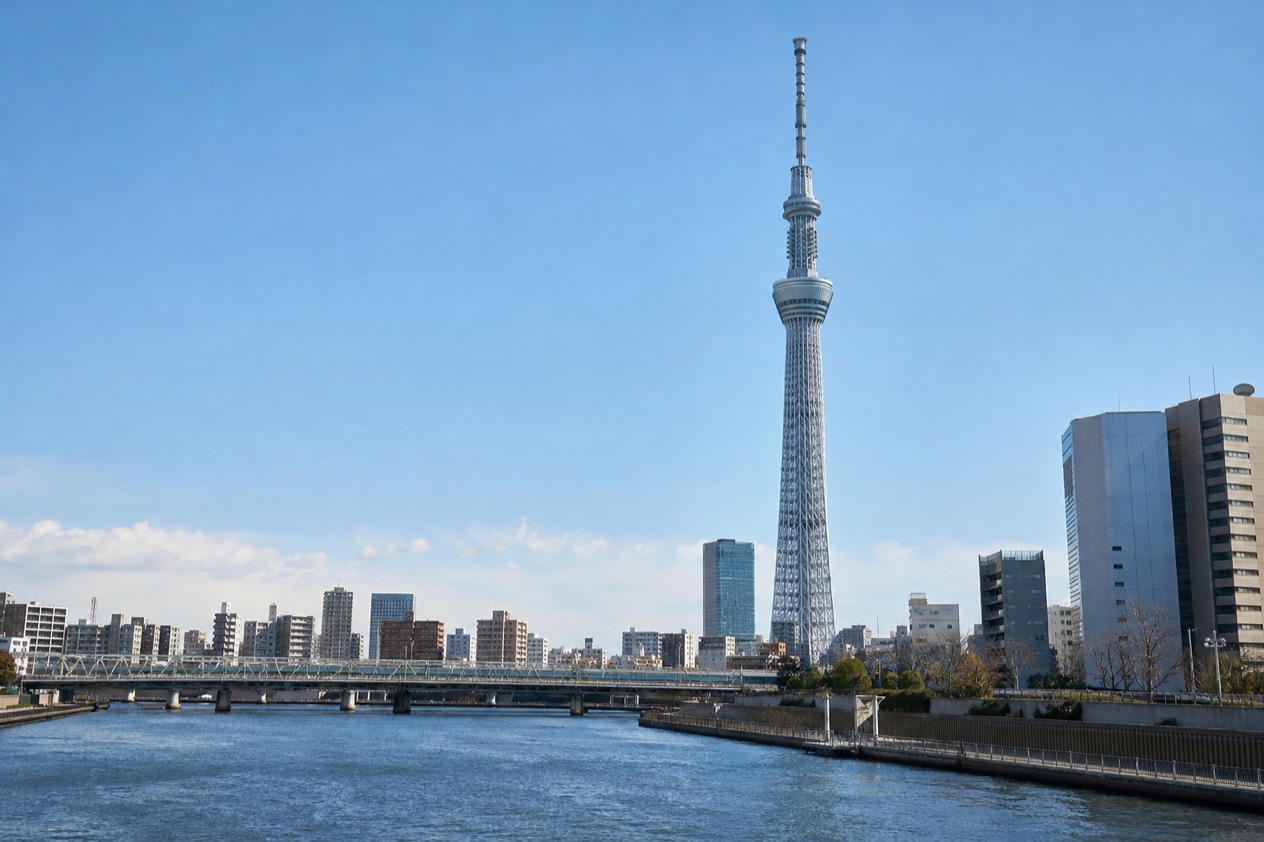
From the streets of Sumida, Tokyo Skytree rises above the rooftops long before you reach its base, a pale steel needle that seems to follow you down every side street. At the foot of the tower, shops and restaurants fill a large complex, and above them the lattice narrows toward the antenna.
Is visiting Tokyo Skytree worth it?
Yes, if you want to see how far Tokyo spreads and you like the idea of standing high above it, with a glass floor under your feet and a meal or a coffee at altitude. It suits first-time visitors who want the whole city in one view, travelers who enjoy towers and skylines, and families who can pair the ride up with an aquarium downstairs.
What sets it apart from the other viewpoints around the city is the scale and the setting. The tower stands 634 meters tall, and the decks sit well above most observation points in Tokyo. The base is a complex in itself, Tokyo Solamachi, so the visit can include shopping, a meal and Sumida Aquarium without leaving the site.
The tower is also a landmark you see from far away, which makes it a pleasure to look at as well as to climb. At night it is lit in one of two patterns, sky blue and purple, so the tower you look at from the street is its own show.
It is less a place for quiet contemplation than for a big view and a sense of the city’s size. If you prefer a lower, more intimate perch, you will find other viewpoints in Tokyo, but few put the whole metropolis at your feet in the same way.
What to see at Tokyo Skytree
The Tembo Deck
The Tembo Deck is the main observation level, and its principal floor is Floor 350. This is where most of the looking happens: the windows wrap around the tower, and the city unrolls in every direction, a grid of rooftops, rivers, railways and towers running to the horizon. On a clear day you pick out the bends of the Sumida River and the dense blocks of the neighborhoods around the tower.
Floor 345 belongs to the same deck and holds restaurants and shops, so you can stop for a drink or a meal with the view beside you. It is a good place to slow down and let the scale sink in, rather than rushing from window to window.
The glass floor on Floor 340
Floor 340 has a glass floor where you can see Tokyo’s panorama beneath your feet. Looking straight down past your shoes at the streets far below is the moment people remember, and a favorite for photographs, usually of friends standing on the glass and laughing at their own nerves.
If heights make you uneasy, you can stand at the edge and look, then step across when you feel ready. Visitors walk onto it slowly the first time and then linger.
The Tembo Galleria
The higher level is the Tembo Galleria, at floors 445 and 450, which is 450 meters high. The Galleria is the upper observatory, and the slow spiral of its sloping walkway lets you rise gradually while the view changes with each turn. From here the city seems smaller and the horizon wider, and the buildings below start to look like a model.
It is the place to go if you want the highest point you can reach on the tower. The two observatories differ in feel: the lower deck is the social one, with shops and tables, while the Galleria is for looking out.
The base: Tokyo Solamachi and Sumida Aquarium
At ground level, the Tokyo Solamachi complex wraps around the foot of the tower with shops and places to eat. Sumida Aquarium is inside it, which gives a rainy-day or family option that does not depend on the sky. After dark, look up from the plaza to see the tower lit, with the two patterns, sky blue called Iki and purple called Miyabi, alternating from one day to the next.
Hours, tickets and rules
The tower opens in the morning and stays open into the evening, with the last entry an hour before closing, so there is time for a late visit after the sun goes down and the city lights come on.
| Site | Open |
|---|---|
| Tokyo Skytree observation decks | 9:00 am to 10:00 pm, final entry at 21:00 |
The hours above are those listed for the tower. Admission amounts are not given here, so the table carries none.
How to get to Tokyo Skytree
Trains stop at the adjacent Tokyo Skytree Station and at nearby Oshiage Station, so the tower is reached by rail right at its base. Tokyo Skytree Station sits next to the complex, and Oshiage Station is close by, which gives you two stations to choose from depending on the line you are on.
The tower is in Sumida, in Tokyo, and the complex lies seven kilometers (4.3 miles) northeast of Tokyo Station. That is the only distance given, and it says where the tower sits in relation to the central station rather than how long a trip takes.
For travelers flying in, the nearest airports to Tokyo are Haneda Airport, officially Tokyo International Airport, and Narita Airport, Japan’s largest international airport. From either, the city’s rail network leads to the tower’s stations.
Travel times and fares are not given here, so none is written. Those staying in districts such as Ginza and Nihonbashi, or Roppongi and Akasaka, are in Tokyo too, and the same station names are the destination whichever neighborhood you start from.
When to visit Tokyo Skytree
The tower is open from morning to late evening, so you can choose a daytime view or a night view. Sunrise today is listed at 05:44 and sunset at 17:10, which means that in this season the light fades in the late afternoon, and the city’s lights are on well before the tower closes. A visit timed around dusk lets you see the city in daylight and then lit, in one trip.
The seasons change what you see and how it feels in the city below. In January the average high is 49.6°F and the average low 34.2°F, with a fairly dry month of about 4.5 days with precipitation and long hours of sun. Winter air is cold, so you will want a coat for the walk from the station, though inside the tower it is comfortable.
April is milder, with highs near 67°F and showers on about nine days. July is hot and humid, with highs in the mid-80s, and about ten days of rain.
October brings highs around 72°F, but also about ten days with rain and the gray skies that can come with them, so views are not guaranteed in any month. The sunshine hours are highest in January and lowest in October, which is worth keeping in mind if a clear view matters most to you.
Tips for your visit
Plan the visit around the view and the base. Give yourself time to move between levels: the glass floor, the main deck, the restaurants and then the Galleria each reward a slower pace.
Combine the tower with the complex at its foot. Pair the tower with a meal on Floor 345 if you want the view with your food, or save the meal for the ground floor and spend your time upstairs looking.
Bring a camera and a light layer. Windows reflect, so photographs tend to come out better when you stand close to the glass. The tower opened to the public on 22 May 2012, and it has become part of the Sumida skyline, which is worth a look from the street before or after you go up.
Good to know before you go
Tokyo is a city where weather shapes a visit, and October, like July, brings a good number of rainy days, so a compact umbrella is a sensible companion on the walk between station and tower. Inside, the decks and the complex keep you out of the weather.
Paying for food or souvenirs in the complex is straightforward at the shops and restaurants, and the view itself is the main thing you came for. Take your time at the windows, since the light over the city changes as the afternoon turns to evening.
Sources
- Tokyo Skytree, official site (https://www.tokyo-skytree.jp/en/), checked October 11, 2026
- Wikipedia, Tokyo Skytree (https://en.wikipedia.org/wiki/Tokyo_Skytree), checked October 11, 2026
- Japan National Tourism Organization, Tokyo (https://www.japan.travel/en/destinations/kanto/tokyo/), checked October 11, 2026
- Japan Meteorological Agency (JMA), Normal values 1991-2020, monthly (https://www.data.jma.go.jp/stats/etrn/view/nml_sfc_ym.php?prec_no=44&block_no=47662), station Tokyo, elevation 25 m, checked October 11, 2026
To plan your stay
- Best Time to Visit Tokyo: Cherry Blossoms, Autumn Leaves, Weather by Month and Festivals
- Where to Stay in Tokyo: Shinjuku, Shibuya, Asakusa, Ginza and Roppongi
- Tokyo from the airport: Narita and Haneda, the Skyliner, Local Trains and Taxis
- Know Before You Go to Tokyo: Entry, Money, Getting Around and Local Etiquette