
Step out of the station and the first thing you meet is the white curve of the Tokyo Dome roof, with roller coaster tracks looping through the amusement park beside it and crowds in team jerseys heading for the gates. A few minutes later the noise falls away behind the garden wall, and a pond with pine-fringed islands opens in front of you. Koishikawa Korakuen sits in the middle of Bunkyo, and together with the dome it makes a visit that moves between a modern entertainment district and a garden laid out in the Edo period.
Is visiting Tokyo Dome and Koishikawa Korakuen worth it?
Yes, if you like contrasts and want a garden visit that does not require leaving the city center: the garden suits anyone who enjoys strolling past ponds, stones and seasonal plantings, and the dome area suits baseball fans, concertgoers and families looking for an amusement park next door.
What sets the garden apart from other green spaces in Tokyo is its age and its pedigree. Koishikawa Korakuen is a daimyo garden, built in 1629 by Tokugawa Yorifusa, lord of Mito Domain, and it is one of three such gardens from the Edo period that survive in the city, the others being Rikugi-en and Hama Rikyu.
It is designated both a Special National Historic Site and a Special National Place of Scenic Beauty, a double recognition that tells you the layout has been kept with care. You walk a path that circles water, with stones placed as deliberate features and plantings arranged to change with the months.
The dome adds something the other old gardens do not have: a living stadium and leisure complex on the doorstep. A baseball stadium was built in 1937 on the site of the former Tokyo Artillery Factory within the old Korakuen grounds, and that history is why the district still carries the Korakuen name.
So the pairing is not random. You see a garden that began as a feudal lord’s estate, and next to it the place where the estate’s land became a stadium district.
The mix will not suit everyone. If you want a single, silent temple-and-moss atmosphere, the dome’s crowds and music on event days may feel like an interruption.
What to see at Tokyo Dome and Koishikawa Korakuen
The garden and its ponds
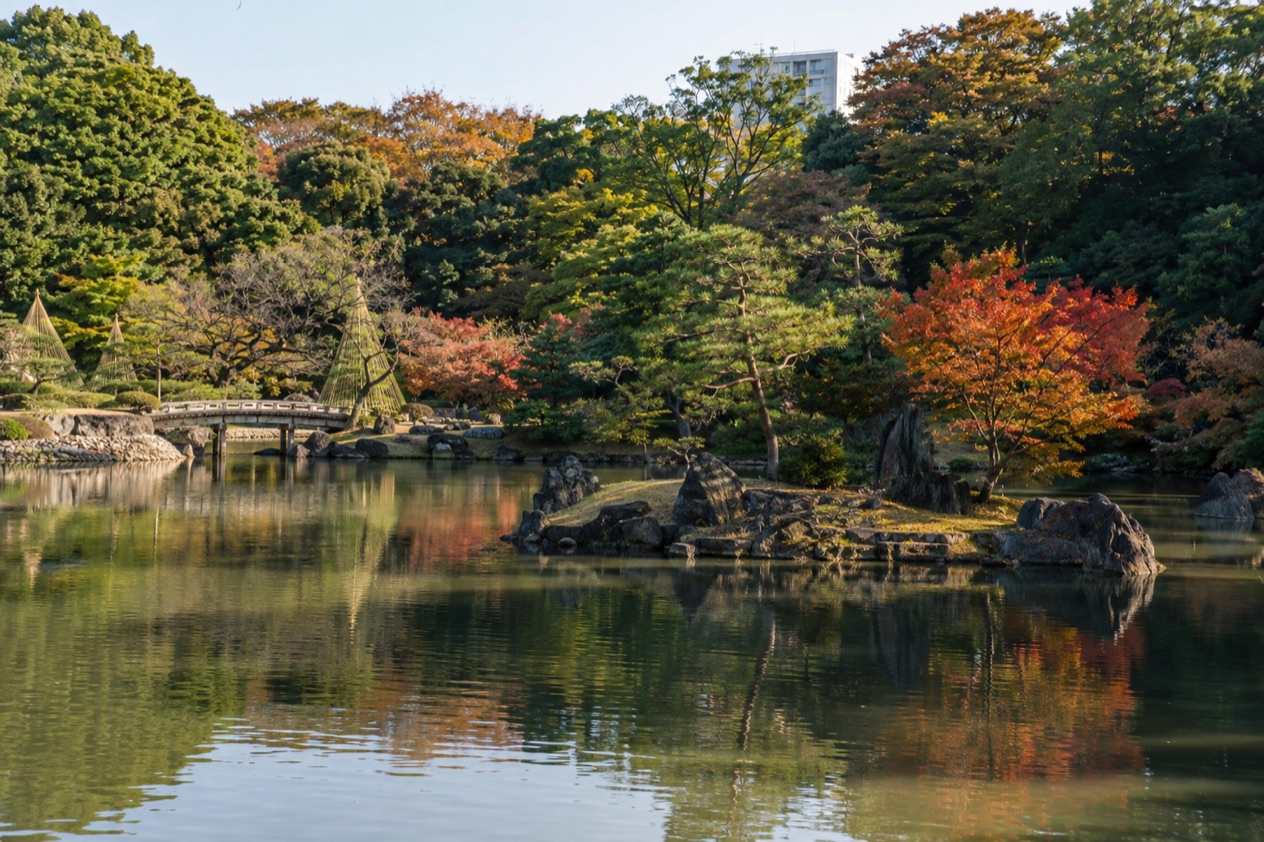
The heart of Koishikawa Korakuen is its water. Ponds anchor the design, and the paths wind around them so that the view keeps rearranging itself: an island here, a stone bridge there, a bank of trees reflected on the surface. The garden covers more than 70,000 square meters, with ponds and monumental stones among its defining features.
Pause at the edge of the water and watch how the plantings frame the view. Gardens like this were made to be seen from the path, one step at a time, and the reward is in noticing how each turn is composed.
Stones, plum, cherry and irises
Monumental stones are part of the garden’s character, set among the ponds as sculpture in their own right. They give the landscape weight and a sense of age, and they are worth a slow look: the shapes, the moss, the way they sit beside the water.
The plantings carry the calendar. Plum blossoms, cherry blossoms, azaleas and irises are all part of the garden, along with other flowering plants, so there is usually something that marks the moment you arrive. The garden is planted with plum and cherry trees, azaleas, irises and other flowering plants.
Tokyo Dome and its surroundings
Outside the garden wall, the scene turns loud and colorful. The Tokyo Dome is the stadium that took over from the 1937 ballpark tradition, and on game days the streets around it fill with fans in team colors, vendors and the sound of cheering drifting out of the gates. Concerts and other events also draw crowds, so the mood changes from one day to the next.
Next to the dome, the amusement park, with its coaster tracks rising above the buildings, gives the area a playful skyline that contrasts sharply with the garden’s calm. Walking from one to the other takes you from steel and neon to pine and still water, and seeing both in the same day is the real point of the pairing.
When to visit Tokyo Dome and Koishikawa Korakuen
Plum blossoms, cherry blossoms, azaleas and irises each have their moment, and the garden rewards a visit in any of those stretches. Spring brings the cherry blossoms and the most obvious color, and April has a pleasant feel, with highs in the mid-60s, lows near 50 and about nine rainy days, so a light layer and a small umbrella are sensible.
January is the cold, clear end of the year: highs reach just under 50 degrees, nights drop to freezing and rain is sparse, with sunshine plentiful. A winter walk past bare branches and still water has a quiet charm of its own, provided you bring a warm coat.
July is hot and humid, with highs in the mid-80s, warm nights and the air feeling heavy. Rain falls on about ten days, and the sun is less generous than in winter. It is a month for taking the garden slowly, drinking something cold in between, and perhaps pairing it with the air-conditioned comfort of the dome area.
October is mild, with highs in the low 70s and cool evenings, and it is one of the wetter months, with rain on around ten days and relatively little sun. A gray day does not ruin the garden, as the pond surfaces and wet stones take on a deeper tone, but an umbrella belongs in the bag. Event days at the dome change the feel of the neighborhood whatever the season, so if you prefer the area calm, look at what is on before choosing your day.
Tips for your visit
Bring comfortable shoes, since the garden is a walking visit and the paths run along the water and past the stones. Add a layer for winter, a hat and water for July, and a compact umbrella for spring and autumn, when rain falls on roughly nine or ten days of the month. A camera is useful, as the compositions of water, stone and tree change with every turn.
A good plan is to start with the garden while your energy is high, giving it time for a slow circuit with pauses at the ponds, then move on to the dome area for lunch and whatever entertainment appeals. If you are going for baseball or a concert, you can do the garden earlier in the day and keep the evening for the event. The two sit in the same neighborhood, so there is no need for a long transfer between them.
For families, the amusement park beside the dome gives children something lively after the quieter garden walk, and the contrast often keeps everyone content. The garden itself offers space to wander, ponds to look at and flowers that change through the year, which suits curious children as well as adults.
The district is in Bunkyo, in the middle of Tokyo, and the city has Haneda Airport and Narita Airport as its nearest airports. Roppongi Station is served by the Tokyo Metro Hibiya Line and Toei Oedo Line, which helps if you plan an evening there after the garden.
Good to know before you go
Tokyo is a big city of mixed weather, so check the season before you pack: winter is cold and dry, summer hot and humid, and spring and autumn bring a fair number of rainy days. Event days at the dome can bring crowds to the surrounding streets, which is part of the character of the area.
Sources
- Wikipedia, Koishikawa Kōrakuen (https://en.wikipedia.org/wiki/Koishikawa_K%C5%8Drakuen), checked October 11, 2026
- Japan National Tourism Organization, Tokyo (https://www.japan.travel/en/destinations/kanto/tokyo/), checked October 11, 2026
- Japan Meteorological Agency (JMA), Normal values 1991-2020, monthly (https://www.data.jma.go.jp/stats/etrn/view/nml_sfc_ym.php?prec_no=44&block_no=47662), station Tokyo, elevation 25 m, checked October 11, 2026
To plan your stay
- Best Time to Visit Tokyo: Cherry Blossoms, Autumn Leaves, Weather by Month and Festivals
- Where to Stay in Tokyo: Shinjuku, Shibuya, Asakusa, Ginza and Roppongi
- Tokyo from the airport: Narita and Haneda, the Skyliner, Local Trains and Taxis
- Know Before You Go to Tokyo: Entry, Money, Getting Around and Local Etiquette