
You step out of arrivals onto an island built in the middle of Osaka Bay, and behind you stretches the glass hall of the longest airport terminal in the world. Planes land here at any hour, because Kansai was the first airport in Japan to run around the clock. Ahead lies Osaka, a city known for its food, its entertainment and its nightlife, and a few ways of getting there to sort out first.
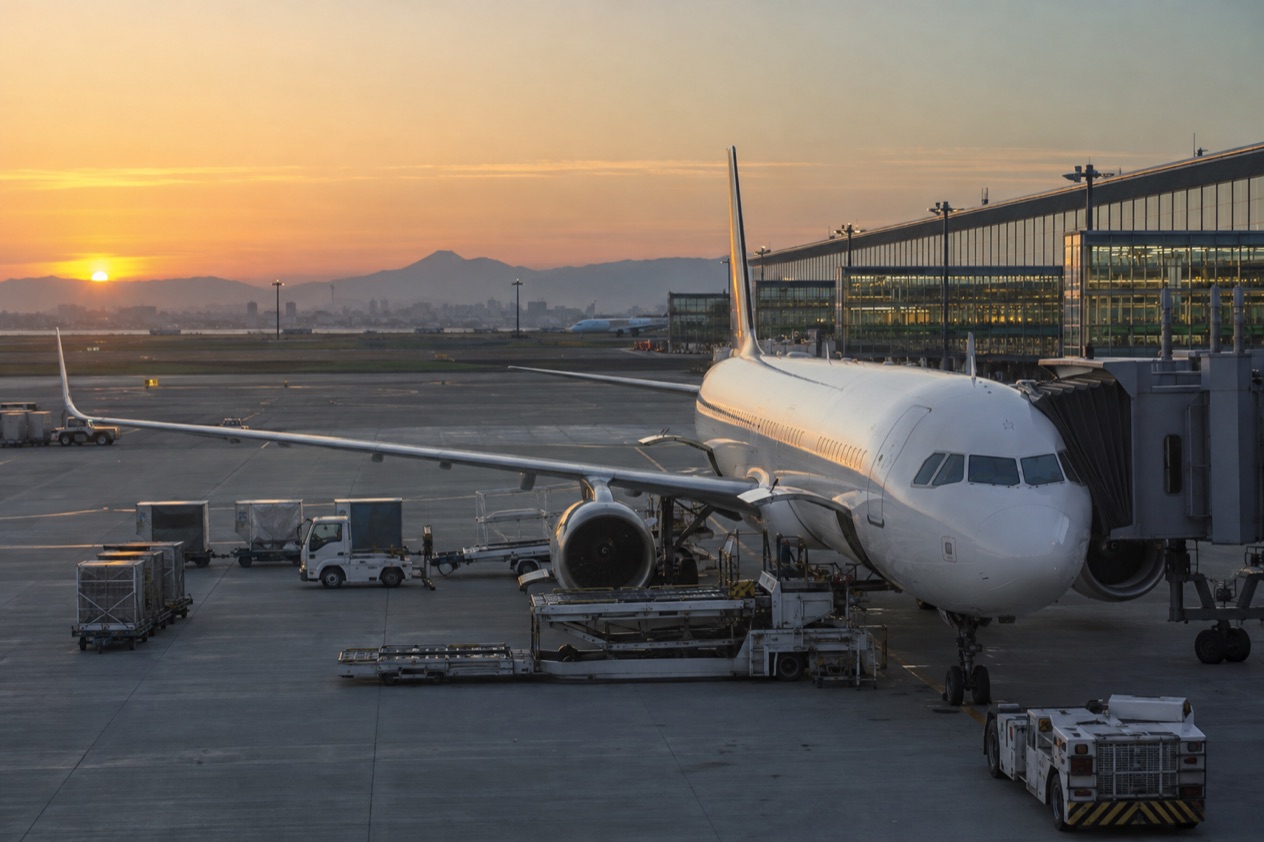
How do you get from the airport to Osaka?
You cross the water in two stages: first the free shuttle buses and the railway station on the island, then the city’s own train and subway lines, which carry you to the district where you are sleeping. The airport stands about 24 miles southwest of Osaka Station, on land that did not exist before it was built, so the trip into town always begins with leaving the island.
What decides the route is mostly where you are headed once you land. Osaka Station and Umeda are one kind of destination. Shin-Osaka, where the shinkansen from Tokyo arrives, is another. Dotonbori, Shinsaibashi and Namba sit along the Midosuji Line, and the bay area with Universal Studios Japan is reached by the JR Loop Line or the Chuo subway line. Pick your neighborhood first, and the line you will need follows from it.
The terminal you arrive at matters too. Terminal 2 is used only by Peach, Spring Airlines and Jeju Air, and from there free shuttle buses run to the railway and ferry stations.
Passengers who land at Terminal 1 are on the main terminal building, with the shuttle linking it to Terminal 2. Luggage, group size and the hour you land change how the day feels, but the route itself stays the same: island first, then city.
Your options from the airport
Free shuttle buses on the island
Free shuttle buses run between Terminal 1 and Terminal 2, and between Terminal 2 and the railway and ferry stations. They are the link that ties the airport buildings to the way off the island, and they cost nothing to ride.
They suit anyone who lands at Terminal 2 with one of the three airlines based there, since this is how you reach the station. They also suit anyone who has to change terminals for a connecting flight. If you arrive at Terminal 1 and are heading straight for the rail platforms, you stay within the main building and its long hall.
Rail and subway once you reach the city
Osaka’s rail network does the work after the island. From Shin-Osaka Station, the JR local line goes on to Osaka Station. From Osaka or Umeda Station, the Midosuji Line runs to Shinsaibashi Station for Shinsaibashi and Dotonbori, and if you stay on it to Namba Station you can also reach Dotonbori from there.
For Osaka Bay, the JR Loop Line and the Chuo subway line both leave from Osaka and Umeda stations. Universal Studios Japan, which opened in 2001 and has the Wizarding World of Harry Potter among its attractions, sits in that bay area.
An IC card for the whole trip
An IC card is a rechargeable card that works on trains, buses and boats, and also in vending machines, convenience stores and some taxis. Most regions have their own card with a different name and mascot, but the cards can be used throughout Japan. That means a Suica or an ICOCA works on the Osaka subway and the JR lines alike.
One card carries you from the island to a ticket gate in the city, then to a vending machine for a cold drink. It suits anyone who plans to hop between the Midosuji Line, the Loop Line and the Chuo line over several days.
Airport transfer options compared
| Destination | Starting point | Line |
|---|---|---|
| Osaka Station | Shin-Osaka Station | JR local line |
| Shinsaibashi and Dotonbori | Osaka or Umeda Station | Midosuji Line to Shinsaibashi Station |
| Dotonbori | Osaka or Umeda Station | Midosuji Line to Namba Station |
| Osaka Bay | Osaka or Umeda Station | JR Loop Line or Chuo subway line |
The lines divide the city by what you want to do. The Midosuji Line takes you into the food and shopping streets of Shinsaibashi and Dotonbori, which is where most visitors who come for Osaka’s reputation for eating and nightlife end up. The JR lines link the big stations and the bay, and the choice between the Loop Line and the Chuo subway line comes down to which stop sits closer to your hotel.
Everything in this network is joined by the same IC card, so switching from JR to the subway needs no new ticket. Arrivals who begin in Tokyo can add the Tokaido-Sanyo shinkansen to Shin-Osaka, where the JR local line picks up for Osaka Station. The shinkansen journey from Tokyo takes about two and a half hours.
Arriving at the airport
Kansai International Airport opened in 1994 on an artificial island in Osaka Bay, and it is the first airport in Japan to run 24 hours a day. Its Terminal 1 is the longest airport terminal in the world, so the walk through it is a real part of arriving. The terminal stretches in a single long line, and signs lead you along it.
Terminal 2 is exclusively occupied by Peach, Spring Airlines and Jeju Air. If your ticket is with one of them, you land there rather than in the big hall. Free shuttle buses run between the two terminals, and between Terminal 2 and the railway and ferry stations.
Inside Terminal 1, a game area called Nintendo Check In offers free Nintendo Switch play, a pleasant way to pass time between flights. The airport also has a second runway, opened on 2 August 2007, built on the same island in the bay.
The island has a long record of handling traffic. In calendar year 2025 the airport handled 34.1 million passengers, with 27.5 million of them on international flights. It has also been tested by weather: after Typhoon Jebi on 4 September 2018, all flights were canceled until 6 September 2018.
Good to know before you go
An IC card is the most useful thing to carry in Osaka, since it pays for trains, buses, boats, vending machines, convenience stores and some taxis. Keep it handy for the Midosuji Line and the JR Loop Line, and it will also work in other regions of Japan on your next stop. Once the island is behind you, Osaka turns relaxed and food-minded, with plenty of history and culture to find between meals.
Sources
- Wikipedia, Kansai International Airport (https://en.wikipedia.org/wiki/Kansai_International_Airport), checked October 11, 2026
- Japan National Tourism Organization, Osaka (https://www.japan.travel/en/destinations/kansai/osaka/), checked October 11, 2026
- Japan National Tourism Organization, IC cards, Suica, Pasmo, ICOCA, how to use (https://www.japan.travel/en/plan/ic-card/), checked October 11, 2026
To plan your stay
- Best Time to Visit Osaka: Cherry Blossoms, Autumn Color, Weather and Festivals
- Things to Do in Osaka: Osaka Castle, Dotonbori Street Food, Universal Studios Japan and Day Trips
- Where to Stay in Osaka: Kita, Minami, Tennoji, the Castle Area and the Bay
- Know Before You Go to Osaka: Entry, Money, Getting Around, Weather and Etiquette