
Under the brick arches of Tokyo Station, commuters stream toward the Marunouchi side while travelers with suitcases head for the shinkansen gates.
How do you get to Osaka from Tokyo?
You ride the Tokaido-Sanyo shinkansen from Tokyo Station to Shin-Osaka Station, a journey of about two and a half hours. Tokyo Station is directly connected to the Tokaido Shinkansen, which JR Central operates, and the line runs all the way to Shin-Osaka, a distance of about 320 miles. Three kinds of train share the tracks, and they differ in how many stations they stop at.
What decides your choice is mostly the kind of service and, for some travelers, the rail pass in their wallet. The fastest service is the Nozomi, which stops only at Shinagawa, Shin-Yokohama, Nagoya and Kyoto on the way. Foreign tourists traveling with a Japan Rail Pass are required to purchase a special ticket to use the Nozomi.
Pass holders can ride the Hikari or the Kodama on the Tokaido Shinkansen free of charge. The Hikari stops more often than the Nozomi, and the Kodama stops at every station, so the choice comes down to how the pass and the stops fit your plans.
Tokyo Station itself is part of the experience. It opened in 1914 as a terminus for the Tokaido Line, and today it handles more scheduled trains than any other station in Japan. Tokyo Metro’s Marunouchi Line serves it, and the Narita Express to Narita International Airport leaves from underground platforms on the Sobu and Yokosuka line. If you are coming straight from a flight, that connection is the one to know.
At the other end, the train does not stop in the heart of old Osaka. Shin-Osaka sits in Yodogawa-ku, about two miles from the older Osaka Station, because extending the shinkansen into the city center posed engineering challenges when the line was built. From Shin-Osaka you take the JR local line to Osaka Station, and from there the subway and loop lines spread across the city.
Japanese trains have a reputation for being always on time, which lets travelers plan to the minute. For a trip like this one, that means a connection at Osaka can be worked out in advance, with the route to your hotel already in mind before you leave Tokyo.
Ways to get to Osaka from Tokyo
Nozomi, the fastest shinkansen
The Nozomi is the super-express of the Tokaido Shinkansen, and it is the fastest train service on Japan’s Tokaido and Sanyo Shinkansen lines. Its quickest run covers the distance between Tokyo and Osaka in 2 hours 21 minutes. It stops only at Shinagawa, Shin-Yokohama, Nagoya and Kyoto before Shin-Osaka, so the ride has the feel of a series of long glides between big cities.
Of the three services, the Nozomi runs most often, with the greatest number of trains on the line. That makes it the service built around travelers who want to reach Osaka with the fewest interruptions.
Keep in mind the rule for rail pass holders: a Japan Rail Pass alone does not cover it, and a special ticket is required for foreign tourists using the pass. If you hold no pass, none of that applies to you.
Hikari and Kodama
The Hikari is the express of the Tokaido Shinkansen. It runs on the same tracks as the Nozomi but stops at more stations, so it suits a traveler who wants to get off at a stop the Nozomi skips. The Kodama is the all-stop train and calls at every station on the line, which means you can step off at any town along the way.
Both are the services that Japan Rail Pass holders can ride free of charge. Each runs two trains an hour, a smaller number than the Nozomi, so a rider planning around these two should look at the timetable on the day. The Kodama is the one to choose if a station between Tokyo and Osaka is part of your plan.
Local and rapid trains
Local trains in Japan stop at every station, which makes them a fit for short distances. Rapid trains skip smaller stations and do not require a supplement. These are the trains you meet once you arrive, not the ones that carry you the full length of the trip between the two cities.
In Osaka, the JR local line is the one that links Shin-Osaka with Osaka Station. From there the city’s rail network takes over, with the JR Osaka Loop Line and the Midosuji subway line carrying you to the main districts. Tokyo has its own mix of operators, with JR trains, Tokyo Metro lines and Toei Subway lines among them, so getting to Tokyo Station is a matter of picking the line that passes closest to your hotel.
Arriving from the airport
If your flight lands at Kansai International Airport rather than in Tokyo, the way into the city is different. From Kansai International Airport, the Nankai or JR lines lead to Tennoji or Namba stations. That path puts you directly in the south of Osaka, close to the entertainment streets of the Minami area. It does not pass through Shin-Osaka at all.
Options compared
| Service | Stops between Tokyo and Shin-Osaka | Trains per hour | Japan Rail Pass |
|---|---|---|---|
| Nozomi (super-express) | Shinagawa, Shin-Yokohama, Nagoya, Kyoto | 13 | Special ticket required for foreign tourists |
| Hikari (express) | More stops than the Nozomi | 2 | Free for pass holders |
| Kodama (all-stop) | Every station | 2 | Free for pass holders |
The three services share one line, one operator and one terminus at Shin-Osaka. They differ in how many times they stop and in how a rail pass applies, and those two differences are what separate them. The Nozomi has the fewest stops and the most departures, the Hikari sits between, and the Kodama visits every station on the way.
The line itself is a landmark in Japanese rail. The Tokaido Shinkansen was the first shinkansen, opened in 1964, and it now runs at a top speed of 177 miles an hour. The wider network has grown to cover thousands of miles. Shin-Osaka opened with the line, and it has remained the western end of the Tokaido route, with eight tracks on its fourth level for the high-speed trains and ten more at ground level for conventional JR West lines.
Once you have settled on a service, the rest of the trip is about the arrival. Shin-Osaka is a major interchange, and it is also the eastern end of the Sanyo Shinkansen from Fukuoka, so trains from the west meet trains from Tokyo here. If your plan is to continue beyond Osaka, the same station is where the two lines hand over to each other.
Making a day of it
A trip to Osaka can be a straight run, or it can be broken at one of the cities where the Nozomi calls. Nagoya and Kyoto are both on its route, and the slower Kodama stops at every station along the way.
Getting off at Kyoto turns the journey into two days in one, with the temples and old streets of Kyoto before you carry on to Osaka. The stop at Shin-Yokohama puts you at the edge of Yokohama, while Shinagawa is the first station after Tokyo.
Once you arrive in Osaka, three areas organize the city. The Kita area is modern, lined with shopping malls, department stores and office buildings, and a short walk leads to Nakanoshima with retro architecture and waterfront scenery.
The Minami area is an energetic downtown where tradition and fashion intersect, packed with everything from traditional culture to gourmet food and trendy fashion. The Bay Area is a beachfront entertainment hub with theme parks, aquariums, Ferris wheels and sports facilities.
Minami, Shinsaibashi and Dotonbori
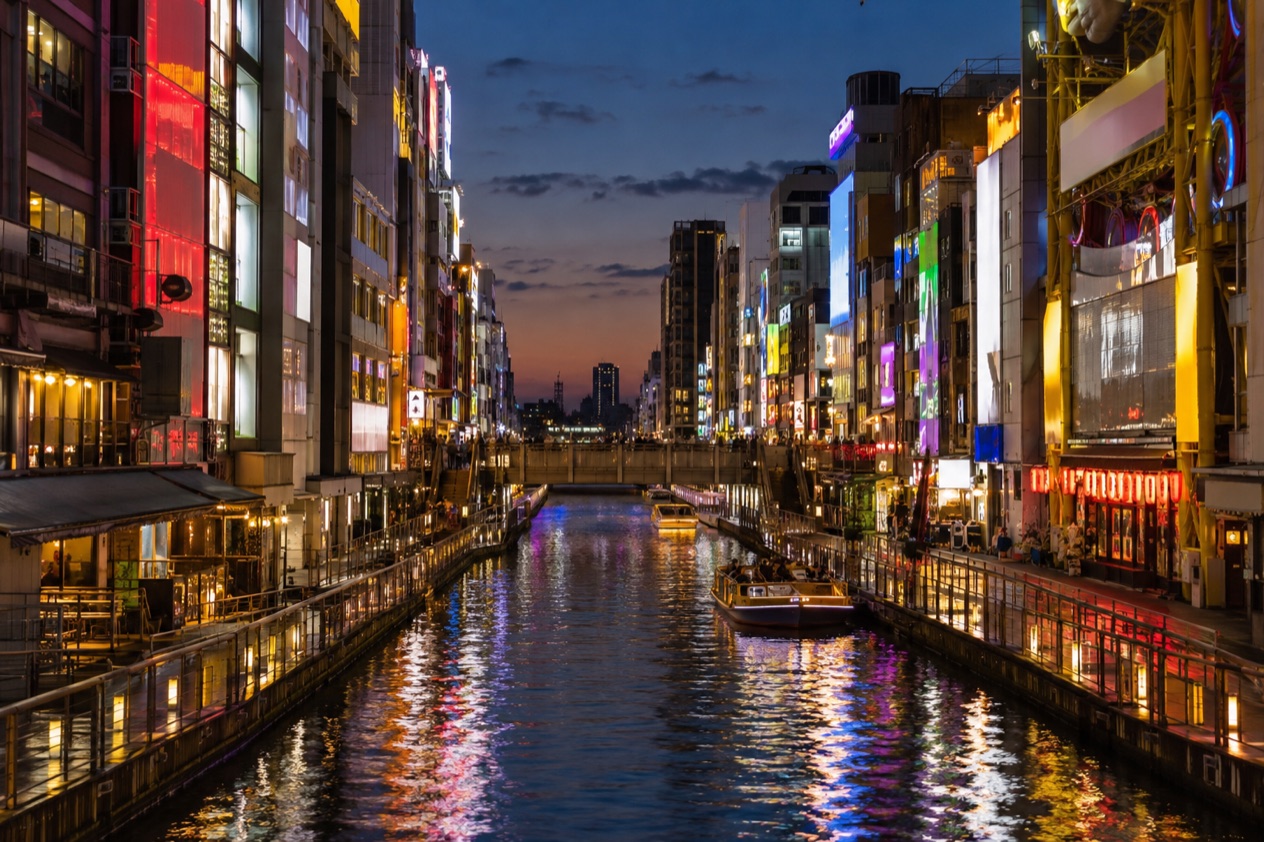
From Osaka or Umeda Station, the Midosuji Line takes you to Shinsaibashi Station, the gateway to Shinsaibashi and Dotonbori. Staying on the line until Namba Station is another way to reach Dotonbori. The Shinsaibashi shopping arcade stretches for nearly two kilometers, running from Shinsaibashi Station all the way to Dotonbori.
This is the part of Osaka that most fits its reputation as a city known for food, entertainment and nightlife. Walking the arcade into Dotonbori means passing shop after shop before the canal-side streets of the food district open up. It is a place for takoyaki from a street stall, okonomiyaki from a griddle counter and the kind of wandering that has no fixed plan.
Osaka Castle
From Osaka or Umeda Station, the JR Osaka Loop Line runs to Morinomiya Station, which is right next to Osaka Castle Park. The original castle was built between 1583 and 1598 by Toyotomi Hideyoshi. The castle standing today is a reconstruction of the one the Tokugawa shogunate built, and it rises above the surrounding parks.
The park around it gives the visit a wider frame than the keep alone, with open grounds and the city’s skyline around it.
Osaka Bay
Osaka Bay can be reached from Osaka or Umeda stations by the JR Loop Line and the Chuo subway line. Universal Studios Japan opened here in 2001 and features attractions like the Wizarding World of Harry Potter. The Kaiyukan Aquarium is one of the largest aquariums in the world and houses whale sharks and penguins in multi-story tanks.
A theme park and an aquarium on the same waterfront give families and groups of friends two very different ways to spend the hours, with Ferris wheels and sports facilities nearby.
Good to know before you go
Osaka sits in the center of Honshu, Japan’s main island, and the rail line from Tokyo is the thread that ties the two cities together. Japanese trains have a reputation for being always on time, so a transfer at Shin-Osaka can be planned to the minute.
Shin-Osaka is one of the busiest stations in the region, with both JR Central and JR West recording well over a hundred thousand passengers a day there in fiscal year 2023. Expect a flow of people at the gates and on the platforms, and give yourself the time to follow the signs toward the JR local line for Osaka Station.
Sources
- Wikipedia, Nozomi (train) (https://en.wikipedia.org/wiki/Nozomi_(train)), checked October 11, 2026
- Wikipedia, Shin-Ōsaka Station (https://en.wikipedia.org/wiki/Shin-%C5%8Csaka_Station), checked October 11, 2026
- Wikipedia, Tōkaidō Shinkansen (https://en.wikipedia.org/wiki/T%C5%8Dkaid%C5%8D_Shinkansen), checked October 11, 2026
- Wikipedia, Tokyo Station (https://en.wikipedia.org/wiki/Tokyo_Station), checked October 11, 2026
- Japan National Tourism Organization, Osaka (https://www.japan.travel/en/destinations/kansai/osaka/), checked October 11, 2026
- Osaka official tourism guide, basic guide (https://www.osaka-info.jp/en/osaka/basic/), checked October 11, 2026
- Japan National Tourism Organization, trains and buses (https://www.japan.travel/en/guide/how-to-travel-by-train-and-bus-in-japan/), checked October 11, 2026
- Japan National Tourism Organization, traveling by rail (https://www.japan.travel/en/guide/traveling-by-rail/), checked October 11, 2026
- Japan National Tourism Organization, getting around Japan: trains, subways, buses, taxis (https://www.japan.travel/en/plan/getting-around/), checked October 11, 2026
- Wikipedia, Shinkansen (https://en.wikipedia.org/wiki/Shinkansen), checked October 11, 2026
To plan your stay
- Best Time to Visit Osaka: Cherry Blossoms, Autumn Color, Weather and Festivals
- Things to Do in Osaka: Osaka Castle, Dotonbori Street Food, Universal Studios Japan and Day Trips
- Where to Stay in Osaka: Kita, Minami, Tennoji, the Castle Area and the Bay
- Know Before You Go to Osaka: Entry, Money, Getting Around, Weather and Etiquette