
The first morning in Osaka often starts with the smell of batter and dashi drifting from a takoyaki stand, and the clatter of a shopping arcade pulling up its shutters. Neon is still switched on in places, the canal is flat and green, and someone is already queuing for breakfast. Three days here give you a castle, a canal-side district of food and signs, an aquarium on the bay and a day trip to a neighboring city.
Is three days enough in Osaka?
Yes, three days is enough for a first visit, especially for travelers who come for eating, wandering and a few landmarks rather than a checklist of museums. Osaka is known for its food, entertainment and nightlife, with some history and culture to discover, and that mix suits a short stay. You can eat well on every one of the three days and still see the main sights.
What three days cover: the castle and its parks, the Kita district around Osaka Station, the Minami nightlife streets of Dotonbori, the bay with its aquarium, and one outing beyond the city. With more time, add the theme park, and use Osaka as a base for Kyoto, Nara, Kobe and Wakayama, each within one hour by train from the central stations.
Day 1 in Osaka
Start at Osaka Castle. From Osaka or Umeda Station, the JR Osaka Loop Line runs to Morinomiya Station, right next to Osaka Castle Park. The first castle was built by Toyotomi Hideyoshi between 1583 and 1598, and the building you see today is a reconstruction of the one raised by the Tokugawa shogunate. Walk the moats and stone walls, then stroll through the surrounding parks, where the keep rises over the trees.
For the afternoon, ride the loop line back toward Kita, the area around Osaka Station. It is a modern district of shopping malls, department stores and office towers, and a walk leads to Nakanoshima, a stretch of waterfront with retro architecture. It is a good place to take a lunch break in a department store restaurant floor or a small noodle counter, then wander along the river.
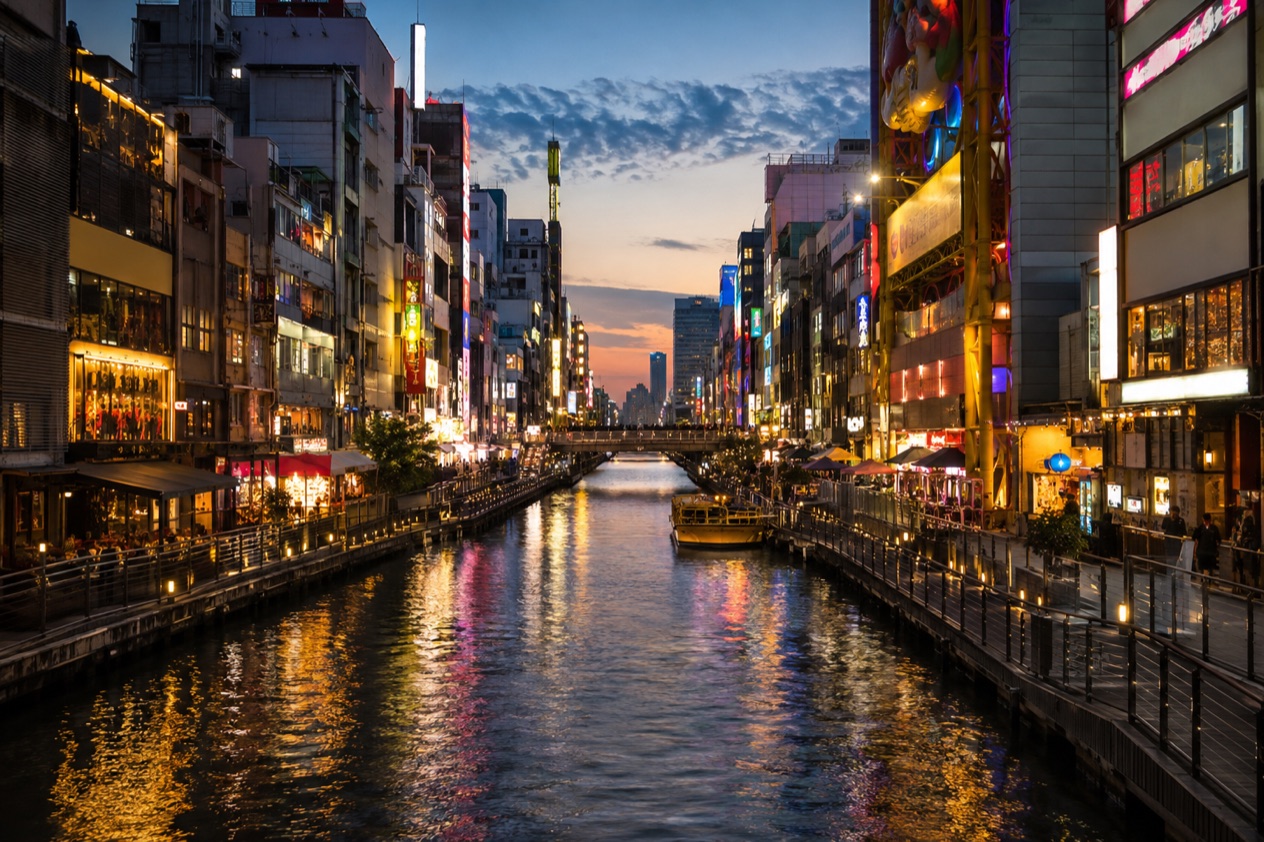
In the evening, take the Midosuji Line from Osaka or Umeda Station to Shinsaibashi, or stay on until Namba. Dotonbori runs along an old canal, and the illuminated Glico Man billboard, a runner with both arms raised, looks down from the south bank just west of Ebisubashi.
Eat as you walk: takoyaki, okonomiyaki, kushikatsu skewers, a bowl of ramen in a counter place. The Shinsaibashi arcade, nearly two kilometers long, ends at the canal, so you can shop your way to dinner.
Day 2 in Osaka
Give the second day to the bay. Osaka Bay is reached from Osaka or Umeda Station by the JR Loop Line and the Chuo subway line, and the area is a beachfront entertainment hub of theme parks, aquariums, Ferris wheels and sports facilities. The Osaka Aquarium Kaiyukan is about a five-minute walk from Osakako Station on the Chuo Line, and it houses whale sharks and penguins in multi-story tanks.
Next door, Tempozan Market Place has a large Ferris wheel and many restaurants, which makes it the natural place for a lunch of seafood, curry or a plate of fried things with a view of the harbor. Spend the early afternoon on the wheel and in the shops, then keep the rest loose, since this district rewards slow strolling more than a schedule.
Travelers who want rides can swap this day for Universal Studios Japan, which is also on the bay side and features attractions like the Wizarding World of Harry Potter, with Super Nintendo World at the northern end of the park, west of Harry Potter. Come back to Umeda or Namba in the evening for dinner in an izakaya, the Japanese pub where small dishes arrive one after another.
Day 3 in Osaka
The third day suits a trip out of town. Kyoto, Nara, Kobe and Wakayama are each within one hour by train from central Osaka stations, so you can leave after breakfast and still be back for the evening. Nara and Kyoto are the two that most first-time visitors pair with Osaka, and either one fills a day with temples, gardens and lanes to walk.
Come back to the south of the city for the evening, to the Tennoji and Abeno area. It holds Abeno Harukas, Japan’s tallest skyscraper, and Tsutenkaku Tower, the symbol of Osaka, along with a zoo, temples and shrines. Ride up or look up at the skyline as lights come on, and let the tower set the mood for the night.
Shinsekai sits next to the Minami downtown. It was created in 1912 with New York’s Coney Island as the model for its southern half and Paris for its northern half, and the streets still have a retro, slightly eccentric feel. This is a good place for a last dinner of fried skewers or a hot pot at a crowded counter, followed by a slow walk under the signs.
Where to stay for three days in Osaka
For this plan, the best base is near a Midosuji Line station, either around Umeda and Osaka Station in the north or around Namba in the south. The line links both with Shinsaibashi and Dotonbori, the loop line reaches the castle and the bay, and the central stations are the starting points for the trains to Kyoto, Nara and Kobe. Staying in Kita puts you close to Nakanoshima and the department stores, with the night streets a ride away.
Namba suits travelers who want to step out of the hotel into the Minami energy, with food stalls and arcades at the door and Tennoji and Shinsekai close in the same part of the city. Shin-Osaka Station is where the shinkansen from Tokyo arrives, so it works for a very short stay with an early departure, though it puts you a little apart from the lively districts. Travelers flying into Kansai International Airport can reach Tennoji or Namba stations on the Nankai or JR lines, which makes the south a natural fit for a first night.
What to skip if you only have three days in Osaka
Skip a second day trip. Pick one, and save the other, along with Kobe and Wakayama, for a longer stay.
Skip the theme park if the aquarium and the Dotonbori evenings already fill the plan. If you do want it, trade it for Day 2 and leave the aquarium for another visit.
Skip a long museum afternoon or a deep dive into every corner of the castle grounds. Osaka is a city for eating and walking, so the time is better spent at a counter or on the Nakanoshima riverside than inside a gallery. Skip, too, the idea of covering every district: Kita, Minami, the bay and Tennoji are plenty for three days, and each one gets more out of an unhurried afternoon than a quick photo.
Getting around Osaka in three days
Most of this plan moves by rail. From Osaka or Umeda Station, the Midosuji Line reaches Shinsaibashi and Namba, the JR Osaka Loop Line reaches Morinomiya for the castle, and the Chuo subway line reaches the bay and Osakako Station for the aquarium. Between Dotonbori and Shinsaibashi you walk, along the arcade and the canal.
IC cards can be used on trains, buses and boats, as well as in vending machines, convenience stores and some taxis, and the regional cards work throughout Japan. That makes one card enough for every ride and snack of the three days. The Osaka Convention & Tourism Bureau runs three tourist information centers, at JR Osaka Station in Umeda, in Namba and at Shin-Osaka, and the staff speak English and other languages.
For arrival, the Tokaido-Sanyo shinkansen takes about two and a half hours from Tokyo to Shin-Osaka, then a JR local line leads to Osaka Station. Kansai International Airport connects with Osaka city by the JR Kansai Airport Rapid, Nankai Railways and limousine buses in roughly 40 to 60 minutes, while Itami Airport is reached in about half an hour by monorail, train or limousine bus. JAL and ANA fly to Osaka from Haneda and Narita.
Good to know before you go
Osaka changes a lot with the season. Spring and autumn sit between those two, with October highs in the mid-70s and showers on some days, so a light layer and an umbrella cover most plans.
Carry some cash for small food stalls, keep to the pace of the crowd in the arcades, and take time to eat standing at a counter or sitting in a booth. Evenings in Dotonbori are for walking slowly, so leave room for a last snack before you head back to the hotel.
Sources
- Japan National Tourism Organization, Osaka (https://www.japan.travel/en/destinations/kansai/osaka/), checked October 11, 2026
- Osaka official tourism guide, basic guide (https://www.osaka-info.jp/en/osaka/basic/), checked October 11, 2026
- Osaka official tourism guide, FAQ (https://www.osaka-info.jp/en/information/osaka-faq/), checked October 11, 2026
- Wikipedia, Osaka Castle (https://en.wikipedia.org/wiki/Osaka_Castle), checked October 11, 2026
- Wikipedia, Dōtonbori (https://en.wikipedia.org/wiki/D%C5%8Dtonbori), checked October 11, 2026
- Wikipedia, Universal Studios Japan (https://en.wikipedia.org/wiki/Universal_Studios_Japan), checked October 11, 2026
- Wikipedia, Super Nintendo World (https://en.wikipedia.org/wiki/Super_Nintendo_World), checked October 11, 2026
- Wikipedia, Osaka Aquarium Kaiyukan (https://en.wikipedia.org/wiki/Osaka_Aquarium_Kaiyukan), checked October 11, 2026
- Wikipedia, Shinsekai (https://en.wikipedia.org/wiki/Shinsekai), checked October 11, 2026
- Japan Meteorological Agency (JMA), Normal values 1991-2020, monthly (https://www.data.jma.go.jp/stats/etrn/view/nml_sfc_ym.php?prec_no=62&block_no=47772), station Osaka, elevation 23 m, checked October 11, 2026
- Japan National Tourism Organization, IC cards, Suica, Pasmo, ICOCA, how to use (https://www.japan.travel/en/plan/ic-card/), checked October 11, 2026
- Japan National Tourism Organization, Japan Rail Pass and regional passes (https://www.japan.travel/en/plan/jr-rail-passes/), checked October 11, 2026
To plan your stay
- Best Time to Visit Osaka: Cherry Blossoms, Autumn Color, Weather and Festivals
- Where to Stay in Osaka: Kita, Minami, Tennoji, the Castle Area and the Bay
- Osaka from Tokyo: Shinkansen Services, Shin-Osaka Station and Where to Go on Arrival
- Know Before You Go to Osaka: Entry, Money, Getting Around, Weather and Etiquette