
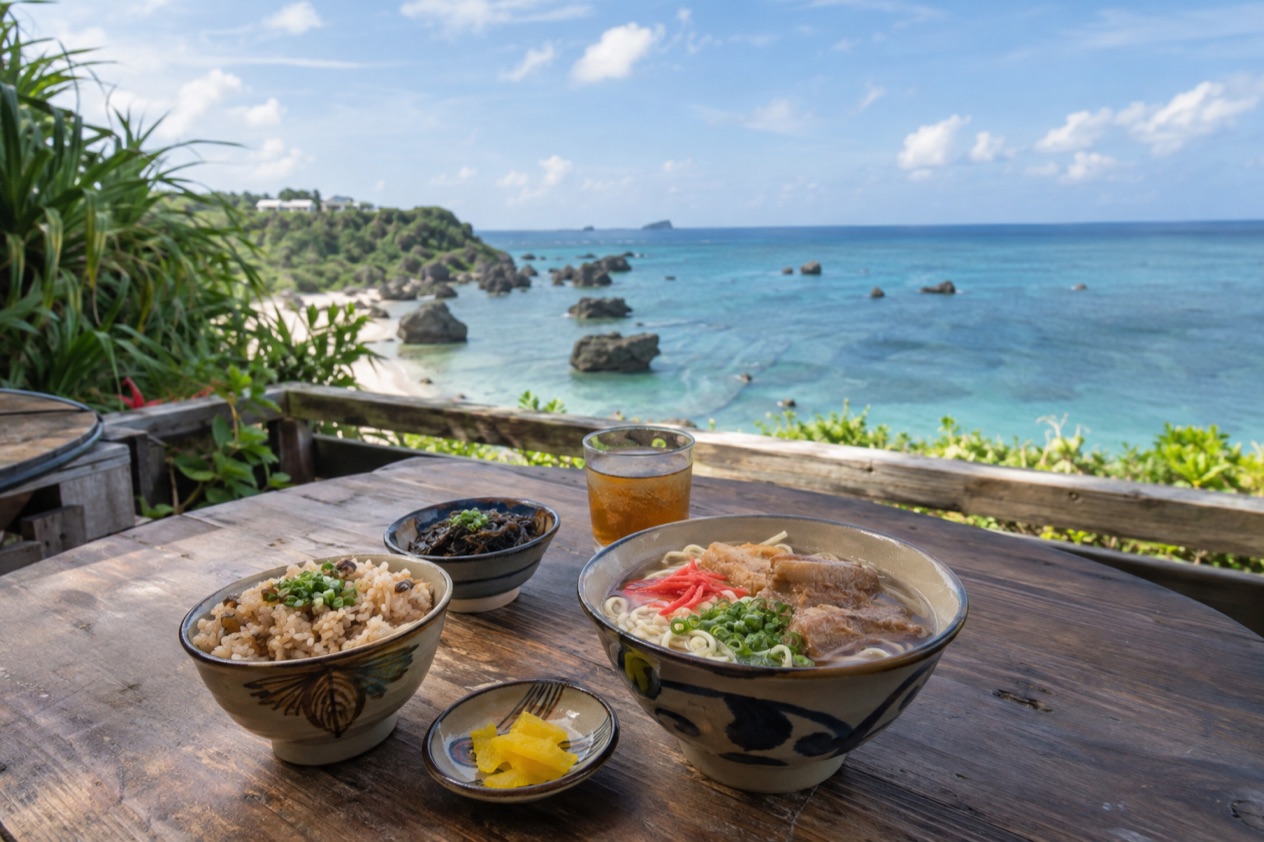
A bowl of Okinawa soba arrives steaming, with a slab of stewed pork rib resting on thick, chewy noodles and a pale, savory broth underneath. Beside it sits a glass of something cold, perhaps Orion beer, perhaps awamori, the local spirit.
Is visiting Okinawa food worth it?
Yes, especially if you like to travel by taste: Okinawan cooking is the food culture of Okinawa Prefecture, also called Ryukyuan cuisine after the old kingdom, and it reads very differently from what most Americans know as Japanese food. It suits curious eaters, pork lovers, people who enjoy noodle shops and izakaya (casual Japanese pubs), and anyone who wants a meal to tell them something about where they are.
The difference comes from history and climate. Okinawa has its own culture, its own contacts with neighboring lands, a warm climate and its own vegetables and ingredients, and all of that ends up on the plate.
Pork carries much of the cooking, sweet potatoes shaped the old diet, and kelp turns up in dishes even though it is not grown here. Soy sauce, salt and slow simmering do the work that raw fish does on the mainland.
The surprise for visitors is how little the sea dominates the table. Okinawa is surrounded by water, yet Okinawans eat relatively little seafood compared with other maritime cultures, because heat once made fish hard to keep. So you come for noodle soups, braised pork, stir-fried bitter melon and sweet-potato sweets, with fish as a supporting player.
Naha, the largest city on Okinawa, is the easiest place to start eating. It is home to about a fifth of the main island’s residents, and it has the island’s only rail line, the Okinawa Urban Monorail, known as Yui Rail. Naha Airport is the gateway to all of Okinawa’s islands, with flights from dozens of cities across Japan, including low-cost carriers, so a food trip can begin the moment you land.
What to see at Okinawa food
Okinawa soba and soki-soba
Okinawa soba is a noodle soup that vaguely resembles udon. The noodles are thick and wheat-based, which surprises anyone expecting buckwheat, and the broth is light, built on pork and often fish stock. It is the dish you will see on the most signs, in small family shops and in noodle counters near the monorail stations.
The version to try first is soki-soba, topped with soki, pork ribs stewed until the meat slides off the bone. Look for the thin slices of red pickled ginger on top, the scatter of green onion, and the little bottle of chile-infused awamori that many tables keep for adding a kick. Order a small side of rice cooked in broth if the menu offers it, and you have a full lunch.
Pork, from rafute to champuru
Pork became important in the Okinawan diet in the seventeenth century, driven by the demands of Chinese ambassadors, and the cooks of the islands went on to use nearly every part of the animal. You may also see mimiga (sliced pig’s ear, served chilled and crunchy) on izakaya menus.
The everyday way to eat pork here is in a champuru, a stir-fry that mixes ingredients together. Goya champuru combines bitter melon with egg, tofu and pork, and the bitterness is part of the point, balanced by the richness of the other ingredients. It is the dish that locals tend to serve at home and that set-meal restaurants serve with rice and miso soup.
Sweet potatoes and island sweets
The sweet potato was introduced to Okinawa in 1605 and became a staple until the early twentieth century. Until the 1950s, it provided more than half of the daily calories on the islands, before grains largely took its place. That history explains why the purple-fleshed variety shows up everywhere today, in tarts, ice cream, croquettes and soft-serve swirls the color of grape juice.
Look for sata andagi, round fried doughnuts with a crackled, golden crust that are dense and gently sweet, sold in bakeries and at market stalls. Chinsuko, a crumbly shortbread-like cookie, is the classic gift to carry home. A cold shikuwasa drink, made from a small local citrus, is a bright way to end a meal on a humid day.
Fish, kelp and what comes from the sea
When fish does appear, it is prepared in a handful of ways. Okinawans traditionally pickle it in salt (shio-zuke), dry it, grill it, simmer it in soy sauce (nitsuke), or turn it into kamaboko, a processed seafood product. That list reflects the old problem of keeping catch fresh in a hot place, and it gives the fish dishes a savory, well-seasoned character.
Kombu is the other surprise. Okinawa is one of the largest consumers of kelp in Japan, even though none is cultivated here. It turns up simmered with pork, stir-fried in a dish called kubuirichi, and in soups. If you see it on a set-meal tray beside a small bowl of pork and vegetables, you are eating the classic Okinawan combination.
Awamori and Orion beer
Awamori and Orion beer are the two drinks most associated with Okinawan cuisine. Awamori is a local spirit, often served with water and ice in a small glass, and it also finds its way into cooking, which is why it appears in the rafute described above. Orion beer is the light lager you will see on menus across the island, ordered with fried food, grilled meat or a plate of champuru.
An izakaya is the natural setting for both. You order several small plates to share, a bowl of soba at the end, and a round of drinks along the way. The evening unfolds slowly, and it is one of the easiest ways to sample many dishes in one sitting.
When to visit Okinawa food
Okinawan food suits any month, because the dishes do not depend on a single harvest, and the question is mostly how you want to feel while you eat. In cooler months a steaming bowl of soki-soba is a comfort. In the heat, shaved ice, cold awamori with water and a bitter-melon stir-fry feel just right.
| Month | Average high (°F) | Average low (°F) | Precipitation (in) | Days with 1 mm or more of rain | Sunshine (hours) |
|---|---|---|---|---|---|
| January | 67.6 | 58.8 | 4.00 | 10.2 | 93 |
| April | 75.7 | 66.4 | 6.34 | 10.3 | 121 |
| July | 89.4 | 80.6 | 7.41 | 9.4 | 227 |
| October | 82.6 | 74.3 | 7.06 | 8.8 | 163 |
January is mild by American winter standards, mild enough for a light layer, with gray spells and the most modest sunshine of the four months. It is a good time for hot noodle soups and long lunches indoors. Rain falls on a good share of the days, usually in showers rather than a single downpour.
April turns warmer and more humid, with enough sun to walk between meals. It is a fine month to follow a food route through Naha, sampling a set meal at midday and an izakaya dinner later. Showers come through on about as many days as in January, so a covered market or a café is always a useful plan B.
July is hot, sunny and humid, with the longest stretch of sunshine in the table. Expect to sweat between stops, and you will welcome cold drinks, shikuwasa and shaved ice. Meals feel lighter, with champuru, cold noodles and iced awamori.
October is still warm enough to eat outdoors in the evening, though it is also one of the wetter months in the table. Rain tends to arrive in showers, so plan indoor meals as the anchor of the day and treat any stroll between them as a bonus. The high humidity is a reminder to pace yourself and drink between courses.
Time of day matters less here than in a museum town, because noodle shops, markets and izakaya are spread across the day. Think of breakfast as a bakery stop, lunch as soba or a set meal, and the evening as the time for small plates and drinks. No special festival date appears in our information for this topic, so any month works for eating well.
Tips for your visit
Come hungry and plan your day around meals rather than sights. Start with soki-soba, add a champuru for lunch another day, and keep an evening free for an izakaya with awamori or an Orion beer.
Naha is the best base for a food trip. It has Okinawa’s only public rail network, the Yui Rail monorail, and Naha Airport is the gateway for all of the islands, so you can reach restaurants and markets on foot and by monorail. The city is home to about a fifth of the main island’s residents, and that concentration of people is why so many noodle shops and izakaya are found there.
Pairing a meal with Churaumi Aquarium
Okinawa Churaumi Aquarium is a natural companion to a food-themed trip, because it shows the marine life that surrounds the islands, the same sea that Okinawan cooking draws on only modestly. The aquarium has recently welcomed a new female Japanese sawshark in an effort to breed the species, which is the kind of detail that makes a visit feel current.
The aquarium also cautions visitors about an increase in bite-wound injuries from white-banded triggerfish during their breeding season.
| Site | Open |
|---|---|
| Okinawa Churaumi Aquarium | 08:30 to 18:30, last admission 17:30 |
Beaches for the rest of the day
Okinawa Island has several beaches, including Manza Beach, Emerald Beach, Okuma Beach, Zanpa Beach, Moon Beach and Sunset Beach in Chatan-cho. They make a good pause between meals, a place to walk or sit with a cold drink and let lunch settle. Conditions in the sea change, so judge each beach by what you see on the day.
If you want a high point rather than a shoreline, Mount Omoto is the highest mountain on Okinawa Island, with Mount Yonaha second. A day that mixes a landscape with a noodle shop and an izakaya evening gives you a fuller picture of how the island lives and eats.
Small habits worth carrying
Share plates at an izakaya, order a small bowl of soba as a finishing course, and try at least one dish with a bitter or tangy edge, since the cuisine likes contrast. Bring an open mind for pig’s ear, kelp and bitter melon, which are all part of the everyday table. Travelers with food restrictions will want to read menus closely, since pork, fish stock and kelp appear in many dishes.
Good to know before you go
Use ordinary habits at the table: wash your hands, share plates politely and drink at your own pace, especially in humid weather when awamori goes down more easily than you expect. Rain is part of the picture on many days across the year, so keep a compact umbrella with you.
Sources
- Wikipedia, Okinawan cuisine (https://en.wikipedia.org/wiki/Okinawan_cuisine), checked October 11, 2026
- Japan National Tourism Organization, Okinawa (https://www.japan.travel/en/destinations/okinawa/okinawa/naha-and-the-main-island/), checked October 11, 2026
- Okinawa Churaumi Aquarium (https://churaumi.okinawa/en/), checked October 11, 2026
- Wikipedia, Okinawa Island (https://en.wikipedia.org/wiki/Okinawa_Island), checked October 11, 2026
- Japan Meteorological Agency (JMA), Normal values 1991-2020, monthly (https://www.data.jma.go.jp/stats/etrn/view/nml_sfc_ym.php?prec_no=91&block_no=47936), station Naha, elevation 28 m, checked October 11, 2026
To plan your stay
- Best Time to Visit Okinawa: Weather by Month, Sea Temperatures, Festivals and Seasons
- Where to Stay in Okinawa: Naha, Chatan, the Aquarium Coast and Beach Resorts
- Okinawa from Tokyo: Flying to Naha, Why No Train Goes There and a First Day on the Island
- Know Before You Go to Okinawa: Entry, Money, Getting Around and Local Etiquette