
Shoes come off at the entrance, a staff member kneels to set out slippers, and a few minutes later you are standing in a room with a tatami floor and sliding doors, holding a folded yukata. That small ritual is what people picture when they search for a ryokan in Kyoto. The city has traditional inns among its most prestigious, and a night in one turns a sightseeing trip into a stay with its own rhythm of baths, dinner and quiet mornings.
Which ryokan are in Kyoto?
Kyoto is home to some of the most prestigious ryokan in Japan, alongside the ones in Nara, and they sit among a much wider tradition of inns found all over the country. A ryokan is a traditional Japanese inn, and the idea is believed to go back to the 8th century. What you find in Kyoto belongs to that long line: rooms laid with tatami, sliding doors, bedding spread on the floor at night and a dinner built around the season.
Not every ryokan is the same, and that is part of the pleasure of choosing. Some are old-style inns with a garden at the center, others are more contemporary in feel. The common thread is that you are a guest in a household of customs rather than a customer in a lobby, and the staff walk you through those customs when you arrive.
What a Kyoto ryokan room is like
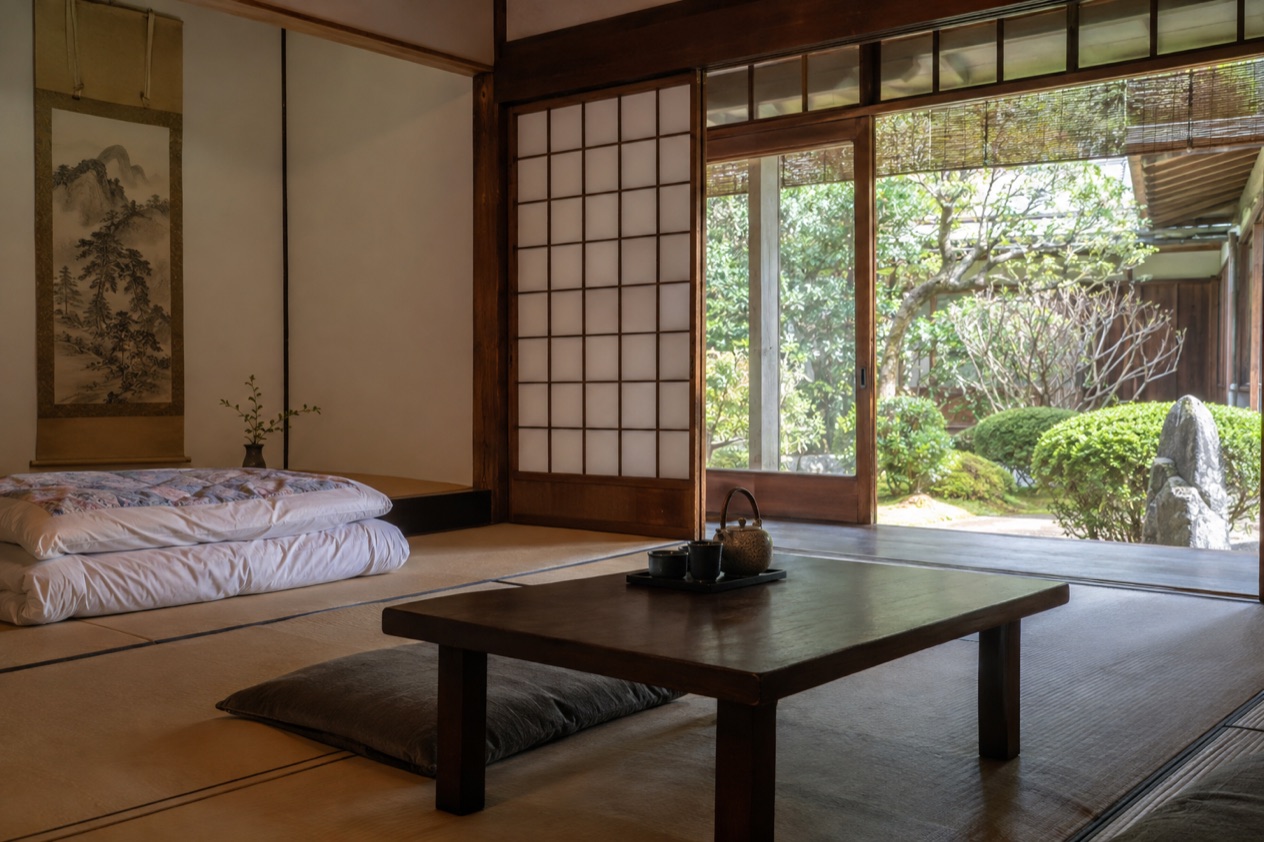
The floor is tatami, woven straw mats that are soft underfoot and are walked on in socks or bare feet. Doors are sliding panels rather than hinged ones, which gives the room a light, open feel. There is no bed frame. In the evening the staff spread a futon directly on the tatami, and in the morning it is folded away so the room becomes a sitting room again.
Ryokan typically provide a yukata, a light cotton robe, to wear during your stay, and possibly geta, wooden sandals you can borrow for strolls outside. Guests are invited to wear the yukata and geta or zori sandals to walk in the garden, which is why people end up drifting out after the bath in their robes, a small pleasure of the stay.
Dinner and breakfast at the inn
Meals are a large part of the experience. A ryokan stay generally includes a formal multi-course kaiseki dinner and a traditional Japanese breakfast the next morning. Kaiseki is a cuisine of seasonal and regional specialties, prepared with local ingredients, and arrives as a series of small dishes, each chosen for how it looks as well as how it tastes.
Depending on the ryokan, the meal is served in a common room or in your own room. Ryokan stress that guests should be punctual for meals, and most ask you to confirm the time you want to eat. Some ryokan offer meal-free stays, though the culinary experience is the part most worth keeping.
| Element | What you find |
|---|---|
| Floor | Tatami |
| Doors | Sliding doors |
| Bedding | Futon spread on the tatami |
| Clothing | Yukata, and geta to borrow |
| Bathing | Ofuro, usually separated by gender |
| Meals | Kaiseki dinner and Japanese breakfast |
Which areas are best for a ryokan?
Kyoto and Nara are named among the places with prestigious ones, while mountain villages and onsen towns, such as those in Nagano, hold others, and contemporary versions exist even in Tokyo.
A ryokan inside the city of Kyoto
A city ryokan gives you the inn and the sightseeing in one trip. You spend the day out among temples, shrines and streets, then come back to remove your shoes, change into the yukata and sit down to dinner. The garden is the center of the experience here. Ryokan gardens may include stone arrangements, water features, carefully placed plants and shrubs, and sometimes a Japanese tea house.
Most ryokan have a beautiful Japanese garden and an onsen, so a city address does not mean giving up the bath. Almost all ryokan have common bathing areas called ofuro, usually separated by gender, and the water comes from a hot spring if there is one nearby. Whether a particular Kyoto inn draws its bath from a spring is a question for the inn itself.
Onsen towns and mountain villages
Traditional ryokan are more commonly found in areas with natural hot springs, such as Beppu Onsen. In those places the bath is the reason for the town, and the ryokan is built around it. If your idea of a ryokan is a long soak in spring water followed by dinner, an onsen town is where that idea comes most fully into focus.
Nagano has mountain villages and onsen towns with ryokan of their own. Among the oldest are Nishiyama Onsen Keiunkan in Yamanashi Prefecture, created in 705 A.D. and called the oldest hotel in the world, and Hoshi Ryokan, founded in 718 A.D. and known as the world’s second-oldest. Hoshino Resorts opened its first ryokan in Karuizawa in 1914. These show how deep the tradition runs outside the big cities.
Why Tokyo is a different case
Ryokan are hard to find in Tokyo, because many are much more expensive than modern hotels and hostels. Contemporary ryokan do exist there, but a traveler who wants the classic inn experience as part of a Japan itinerary often pairs a Tokyo hotel with a ryokan night elsewhere.
A trip that moves between Tokyo and Kyoto can use that to advantage: a modern base in one city, then a night on tatami in the other. The ryokan becomes a chapter of its own, with dinner, bath and breakfast folded into a single evening and morning.
What should you know before you book?
Before booking, know that a ryokan price is quoted per person per room and typically includes meals, so it covers more than a bed. The average cost of a ryokan stay is around 15,000 yen per night, with higher prices at upscale establishments. Most ryokan offer dinner and breakfast, often included in the price of the room.
Reading a rate with that in mind changes how you compare. A ryokan night holds a kaiseki dinner and a Japanese breakfast, so setting it beside a hotel room with no meals does not compare like with like. If a ryokan offers a meal-free option, the price will reflect it, but you will give up the part of the stay many guests remember best.
Customs you will be shown on arrival
Ryokan staff explain Japanese customs to guests, including removing shoes indoors, bathing in the onsen and wearing the yukata. You do not need to arrive knowing it all. Shoes stay at the entrance, the tatami is walked on in socks or bare feet, and the staff will tell you how the bath works.
The bath is shared and usually separated by gender, so it is something to expect rather than a surprise. Many guests find it easier to take in the customs in the order the inn presents them: arrival, room, bath, dinner, then sleep on the futon.
Planning around dinner
Because dinner is a central part of the stay, the day is shaped around it. Ryokan stress punctuality for meals, and most ask guests to confirm the time they want to eat. Plan your sightseeing so you are back at the inn in good time, with a moment to settle into the room and perhaps take the bath first.
The meal itself is served either in a common room or in your own room, depending on the ryokan, so it is worth knowing which style you are booking. In either case, the dishes follow the season and the region, and the evening is unhurried, a long sequence of small courses rather than a single plate.
Choosing the right kind of stay
A ryokan suits travelers who want the atmosphere as much as the room: the garden, the sandals for an evening stroll, the folded futon and the formal meals. Those who would rather eat out every night or keep a flexible schedule may prefer a modern hotel for the rest of the trip and a single ryokan night as a highlight.
Whichever you choose, the pleasure comes from taking the stay at its pace. Arrive, change into the yukata, walk the garden, bathe, eat and sleep on the tatami. In the morning, breakfast follows in the Japanese style, and the day begins slowly.
Good to know before you go
Money matters are simple to plan around once you know the rate covers meals: the yen figure you see is a per-person price that already carries dinner and breakfast. In the room, the habits of the house are worth following gladly, from slippers at the door to the yukata in the evening. Kyoto rewards a slow night, so leave the evening free for the inn rather than packing it with plans.
Sources
- Japan National Tourism Organization, ryokan stays, what is included, etiquette (https://www.japan.travel/en/guide/japanese-ryokan/), checked October 11, 2026
- Wikipedia, Ryokan (https://en.wikipedia.org/wiki/Ryokan), checked October 11, 2026
To plan your stay
- Best Time to Visit Kyoto: Cherry Blossoms, Autumn Leaves, Weather by Month and Festivals
- Where to Stay in Kyoto: Kyoto Station, Central and Eastern Districts, and Ryokan Stays
- Kyoto from Tokyo: Shinkansen Trains, Nozomi vs. Hikari and Kodama, and a First Day in Kyoto
- Know Before You Go to Kyoto: Entry, Money, Getting Around and Local Etiquette