
The doors slide open on an island built in the middle of Osaka Bay, and the air carries a little salt from the water all around. Somewhere beyond the glass of the terminal, the port city of Kobe waits on the far side of the bay, with its hillside neighborhoods, its bakeries and its steakhouses. This is the page for the first hour of that trip, from the arrivals hall at Kansai International Airport to the moment you start heading for Kobe.
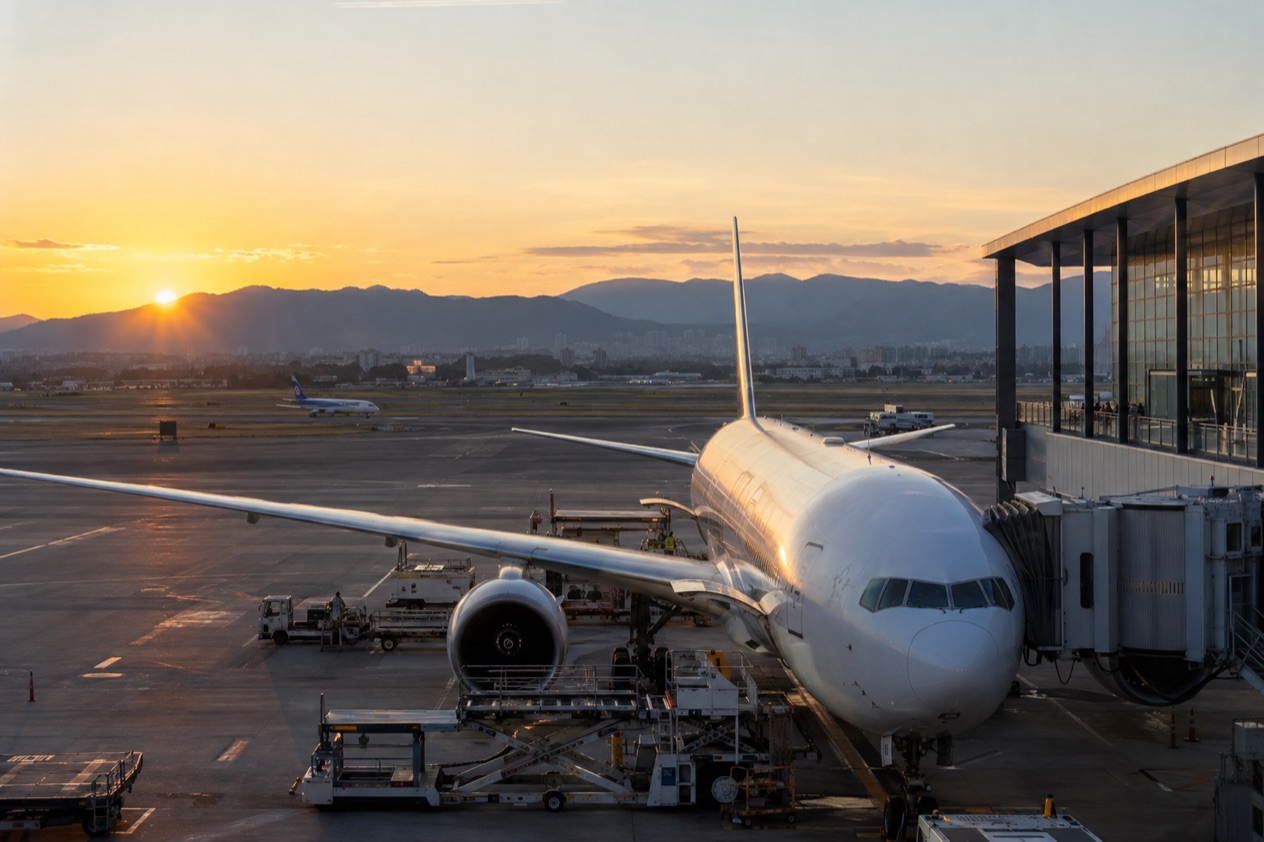
How do you get from the airport to Kobe?
You start at the airport’s railway station, which the free shuttle buses from Terminal 2 serve directly. Those same shuttles also stop at the ferry station, so the airport has both rail and water connections on its doorstep. From there, Kobe is a city you reach across Osaka Bay, and the onward leg depends on where in Kobe you are sleeping.
Several things decide how you go. Your luggage matters first: a single carry-on and two large suitcases do not make the same trip, and the free shuttles and station platforms are things you handle with every bag you own.
The size of your group matters too, since a pair of travelers and a family of five weigh their choices differently. Your hotel’s location counts as well, because Kobe stretches along the water and up the slopes behind it, and Shin-Kobe, the bullet train station, sits in a different part of the city from the port.
Time of arrival is the last piece. The airport was the first in Japan to operate around the clock, so late and early landings are part of its story, but what runs after dark in town is something to settle with your hotel. Spend a few minutes in the terminal making that decision rather than rushing it. The airport is large, and the first choice you make there shapes everything after it.
Your options from the airport
What you have at the airport itself is a set of free connections and a card that works across the rail network. Each one covers a different stretch of the journey, and they combine more than they compete.
Free shuttle buses between the terminals
Free shuttle buses run between Terminal 1 and Terminal 2. Terminal 2 is used only by Peach, Spring Airlines and Jeju Air, so if you landed on one of those three, the shuttle is the link that carries you toward the rest of the airport. Passengers arriving at Terminal 1 are on the main building, which is the longest airport terminal in the world.
The shuttle costs nothing to ride, which makes it the first thing to find when you step out of a Terminal 2 arrivals hall. Look for the signs pointing to the bus stop, and keep your bags with you on board, as on any bus in Japan.
Free shuttle to the railway and ferry stations
From Terminal 2, free shuttle buses also run to the railway station and the ferry station. This is the stretch that takes a Terminal 2 arrival from the building to the tracks, and from there the train carries you off the island. It is the same free service, so there is no ticket to buy for this leg.
The ferry station is a reminder that this airport sits on water, and that the sea is part of how people move around Osaka Bay. For a trip to Kobe, the railway station is the connection that matters most, but the shuttle serves both stops from the same place.
An IC card for the trains and buses beyond
An IC card is a rechargeable card you tap at the gate. It works on trains, buses and boats, and also in vending machines, convenience stores and some taxis. Most regions have their own card with a different name and mascot, yet the cards work throughout Japan, so Suica, Pasmo and ICOCA all do the same job.
For a trip that may include a train, a local bus in Kobe and a snack from a convenience store before you even reach the hotel, one card covers each tap. It also saves you from working out a fare at the ticket machine every time you change lines.
The bullet train once you are in Kobe
Shin-Kobe is the bullet train station in Kobe. Kobe is directly connected to Tokyo by the JR Tokaido/Sanyo Shinkansen, and the journey from Tokyo to Shin-Kobe Station takes between 2 hours 40 minutes and 3 hours 15 minutes. If your Japan trip continues beyond Kobe, this is the station where the next leg begins.
Kobe sits across the bay from Osaka, so the city and the airport are tied to the same corner of Kansai. Shin-Kobe is a place to know about on arrival day even if you do not use it yet, because it is where the city plugs into the national rail network.
Airport transfer options compared
| Connection | What it covers |
|---|---|
| Free shuttle bus | Between Terminal 1 and Terminal 2 |
| Free shuttle bus | Between Terminal 2 and the railway and ferry stations |
| IC card | Trains, buses and boats, plus vending machines, convenience stores and some taxis |
| JR Tokaido/Sanyo Shinkansen | Tokyo to Shin-Kobe Station in 2 hours 40 minutes to 3 hours 15 minutes |
The shuttles cost nothing, but they only link the parts of the airport and its stations, so they are the first step and not the whole trip. The IC card is the item that stays with you the longest, since it keeps working once you leave the island and move around Kobe by train, bus or boat. The bullet train is a different kind of connection altogether, one that belongs to travelers heading on to or arriving from Tokyo.
What matters in practice is how many pieces your day has. A traveler going straight to a hotel near the port uses the free shuttle, a card and the rail network. A traveler who plans to leave Kobe for Tokyo in a few days will meet the bullet train soon enough, at Shin-Kobe.
Arriving at the airport
Kansai International Airport stands on an artificial island in Osaka Bay, 24 miles southwest of Osaka Station. It opened in September 1994 and was the first airport in Japan to operate 24 hours a day. That makes it a relatively young airport, built out on the water instead of on the land around Osaka.
Terminal 1 is the main building, and it is the longest airport terminal in the world. Terminal 2 is smaller in purpose, used only by Peach, Spring Airlines and Jeju Air. Free shuttle buses join the two, and from Terminal 2 further shuttles reach the railway and ferry stations, so even a low-cost arrival is connected to the trains.
Inside Terminal 1, a game area called Nintendo Check In offers free Nintendo Switch play. It is a small detail, but a welcome one if you land with children or with time to fill before heading into the city. The airport has a second runway, opened in August 2007, which gives the island two long strips of tarmac pointing out over the bay.
The airport is also a large operation. It handled 34.1 million passengers in calendar year 2025, 27.5 million of them on international flights. Its freight volume that year was 786,814 tonnes.
The sea is also a risk for an island airport. That is a reminder that the airport sits in the path of the bay’s weather, and that the late-summer and early-autumn period brings storms to this part of Japan.
Good to know before you go
Kobe is the capital of Hyogo Prefecture and one of Japan’s major port cities. The city is lived in by the water, with the slopes of the hills behind it.
An IC card handles most small payments, from a vending machine drink to a bus ride, so you can leave the airport with one tap-ready tool in your pocket. Arrive with the practical details of your hotel written down, and take the free shuttle first. The first leg of the journey costs nothing, and the rest is a matter of following the signs toward the trains.
Sources
- Wikipedia, Kansai International Airport (https://en.wikipedia.org/wiki/Kansai_International_Airport), checked October 11, 2026
- Japan National Tourism Organization, Kobe (https://www.japan.travel/en/destinations/kansai/hyogo/kobe-and-around/), checked October 11, 2026
- Visit Kobe, the official travel guide (https://www.feel-kobe.jp/en/), checked October 11, 2026
- Wikipedia, Kobe (https://en.wikipedia.org/wiki/Kobe), checked October 11, 2026
- Japan National Tourism Organization, IC cards, Suica, Pasmo, ICOCA, how to use (https://www.japan.travel/en/plan/ic-card/), checked October 11, 2026
To plan your stay
- Best Time to Visit Kobe: Cherry Blossoms, Autumn Leaves, Weather and Festivals
- Things to Do in Kobe: Kobe Beef, Kitano's Foreign Houses, Arima Onsen and Harbor Night Views
- Where to Stay in Kobe: Shin-Kobe, the City Center, Harborland and Arima Onsen
- Kobe vs Osaka: Beef, Dotonbori Nights, Getting Around and Weather