
THE AZORES · KNOW BEFORE YOU GO · NINE ISLANDS IN THE MID-ATLANTIC
Nine islands sit alone in the middle of the Atlantic, each with its own airstrip and its own weather. That geography explains almost everything first-timers get wrong here: the forecast that changes between the parking lot and the rim, the crater lake that was flawless yesterday and is inside a cloud today, the boat trip a distant swell quietly cancels. None of that is bad luck. It is the operating condition of the archipelago, and travelers who land already knowing it lose far fewer mornings.
Monthly averages are settled on the best-time page, the choice between two Atlantic archipelagos on Madeira vs the Azores, and the suitcase on the packing list. Everything below is behavior rather than data: how the islands act once you are standing on them, and which habits buy back a day.
THE LESSONS AT A GLANCE · THE AZORES
Base on one island, chase the clear hours instead of scheduling them, and treat every boat sailing as provisional: do that and the archipelago stops feeling unlucky.
NINE ISLANDS · CRATERS IN THE MORNING · RAIN IN EVERY MONTH · BOATS DECIDED BY SWELL
Get this right: the islands reward flexible mornings and punish fixed afternoons. Book the boat and the crater early in the stay, so a bad sky has a spare day behind it.
Where this page stops: we print no ferry or inter-island flight timetables, because we could not read current schedules at source. Check the operators against your dates before you build a two-island week.
Experience page · judgment from our desk’s Azores trips, with checkable facts linked to their own pages
On this page
- Rain, fog and what to pack for the AzoresWeather habits and the shell jacket
- Driving times and fog on São Miguel’s crater roadsSete Cidades and Lagoa do Fogo by car
- Whale watching trips and cancellationsSea state, swell and the shore lookouts
- Furnas hot springs and the iron waterSulphur, cozido and stained swimwear
- Which island to base on for a first weekHow the nine islands divide up
- Mistakes first-timers make in the AzoresTwelve of them, in one table
Weather in the Azores: rain, fog and what to pack
Treat the forecast as a mood, not a schedule. An island this size sitting in open ocean makes its own weather, so the north coast can be streaming with drizzle while the south coast dries out, and both can swap over lunch. The habit that works is simple and slightly annoying: keep two plans alive each morning, look outside, then choose. Locals do exactly this, which is why nobody here promises you a viewpoint two days ahead.
The packing consequence is small and non-negotiable. A hooded rain shell beats an umbrella, because the wind will fold the umbrella before you reach the trailhead. Add a fleece for crater rims, sun cream for the hours the cloud lifts, and shoes with real grip, since volcanic mud on a levada-style path behaves like soap. Mild all year does not mean dry all year, and the month tables on the best-time page exist to make that arithmetic visible before you book.
Driving on São Miguel: distances, fog and the crater roads
Distances look trivial on the map and behave otherwise. The island’s spine is a chain of volcanic ridges, and the roads that matter climb them in switchbacks behind a tractor, a herd of dairy cows or a van of hikers. Ponta Delgada to Furnas, Ponta Delgada to Sete Cidades, Ribeira Grande up to Lagoa do Fogo: each is a short hop on paper that swallows more of the day than the kilometers suggest, once you add the stops and the wrong turn.
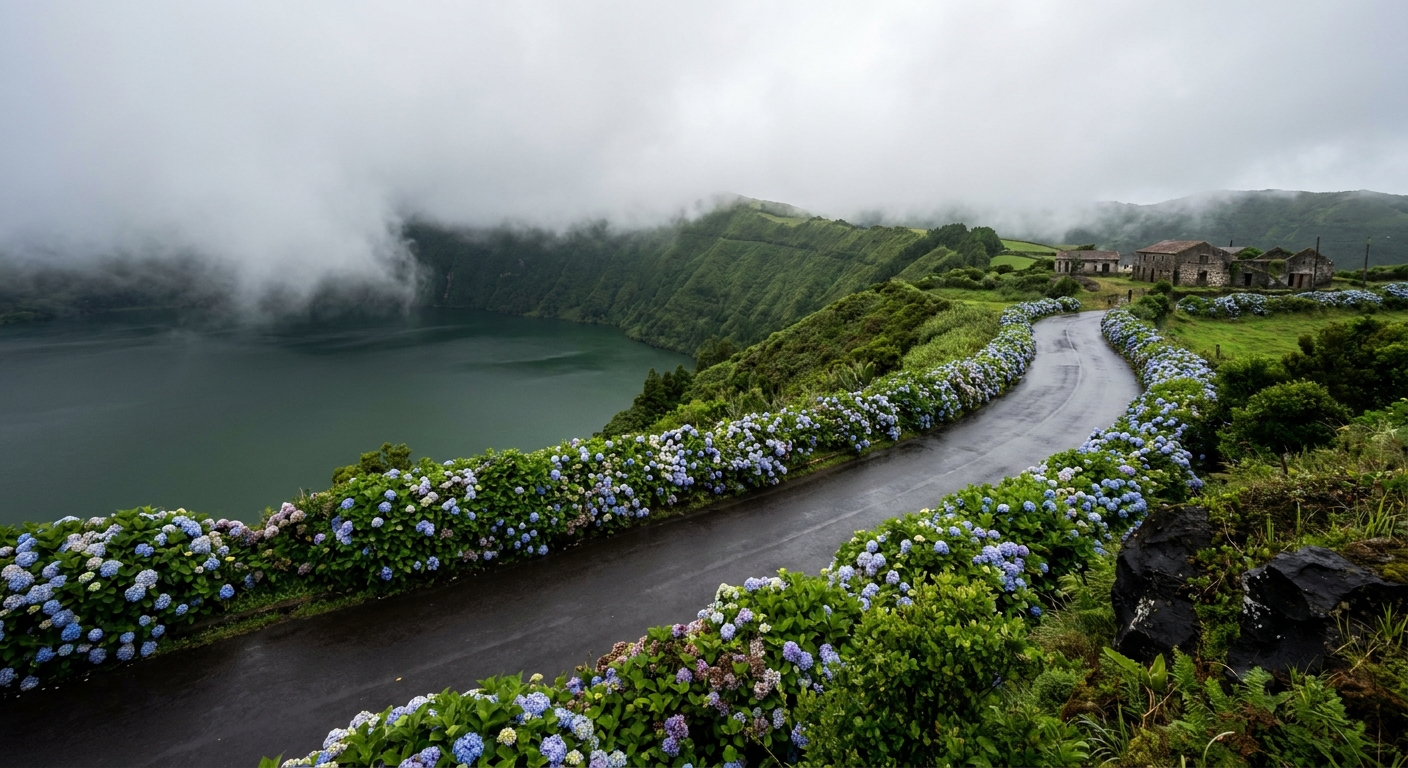
Rim roads are the part nobody warns you about. The ridge above Sete Cidades and the approach to Lagoa do Fogo run narrow, with a soft grass verge on one side and a long green drop on the other, and cloud arrives sideways rather than from above. Tarmac turns greasy the moment drizzle starts, particularly where cattle cross. Headlights on, speed well down, and when a pull-out appears while the view is still open, take it rather than the next one.
A car is the only tool that lets you chase a clear patch, and that, more than sightseeing, is what it is for here. Buses follow timetables, and timetables do not follow the sky. The general rules for renting in Portugal, including the reservation habits worth copying before you land, sit on the car page. Fuel up in the bigger towns and assume nothing about pumps in the interior after dark.
Whale watching in the Azores: the season and the sea state
Sailings are decided by the water, not by the sky. A blue morning with a long swell running keeps the boats tied up, while a grey damp one over flat sea goes out fine. Skippers call it at dawn or the night before, and their own rebooking terms apply. One local tradition works in your favor: spotters watch from the old cliff-top vigias and radio the boats. Put the trip early in your stay, and read the season on the best-time page.
Furnas: the hot springs, the smell and what the water does to swimwear
Furnas smells, and pretending otherwise helps nobody. The valley sits on active fumaroles, so the village air carries a sulphur note that hits somewhere between struck match and boiled egg. Steam rises out of the ground beside the road, out of garden walls, out of a lakeside field. Most visitors stop registering it within an hour. A few never do, and those travelers are happier day-tripping in than sleeping there.
Lunch here is cooked by the volcano. Cozido das Furnas goes into a pot, the pot goes into a pit by the lake, the ground does the rest, and the pots come out at midday to be driven back to the restaurants. It is ordered ahead rather than on a whim, and it arrives as meat, cabbage, blood sausage and potatoes in quantities designed for farm work. Book it for a day when you plan to walk afterward, not before a drive over the ridge.
Then the water. The thermal pools here run iron-rich and orange-brown, and the color transfers. Pale swimwear comes out permanently tinted, white towels the same, and silver jewelry can dull in the sulphur. Bring a dark suit you are prepared to lose, leave the rings in the room, and rinse everything in fresh water the moment you get out. Nobody at the pool will mention this, because everybody local already knows it.
Beyond the pools, the valley is the archipelago’s best wet-weather insurance: botanical gardens, mineral springs that each taste different from the next along a single path, and steam vents you can walk between with a hood up. When the crater rims are socketed in cloud all day, this is where the day goes. Other rainy-day options are gathered on the things-to-do page.
Azores travel tips: 12 mistakes to avoid
| The mistake | The fix |
|---|---|
| Treating “the Azores” as one destination | Choose one island for a first week. A second costs a travel day and doubles the weather gamble. |
| Saving Sete Cidades for the afternoon | Drive up at the first clear light. Cloud tends to settle on the rim as the morning warms. |
| Planning the week off a long-range forecast | Keep two plans alive each morning and pick after you look outside. |
| Reading “mild all year” as “dry” | Rain turns up in every month. The shell travels with the sun cream. |
| Bringing an umbrella | The wind takes it. A hooded jacket is the local answer. |
| Wearing swimwear you love into the iron pools | The brown water stains for good. Pack a dark suit you can retire. |
| Booking the whale trip for your last morning | Put it early, so a canceled sailing still has a spare day behind it. |
| Expecting island hops to link like a metro | Ferries and inter-island flights follow their own logic. A missed leg can cost a night. |
| Taking crater-rim roads at mainland speed | Narrow lanes, soft verges, greasy tarmac under cloud, and cows with right of way. |
| Skipping the tea slopes as filler | This is the only place in Europe where tea is grown, and the rows walk well in drizzle. |
| Booking dinner at an American hour | Kitchens run late here. Eat late, and keep lunch lighter than the cozido. |
| Coming for a beach week | The Atlantic here belongs to whale boats and hot springs. The trip is a hiking one. |
Two of those cost more than the other ten. The island count is the first: a week cut across three islands buys three airport mornings and three separate chances for fog, and returns less than a week spent learning one. The second is the afternoon crater, which is how most visitors end up with a photograph of grey soup where Lagoa do Fogo should be.
If you do add an island, add it for a named reason rather than for the count: the mountain on Pico, the caldera and marina on Faial, the painted streets of Angra on Terceira. We are not printing crossing times or frequencies for those hops, because we could not verify current schedules at source, and a guessed timetable is worse than none. Check the operators for your dates, then build the week around what they actually run.
The last word
Sources & data for this guide
- Experience page: the lessons are editorial judgment from our desk’s trips in the Azores, deliberately unsourced because they are observations rather than published figures · re-read Sep 2, 2026
- Admission: inter-island ferry and flight schedules could not be read at source for this page, so no durations, frequencies or fares appear here. Nothing has been estimated to fill the gap
- Checkable facts touched in passing (monthly weather, packing, car rules) are sourced on their own pages · entry, best time, packing, renting a car · checked Sep 14, 2026
Almost every disappointed Azores trip we have heard about shares one shape: a fixed plan meeting a moving sky. Stand on the rim above Sete Cidades at first light, with the lakes still uncovered and the cattle already out, and the whole logic of the place clicks into position. Get there at three in the afternoon and you have driven a mountain road to look at the inside of a cloud.
So the first decision is subtraction. One island, one rental car, one base you unpack in properly. The archipelago is not a circuit to be completed, and the travelers who come home saying it was the best week of their year are almost always the ones who saw less of it.
Rain, meanwhile, is not a lost day unless you make it one. There is a valley full of steam to walk through, a lake that boils lunch, and hillsides of tea rows that exist nowhere else on this side of the world. Wet weather is when those are at their best and their emptiest.
Eat on local time while you are at it. Dinner starts later than most American stomachs expect, portions arrive built for people who work outdoors, and the correct response is a small lunch and a long evening. Order the local cheese, the pineapple grown under glass, and whatever the boats brought in that morning.
If the week still needs a shape, the three-day version puts the same places in an order that survives a changing sky. Then stop planning. São Miguel gives its best hour to whoever is already outside when the cloud lifts, and no itinerary has ever made that hour arrive on schedule.