
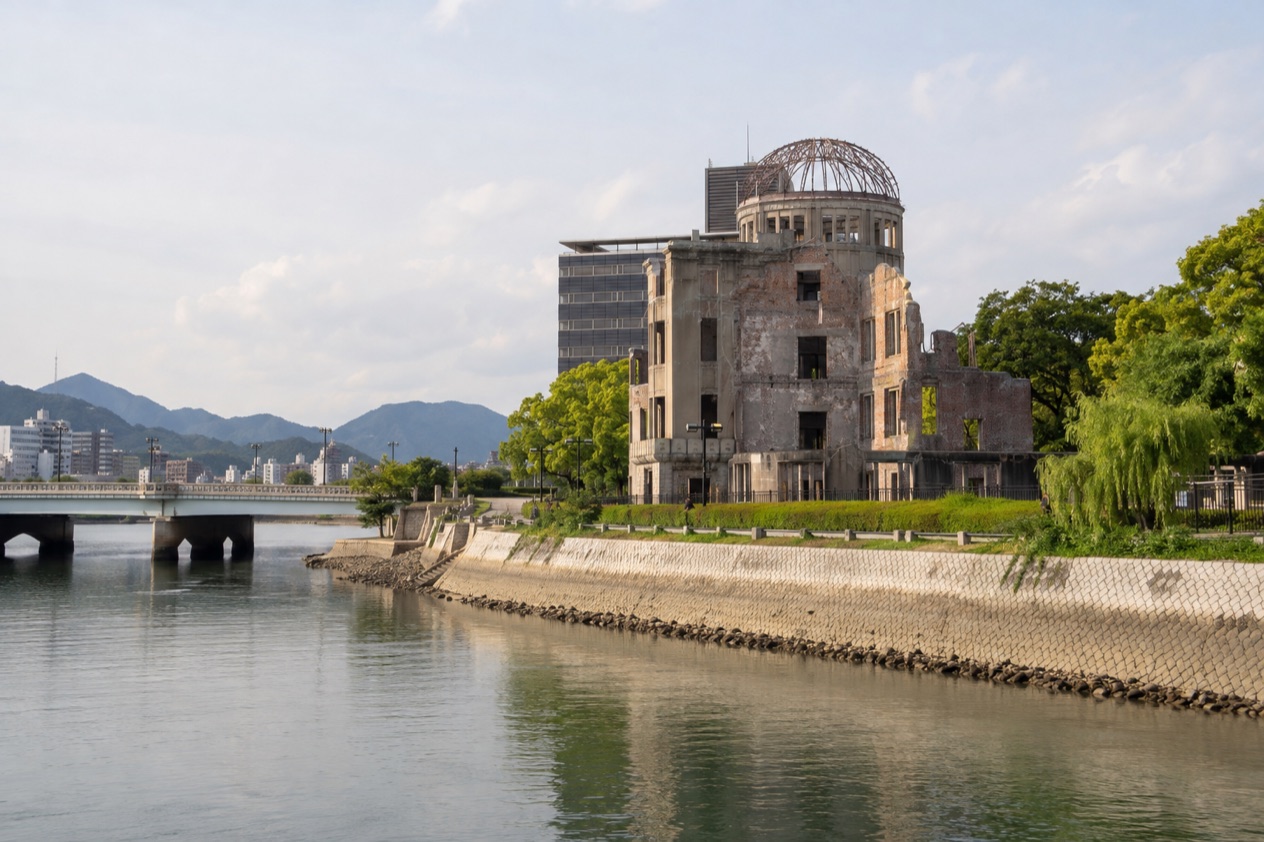
On the evening of August 6, paper lanterns carrying handwritten messages drift down the river past the Atomic Bomb Dome, and the people watching from the banks fall silent as the light fades. The rest of the month keeps a slower summer rhythm: cicadas loud in the trees, streetcars rattling through the heat, grills hissing under okonomiyaki. August is the month to see Hiroshima at its most reflective, and also at its hottest and brightest.
What is the weather like in Hiroshima in August?
August in Hiroshima is hot, bright and sticky, with sunshine most days and rain that comes in far smaller amounts than in July.
| Month | Average high (°F) | Average low (°F) | Precipitation (in) | Days with 1 mm or more of precipitation | Hours of sunshine | Daylight on the 15th |
|---|---|---|---|---|---|---|
| July | 87.6 | 75.4 | 11.02 | 10.6 | 173 | 14 h 15 min |
| August | 91.0 | 77.2 | 5.17 | 7.6 | 207 | 13 h 29 min |
| September | 84.4 | 70.0 | 6.41 | 8.5 | 167 | 12 h 26 min |
Afternoons run into the low 90s, and the nights barely cool off, so the city stays warm well after dark. Humidity hangs around the high 60s, which is why the heat feels heavier than the thermometer suggests. The Japanese summer here is the sultry kind, and the usual rhythm is to walk outdoors in the morning, step into a museum or a café when the sun is at its strongest, and come back out as the light softens.
Rain still turns up, mostly as a passing downpour rather than a gray day. With around a week of wet days in the month, a small folding umbrella earns its place in a bag, and it doubles as shade. Light, breathable clothes do the work here, with one thin layer for the air-conditioned trains, museums and shops, which can feel cold after the street.
The days are long enough to fit a full program, with the light fading in the evening just as the city begins to cool a little. Dusk is the moment that matters on August 6, when the lanterns go on the river at sunset.
What to do in Hiroshima in August
The month belongs to August 6, the day Hiroshima gathers to remember. Around it come the Obon days, a Buddhist custom in which families honor their ancestors, return to ancestral places and clean the graves, and which lasts three days. Between ceremonies, the city offers streetcar rides, shaded riverbanks, cold noodles and a ferry-hop to an island shrine.
August 6 at the Peace Memorial Park
The Peace Memorial Park and the Atomic Bomb Dome, the two UNESCO World Cultural Heritage sites of Hiroshima, are the center of the day. A ceremony takes place here on August 6, and as the sun sets, thousands of people write peace messages on lanterns that are lit and floated along the river in front of the Dome. The Dome cannot be entered, so you see it from outside, from the riverbank, in a quiet that visitors respect.
The Peace Memorial Museum is the place to understand what the park commemorates. It shows belongings left by victims, artifacts from the bombing and survivor testimonies, and its message is “No More Hiroshimas.” The exhibits are heavy, so give yourself room afterward, perhaps a bench under the park’s trees or a slow walk along the river. In summer, the museum’s interior also offers a cool break from the heat outside.
| Site | Admission |
|---|---|
| Hiroshima Peace Memorial Museum, adult | ¥200 |
| Hiroshima Peace Memorial Museum, high school student | ¥100 |
Miyajima and its floating shrine
The shrine was registered as a World Heritage Site in 1996. Deer wander the lanes near the waterfront, and the wooden shrine corridors give a break from the sun, even if the walking between the ferry dock and the shrine is a warm one in August.
Fuel up on the island’s local specialties: momiji manju, the maple-leaf-shaped cakes filled with sweet bean paste, and grilled conger eel (anago) over rice. A cold drink or shaved ice (kakigori) in a shop along the arcade makes a good pause. Wear shoes you can walk in, since the island rewards wandering past the main path.
Okonomiyaki and other food of a hot month
Hiroshima’s version of okonomiyaki is built in layers on a hot griddle: a thin crepe, a heap of cabbage, bean sprouts, pork, noodles and an egg, all finished with a sweet-savory sauce. Eating it at the counter, watching the cook work, is an August ritual for locals and visitors alike, even in the heat. A cold beer or barley tea is the usual companion.
When appetite flags, summer food comes to the rescue. Chilled somen or soba noodles, slices of watermelon, kakigori in colored syrups and iced green tea are the things Japanese summers are built around. Convenience stores and café counters stock them in every neighborhood, and a cold drink in hand is as much part of walking the city as a map.
Streetcars and a rabbit island
Hiroden, the Hiroshima Electric Railway, runs streetcars and buses in and around the city, and its trams, built in Japan and in Europe, have earned the nickname “The Moving Streetcar Museum.” Riding one past the shops and the rivers is a good way to cover ground while staying out of the sun, and a fine way to see the city beyond the memorial sites.
Okunoshima, with its wild rabbits, is another outing from Hiroshima Prefecture. Visitors there must not chase or pick up the rabbits, and anyone offering food should do so in a safe place.
A two-day itinerary for Hiroshima in August
Day 1 is for the memorial sites, taken in the cooler hours of the morning. Start at the Peace Memorial Park and walk the grounds slowly, stopping at the Atomic Bomb Dome, which is viewed from outside. Then move indoors to the Peace Memorial Museum, which also gives a break from the heat.
Midday is for lunch and a pause. Look for an okonomiyaki counter, or a cold-noodle shop, and let the hottest hours pass in the shade or in an air-conditioned café.
In the afternoon, ride a Hiroden streetcar through the city, getting off wherever a riverbank or a covered arcade looks inviting. If the weather turns, a downpour is a good excuse to extend the museum visit or linger over a second round of kakigori.
As evening approaches, return to the riverbank near the Dome. On August 6 the lanterns are lit at sunset and set on the water, and the days around it still carry the mood of remembrance. Plan dinner after dusk, once the heat has eased.
Day 2 goes to Miyajima. Head out in the morning for the ferry to the island, and spend the first hours at Itsukushima Shrine and its torii gate in the sea, then wander among the deer and the shopping arcade. Eat anago over rice for lunch, and try momiji manju as a snack.
In the afternoon, when the sun is high, stay under the roofs of the arcade and the shrine corridors rather than on the open waterfront. Return to the city for a final evening: a cold beer, a plate of okonomiyaki you haven’t tried yet, and a last walk along the river. If rain comes on Miyajima, the shrine’s covered walkways and the shop arcades keep the day going.
Is Hiroshima busy in August?
August in Hiroshima is a month with a distinct calendar rather than a single peak, shaped by the August 6 ceremony and the Obon days.
Obon sends many families back to their ancestral hometowns to visit and clean graves, so the month carries a sense of homecoming across Japan. In Hiroshima, the ceremony and the lantern floating draw people to the Peace Memorial Park, and the riverbank near the Dome becomes a place of gathering as the sun sets.
The rest of the month moves at a summer pace. The heat shapes how people spend their days, with more time indoors in the middle of the day and more life on the streets in the evening. Shops in urban areas are generally open every day, which keeps the city easy to move through on holiday weeks.
What to pack for Hiroshima in August
Pack for heat and humidity, with a plan for the occasional downpour and for indoor air conditioning.
- Light, breathable clothing, because the days are hot and humid.
- A thin layer for museums, trains and shops, where air conditioning can feel chilly.
- A compact umbrella for sudden showers, which also gives shade.
- A hat and sunscreen for the long, sunny stretches in the park and on Miyajima.
- Comfortable walking shoes for the park, the island lanes and city streets.
- A reusable water bottle and a small towel for the heat.
Good to know before you go
Summers on Honshu are very humid, hot and sultry, so Hiroshima’s August rewards a slower schedule with breaks built in. In urban areas shops are generally open from 10:00 a.m. to 8:00 p.m. every day, while rural areas often close earlier, sometimes as early as 6:00 p.m., which matters if an outing takes you beyond the city.
When a national holiday falls on a Sunday, the next working day becomes a public holiday, and a day sandwiched between two holidays also becomes one. Those rules can shift closures around a holiday week. The Japan Meteorological Agency also issues Emergency Warnings for natural phenomena of extraordinary magnitude, so keep an eye on local alerts if the weather turns severe.
Hiroshima in August vs July and September
Moving the trip four weeks earlier brings you to July, which is much wetter and slightly cooler by day, with longer evenings but far less sunshine. The rain falls more often and in larger amounts, so plans for the park and the island have to bend around it. The lantern ceremony is an August event, so July misses it.
Four weeks later, September is a touch cooler, with highs dropping and nights easing, and the days growing shorter. It is a gentler month for walking, though rain is still part of the picture. The August 6 ceremony is behind you by then, and Obon has passed.
Travelers who want to witness the August 6 ceremony and the lanterns on the river should stay with August and accept the heat. Those who prefer cooler walking days can shift to September, while July suits only those ready to plan around frequent rain.
Is August a good time to visit Hiroshima?
Yes, August is a good time to visit Hiroshima for travelers who want to be here for the remembrance of August 6 and can handle summer heat.
It suits visitors who come with respect for the city’s history and who like to organize the day around the sun, with early starts, midday breaks and long evenings. It is less suited to anyone who struggles in humid heat, or who wants cool, crisp walking weather, for whom a later month fits better.
On arrival, start with the Peace Memorial Park and the museum, since they anchor everything else in the visit. After that, the island shrine, the okonomiyaki counters and the streetcars fill the days. What sets August apart is the lantern ceremony, when messages for peace are floated down the river past the Dome at sunset.
Sources
- Japan Meteorological Agency (JMA), Normal values 1991-2020, monthly (https://www.data.jma.go.jp/stats/etrn/view/nml_sfc_ym.php?prec_no=67&block_no=47765), station Hiroshima, elevation 4 m, checked October 11, 2026
- Computed from the date and the latitude of the place (sunrise equation, solar elevation -0.833 degrees), October 11, 2026
- Japan National Tourism Organization, shop and attraction hours, national holidays (https://www.japan.travel/en/plan/business-hours-and-holidays/), checked October 11, 2026
- Wikipedia, Obon (https://en.wikipedia.org/wiki/Obon), checked October 11, 2026
- Wikipedia, Public holidays in Japan (https://en.wikipedia.org/wiki/Public_holidays_in_Japan), checked October 11, 2026
- Japan National Tourism Organization, summer in Japan (https://www.japan.travel/en/guide/summer-guide/), checked October 11, 2026
- Japan National Tourism Organization, festivals and events (https://www.japan.travel/en/see-and-do/festivals-and-events/), checked October 11, 2026
- Wikipedia, Hanabi (https://en.wikipedia.org/wiki/Hanabi), checked October 11, 2026
- Japan Meteorological Agency, Emergency Warnings (https://www.jma.go.jp/jma/en/Emergency_Warning/ew_index.html), checked October 11, 2026
- Japan National Tourism Organization, safety information (https://www.japan.travel/en/japan-safe-travel-information/), checked October 11, 2026
- Japan National Tourism Organization, weather and seasons in Japan (https://www.japan.travel/en/plan/weather/), checked October 11, 2026
- Wikipedia, Awa Odori (https://en.wikipedia.org/wiki/Awa_Odori), checked October 11, 2026
- Wikipedia, Climate of Japan (https://en.wikipedia.org/wiki/Climate_of_Japan), checked October 11, 2026
- Japan National Tourism Organization, Mount Fuji guide (https://www.japan.travel/en/fuji-guide/), checked October 11, 2026
- Official website for Mt. Fuji climbing, about the climb (https://www.fujisan-climb.jp/en/about/), checked October 11, 2026
- Wikipedia, Nebuta (https://en.wikipedia.org/wiki/Nebuta), checked October 11, 2026
- Japan National Tourism Organization, Hiroshima (https://www.japan.travel/en/destinations/chugoku/hiroshima/), checked October 11, 2026
- Visit Hiroshima, the official guide (https://visithiroshima.net/), checked October 11, 2026
- Hiroshima Peace Memorial Museum (https://hpmmuseum.jp/?lang=eng), checked October 11, 2026
- Wikipedia, Hiroden (https://en.wikipedia.org/wiki/Hiroden), checked October 11, 2026
To plan your stay
- Things to Do in Hiroshima: Peace Memorial Park, Miyajima, Okonomiyaki and Day Trips
- Where to Stay in Hiroshima: Peace Park, Station Area, Castle District and Miyajima Island
- Hiroshima from Osaka: Shinkansen, Local Trains and a Day at the Peace Park
- Know Before You Go to Hiroshima: Entry, Money, Getting Around and Local Etiquette